February 25th, 2026Hepburn Wildlife Shelter
It has been a very busy month at the Hepburn Wildlife Shelter, with five orphaned joeys arriving in one day.
The joeys’ mothers had all been hit by cars in different locations near Daylesford, which shows the need to be aware when driving along country roads. Extra vigilance is required especially from dusk to dawn, as this is when wildlife feed.
Of course, there is nothing you can do to avoid hitting an animal that jumps out directly in front of your car, but you can minimise the damage by driving slower. If you are driving at night and see kangaroos and wallabies grazing by the roadside, it is good practice to slow down and dim your headlights.
If the animals start to move across the road, drive slowly or pull right off the road and turn your lights off, so they can see where they are going. Bright lights blind the animals causing them to panic, all they see is the light.
Imagine what it would be like, if you didn’t know that those bright lights coming down the road were attached to something that could hurt or kill you. They don’t know that it is a road for cars and frightened animals will take the easiest route away from danger and that may often be down the road.
If you do hit an animal with your car, the first thing to do is park your car safely. Then from a safe distance, see if the animal is still alive. If the animal is dead, drag it off the road.
If it is alive call Wildlife Victoria (03) 8400 7300 or Warrior for Wildlife 1300 352 923 or Hepburn Wildlife Shelter 0428 540 000.
From a safe distance look for a joey, it may be on the road or nearby. If you can reach the joey without frightening it, wrap it in something warm and cover its head. Don’t speak to it or pat it, wild animals do not recognise these actions as comforting and will become more frightened.
If the joey and injured mother move off into the bush, record the direction and location where they left the road. This will enable a wildlife rescuer to find them. If the injured animal cannot move, and you cannot get in touch with Wildlife Victoria, call the police to assist.
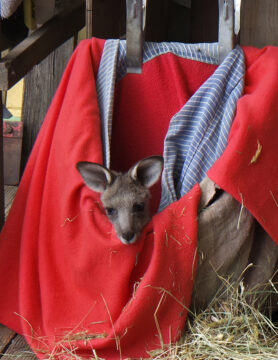
Above, one of the orphaned joeys at Hepburn Wildlife Shelter
Image: Barb Davies
Words: Dr Marita McGuirk