September 15th, 2026The tree-change research is over, and Google’s been watching it happen

This content was created in partnership with Google Trends.
Five years ago this month, half of regional Victoria’s future population seemed to be sitting at their kitchen table in Melbourne, searching for a way out. Google Trends data shows search interest in “Ballarat real estate” hit its peak in October 2021, the single highest month in five years of data. Bendigo wasn’t far behind it. Daylesford, Castlemaine, Kyneton and the rest of the Central Highlands were all riding the same wave, smaller towns catching the overflow from buyers who’d already given up on Ballarat and Bendigo and were casting the net wider.
That wave has well and truly broken. Search interest in Ballarat real estate has dropped by roughly 44 per cent since that 2021 peak, and Bendigo has fallen almost as far, down about 48 per cent. This isn’t a blip. It’s a slow, steady five-year slide, averaging 91 points back in 2021 and sitting at 45 this year, which means the search bar has quietly lost interest in regional Victoria at almost exactly the same pace property prices kept climbing.
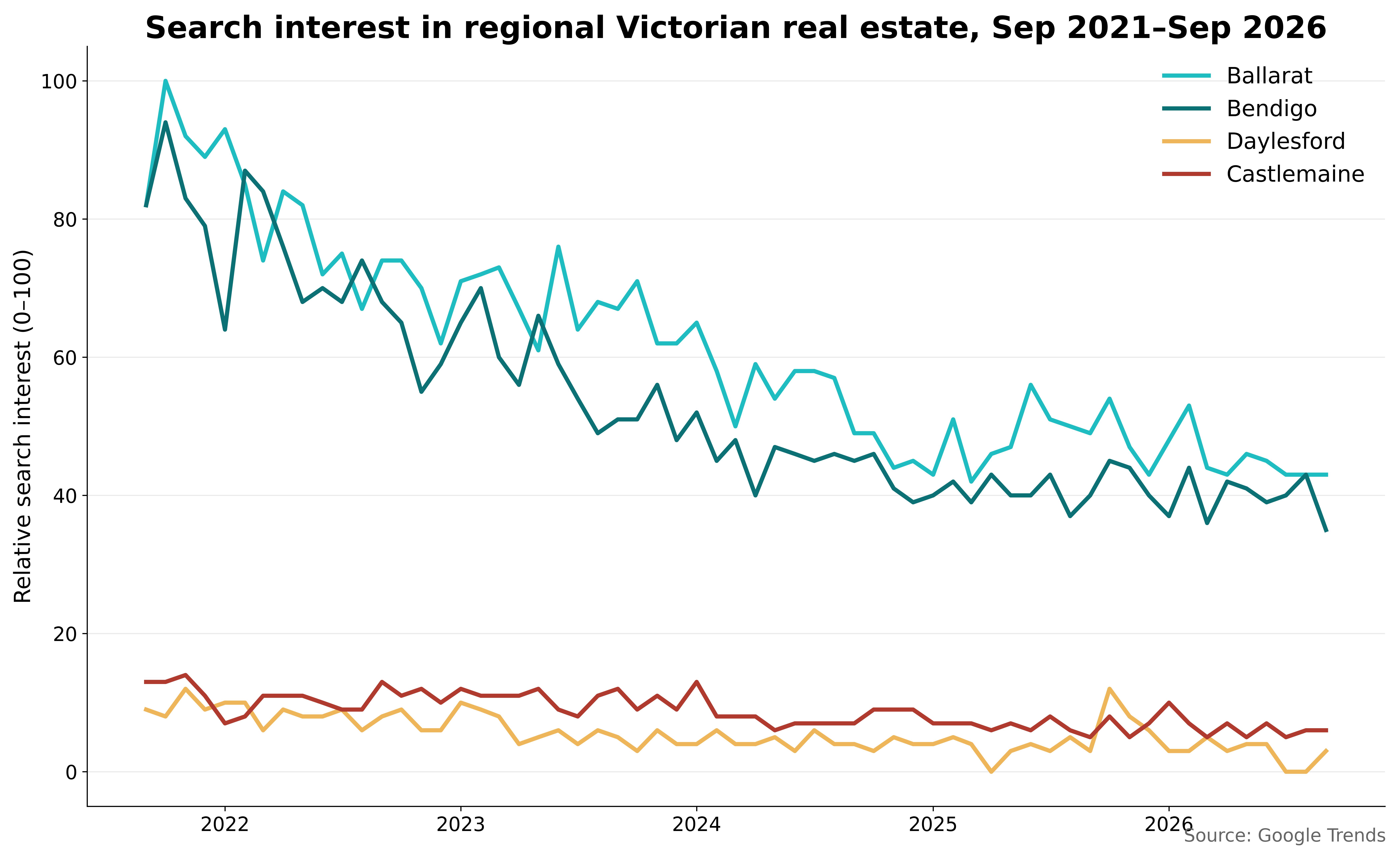
The smaller towns tell an even starker story. Daylesford’s search interest has fallen 51 per cent since 2021, and for long stretches over the past two years it’s registered nothing at all, flatlining at zero for months before a stray spike breaks the silence, like the jump to 12 points in October last year that came from nowhere and vanished just as fast. Castlemaine, Kyneton and Maryborough have all followed a similar path, holding on in the high single digits where they once sat in the low teens. Clunes has slid 65 per cent. Macedon Ranges searches have essentially disappeared altogether, down 96 per cent on where they started, a rounding error next to what it used to be.
None of this means nobody’s buying. It means fewer people are still in the research phase, still typing town names into a search bar trying to work out where they might land. The tree-change rush that defined 2021 was, by its nature, a moment of mass curiosity: a huge number of people all wondering, at the same time, whether a life in the Central Highlands was for them. Search interest is usually the first, cheapest signal of that kind of curiosity, well before it turns into an open home inspection or a call to an agent. And on that measure, the curiosity has largely dried up.
What’s left is a smaller, steadier pool of buyers, ones who already know where they’re headed and don’t need Google to help them decide. That would line up with a market that’s cooled from its post-pandemic highs without collapsing, still carrying elevated prices in towns like Daylesford, but without the crowd of new entrants that once kept auctions running hot. Whether that’s a healthier, more sustainable version of the regional property market, or just a longer, quieter version of the same story, depends on who you ask.
It’s also worth remembering what this data can and can’t tell us. Google Trends measures relative search interest, not the number of people actually searching or the number of sales that followed. A term losing popularity doesn’t necessarily mean a town is losing appeal, it might just mean would-be buyers have shifted to real estate portals or agent shortlists instead of a general search bar once they know roughly where they’re looking. But as a measure of first-glance curiosity, the kind that used to flood in from Melbourne every winter, it’s hard to argue the numbers are pointing anywhere but down.
Either way, the data is a useful corrective to the idea that the tree-change boom is still in full swing. Five years on, the search bar suggests otherwise.
Search interest in regional Victorian real estate terms, September 2021 to September 2026. Source: Google Trends.
This content is part of a paid partnership with Google to promote Google Trends. It uses Google Trends data to explore search interest in real estate across Ballarat, Bendigo, Castlemaine, Maryborough, Kyneton, Daylesford, Clunes and the Macedon Ranges over the past five years. Google Trends data is aggregated and anonymous. Search interest is measured on a relative scale and does not represent total search volume.