November 4th, 2026Beetham’s Botanicals

Well, here I am again penning another article for you, the reader, to enjoy…
This time I’ll be taking you on a discovery tour of cultivated plants with links to Gondwanaland – once a supercontinent over 500 million years ago that eventually drifted apart to form Africa, India, Southern America, Antarctica, South Western Pacific Islands, New Zealand and Australia.
I’ve chosen five trees that span the above locations.
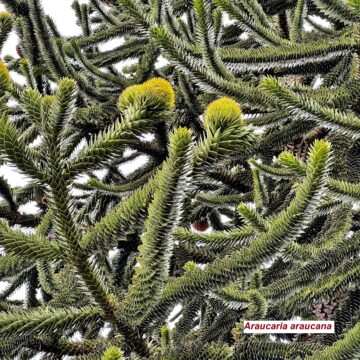
1. Araucaria araucana (monkey puzzle tree) was once found only in the Chilean Andes and adjacent Argentina but this remarkable tree can now be found in cultivation all around the world. The common name refers to an observation that a monkey would find it hard to climb. The image at top right taken, in the VanDusen Botanical Garden, Vancouver (BC, Canada), shows some female cones and you can see fine specimens growing in the Wombat Hill Botanic Gardens in Daylesford.
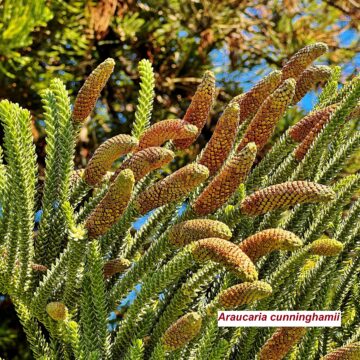
2. Araucaria cunninghamii (hoop pine) is an Australian native tree that also occurs in New South Wales, Queensland and New Guinea and is one of 20 described species – with 14 endemic to New Caledonia – that make up a strong Gondwanaland connection as Southern America was connected to Australia and beyond by the Antarctic land bridge. The image second from top is of male cones on a tree in the Royal Botanic Garden in Sydney.
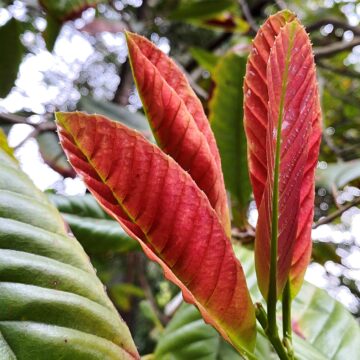
3. Nothofagus codonandra (New Caledonian beech) is another example of interconnected flora by the Antarctic land bridge just like the araucarias. For example, these Southern Hemisphere beeches are distributed from Southern America to Australia, New Caledonia and New Zealand. The middle image of the beautiful emerging foliage was taken in the Royal Botanic Gardens in Melbourne.
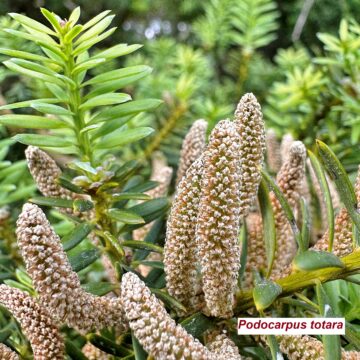
4. Podocarpus totara (totara) is a New Zealand endemic tree that is part of a genus with widespread Gondwanaland heritage that includes Africa, Australia, New Zealand and Southern America. So far three of the four trees listed do not have any link to Africa but here with the podocarps we have direct lineage with species such as podocarpus elongatus (Breede River yellowwood) and P. latifolius (broad-leaved yellowwood). Image second from bottom was taken in the Royal Botanic Gardens in Melbourne.
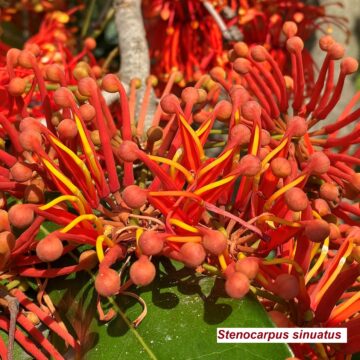
5. Stenocarpus sinuatus (firewheel tree) is an upright growing tree with its native origins in New South Wales and Queensland and here the Gondwanaland parentage is obvious as we see representatives of its botanical family Proteaceae found in Africa (think Protea), New Zealand (think Knightia – rewarewa) and Southern America (think Gevuina – Chilean hazelnut). A journey to the Royal Botanic Gardens in Melbourne to see this commemorative tree planted in 1920 is well worth it. Image bottom.
And so there you have it – a glimpse into the distant past of how trees got to be where they are now, and for some more detailed information type this link into your browser: www.inalanature.com.au Cheers John Beetham (Trees in Australia 0418 375 708).
Next time: The wonderful world of maples.
Scan the QR code to see JB’s instagram post.