


September 14th, 2026Inquiry into voting centre accessibility
The Victorian Electoral Commission (VEC) welcomes the Parliament of Victoria’s Electoral Matters Committee report from its inquiry into voting centre accessibility.
‘Accessible voting services are a critical part of achieving our vision for all Victorians to actively participate in their democracy,’ Electoral Commissioner Sven Bluemmel said.
‘We have integrated a number of accessibility measures to improve the voting experience, and this remains a priority for us at every election.
‘We must work together to identify and eliminate the remaining barriers that prevent electors from voting. Some actions will require legislative change and these will be matters for Parliament to consider.’
Our final service plan for the state election was published in August following more than 18-months of planning. At the 2026 state election on Saturday 28 November, Victorians can expect a range of voting options to suit their needs, including in-person voting on the day or during the early voting period between Wednesday 18 November and Friday 27 November (except Sunday 22 November).
Every election venue is audited for accessibility, with the aim of having at least one fully accessible voting centre in each district. Location details and accessibility information will be available on the VEC website from Wednesday 4 November.
Voters at voting centres can also access accessible voting screens, magnifying sheets and large, tactile pencils. Voters can also access voting information in 29 languages. VEC staff will also be ready to help voters that need help to complete their vote.
More than 400 mobile voting services will reach people in aged-care facilities, hospitals, homeless shelters and prisons. Following trials at recent state by-elections, the VEC is also expanding its low sensory voting option to all 88 districts for carers and people with low sensory needs on Tuesday 17 November. These venues include dimmed lighting and reduced noise.
Voters who are blind, have low vision or live with a motor impairment can also register for our telephone-assisted voting service. This service is a scalable voting option for those who need it, and we’ve recommended that it should be available to more voters than Victoria’s electoral laws currently allow. The VEC will continue to advocate for this change, including in our response to the Electoral Matters Committee’s report.
Postal voting is open to all voters with a simple application available from early November through the VEC website or at Australia Post outlets in Victoria.
The VEC’s accessibility approach has been developed over many years, with input from the community, including our Electoral Access Advisory Group, which provides us with independent advice, feedback and community perspectives on accessible and inclusive election participation.
The VEC will review the recommendations and prepare a response following the 2026 state election.
For more information about accessible voting services visit vec.vic.gov.au or call 131 832.
September 14th, 2026Work From Home Works For Victorians
The right to work from home in law, with world-first legislation, is supporting families and workers.
The laws need to work for business, too – because if they aren’t practical, the laws won’t last.
Sensible amendments will get the balance right.
The amendments address issues raised in consultation and provide a lasting framework for working from home.
Clarifying the rules so the laws can last
Workers whose jobs can reasonably be done from home will have the right to work from home two days a week – that is the principle.
The new amendments simplify and clarify the legislation to address areas of uncertainty, including clarifying that:
- The laws will only apply to employees who reside in Victoria
- The right won’t stack on top of other rights or entitlements to work from home in Commonwealth law
- The definition of ‘home’ has been amended to mean the employee’s principal place of residence, or a location agreed between the employer and employee
- The Bill will not create any additional rights to vary an employment agreement’s days and times – this is just about working from home
- Reasonable costs payable by the employer have been limited to essential equipment, like a laptop and software required to complete tasks
- Employers will not be responsible for paying for home internet or other basic utilities
When the employer has a clear operational need which may make work from home arrangements unreasonable – such as a trade show, major event, peak trading period or requirement for in-person customer service – they can issue a notice to temporarily pause or revoke arrangements for those days and times.
We have clarified that work from home rights will apply to part-time workers. For employees who work fewer than 38 hours a week, the entitlement will be 40 per cent of their weekly working hours.
The law commences on 1 July 2027. That’s the day most eligible workers will attain the right to work from home.
The commencement date for small businesses – with fewer than 15 staff – will move to 1 January 2028, so they have more time to prepare.
Employers will have 28 days to respond to work from home requests.
A review of the legislation will be brought forward to 1 January 2029 to ensure the settings still work for everyone.

September 14th, 2026SEC Horsham Powers Up For Lower Bills
The SEC Renewable Energy Park in Horsham has connected to Victoria’s electricity grid for the first time – another major step towards delivering cheaper, more reliable renewable energy.
The project is now being progressively powered up and tested ahead of full operations in 2027.
More than 212,000 solar panels have been installed, alongside new substations, transformers and high-voltage infrastructure.
A 100-megawatt, two-hour battery will be installed later this year, storing cheap renewable energy so it can be used when Victorians need it most.
Once operational, the solar farm and battery will generate and store enough renewable energy to power more than 51,000 Victorian homes each year.
The project has created around 250 jobs, including 18 apprenticeships, delivering more opportunities for workers and young people in Western Victoria.
The SEC Renewable Energy Park – Horsham Community Benefit Fund will also invest $3 million in local projects, services and initiatives over the life of the project.
The SEC is publicly owned by Victorians and is investing in the renewable energy and storage needed to replace ageing coal-fired power stations and keep driving down power prices.

September 14th, 2026Station Pier Now Open Seven Days A Week
Locals and visitors can now enjoy Station Pier seven days a week.
Minister for Ports and Freight Melissa Horne has announced Station Pier is now open to the public every day from 7:00am until 5:00pm.
The extended opening hours will give Victorians more opportunities to visit, fish and sightsee when there are no ship operations being conducted at the pier.
This comes after the pier’s limited reopening in 2025 following the completion of maintenance works after it closed in 2020.
Maintenance works included the refurbishment of the Pier’s Gatehouse, structural pylons, electrical systems, corrosion protection, and wharf deck.
Local community members, tourists and recreational fishers will be able to access the southern end of the pier via the Station Pier central access way.
There will also be an entry point for vehicles with accessible parking permits, with limited parking at the southern end of the pier.
Demand for Station Pier remains strong, with future cruise booking continuing to grow including an increasing number of ships choosing to home port in Melbourne.
There are currently 63 vessel visits scheduled to arrive at Station Pier for the upcoming 2026/27 cruise season.
Victoria’s local ports contribute more than $900 million a year to local and regional economies through critical industries, marine activities and tourism.

September 13th, 2026Just sayin’…

I loved reading about David Hall’s epic journey across Asia and Europe – and the release of his book about his escapades. Head back to page 13 for a really great read.
Journalist Kevin Childs sums it up well, saying that trips of that nature are no longer possible due to political and social upheaval.
I never did anything like that but it did remind me of heading to Japan in my early 20s. I know every man, and woman, and their dog, have been to Japan now but this was before the www’s, Facebook, live chats, email…
I had applied to the Japanese Ministry of Education for a position as an Assistant English Teacher (AET) and failed to get the job. Oh well, I was on my way in my journalism career and had no great interest in Japan. (Mum made me apply.)
But then I got a call out of the blue saying someone had dropped out and I was in. Could I be at Tullamarine Airport the following Monday for the flight out and a year away?
Hmmm. I had never lived out of home and now I was travelling to a very, at the time, exotic place for a whole year – with not a jot of Japanese speaking ability. OMG. What had I done?
I like the saying ‘go hard or go home’ so I went hard. I broke up with my boyfriend of six years, quit my job as the editor of the Mornington Leader and, as an asthmatic, got a stack of scripts for a host of medications to keep me breathing.
And then I was on the Qantas plane, and landing at Narita Airport where I was met by not one, but three, business-suited men, none of whom spoke English.
We drove, quietly, to my new home in Ome, about two hours away, and they left me at my new apartment, with a futon rolled out, and instructions to be at the front door by 7.30am for my first day at work.
I remember looking out the window at the hills over the way, and down the street with all of its shop awnings covered with strange writing – and feeling absolutely elated.
I talked to other AETs over the next few weeks, as we gathered at gaijin (foreigner) friendly bars and heard lots of different stories.
One bloke, who looked as tough as nails, said he spent his first night crying, wishing he was back in America. Another girl, from Wales, said she managed to throw up on her principal’s shoes as she bowed, from anxiety. But mostly we were young, having fun and being well paid to be in this very exciting but hard to navigate country.
I bought a book before I left, Solo Japan, and at the back it had little tear out pieces with Japanese phrases for things like ‘please take me to ….’ and you asked a Japanese teacher to fill in the blank in kanji (Japanese characters). Too easy I thought, until a taxi driver told me to get out because ‘no English!’. I kept pointing to my bit of paper, to no avail.
Buses were always a fun way to travel. You had to listen as best you could and hope you picked up on the name of the stop you wanted to get off at. It turned out to be a great way to see the country – because you rarely ended up where you wanted to be.
But the Japanese people were amazingly friendly and warm and as helpful as anyone could ask for. The people of Ome were very happy to see me because we had a real connection – there had been a POW camp in the town during WWII.
Not quite the connection I wanted but shou ga nai, ne. Just sayin’…

September 13th, 2026Pick me, pick me

Hi there, I am Pixie. I am only six months old and a little shy when meeting new people, but with a little patience and kindness, my real personality quickly shines. I am friendly, affectionate and love spending time with people.
One of my favourite things is burrowing under soft blankets for a cosy nap. I love being tucked up on the couch or snuggled beside you in bed. I would love a calm, loving home.
Microchip: 956000019747904
Come and meet me at MAAWS.
Call 5472 5277 | shelter@maaw.org.au
Source No. BR100938

September 13th, 2026Local Lines

The boxer and the wrestler
I taught a boxer English
No bruiser, he was deft
In year nine at high school
he enjoyed respect
A wrestler in the same class
fell to wrangling words
For his trouble he got
lumped in with the nerds
The boxer had a girlfriend
knew how to manage him
The wrestler had tattoos
and an easy grin
The boxer taught me something
Up against a wall
how to roll my hip
into a tennis ball
The wrestler hardly taught me
anything at all
till one day on the oval
he showed me how to fall
Neither boy was hostile
They just cared to win
and each knew that the other
worked a discipline
– Bill Wootton
Bill did in fact teach a boxer and a wrestler many moons ago but he hasn’t a pugilistic bone in his body.
Local Lines features poetry by locals about local and any other matters.
Please submit poems to Bill Wootton at cottlesbreedge@gmail.com

September 13th, 2026Kyle’s Rant

The wettest ‘dry’ winter we’ve ever had or how Victoria’s Google search history, and Clarkes Hill’s rain gauge, both called out the Bureau’s ‘super El Niño’ this winter.
Google Trends data has confirmed what one Clarkes Hill local, Robert Grieve, suspected all along: this winter didn’t just break the Bureau of Meteorology’s forecast, it broke Victoria’s search habits too.
Somebody needs to have a word with the Bureau, because either their computer’s broken or Clarkes Hill didn’t get the memo.
Back in April, the story hit everywhere at once. A super El Niño was coming, they said. Possibly the strongest on record. Rivers and dams would drop, the Murray-Darling would struggle, farmers would watch their wheat crops shrivel, and the whole east coast should brace for warm, dry, below-average rainfall right through winter and into spring.
It was the kind of story that gets picked up, shared and typed into a search bar by everyone within a hundred kilometres of a rain gauge.
And it did. I pulled 12 months of Google Trends data for Victoria and it tells the story plainly enough. From September last year right through to the end of March, search interest in “El Niño” sat at zero. Flat, for seven straight months. Then in the second week of April, it jumps from nothing to the highest spike in the entire dataset, virtually overnight.
That’s not a slow build of curiosity. That’s a headline landing on a Tuesday and search interest across half of Victoria climbing by Thursday.
Fair enough too. The papers were saying sea surface temperatures in the Pacific had jumped more than a degree since January, the fastest swing from La Niña to El Niño since 1976. The Bureau’s own modelling was tipping a record-breaking event. If you own a dam, a crop, or a garden, that’s worth a search.
Here’s the bit that doesn’t add up. While all of Victoria was busy searching “El Niño” and bracing for drought, the rain at Clarkes Hill was doing the exact opposite of what the story promised.
I’ve got the rainfall figures going back to 2016, and this winter just gone. The one that was supposed to be dry, delivered 459.4mm between June and August. Compare that to 353.4mm over the same months in 2016, and 318.2mm in 2025. That’s not a marginal difference. That’s roughly 30 to 45 per cent more rain than either of the other two years, arriving in the exact window we were told to expect the taps to turn off.
By the end of August, we’d already had 700.2mm for the year, well ahead of where 2025 sat at the same point (469.8mm) and comfortably past 2016 too (618.8mm). If the current trend holds, we’re on track for somewhere around 1180 to 1190mm for the full year. That would make 2026 the wettest of the three years by a clear margin, not the driest.
So somewhere between the modelling and my back paddock, something’s gone sideways. Maybe it’s the Indian Ocean Dipole throwing its weight around, which the Bureau themselves admit can amplify or soften whatever El Niño’s doing.
Maybe Clarkes Hill just sits in one of those pockets that answers to nobody. Either way, the forecast said dry, and the sky said otherwise, loudly, for three months straight. And Clarkes Hill is simply where I got the data from; all over the Central Highlands the word is damp.
And now the search data’s throwing up something else worth watching. “La Niña” barely registered a pulse in this whole 12-month stretch. One random blip back in November, then near silence for the better part of a year.
But in the last three weeks of data, it’s shown up every single week for the first time. Small numbers, 2 and 3, nothing dramatic. But that’s exactly the shape “El Niño” had back before its own breakout in April. Zero, zero, zero, then suddenly everyone’s searching for it.
Whether that means La Niña’s quietly working its way back into the conversation, or just a few sharp locals starting to wonder if the “super El Niño” ever actually turned up, I couldn’t tell you.
What I can tell you is that if you’ve been out fixing your gutters, topping up the tank, or watching the dam creep back up the bank this winter, you’ve got the actual data to back up what you already knew. The forecast promised us a drought. Clarkes Hill gave us a flood warning instead.
And as for Robert, he says if it does become a dry year, that’s great. The dams are all full and the farmers need a dry spell. Somebody should probably tell the Bureau that.
Dry, wet winter, rant over.

September 12th, 2026Beetham’s Botanicals
Well here I am again penning another article for you, the reader, to enjoy…




This time I’ve chosen conifers to focus on…so sit back and open your mind to the world of these ancient plants.
Without trying to blind you with science, gymnosperms (which includes conifers) pre-dated the evolution of flowering plants known as angiosperms, and their botanical history has been well plotted over the centuries.
Let’s start, once again in alphabetical order, with Austrocedrus chilensis (Chilean cedar) that hails from Argentina and Chile.
1.This fine evergreen tree (see image top) can reach over 20m in its native habitat and has a strong link with other Gondwanaland species.
2. Metasequoia glyptostroboides (dawn redwood) is a stately endemic Chinese deciduous tree (see second image) that, in the right cultural conditions, may soar to over 30m in height, retaining a pyramidal habit along the way. Thought to be extinct in the wild, it was rediscovered at a temple in China in the late 1940s and subsequent seed was sent to Royal Botanic Gardens, Kew, UK which then, after successful germination, distributed plants all around the world.
3. Pinus radiata (Monterey pine) must be one of the most controversial tree species in Australia and yet it has been classified as endangered in its native range of central California and close by Mexican islands. Unfortunately weedy in our native forests there is a grand specimen growing in the Blackwood Sports & Recreational Reserve that defies imagination – see third image.
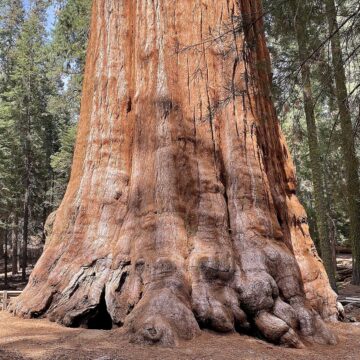
4. Sequoiadendron giganteum (giant redwood) has the honour of not only being one of the oldest but also the biggest of any single tree on the planet. The image seen at fourth right is the champion “General Sherman” tree. So many amazing statistics here you’ll just have to google it…
5. Wollemia nobilis (Wollemi pine) was only discovered as recently as 1994 in an isolated gorge not far from Sydney in NSW. It lit the botanical world alight and can now be found growing in both public and private gardens (see fifth image)all over the globe.
Of the five species featured above only one, the dawn redwood, is deciduous but for some (more) stunning autumnal colour try searching for these: larix kaempferi (Japanese larch), pseudolarix amabilis (golden larch) and taxodium distichum (swamp cypress). They make fine specimens in their own right but could be planted as copses and do particularly well planted near water.
Cheers John Beetham
Trading as Trees in Australia – 0418 375 708.
Next time: October plant highlights.
Scan the QR code to see JB’s Instagram post.
Do you have a gardening question for John? He is happy to answer them whether they are about trees, shrubs, the best time to plant, the best time to trim back… Email news@tlnews.com.au and we’ll make sure he gets them.

September 12th, 2026The Midnight Blue Review
Castlemaine’s The Midnight Blue Revue will celebrate three years of performing at Maurocco Bar with a special afternoon of live music on Sunday, September 13, from 2pm to 5pm.
For the past three years, Maurocco has provided a regular home for the band and its distinctive mix of blues, soul and R&B, attracting audiences who enjoy good live music in the intimate atmosphere of one of Castlemaine’s local venues.
The September performance will be both a gig and a celebration of the relationship that has developed between the band, Maurocco and its audiences.
Band member Rob Williams said the anniversary was an opportunity to acknowledge the people who have supported the band and local live music.
“Maurocco has become a real musical home for us. We’ve had three terrific years playing there and we’ve met a lot of wonderful people along the way. We wanted this gig to be a celebration and a chance to thank everyone who has come along, listened, danced and supported us.”
The Midnight Blue Revue brings together experienced local musicians playing music drawn from the great traditions of blues, soul, and rhythm & blues — music to listen to, but also music intended to get people up and dancing. Entry $10.
September 12th, 2026To build or not to build – that was the question
Things seemed to go so slowly for a long time but now they are speeding up. The slab is in and now the frame is up and the roof is starting to take shape.
It’s still an April bump-in date but at least we can see something happening – which is fantastic.
Mind you, we keep getting invoices now for each piece of work as it happens, which is fine, but the figures are still a bit of a shock. But better than just paying interest on a mortgage with nothing to see for it.
The builders, Sherridon Homes, have been really good with the site, looking after the plants which are pretty close to the building, and keeping the site really tidy.
And so it is actually getting a bit exciting to think about living in a modern home after so long in something built in 1862.
The school is amazing, and always gets a lot of comments, but this will be the newest home we have ever had. We always tended to go for older-style homes built in the 1980s – and because we never had the money to renovate – we got used to lots of different styles already inside the houses.
I think we have owned four houses all up and lived in about another 24 rentals around the country. Then there’s the ones we lived in before we met. That’s a lot of moving and lugging furniture.
Every time we move Kyle promises it’s the last time I have to be involved in carrying fridges or the huge tiled coffee table made by my Dad – and over-engineered for strength – because he was an engineer.
And every time we move, I find myself carrying another chair or side table. A bit lighter these days but still, no wonder I am tired. We will see how this one goes…
Words: Donna Kelly

September 12th, 2026Hepburn Springs Golf Club with Jan Smith
Hepburn Springs Golf Club traces its origins to the vision of local community leaders and golf enthusiasts who sought to establish a high-quality golf course in the scenic hills surrounding the town.
The driving force behind the project was George Parker Jr, a prominent Daylesford figure and chair of the Daylesford Progress Association and, later, Mayor. Although a golf course had already been quickly established at Victoria Park, Daylesford, in 1921, Parker remained committed to creating a superior course among the hills of Hepburn.
In the early 1920s, members of the Daylesford Progress Association searched extensively for suitable golf-course land. Parker spent several years planning the purchase of approximately 123 acres in Hepburn that would eventually become the club site. To finance it Hepburn Springs Golf Estates Pty Ltd was established by Parker, James McDonald, Daylesford chemist and Managing Director of Hepburn Spa Limited and Reginald Austin Simmons, of Camp St, Daylesford, civil engineer. The company issued 1000 £1 shares to finance not only a golf course but also a wider tourism and recreation development.
The vision included guest houses, tennis courts, a bowling green and about 50 residential allotments to build a “mountain home”. These allotments were all alongside the golf course and along what is now Lakeside Drive. Public meetings held early in 1926 attracted considerable enthusiasm, reflecting the belief that golf would strengthen Hepburn Springs as a major tourist destination. Promotional material linked the project with the region’s famous mineral springs and bathhouse and argued that modern holiday resorts required high-quality golf facilities.
Professional golfers and course designers Mr Keating of Woodend and later Mr Cates of Ballarat assisted in planning the layout. Cates praised the naturally undulating land, which offered variety, challenge and scenic beauty. His reports emphasized that the landscape was ideally suited to golf and could accommodate players of differing abilities.
Construction during 1926 involved extensive clearing of timber and scrub. Although weather slowed progress, local newspaper reports described the transformation as remarkable. Great emphasis was placed on the impressive panoramic views and attractive natural setting. Initial development focused on a nine-hole course, with longer-term ambitions for a full 18-hole layout.
At the same time, Hepburn Springs was experiencing broader tourism growth. Development of the new Hepburn Mineral Springs Hotel from October 1926 complemented the golf project, with promoters presenting the springs, hotel and golf course as interconnected attractions capable of drawing large numbers of visitors from Melbourne and beyond.
By mid-1926, nine holes had been completed, greens and tees had been sown, and a clubhouse was under construction overlooking the first fairway. The clubhouse was designed as both a sporting and social venue, featuring gathering spaces and a wide verandah. Reports predicted that the golf course would become one of the district’s greatest assets. Improvements included bunkering, fairway mowing, water supplies for greens, scorecards, telephones and visitor permit systems. The course quickly attracted favourable comment from local and visiting golfers.
Hepburn Springs Golf Estates leased the course to the Hepburn Springs Golf Club which had been formed in 1926 with George Parker and Dr. J.C.M. Harper as foundation members. Club competitions commenced with afternoon teas as an attraction. In November 1926, the club hosted its first Annual Open Tournament under the auspices of the Victorian Golf Association. The event provided competitions for men and women and established the club on the golfing calendar.
To keep the company afloat during the 1930s a few committed locals purchased 20 of the residential allotments and Parker guaranteed another £2000. The golf course and 26 building lots were passed in at auction in April 1938 despite a bid of £3500 by Mr. A.D. Anson. On August 8, 1938 Mr. E. Dowling, acting for the Mineral Springs Hotel, bought it for £4250. The golf club held a lease into1939 and then negotiated a lease on an annual rental basis from the freehold owners, the Mineral Springs Hotel. In return, the hotel guests were entitled to free golf.
The members proved to be committed to retaining the name Hepburn Springs Golf Club in 1939 when a proposal was made to rename the organisation the Daylesford-Hepburn Springs Golf Club. Supporters believed this would improve regional promotion, while opponents argued that the Daylesford name might be needed for a future separate club. Hepburn Springs members were the most invested in this decision, believing that the joint name would diminish Hepburn, and they ultimately voted against the change.
Next edition – The second nine holes…
Compiled by Daylesford & District Historical Society volunteer and Hepburn Golf member Jan Smith. Thanks to the society and Ross Baker, whose collection of golf club history filled in many gaps.

September 11th, 2026Don Giovanni tour
Lyster Opera will tour a fully staged production of Mozart’s Don Giovanni to eight venues across Melbourne and regional Victoria this spring.
Directed by Jamie Moffat with Pamela Christie as musical director, the production is sung in Italian with English surtitles and runs for approximately two hours and thirty minutes in two acts, with one interval. The score is performed live by a chamber ensemble of twelve musicians, supported by Melbourne Opera. Costumes are designed by Maddy Connellan, with lighting by Daniel Sinfield and assistant direction by Naomi Hobbs.
First performed in Prague on 29 October 1787, Don Giovanni follows a wealthy nobleman whose appetite for pleasure and conquest knows no limits, and who leaves chaos wherever he goes.
Mozart called it a dramma giocoso, a playful drama, and the work refuses to settle into either comedy or tragedy. Audiences laugh at the wit of Giovanni’s servant Leporello one moment and watch murder, revenge and supernatural judgment the next.
More than 230 years on, the central question still stands: what happens when someone believes the rules simply do not apply to them? What makes Don Giovanni endure is that it never offers easy answers. Giovanni is charismatic, funny and fearless, yet his pursuit of absolute freedom comes at the expense of everyone around him.
The production will be held at the Creswick Town Hall on Saturday, October 24 and then Talbot Town Hall on Saturday, November 14. All performance start at 2pm.
Tickets are on sale now. Link: www.lysteropera.com.au
September 11th, 2026Spielberg movies
Spielberg Month gets into top gear the rest of this month, with 11 of his greatest films to be shown at Daylesford’s Phoenix Cinema.
Spielberg’s range is shown in Sugarland Express from 1974. Goldie Hawn stars as a former crook who must talk her husband into a prison break to help pluck their two-year-old son out of foster care. (Thursday, September 10, 4.30pm)
American pilot Gary Powers flew a high-altitude plane on a spying mission into the Soviet Union in 1960. He was shot down, captured and sentenced to 10 years but served only four months thanks to a prisoner swap. Spielberg’s Bridge of Spies tell this story through Tom Hanks, who puts in a fine performance as a lawyer sent to secure Powers’ release. (Friday, September 11, 7pm and Saturday, September 12, 11am).
Spielberg spent 12 years researching Lincoln. The result is a monumental result, especially with being sombre, familiar but without cliches. Daniel Day-Lewis is outstanding. (Monday, September 14, 7pm).
Based on Roald Dahl’s book, The BFG tells of a young girl who befriends a giant. Ten-year-old Sophie is in for an adventure of a lifetime, overshadowed by unattractive giants such as Bloodbottler and Fleshlumpeater so has to go to London to seek the help of Queen Victoria (Saturday, September 19, 4.30pm).
Over the following two days another three Spielberg films will be shown: A.I. Artificial Intelligence, E.T. The Extra Terrestrial and Close Encounters of the Third Kind.
His West Side Story updates the sweeping Romeo and Juliet story, with dazzling dance routines. The film showcases everything Spielberg does best. (Thursday, September 24 and Sunday, September 27, 7pm).
Saving Private Ryan is anchored by another fine role by Tom Hanks, based on the true story of an army sergeant recalled to the front-line after the D-Day landing. (Friday, September 25, 7pm). Spielberg takes a nostalgic look at his family in The Fabelmans. We get a critical insight into his work and the impact of childhood pain, the agonies of growing up and childhood film-making. (Monday, September 28, 1pm). War Horse is a powerful emotional journey through the First World War. Described as an instant classic on its release, it sweeps from the English countryside to the horror of France. (Monday, September 28, 7pm). More movies, bookings and session times head to Phoenix Cinema.

September 11th, 2026Hepburn Wildlife News by Marita McGuirk
Where have all the tree hollows gone?
One of the problems faced by our native birds at this time of year is the lack of good, safe nesting sites. We may look at our forests and think that there are a lot of trees growing, but they are mostly relatively young trees that have not yet formed the nesting hollows required by birds and other wildlife such as sugar gliders, possums and antechinus.
Before white colonisation there were many more large hollow-bearing trees, but there has been a huge change in the vegetative cover of the landscape and most of these trees were cut down many years ago.
You may sometimes see the remnant stumps of these old trees in the forest and there are still some magnificent living examples on farms and roadsides.
An important fact is that offsetting the clearing of old growth forests and remnant patches of hollow-bearing mature trees with tree plantings, is no substitute for the loss of vital hollows for breeding and shelter. Especially considering that the formation of hollows in trees can take from 100 to 300 years.
The loss of these important places of animal refuge has resulted in birds looking for nesting sites in very odd places (see photo). The Hepburn Wildlife Shelter has four wood ducks in care that went down a chimney looking for nesting space, as well as several rosellas that sought out inappropriate nesting sites.
The right type of hollow is critical, and safety is often a main concern, as birds want to ensure that a predator cannot enter the hollow. Distance from the ground and proximity to food and water sources is also important.
The website Nest Box Tales contains excellent information on the construction of nesting boxes for all different species of birds, and provides links to nest box designs developed by a number of Australian organisations.
Link: www.nestboxtales.com
Wires also has important information on tree hollows for birds.
www.wires.org.au/wildlife-information/tree-hollows-for-wildlife
Dr Marita McGuirk is a field ecologist and environmental scientist, and a volunteer at the Hepburn Wildlife Shelter. Marita writes monthly columns about the shelter and the animals it cares for. If you would like to donate or volunteer, or just to find out more information, head to www.hepburnwildlifeshelter.org