


August 4th, 2026Clarkes Hill primary will close at the end of the 2026

It is with great sadness that the Diocese of Ballarat Catholic Education Ltd (DOBCEL) has made the difficult decision to close St Mary’s Primary School, Clarkes Hill at the end of the 2026 school year. This decision has been made in the context of forecast 2027 enrolments falling below the level required for non-government schools to meet VRQA regulatory obligations and the school’s financial viability.
The decision has also been informed by the changing financial context for schools, including the anticipated impact of the proposed Enterprise Bargaining Agreement. While DOBCEL supports fair and appropriate remuneration for teachers and staff, the associated increase in staffing costs means long-term viability can no longer be assessed by enrolment numbers alone.
In recent years, Principal Clare Scanlon and the entire St Mary’s staff have worked tirelessly to promote the unique strengths of the school, deepen connections with families and continue offering a profoundly personal Catholic education in a small rural setting.
Despite these sustained efforts, broader enrolment growth has not materialised to the extent required to ensure the school’s long-term sustainability. Nevertheless, we remain deeply proud of the commitment, care and professionalism shown by the St Mary’s team, and of the education and pastoral support they continue to provide for every child. This support will remain in place through to the end of the school year, with learning continuing in a calm, consistent and uninterrupted way.
This has been, and continues to be, a particularly challenging time for Principal Clare Scanlon, who has led the community through this difficult period with compassion, steadiness and a clear focus on the wellbeing of students, families and staff. I am very grateful for Clare’s leadership.
I have met with the staff and families of St Mary’s to discuss how we can best support students to continue receiving the high-quality Catholic education they deserve. Catholic Education Ballarat will work closely with families impacted by this decision to help them explore schooling options for 2027, with nearby Catholic schools also ready to assist families through the enrolment process and provide support over the coming months.
Similarly, staff of St Mary’s will be fully supported to understand their options and career opportunities, including redeployment within other Catholic schools in the Diocese, if desired.
St Mary’s Primary School opened in 1946 to provide Catholic education for the children of the farming community of Clarkes Hill and surrounding districts. Built through local fundraising and hard work, without government funding assistance, the school stands as a testament to the commitment and generosity of the community that brought it into being. For 80 years, generations of local families have been part of the St Mary’s story, with many students following in the footsteps of parents and grandparents who were also educated there.
The school’s history is woven into the physical fabric of the site, from the commemorative bricks laid for its 50th anniversary and the time capsule beneath them, to the mural painted in 1996 to mark 50 years of Catholic education at St Mary’s. These markers speak to a community that has cherished its school and the place it has held in the life and heart of Clarkes Hill for decades.
Above all, we acknowledge the families who have chosen St Mary’s across generations, recognising their deep commitment to a school where children have been known by name, encouraged to contribute and supported to grow in faith, learning and friendship.
Opportunities to recognise the contribution of the school, and all who have played a part in its proud and distinctive history, will be planned during the remainder of the year.
DOBCEL continues to advocate for the important role that small Catholic schools play in rural and regional communities, providing parental choice in education and contributing to the strength, identity and vitality of local communities.
I take solace in the fact that Catholic education throughout the Diocese of Ballarat continues to grow, now educating almost 19,000 students across 62 schools.
I ask for your prayerful support and understanding as we walk with the St Mary’s community through this challenging time.


August 3rd, 2026Cycle of despair: snapshot reveals young and homeless are shunted between hospitals and the street
More than half the young Victorians accessing homelessness services in Victoria have ended up in a hospital emergency department during a mental health crisis, and almost three in five have self-harmed, had suicidal thoughts, or attempted suicide, according to new data released today by Melbourne City Mission (MCM).
The findings show a health system now doing a job it was never built for, treating young people in crisis because Victoria still doesn’t have the dedicated housing that could stop them cycling straight back onto the street.
MCM’s Victorian Youth Homelessness Snapshot 2026 captures the experiences of 209 young people aged 15 to 24 who were accessing homelessness services on a single day, 1 April 2026, across Greater Melbourne and Latrobe/Gippsland.
Key findings:
- In Greater Melbourne, half of all young people accessing homelessness services had attended an emergency department for mental health concerns at least once, and 17 per cent had done so four or more times. In Latrobe/Gippsland, 1 in 6 had attended at least once.
- 3 in 5 young people in Greater Melbourne, and almost half in Latrobe/Gippsland, reported self-harm, suicidal ideation, or a suicide attempt.
- 5 in 6 young people in Greater Melbourne grew up experiencing family violence, and two-thirds of those were already known to child protection. In Latrobe/Gippsland, three-quarters grew up experiencing family violence.
- More than half of young people in both regions have been homeless for two years or more, with 26 per cent in Greater Melbourne homeless for four years or more.
- Two-thirds of young people in Greater Melbourne, and 3 in 5 in Latrobe/Gippsland, are not engaged in study or work.
MCM CEO Paul Wappett said the data showed young people were being repeatedly discharged from hospital back into homelessness, with nowhere safe to recover.
“Every young person in this snapshot has a story that starts with trauma and ends up in an emergency department, because there is nowhere else for them to go. Police, paramedics and hospital staff are working in a broken system and none of them can give a young person the home they need. That’s not a job any of them signed up for, and it’s not a job they should have to do.”
MCM and Orygen are calling on whoever forms Victoria’s next government to commit to a dedicated, funded supported housing model for young people. This would be the youth equivalent of a program already promised, and only partly delivered, for adults.
Orygen executive director, Professor Pat McGorry, said the findings reinforced the case for secure, supported housing as a mental health intervention in its own right.
“You cannot recover from a mental health crisis while you are sleeping rough or moving between crisis beds. Housing has to be part of youth mental health care, not an afterthought for when a young person has recovered. The Royal Commission made a promise to address this and so far the Victorian Government has failed to deliver.”
August 3rd, 2026Nutbush for cancer research
Ten years after Horsham danced into the record books, the community is being invited to pull on its dancing shoes again, this time to raise funds for cancer research.
Communities across Western Victoria are being called on to dance, donate and transform an Australian party favourite into a powerful movement for hope.
The Nutbush for Hope campaign will culminate in a mass community dance at the Horsham Agricultural Show on Sunday, 27 September 2026, raising funds and awareness for the Fiona Elsey Cancer Research Institute (FECRI).
People can join the movement by dancing at the Horsham Show, making a one-off $10 Donation of Hope online or organising their own Nutbush fundraiser at a school, sporting club, workplace, farm or local landmark.
Professor George Kannourakis, founder of FECRI and a long-serving oncologist and haematologist in regional Victoria, said the campaign reflected the community spirit on which the Institute was built.
“Our research has always been powered by communities coming together. Nutbush for Hope continues that tradition in a wonderfully Australian way,” Professor Kannourakis said.
“Every person who dances, donates or shares the campaign is helping fund research into cancers affecting families across regional Victoria and throughout Australia.”
While the campaign promises plenty of fun, it also carries a serious message for people to keep up to date with recommended cancer screening and speak with their GP about persistent or unexplained changes in their health.
“People generally know when something has changed in their body, and those changes should not be ignored,” Professor Kannourakis said.
“Cancer diagnosis and mortality rates in parts of Western Victoria remain unacceptably high, reinforcing the need for greater awareness, earlier detection and continued investment in cancer research.”
Horsham made national and international headlines when the community staged its original Nutbush world record event. A decade later, organisers hope people from across the Wimmera, Grampians, Mallee and beyond will help recapture that energy for a cause that touches almost every family.
“The original event demonstrated what Horsham can achieve when the community gets behind an ambitious idea,” Professor Kannourakis said.
“You do not need to be a great dancer… I am certainly not known for my moves on the dance floor. You simply need to have a go.”
FECRI was established in Ballarat in 1998 following a promise Professor Kannourakis made to his young patient, Fiona Elsey, who lost her fight for life at just 14 years of age.
Fiona wanted cancer research to take place in regional Victoria so other people might have a better chance. Her wish inspired the creation of what is now Australia’s only regionally based, community-funded and independent cancer research institute.
Today, FECRI conducts research into ovarian, breast, bowel, prostate, brain and other cancers. Its scientists investigate cancer progression, treatment resistance and ways of harnessing the immune system to fight the disease.
How to Nutbush for Hope
People can support the campaign by:
- Making a one-off $10 Donation of Hope and joining the movement online.
- Registering for $15 to become a Horsham History Dancer at the Show, for participants aged eight and over.
- Combine your dance registration with entry to the Horsham Show and make a day of it complete with entertainment, attractions and activities.
- Children aged seven and under to dance for a gold coin donation on the day.
- Organising a Nutbush fundraiser through a school, sporting club, workplace or community group.
- Sharing a Nutbush video on social media and challenging others to take part, be sure to tag #NutbushFECRI #NutbushForHope #NutbushHorsham2026
- Talking with family and friends about cancer screening and the importance of consulting a GP about persistent or unexplained changes.
Donations and Dance Registrations are available through fecri.org.au. Dance registrations and combined Horsham Show entry options will also be available through horshamshow.com.au making it easy to Nutbush for Hope and enjoy everything the Show has to offer.
Businesses, organisations and individuals interested in becoming a sponsor, partner or volunteer can contact Vicky De George on 0405 151 485 or vicky@mediacomservices.com.au
Event details
What: Nutbush for Hope
When: Sunday, 27 September 2026
Time: 1.00pm
Where: Horsham Agricultural Show, Horsham Showgrounds
Purpose: Raising funds and awareness for the Fiona Elsey Cancer Research Institute
Information: fecri.org.au and horshamshow.com.au
Follow: @NutbushforHope and @horshamshow
Share: #NutbushFECRI #NutbushForHope #NutbushHorsham2026

August 3rd, 2026Subtle symptom saves life
When Cranbourne mum Belinda came down with a sudden, searing headache that wouldn’t ease, Ambulance Victoria paramedics identified a subtle symptom that would save her life from a stroke.
This National Stroke Week (3 – 9 August) Ambulance Victoria is encouraging Victorians to know all the signs of stroke, including those that don’t fall within the standard F.A.S.T. (Face, Arms, Speech, Time) symptoms.
In July 2024, Belinda Timmins, then 48, thought she was having a migraine when she suffered a haemorrhagic stroke, caused by a ruptured brain aneurysm.
“I was unaware at the time as to what was happening, I just knew I had an intense pain like a lightning bolt had hit the side of my head. It was the worst head pain I had ever had,” Belinda said.
When the pain continued to worsen, Belinda’s son called Triple Zero (000) with Ambulance Victoria paramedics Hayley and John arriving at the scene within minutes.
Although Belinda’s initial stroke assessment did not raise any concerns, graduate paramedic Hayley noticed one subtle sign that the situation could be life-threatening.
“Belinda did not seem to have any neurological deficits, such as slurred speech or a facial droop, but she did have unequal pupil sizes and a severe headache despite strong pain relief,” Hayley said.
“The pupil symptom alone was enough for me to know she needed to be transported to a neurological hospital.”
Belinda was immediately transported to the Monash Medical Centre under lights and sirens, where her care was handed over to the specialist stroke team.
This was Hayley’s first haemorrhagic stroke case as a paramedic and one she said will stay with her.
“It’s important to be exposed to different types of cases as a graduate and especially ones with less obvious symptoms such as Belinda’s,” Hayley said.
“Each experience sharpens your skills and develops your knowledge which I can use going forward to help inform the care I provide others.
“It’s rewarding knowing we were able to use our skills to ensure Belinda received the emergency care she needed, which ultimately, helped to keep her here with her children.”
Ambulance Victoria Director of Stroke Services Professor Chris Bladin urged the community to familiarise themselves with all signs of stroke, including those that fall outside the F.A.S.T. (Face, Arms, Speech, Time) symptoms.
“Belinda’s case highlights the critical role paramedics play in recognising stroke symptoms, even when they don’t present in typical ways,” he said.
“The most common non-F.A.S.T. symptoms can include loss of vision, double vision, sudden imbalance or vertigo (if there is no prior history), sudden loss of consciousness and isolated limb weakness.
“Our message to Victorians is that if you suspect someone is having a stroke, always call Triple Zero (000) for advice.”
Belinda said she will be forever grateful to her son for calling Triple Zero (000) and to Hayley and John for saving her life.
“As far as I am concerned, Hayley and John are the reason I am still here today,” she said.
“They stabilised me and got me to the Monash Medical Centre for the treatment which saved me and has kept me here with my three children.
“The brain aneurysm could have taken my life. I am eternally grateful for these wonderful paramedics.”

August 3rd, 2026Australian-first Stubble Quail GPS tracking research begins in Victoria
The Game Management Authority (GMA) has partnered with Deakin University to conduct an Australian-first research project that will use GPS tracking technology to better understand the movements, habitat use and behaviour of Stubble Quail.
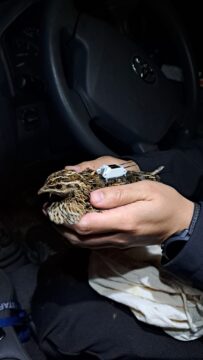
The new study aims to understand what drives Stubble Quail movement, which habitats they use and when and how they respond to environmental conditions and changing land management. This improved ecological understanding will help to ensure sustainable management of Stubble Quail hunting in Victoria.
As part of this project, Stubble Quail will be fitted with lightweight solar-powered GPS tracking devices at locations across Victoria. Researchers are aiming to fit a small number of birds with trackers in the first year to ensure they work properly on this species before they are fitted to a larger number of birds over the following two years.
The GPS tracking devices will record the Stubble Quails’ location, movement, breeding, feeding and resting patterns 24 hours a day, allowing researchers to monitor how they respond to environmental conditions, agricultural practices and habitat changes.
GMA Strategy and Research Director Simon Toop said this Australian-first research will provide vital insights into Stubble Quail ecology.
“The GMA has long-running research into the annual recreational harvest of Stubble Quail and has conducted state-wide abundance surveys since 2021, however, there is more to learn about their population dynamics and response to environmental conditions,” Mr Toop said.
“While Stubble Quail are one of Victoria’s most widespread native grassland birds, little is known about how they move across the landscape, where they breed, what habitats they rely on and what factors influence their survival.”
“Understanding the movements and behaviours of this cryptic species is of great importance, not only for game management, but also for their broader conservation.”
Researchers will also collect blood and swab samples from captured birds to investigate potential exposure to pesticides and diseases. This could include testing for the highly pathogenic avian influenza (HPAI), contributing information to broader HPAI surveillance.
The research began in June 2026 and will continue to 2029. Results will be published in a PhD thesis, technical report and in peer-reviewed scientific literature.
To keep up-to-date with the latest progress on the project, visit https://shorturl.at/V4y3m
This project builds on the GMA and Deakin University’s ongoing research partnership, which also includes a duck spatial ecology study investigating the movements, survival and behaviour of four of Victoria’s most important duck species. For updates on the duck spatial ecology research, visit the Tracking Victorian ducks website.
August 2nd, 2026Powerful exhibition revealing the hidden face of women’s homelessness heads to Gippsland
A striking exhibition of illustration and photography, telling the stories of three Victorian women who have lived through homelessness, will open in Traralgon in early August.
Walk In Her Shoes charts the very different paths of three women who lost their housing at separate stages of life, one as a young person, one as a mother, and one later in life, and shows how family violence, poverty and a shortage of safe homes can tip a woman into crisis.
Its arrival coincides with the latest Australian Institute of Health and Welfare data, which found that women and girls accounted for 59 per cent of Victorians seeking help from homelessness services in 2024-25, close to 62,000 people in all.
Within that group were more than 13,000 girls under 18 and over 6,800 women aged 55 and older, and for more than half, family and domestic violence formed part of their story.
A community forum will run alongside the exhibition, bringing together women with lived experience, frontline workers, local MPs and residents to talk through what is driving more women into homelessness in Gippsland and across the state, and what needs to change to keep them housed.
The panel includes lived experience advocate Shaini from Melbourne City Mission, alongside Wayne Farnham MP, State Member for Narracan, Mitchell Burney, Head of Children, Youth, Families and Housing Supports at Quantum Support Services, and Aleisha Olivier, Regional Homelessness Services Coordinator at Community Housing Limited.
Council to Homeless Persons CEO Deborah Di Natale said the exhibition laid bare the human cost of Victoria’s housing shortfall, and the particular toll it takes on women and children fleeing violence.
“Right across Victoria, and here in Gippsland, women are now the majority of people asking homelessness services for help, yet too often they remain the hidden face of this crisis,” Ms Di Natale said.
“These three stories show what the statistics really mean, a young woman escaping violence, a mother trying to keep her children safe, or an older woman left with nowhere to turn.
“For women in regional communities the options can be even thinner, with fewer services and greater distances to travel. Victoria needs close to 80,000 additional social housing properties over the next decade simply to reach the national average, and the government’s recent investment has to be the first step in a far bigger effort.”
The exhibition is on display at the Gippsland Performing Arts Centre from Thursday 6 August to Thursday 13 August. The community forum takes place at the same venue on Thursday 6 August, 6:30pm to 8:30pm. Entry is free and catering will be provided.
The event is presented by Council to Homeless Persons and proudly sponsored by the Municipal Association of Victoria and Community Information and Support Victoria, with support from Latrobe City Council and Quantum Support Services.
August 2nd, 2026Victorian GPs urge parties to boost addiction treatment access so patients don’t ‘suffer in silence’: National Pain Week
The Royal Australian College of GPs (RACGP) is encouraging people living with persistent pain to work closely with their GP to find the right treatment and support, while calling on the next Victorian Government to improve access to Medication-Assisted Treatment for Opioid Dependence (MATOD) through general practice.
Marking National Pain Week, the RACGP said pain is a complex health issue that often requires a holistic, long-term approach rather than reliance on medicines alone.
RACGP Victoria Co-Deputy Chair Dr Aadhil Aziz said GPs play a vital role helping patients manage pain, maintain quality of life, and where appropriate, deprescribe medicines that may no longer be providing benefit.
“Living with chronic pain can have a profound impact on every aspect of a person’s life, including their physical health, mental wellbeing, relationships, and ability to work,” he said.
“Your GP can support you to manage pain. Good holistic care means minimising pain, including supporting you to move off pain medication when it’s no longer providing benefit.
“Addiction too often catches a patient using these medicines by surprise. They shouldn’t suffer in silence.
“That’s why it’s so important people feel comfortable talking openly with their GP about their pain, their medicines, and any concerns they may have.
“Pain should never be stigmatised, and neither should dependence on a medicine that was originally prescribed to help. Many patients find themselves in difficult circumstances through no fault of their own and deserve compassionate, evidence-based care.”
Dr Aziz said Victoria’s specialist GPs increasingly support patients to safely reduce or stop medicines where the risks outweigh the benefits, including opioid medicines used for pain management.
“The goal is always better health outcomes and quality of life,” he said.
“In many cases that means looking at the whole picture, including physical activity, mental health support, sleep, social connection and other treatments that can help people manage pain safely and effectively.”
The RACGP recently worked with Monash University researchers, pharmacists, nurses and medical scientists to help develop Australia’s first national deprescribing roadmap, designed to support safer use of medicines and reduce harms associated with unnecessary or inappropriate medication use.
Dr Aziz said Victoria also needed stronger support systems for people experiencing opioid dependence.
“GPs are often the first point of contact for patients experiencing problems related to prescription opioids or other medicines,” he said.
“That’s why the RACGP is calling on the next Victorian Government to support more GPs to undertake training and provide medication-assisted treatment for opioid dependence [MATOD] through general practice.
“Improving access to MATOD means patients can get support from a trusted GP in their local community, reducing barriers to treatment and helping more people access care earlier.
“Medicare funding often doesn’t match the cost of the longer consultations which patients need for this kind of complex care, and patients are typically left to cover the gap – if they can. That’s another reason the RACGP and patient representatives been calling for a 40% boost to funding for long consults.
“No Victorian should miss out on treatment because they can’t find a local GP with the training and support needed to provide this care.”
The RACGP is also encouraging Victorian GPs with an interest in addiction medicine and dependency care to attend the upcoming GPADD Conference, which brings together clinicians and experts to share the latest evidence and best practice approaches.
“Addiction medicine isn’t a niche – and the GPADD theme reflects that providing care for patients affected by alcohol and other drug use is part of normal, bread-and-butter general practice,” Dr Aziz said.
“GPs are very often our patients’ first point of contact, and the conference program covers opioid stewardship and governance, ADHD, family violence co-occurring with substance use, and sessions on alcohol, party drugs, and prescription opioids, as well as self-care and burnout prevention.
“There’s something there for every GP and addiction medicine multidisciplinary team member.”
August 2nd, 2026Thousands of origami houses to highlight housing need during Homelessness Week
As part of Homelessness Week 2026 (3-9 August), the Central Highlands Homelessness Alliance (CHHA) will once again bring the impact of homelessness and housing insecurity into public view through the powerful Houses at the Lake community event at Lake Wendouree.
Taking place on Tuesday 4 August, the display will feature 6,000 origami houses along the Lake Wendouree foreshore, contributing to a statewide campaign aiming to create 60,000 origami houses, representing the additional social homes needed across Victoria. The visual installation serves as a reminder that behind every housing statistic is a person, family or young person seeking safety, stability and a place to call home.
The event is coordinated locally by the Central Highlands Homelessness Alliance, a collaboration of organisations working together to prevent and end homelessness across the region, including Ballarat Community Health, BADAC, Berry Street, Cafs, CatholicCare, Grampians Community Health, McAuley, The Salvation Army, Uniting, Wintringham and WRISC.
Jack Weibgen, Cafs Housing and Homelessness Practitioner said Homelessness Week provides an important opportunity for communities to come together, increase understanding and advocate for meaningful solutions.
“Homelessness can affect anyone. It is often the result of a combination of factors including housing affordability, family violence, financial hardship, health challenges and relationship breakdown.”
“Through events like Houses at the Lake, we can help raise awareness, challenge misconceptions and encourage conversations about the practical solutions needed to ensure everyone has access to safe and secure housing,” Mr Weibgen said.
August 2nd, 2026MAKING VICTORIA’S ELECTIONS FAIRER AND MORE TRANSPARENT
The Electoral Amendment (Miscellaneous Matters) Bill 2026, introduced into the Victorian Parliament this week, will abolish group voting tickets.
This will end “preference whispering”, where parties strike complex preference deals that can see candidates elected with only a small share of the primary vote.
A new above-the-line voting system will require voters to number at least five groups in order of preference.
Those preferences will then flow to candidates in the order they appear below the line for each party or group.
This will put voters in control of their preferences making our elections fairer and more transparent.
This change will also bring Victoria into line with other states.
The reforms will also require the Victorian Electoral Commission to publish information about new political parties – because a party’s name does not always tell voters who is behind it or where their preferences may flow.
The information will be publicly available so Victorians can make more informed decisions.
August 1st, 2026Council to Hold Unscheduled Meeting to Elect New Mayor

Macedon Ranges Shire Council will hold an Unscheduled Council Meeting on Tuesday 4 August 2026 to elect a new Mayor following the resignation of Cr Kate Kendall from the office of Mayor.
The meeting will be held at 12.30pm at the Gisborne Administration Centre, in accordance with Council’s Governance Rules, which require a mayoral election to be conducted when a vacancy occurs in the office of Mayor.
Cr Kendall’s resignation as Mayor became effective at the close of business on Friday 24 July 2026. Cr Kendall remains a councillor.
Chief Executive Officer Bernie O’Sullivan said the meeting had been called in accordance with Council’s governance requirements.
“Council’s Governance Rules outline the process for electing a Mayor when a vacancy occurs during a mayoral term,” Mr O’Sullivan said.
“The councillor elected at the meeting will serve as Mayor for the remainder of the current term, which concludes on 18 November 2026.”
In accordance with Section 21 of the Local Government Act 2020, Deputy Mayor Cr Cassy Borthwick is performing the role of Mayor from 5.00pm on Friday 24 July 2026 until the mayoral election is conducted on 4 August 2026.
The agenda for the meeting is on the council’s website.
Members of the public can attend the meeting in person or view proceedings via the livestream available on Council’s website at mrsc.vic.gov.au/Council-Meetings
August 1st, 2026And then there were two – council disarray

Five of Hepburn Shire Council’s seven councillors are now stood down after private prosecutions from a Hepburn Shire resident.

Cr Don Henderson was stood down in March followed this month by Mayor Cr Tony Clark, then Cr Lesley Hewitt, Deputy Mayor Cr Shirley Cornish and Cr Pat Hockey. The two remaining councillors are Cr Brian Hood and Cr Tim Drylie.
CEO Bradley Thomas is also facing charges but was not stood down. However he has since resigned.
Janet Dore, pictured, has been appointed acting Chief Executive Officer of the council from August 3 to August 23.
Ms Dore served as CEO of the Transport Accident Commission from 2007 to 2015. She has also held senior local government roles, including general manager at the City of Newcastle and interim CEO at the City of Ballarat, along with several council monitor and administrator appointments.
The appointment follows an external recruitment process led by CEO Employment and Remuneration Committee temporary interim chair Rebecca McKenzie, with councillors Tim Drylie and Brian Hood.
A council media release said Ms Dore’s short-term arrangement would enable the council to continue working with the Victorian Government to establish an appropriate decision-making mechanism, including the potential extension of Ms Dore’s appointment as interim CEO beyond August 23.
(The next step could be seeing the state government appointing an administrator or administrators to take over the role of councillors.)
A July 15 council media release said the council had reaffirmed with independent advice that its adopted 2026/27 Budget was compliant with legislative requirements and would like to correct commentary suggesting otherwise.
“Council considered placing the draft 2026/27 Budget on public exhibition for community feedback at its Council Meeting on 26 May 2026. The draft Budget was prepared using the relevant Victorian Government budget template and included the information required under the Local Government Act 2020 and associated regulations.
“Following community engagement, councillors considered a further report at a Special Council Meeting on 30 June 2026. That report requested that council adopt the draft Budget including a number of changes that had occurred since the draft was released. This is a normal and consistent practice across the local government sector, where budgets are refined following public exhibition, updated information and council consideration.
“During the meeting, a concern was raised that the Budget may not be compliant. Clarification was sought and the Chief Executive Officer advised that the Budget was compliant and it was adopted. Since its adoption, council has sought further independent legal advice. That advice confirms council’s position that the adopted 2026/27 Budget is compliant with legislative requirements.
“The 2026/27 Budget was developed in a challenging financial environment and is focused on responsible service delivery, investment in essential community infrastructure and the ongoing management of council’s long-term financial sustainability.”
Meanwhile, the July council meeting was cancelled because the council no longer has a quorum. A council media release said: “We’ll keep you updated on any developments with the situation and any action by the Victorian Government.
“Remember, operationally it’s business as usual for us. We are still delivering services and completing projects.”
Words: Donna Kelly | Images: Hepburn Shire Council
August 1st, 2026Bird flu

DEECA is using helicopter-mounted cameras to monitor Victoria’s coastline and detect possible H5 bird flu cases in wild birds and wildlife.
Detections of H5 bird flu on Australian shores reinforce the need for continued surveillance, preparedness and prompt reporting of sick or dead wild birds and wildlife.
August 1st, 2026Women’s Wellbeing Day
Central Highlands Rural Health will host a Women’s Wellbeing Day at the Mechanics Trentham on Saturday, September 5, in celebration of Women’s Health Week.
Organised by the CWA Trentham Night Owls and Trentham Neighbourhood Centre, this event will focus on the health and wellbeing needs of women over 40. The program includes expert guest speakers discussing perimenopause, nutrition for energy, stronger bodies, sleep and better mental health, along with lunchtime information stalls showcasing local health and wellbeing services.
Enquiries: trenthamwomenswellbeing@gmail.com
August 1st, 2026Water diversion
Central Highlands Water is providing surplus water to the Goldfields Reservoir.
The water is being delivered under a Memorandum of Understanding between Central Goldfields Shire Council and Central Highlands Water that enables water to be diverted to this important community asset whenever the Evansford Reservoir exceeds capacity. Water began flowing last week at a rate of 1- 3 megalitres per day – at no cost to the community thanks also to the Goldfields Reservoir Action Group.
July 31st, 2026Liberal Ripon candidate
The Liberal Party has endorsed local farmer, small business owner, volunteer and mother of four Megan Read as its candidate for Ripon at the Victorian election on November 28.
Born in Creswick, raised in Ballarat and now farming near Beaufort with her husband Warwick, Megan has spent her life living, working and volunteering across the communities of Ripon. She has built successful businesses, served local schools and sporting clubs, helped raise hundreds of thousands of dollars for community causes, and played a leading role in supporting recovery following the devastating Streatham-Skipton fires.