


November 14th, 2021Stories of the Storm

SANDY Scheltema’s Stories of the Storm series is supported by Hepburn Shire Council, Trentham & Districts Community Bank and the Trentham Lions Club. The series showcases stories of courage, tenacity, bravery and resilience within the community from people who experienced the terrifying storm of June 10, 2021.
This piece features veterinary nurse Eva Evans who was with her 11-year-old daughter Lily on her 60-acre mixed animal farm just outside Trentham when the storm hit. Her 13-year-old son George and husband Scott were at the Royal Children’s Hospital, due to return home on Friday, but couldn’t because of the blocked roads.
“I picked Lily up from the school bus and the weather was getting pretty wild. When we got home, I said to her ‘Let’s secure the animals’. (Eva has ducks, chickens, horses, sheep, goats and a calf named Snickers). We moved the animals into a paddock with the most shelter. The wind was vicious. After we’d secured the animals we hid inside – we had to really push the door closed – the wind was howling from a direction it doesn’t normally come from.
“We made dinner, then lost power just on sunset. I remember thinking ‘Thank God I’ve cooked.’ We had a lovely dinner by candlelight. The wind was coming from a different direction; it was like a jumbo jet flying over the house. So much so that Lily came into bed with me. We had no power, no lights, we lost wi-fi.
“I woke six or seven times during the night and thought ‘jeez, it’s still windy, the power’s still out’. As soon as it was light, I checked to see if the trampoline was still there – I was surprised that it was. There was a message from the school bus driver saying there’d be no school bus today.
“The weather was still wild. I’d noticed there were a lot of trees down in the paddock – all of our shelter trees were uprooted. At 7am the weather seemed to settle. I went up my driveway to see if I could get out and to check the stock.
“It was like God had played pick-up sticks and walked out halfway through the game. The adrenaline kicked in once I saw how many trees had fallen, there were over 30 down over the perimeter fences. I thought ‘We have to find all the animals and move them into a secure location’, because all the boundary fences were gone.
“Trying to catch six flighty horses in a storm was challenging. We managed to get the rugs off two of them, they were flapping and scaring them. Lily was opening gates and I was herding them through. We could hear massive trees crashing down around us and realised it wasn’t safe to assess the boundary fences. We managed to get the stock in an internal paddock that still had fencing.
“We decided to just sit it out. Both driveways were impassable and there was no way I could get out on my own. We ended up with 10 chickens and 15 quail inside because they’d got wet.
“We sat it out until 4pm on the Thursday. About 5pm the storm died down and we walked the 500 metres to our neighbour’s house. We saw utter devastation there. It was horrific, seeing the bush lying on the ground. We’ve all prepared our houses for bushfires, which helped prevent damage from this storm. Our neighbours have earth moving equipment and were already out clearing the roads that were impassable. They put in a solid 10 hours with their equipment and got about a kilometre.
“We found our missing sheep under a branch that had come down in the storm. She was dead. As we went down the drive, we found one of our goats had tried to jump the fence and got caught. We got the car, the wire cutters, and cut her out. She was wet, cold, and miserable. Unfortunately, she never recovered.
“George and Scott couldn’t get home from hospital in Melbourne because roads were still blocked. George was supposed to continue treatment with ‘Hospital in the Home’ via the Hepburn District Nursing Service. Because of the lack of power and road access they made the decision to keep George in the Royal Children’s Hospital until the power and services were restored, which didn’t happen until Tuesday, six days after the storm. I was happy he was safe and not involved with what was happening.
“We put on the generator for our 100-litre chest freezer which had last season’s four lambs and a steer. Once the roads were clear Scott and I made the decision to swap places because I didn’t know where to start with the clean-up of the property. He felt frustrated and useless being stuck in a hospital room in Melbourne knowing how much work was ahead of us. I felt useless not being able to do the heavy work.
“I went to Melbourne to the hospital and came home and was just awestruck by the devastation. We felt overwhelmed by the amount of work to clean up, we were just grateful no-one was hurt. Family and friends from Melbourne were offering to help but because of Covid they couldn’t get here, which made things overwhelming.
“In situations like this it’s important to be in contact with your neighbours, friends and family. Without my neighbours and their amazing earthmoving equipment I’d still be cutting wood out of my driveway. If they hadn’t had a 20-tonne excavator, I wouldn’t have been able to leave my property for days. But it wouldn’t have been the end of the world, we had enough food.
“This storm has made us question our impact on the environment, and question how to mitigate our impact. I feel like extreme weather events are becoming more frequent. It’s important to be prepared to be self-reliant in events like this. Don’t get angry if they can’t turn the power back on in six hours. It doesn’t help being angry.
“When I came home from hospital with George he complained he’d missed everything. I took him for a walk to show him all the damage and George found a mountain brushtail possum stuck in a tree hollow. We pulled him out, he was weak and it was six days after the storm but he had enough fight in him that we made the decision to release him.”
To read Sandy’s final seven features in the series head to www.tlnews.com.au


November 13th, 2021Power lines jeopardise World Heritage bid

“THE Western Victoria Transmission Network Project (WVTNP) is a critical upgrade of the state’s transmission network which will ensure Victoria’s successful transition from coal generated energy to sustainable, affordable and reliable renewable energy. It will connect large-scale wind and solar in the west into the grid to power more than half a million homes across Victoria.”
Therein begins a glowing description, on the WVTNP website, of the huge high voltage power line development proposal extending 190 kilometres from Bulgana near Stawell to the outskirts of Melbourne.
The project is intended to connect the Western Victoria Renewable Energy Zone with its (predominantly) Melbourne-based consumers. Local opposition to the project has been immense and highly visible especially through areas such as Kingston, Newlyn, Blampied and Dean. The principal issues being the ongoing disruption to farming and the height of the towers (85m).
Their vast size creates some serious visual pollution to what is considered highly valuable, significant and unspoiled country. And this aspect could potentially draw additional state and national attention to what, so far, has been a regional squabble; as Greg May (pictured) from the Kingston and District Power Alliance explains.
“There has been a UNESCO World Heritage bid project under way for several years now to have the historic Central Victorian Goldfields recognised as culturally significant and while it could take many years before getting approval, it is still particularly important.
“The area around Kingston and Smeaton where these lines are proposed are one of the most important parts of the World Heritage bid with more intact mine sites than anywhere else in that whole region.”
The idea of giving World Heritage status to the Goldfields region has been around in its current form since the late 1980s with momentum increasing in the past few years. They represent, according to World Heritage experts, “the most extensive, coherent and best surviving landscape anywhere, that illustrates the global gold rush phenomenon of the second half of the nineteenth century”.
The proposal is still in its draft phase and any heritage listing, if successful, would not be ratified for another five years. However, the bid stands a good chance of being accepted and with it a potentially huge boost to local economies. The bid process is supported by 13 local governments, led by the cities of Ballarat and Bendigo and now has as its patrons former premiers John Brumby and Denis Napthine.
“I left some detailed information on the Goldfield World Heritage Bid website,” says Greg, “expressing my concerns about how the WVTNP development could impact the bid but still haven’t received a reply.”
Meanwhile, the power line development process including consultation, public submissions, environmental studies, not to mention the distractions of federal and state elections, is slow and may push construction several years down the road.
That could see the entire development dovetailing with the progress of the World Heritage bid. The result could see the Victorian Government in a peculiar situation where it has approved the desecration of the same landscape it has been actively seeking to protect through a UNESCO heritage listing.
It is a glaring contradiction that anti-tower activist groups are keen to exploit. World Heritage efforts would result in more eyes on the region and such attention would be a significant incentive to convince the government to place the lines underground. Underground lines, while considerably more expensive, are the preferred option across the region.
“I’m a small-scale organic farmer who has lived in Blampied for all of his 65 years,” says Greg, “and I’m buggered if I want to see these towers built across our countryside.
“We want to get this message out far and wide so the more people that know about it the better. Most people, I think, would be appalled if they thought that this World Heritage bid might be in jeopardy due to power line construction.”
The Local sent emails to the Goldfield World Heritage Bid website contact page but did not receive replies by press time.
Words: Tony Sawrey | Image: Kyle Barnes

November 13th, 2021CresFest 2022 will be a joyful celebration of music and dance
Set in the beautiful town of Creswick and featuring local and national artists.
Tickets recently went on sale for the event, from April 1-3 next year, and an official launch will be held at Creswick Town Hall on Saturday, December 4 from 7.30pm. Celebrations feature Central Victoria’s The Ugly Uncles, fiddle and banjo duo Kat Mear and Craig Woodward, and the Creswick Swingalong Orchestra. Bookings: www.trybooking.com/BSRIS Thanks to CresFest 2022’s partnership with The Local, readers get a special discount – at checkout use the code TLCF2022.

November 13th, 2021Hepburn Shire Council has begun distributing free firewood
from the June storm to community groups and organisations.
They include the Clunes Angling Club, Trentham Primary School, the Creswick Railway Workshop and the Hepburn Football Club. Community groups keen on free firewood can contact Inga Hamilton on ihamilton@hepburn.vic.gov.au

November 13th, 2021Macedon Ranges Shire Council is hosting free online training
Macedon Ranges Shire Council is hosting free online training to help people deal with difficult customers titled Dealing with Aggressive and Abusive Customers.
The session is provided by the National Retail Association. Limited spots are available and bookings are essential. Details: mrsc.vic.gov.au/business-events or call 5421 9654.

November 12th, 2021The 2021 Macedon Ranges Youth Award winners have been announced.
They are Willpower – Lara Vicente, Nicely played – Hugo Lobb, Good deeds – Siena Payne, Skilling it – Gisborne Family Dental trainee dental nurses: Melanie Horvath, Lorissa Koleceg and Abbey Raynor, Well aware – Molly Consiglio and Pure imagination – Mount Players Youth Theatre Leadership Group. The awards are available to watch on Macedon Ranges Youth Facebook and council’s website at mrsc.vic.gov.au/youth

November 12th, 2021The Good Grub Club: Sharing food and love

WE MIGHT be seen as the wellness, spa and foodie capital of Victoria, but behind closed doors many people continue to be supported each week thanks to the efforts of Daylesford’s Good Grub Club volunteers and community support.
The first lockdown 18 months ago highlighted the need for residents to be nurtured, cared for and fed. When jobs were lost, businesses closed and income became limited for many, it was a revamped the Good Grub Club that went from a weekly sit-down meal to a local foodbank ensuring people didn’t go without.
Over that time the Good Grub Club has continued to evolve, it’s back to a three- course sit-down meal on a Thursday, a light meal on a Tuesday and food pickups and deliveries on a Thursday. And now given the region’s numerous tier one Covid exposure sites, the club has become a much-needed food delivery service for many self-isolating.
Supported by FoodBank and Bendigo Food Share, a host of local businesses and organisations including Bakers Delight, Wombat Hill House café, Daylesford Rotary, Coles and Istra Smallgoods, the Good Grub Club has proven itself to be the model of a circular economy, according to volunteer Cathy Walker.
“Through lockdowns, job losses, storms and Covid, we are a smaller version of a major foodbank. This is a group by locals, for locals, supported by locals and this is what a circular economy looks like. It reminds us of the importance of helping one another and at the end of the day no one in our community needs to worry about food and food insecurity,” she said.
“We are all volunteers, from all walks of life coming together with the support of other vital local groups, like the Community Op Shop, to help and support anyone without judgement or bureaucracy. If you ask, you receive.”
Natasha Hall has been one of the volunteers that helped move the club into the Covid phase and while a number of wonderful community members have been involved in that time, Natasha has ensured the volunteers, kitchen, delivery drivers and community support continues.
“We are a local foodbank and we need people to understand that and that we are a registered charity providing food security now for Hepburn Shire,” she said.
“We want to be known as a place to go to connect, to have a chat and to feel connected again after so many months isolated. At the height of the first lockdown we were delivering more than 360 care packages a week. While that number has dropped, we continue to deliver parcels to those that can’t make it into town and we have parcels available for residents to pick up weekly.”
The club has around 15 volunteers. Some have been around since its inception, while others have been giving back for a few months. For Natasha, the hours people volunteer is irrelevant, it’s the simple act that counts.
“We love seeing new volunteers but we don’t ask for hours and hours a week. It might be for an hour on a Monday packing up eggs and veggies or setting up on a Thursday. It’s not about the time but the fact that we are all working to make sure everyone in our community is cared for and has food.
“Although we have been operating all through lockdown, we are certain there are some people that just don’t know we are here and can provide food support. It’s a matter of sharing the information and getting the word out that this is a community group for the community. Providing beautiful healthy food and care packages and providing a place to connect is our focus.”
The Good Grub Club continues to be supported by businesses and individuals and when snap lockdowns occurred, businesses including Splinters Café, Farmers Arms Hotel, Cliffy’s and Hepburn Pavilion Café are among those who have sent food the club’s way so none would be wasted.
The club works closely with Daylesford Primary School, taking excess veggies from the kitchen garden, while Daylesford College students work in the kitchen.
For Natasha, Cathy, the committee members and the volunteers, the Good Grub Club is seen as an important part of the community, underpinning the basic necessities of food and company as its main motivator.
“No-one should ever feel they have to go without food to pay a bill. We are there for you, now and into the future. For a one-off or ongoing support. We are just a phone call away,” Cathy says.
Want to volunteer?
From an hour or two a week, volunteers are welcome and needed. The club would love to expand its offerings and to do that more volunteers would be great. Phone Sue on 0475 430 326.
Donate
The Good Grub Club is grateful for all donations.
A great and thoughtful Christmas gift would be to donate on behalf of a family member or friend. The gift giver and recipient will both receive thank you letters from the club. BSB 633 A/C 173 753 609.
Drop in excess food
If you find yourself with excess fruit and veggies, the Good Grub Club will gratefully accept the produce. If you are having a pantry declutter, any unwanted packaged and tin food can be donated at the little hall next door to the Uniting Church in Central Springs Road or the food box at the community garden.
Above, from left, Robyn, Vivienne, Jackie and Rose prepare a roast lunch and take-home meals in the Good Grub Club kitchen
Words & image: Narelle Groenhout

November 12th, 2021Glen About the house
Space invaders? Maybe not.

But these UFOs (ugly foreign organisms) are certainly as unwelcome and maybe as destructive as any invasion of “little green men” from Mars.
They are, in fact, grubs of one of the native wasps called sawfly and, in this case, called “spitfire grubs”, so-called because of their nasty habit of spitting out a skin- irritating substance when in danger of attack. They also cluster in a swarming mass as a protection from birds and other predators.
Spitfire grubs leave their groups at night to feed on the leaves of their host tree. When fully grown they move to the ground to pupate into their last stage of development as wasps.
Unfortunately for them this finger-sized bunch who, after feasting on my enormous eucalyptus tree, decided to congregate on the adjacent gravel path, which may as well have been concrete. They were quickly dispatched in a shower of pyrethrum spray and were then added to the compost heap.
Normally, established trees need little protection from these caterpillars although young trees can often be severely affected. This usually applies to most eucalyptus feeders as eucalypts have tremendous powers of recovery from most invasions and will usually grow out of them in no time.
Infested young trees can be protected by simply removing any grubs or hitting them with a dose of pyrethrum or similar organic concoction. In most cases it is better to live with our native insects rather than fight against them and risk harming the good guys.
Fruitful harvest
After recent good rains and intermittent warm, sunny days the new season’s fruit on pome (apple and pear) and stone fruit trees should be filling out rapidly. Where the set of fruit is good some trees could be really overcrowded and although Mother Nature frequently rectifies this by allowing some fruit to drop it is not really wise to rely on this.
In some severe seasons of floods or drought nature can go a bit too far and cause a crop failure but this usually indicates that the trees are not happy, possibly due to either not enough or way too much water.
We can, at least, make sure of large, well-formed fruit by thinning out the surplus leaving only one or two fruits on each growth and burning the surplus – to prevent the ever-present fruit fly infection.
Peaches, plums, apricots, nectarines and similar fruit will benefit from a periodic dressing of garden lime because, if this is deficient in the soil when the fruit begin to form, the fruit will begin to drop. Soils with a high pH (alkaline) seldom require such a dressing but it is worthwhile noting in seasons of high rainfall such as we have been experiencing this spring.
Deadheading
This is the term commonly used when we remove the spent flowers from annuals and perennials. Its real purpose is to prevent, as far as possible, the formation of seed as well as keeping the flower bed looking tidy.
Once a plant has formed several seed pods it will direct its energies into maturing and nourishing those instead of producing more new growth or flowers. After all the provision of future generations of the species is always utmost in the plant’s being.
Another benefit in keeping the beds seed free is that many annuals can feed seed early and if that is left to ripen and drop and germinate they will only serve to choke existing plants, adding nothing to the display.
Worse still, stray seeds can often find their way onto adjoining garden areas and become no better than weeds. After all, weeds are only plants that shouldn’t be there.
Got a gardening question? Email glenzgarden@gmail.com

November 12th, 2021Kate Taylor imagines no more disability tropes

IMAGINE there’s no disability tropes. I wonder if you can.
And I don’t mean to hijack the lyrics to one of the most recognised songs of all time, here. I think it’s more just another verse that Lennon totally would have got to, once he sorted out imagining no heaven and no religion, no possessions and a brotherhood of man. And women. And gender diversity. Okay so he had a bit of a way to go there but you know where I’m going with this, yeah?
Sometimes it’s nice to imagine. To imagine a world where I don’t have to fit the stereotype of disability. Because at the moment, I feel like I have to live a trope. I’m blind, therefore I have to appear happy all the time. I can be sad, yes, but only because I’m blind. Not for any other reasons. Certainly not sad because I accidentally booked in to give nine guest lectures at uni in one day. Nope. Not that. Just sad about being blind. Or back to happy.
We do it to other people, too. Judge them. On appearance. I listen to a podcaster who was saying that because he’s 6’7”, he can’t approach women in bars. Ever. He has to sit down and wait for them to come over to him. Because otherwise? He’s seen as threatening. Someone that tall is clearly always up to no good.
I have another friend who is tall and he, like me, must never be angry. Ever. Once, he met a very high-up politician. And it didn’t matter that he was standing there in a suit, that he has lovely manners and is eye-wateringly intelligent and empathetic. The first words out of the pollie’s mouth were ‘Wow I’d hate to run into you in a dark alley’. Because he’s tall. Therefore threatening and violent by his appearance.
What is happening? I thought that, as a world, we were moving forward. Making great gains in diversity, equity and inclusion. But I was imagining that. Another great example of how we are told we must appear by society is the #blacklivesmatter movement. Amid all the progress, society still heavily criticised a woman of colour who did an amazing video comparing slavery in America to the game Monopoly and it went viral and everything…yet she was criticised for ‘being angry.’ Look, ‘Angry Black Woman’ as a trope even has its own Wikipedia entry: Angry black woman – Wikipedia.
Michelle Obama talks about copping it too. In her biography Becoming she describes how she gave a ‘passionate’ speech in the early days of her husband’s election campaign…but was told by his campaign managers to tone it down because they were seeing voter backlash against her appearing as an ‘angry black woman’. And if there’s one thing American voters don’t like, apparently, it’s an angry black woman.
In years past, we’ve had to market ourselves as ‘palatable’. Which is repugnant in itself. But when you look back over history we have done some pretty rubbish things all over the world. There have been laws prohibiting people with disability from working, from earning money at all. There have been laws prohibiting marriage. We have been locked away from society. We have been killed by our parents out of shame. Does that make me angry? Yes. And do you know what? I’m allowed to be angry.
Yep. Me. Blind. And angry. And you can’t stop me. Not anymore. Because I’m no longer just disabled. On Twitter, Facebook, YouTube, I have a voice. I’m educated. I’m capable of independent thought. I have opinions. And I’ve thought about this. About you ascribing your social expectations, your stereotypes, your tropes to me about how I must appear and act and behave to meet your standards for inclusion into your society. And you know what? I’m choosing not to go for litigation. Not to make you pay for each and every time in history you have tried to crush us. To hold us down. To hide us. To hurt us. I’m not seeking redress, reparations, liability.
Instead? I want a deal. You have to stop trying to make me into a disability trope. No, scratch that, you have to stop trying to make anyone into a trope based on their physical or intellectual attributes. If you let me be who I am, then I’ll let you be who you are. It’s as simple as that.
Do we have a deal? Because…you may say I’m a dreamer. But I’m not the only one. I hope someday, you’ll join us. And the world will be as one.
Kate Taylor is an award-winning journalist…and she’s also blind. In this series, she explores world issues through the lens of living in regional Victoria with a disability. Sometimes dark, sometimes funny, her stories will always make you think.

November 11th, 2021Hepburn House residents out and about
IF YOU think it’s been a long 20 months or so, put yourself in the shoes of the residents of Hepburn House.
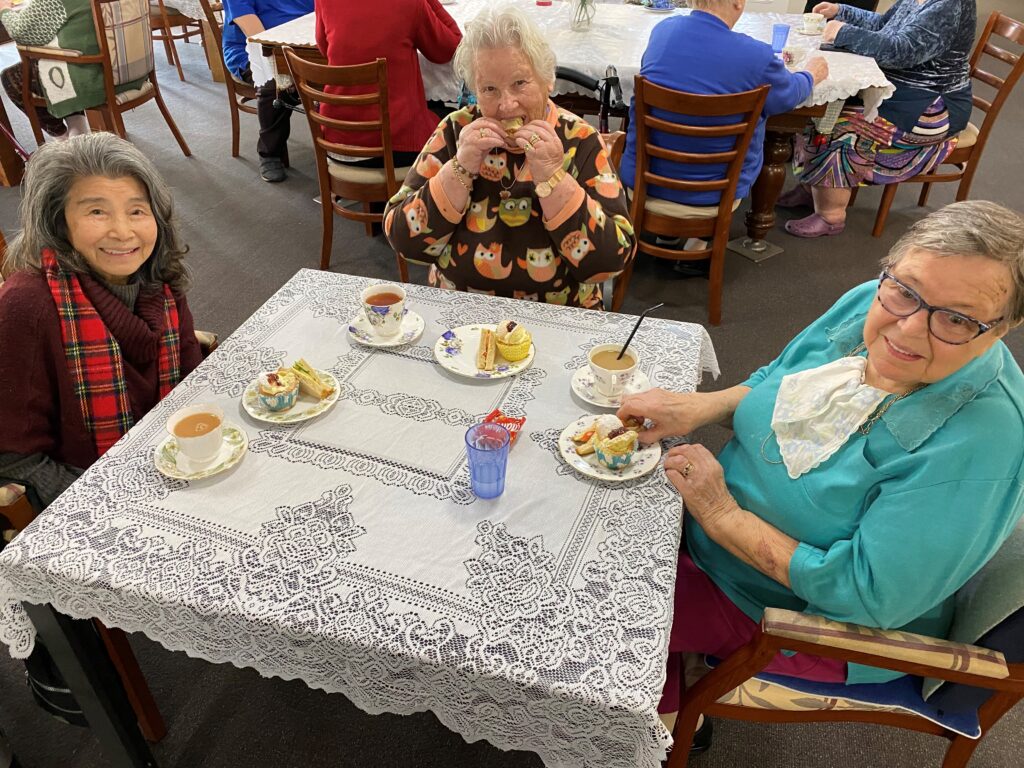
Visitors have been restricted during the many periods of lockdowns in accordance with government guidelines and specified reasons.
But they have kept busy with the Lifestyle team thinking up lots of games and activities including the very popular armchair travel.
Lifestyle coordinator Lily Bof said afternoons of armchair travel had been one of the most enjoyable activities with fake passports and airline tickets, and slideshows of countries including Spain and Italy. Even the kitchen staff got involved, cooking up some exotic meals to add to the atmosphere.
But with the latest lockdown lifted at the end of October, residents are now seeing family and friends again, enjoying entertainment and visiting gardens and cafes.
“With the lovely warm weather we have been enjoying we have been able to have picnics at gardens around Daylesford, Trentham and Castlemaine,” Lily said.
“It has definitely been hard to remain upbeat but now everyone is really excited to see their families coming in for a visit, or going out for a coffee, or just seeing their grandkids and great-grandchildren for the first time. That is really nice.
“We also had entertainer Vanessa Craven in last week – they really love her being here again.”
Hepburn House manager Dianne Jones said it was fantastic to be able to open the aged care facility again, and also for residents to be able to get back into the community.
“We have been running a group called Ageing (Dis)gracefully for a couple of months now but residents have not been able to take part. Now they can join everyone for morning tea on a Thursday at the Convent Gallery. It is just lovely that we can be out and about finally.”
Ms Jones said there were some restrictions still in place and anyone who wanted to visit was encouraged to be double vaccinated. If not they would have to undergo a rapid antigen test. Visitors must wear masks and are not allowed in communal areas, she said. “Anyone with any queries can call us on 5348 8100. We still have to be careful.”

November 11th, 2021Toys and vouchers needed for Christmas
EVERY year Hepburn Regional Community Cheer collects toys and gift vouchers to make sure every child receives a toy for Christmas.
The toy age groups are 0 to 2 years, 3 to 5 years, 6 to 9 years with vouchers for those older. Toys should preferably be unisex.
Toys can be dropped off at the Daylesford Community Health Centre and the Daylesford District Community Bank. Secretary Wendy Berry can also collect them, just call 0408 410 403.
Cash donations be made to the Daylesford District Community Bank with BSB: 633 000 and Account: 162 925 689
Email wendyberry200@gmail.com to receive a tax deductible receipt.
Every year Hepburn Regional Community Cheer distributes toys and gift vouchers, hosts a Christmas Day lunch for 50 locals to provide a fun and socially inclusive event, auspices other iniatives that support its mission statement and provides hampers for pensioners and gifts for Daylesford Aged Care Facility and Lumeah Lodge residents.
Money is raised through a Christmas in July lunch and fundraising auction, raffles, collection tins, street stalls, sausage sizzles and grants.

November 11th, 2021Kyle’s Rant
I KNOW I should thank my lucky stars living the life I live and being born into a first world community, having hot dinners on the table every night and a reliable car to run around in.
I know there are a lot of others worse off than me, there are famines and plagues around the globe, climate change is snapping at our heels and countries and families are torn apart by dictators and genocide.
Yes, my life is pretty privileged when I look at the world that way, however I only have my own reality, which is the small community I wander among and the feelings of fatigue and frustration they have experienced over the past two laborious years.
The obvious frustrations that spring to mind are the lockdowns and the separation from family, friends and visitors from Melbourne who form one of our local major economic drivers. The second, among a growing list, is the state of the electricity.
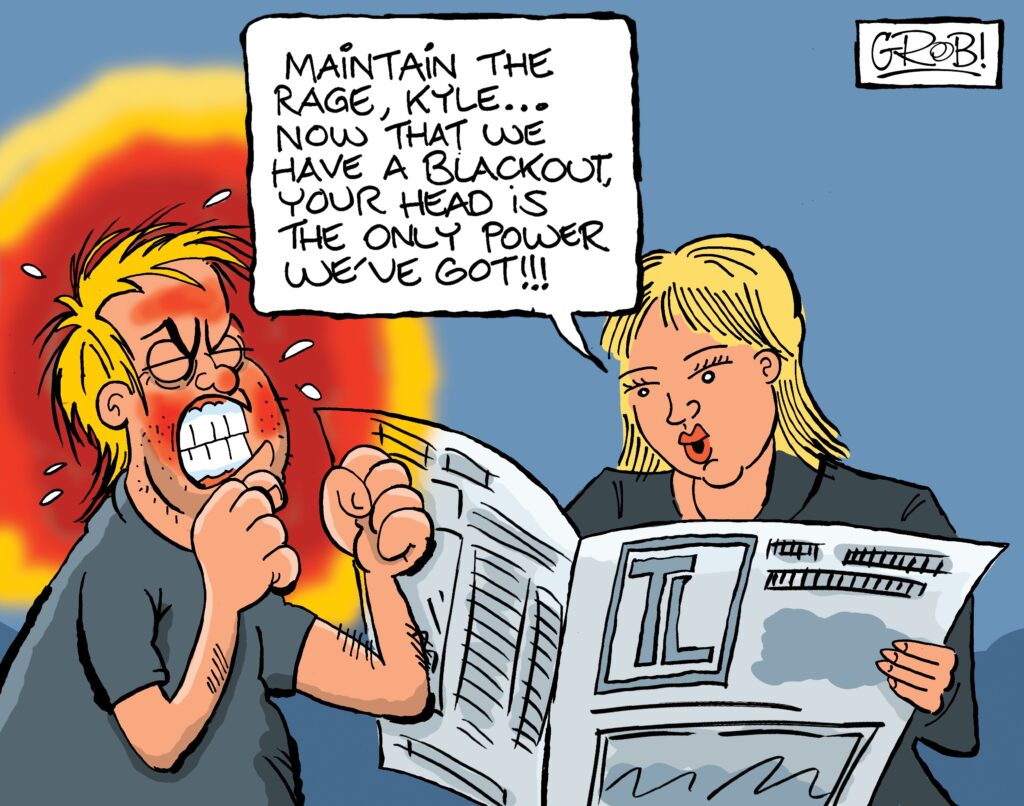
I have had many messages from Powercor stating that the power is out at my address (duh) and will be restored in two, four, oh no, make that eight hours, but the message I received today was particularly frightening and damning of the corporate conglomerate. And yes, it is a conglomerate. Powercor and CitiPower are simply subsidiaries of parent companies Spark Infrastructure, Cheung Kong Holdings and Victoria Power Networks Pty Ltd. The company owns and maintains power lines, substations and street lights and also manages the largest electricity distribution network in Victoria.
But to my point, the message that I received was tantamount to a little bureaucrat running down the street throwing their hands up in the air and screaming from the top of their lungs “I give up”.
The message was: “We#re (sic) facing significant challenges with widespread faults and extensive damageon (sic) our network. We are continuing to respond to faults but may not be able to restore power to you today. We apologise for this inconvenience and will provide more information as soon as possible.”
Now to put this into context the power at my joint was fine and going strong and there was no rhyme nor reason for this message, except maybe it was a sign of things to come later in the day. With that in mind I quickly topped up the generator which allows us here at TL HQ to limp along on pared-down power.
It seems that we may only be a little over an hour’s drive from Melbourne CBD, who for the most part enjoy an uninterrupted supply, but we are about 50 years behind in infrastructure with barely an underground powerline in sight or as it turns out, out of sight.
This begs the question, what is to happen to us as our community grows with all the new treechangers running away from the ‘burbs to our piece of Utopia and leaning heavily on our power supply?
Get it together Powercor rant over…
November 11th, 2021Just sayin’…
WENT to a function the other day. It was pretty exciting. I even washed my hair. It’s not that hard once you get around to it.
Anyway, it doesn’t really matter where and what, but I arrived to find a bloke in a wheelchair stuck at the entrance to the function. In front of him was a step. Quite a big step. So he was stuck. As in, he couldn’t join the party.
Someone had already asked the venue if they had a wheelchair ramp and the answer was no. So another guest and I brainstormed a bit and I called the Daylesford Regional Visitor Information Centre. Someone thought they had a few ramps there and it would have been pretty easy to go and pick it up. No go. They do have one but it was rented out already. Rented? Do you really make money on wheelchair ramps? Hmmm. (Need to check this one. See below.)
So then I called Springs Medical Centre but the person who answered the phone said they were disability compliant with fixed accesses. Makes sense. Next I called Hepburn Shire Council and listened to the options. I pushed 3 for aged and disability services. No go again. The person who answered said they had nothing available and I should try Central Highlands Rural Health.
By this stage the bloke was pretty over the whole affair and said he would just go home which seemed pretty sad. He had, after all, made a real effort, more than anyone else when you think about it, to be there. And if we don’t have wheelchair access in 2021 something is wrong with the system. He ended up staying, in the corner, by the big step, and sort of watched proceedings until the rain started. You see, the bit with the step was outside, in the rain. You may remember the torrential downpour early last week. Yep, that rain.
I don’t know the answer but I do have another story. In the 80s I lived in Japan and worked as an English teacher at a junior high school. So think Year 7, 8 and 9 or if you are really elderly, like me, Form 1, 2 and 3.
The school was three storeys if you count the ground floor as the first storey. So maybe it was two storeys and a ground floor. Doesn’t matter. The youngest students had the first or ground floor, the next youngest had the next floor and the oldest had the top floor.
Anyway, one of the kids in Year 9 or Form 3 was in a wheelchair and every morning his classmates carried him in his chair up to the third floor of the school. (No lifts or ramps.) And there he stayed until the end of the day when they carried him back down again. No outside play, no taking part in sports, just spent the entire day on the third floor.
I talked to one of the other teachers about this and said it seemed a little unfair. He disagreed, feeling the student was lucky to be at school, and then added that Japan was lucky because they had very few people in wheelchairs. I tried to explain that maybe there were very few people in wheelchairs who were out and about, more likely stuck in their homes, like that kid was stuck on the third floor.
Just like that bloke was stuck in the corner in front of that step. Surely in 2021 we can do better? Just sayin’…
OK, a bit of checking done. Thanks to Hepburn Shire Council for providing this information.
Daylesford Visitor Information Centre has two ramps, a metal ramp and a heavy duty rubber wedge. You do hire them but they are free of charge. You just have to fill out a form.
On another note, did you know there is just one wheelchair access toilet in the Daylesford CBD – also at the Daylesford visitor centre. There is another but it is at the Duke Street council offices, so only open during office hours and maybe not during Covid.
And we all know until The Rex is completed in 2030 (joking) that the only public toilets are also up at the info centre. I have been stopped numerous times while outside Coles – I must look approachable – by people looking for toilets. One was a very pregnant woman, one was a woman with a child clearly needing to go and another was an older woman with a walking stick. Their faces fell as I told them the only public toilet was a good five-minute walk, uphill.
With The Rex a way off maybe it’s time for council to provide another toilet or two somewhere in the CBD area. Festivals seem to manage portable toilets, as do building sites, so it doesn’t seem too far out of the realm of possibility. Perhaps they could get friendly with Coles and open up those down that little laneway? Pay for the cleaning etc. Once again, I don’t know the answer, but with Melbourne out and about again, someone is going to get caught short.

November 10th, 2021Backing regional events
The state government is backing regional Victorian events of all sizes, to ensure the state’s diverse and
vibrant calendar of community events can continue to thrive.
Minister for Regional Development and Member for Macedon Mary-Anne Thomas has visited the Kyneton
Mechanics Institute to announce local councils, community groups and small-scale event organisers could apply for
grants under the $1 million Regional Community Events Fund.
The Fund will open on Monday, 1 November with grants of up to $25,000 available for small-scale events and
festivals held across the state.
Eligible events could include community festivals, sporting carnivals and arts and cultural events. Kyneton is known
for its diverse calendar of events, including the Daffodil and Art Festival as well as regular markets and music
festivals.
Support will go towards a range of costs associated with hosting events in a COVIDSafe environment including for
density limit management, record keeping, good hygiene practices and marketing.
The new Fund is part of the Labor Government’s targeted support for local communities to come together safely
to help Victoria recover from the pandemic. The Fund will be administered by Visit Victoria, which is well connected
to regional event organisers and positioned to respond swiftly to event proposals.
Visit Victoria will work with Regional Development Victoria to ensure that regional councils and event organisers
have more support and confidence to plan and stage events with COVIDSafe settings.
The Regional Community Events Fund complements the $20 million Regional Events Fund, a commitment to bring
blockbuster events to Victoria’s regions as part of the $633 million Visitor Economy Recovery and Reform Plan.
The Fund comes off the back of the recent Play On regional series, featuring more than 20 regional Victorian artists
at eight outdoor events across the state this weekend.
Concerts will be held for double vaccinated audiences at outdoor venues in Geelong, Ballarat, Bendigo, Halls Gap,
Warrnambool, Castlemaine, Archies Creek and Avenel, with the line-up featuring regional Victorian talent including
Gareth Liddiard, Dan Kelly, Kutcha Edwards & Friends, Dallas Frasca, The Kite Machine and Jess Ribeiro.
The Fund will close on 30 November. For eligibility details and information on how to apply, visit rdv.vic.gov.au/rcef.

November 10th, 2021Learn Local finalists announced
A pool of 25 finalists has been announced in the 15th annual Victorian Learn Local Awards, recognising excellence
in the adult community education sector.
Finalists have been named across eight categories, whose achievements illustrate how adult and community
education changes the lives of Victorians. Additional categories at this year’s event recognise innovation, leadership
and local partnerships.
The finalists represent the diversity of skills and training provided by the sector across different vocations in all
parts of metropolitan and regional Victoria, including Mildura, Horsham, Ballarat, Shepparton and Gippsland.
The prize money totals $84,000, with organisation award category winners receiving $10,000, individual category
winners awarded $5,000 and category finalists given $1,000.
The Learn Local Awards is presented by the Adult, Community and Further Education Board and shine a spotlight
on the industry and its learners, trainers and leaders.
Learn Local providers offer a unique, community-based learning option, with a focus on the individual needs of
learners. They are particularly suited to adult learners of all ages looking to develop their digital, literacy, numeracy
and employability skills for study, work and life.
There are more than 240 not-for-profit community organisations registered as Learn Locals across Victoria, which
deliver pre-accredited training and other programs to nearly 30,000 people each year.
See all the finalists and find out more at vic.gov.au/learn-local-awards. Winners will be announced in December.
Minister for Training and Skills Gayle Tierney congratulated all finalists.
“The Learn Local Awards are a chance for them, and the whole adult education
sector, to celebrate their successes and resilience throughout the challenges of the pandemic.”