


April 26th, 2021Ambulance times cause for country concern

Her statement has been backed up by Victorian Ambulance Union secretary Danny Hill who said rural towns like those in the Central Highlands could be left without ambulance coverage for up to six hours.
However, Central Highlands Rural Health deputy CEO Phillip Catterson said anyone with an emergency not requiring an ambulance could always attend either Daylesford or Kyneton hospitals “24/7”.
Cr Hewitt said the recent Saturday incident at Victoria Park, on April 17, where Daylesford footballer Josh Cowan was left waiting for more than an hour for an ambulance after breaking his leg, highlighted the ambulance problem.

“I understand that Ambulance Victoria have said it was a communication problem, apologised for something that was extremely distressing and are currently undertaking a look at their response times across Victoria.
“So, it is a statewide problem but there is also concern about the amount of time it can take for an ambulance to arrive in Hepburn Shire. The data on response times indicates it is a real concern. And I totally understand the distress and concern that people have if they are facing an emergency. I would hope this incident would lead to some changes.”
Cr Hewitt also said new residents, perhaps moving from bigger cities, needed to be aware that in a small regional area, many services were less available than they were in metropolitan areas.

She said while ambulance transport was always best for emergencies, if people were given a real-time estimate of when an ambulance was going to arrive it would help them make more informed decisions.
“Obviously on Saturday you would not have moved that footballer but maybe in other circumstances if you could drive and had someone else with you giving first aid, that might be an option.
“Being properly informed allows people to make better decisions.”
Cr Hewitt said council’s role was to advocate for more resources in the area and that was done whenever the opportunity arose.
“People living here need to be aware there can be delays and if that happens in front of everyone at the football that becomes incredibly distressing to both the family and the spectators. Hopefully he is now receiving good care.”
Victorian Ambulance Union secretary Danny Hill said people “absolutely” had a right to be concerned about the lack of ambulance coverage in Hepburn Shire.
“The sad thing is, that while this gentleman last week suffered an extremely painful and traumatic injury to his leg, it wasn’t life threatening at that time, and eventually someone in a life-threatening emergency will have to wait for an ambulance and suffer the consequences of that. And that is frightening and people’s concerns are absolutely valid that they won’t get an ambulance in time.”
Mr Hill said it would be common across rural regions, and especially towns around Ballarat, for there to be no ambulance available for up to six hours.
“Ballarat is such a busy area and Daylesford would transport most of their patients to Ballarat (Base) Hospital and once they are there they might have to ramp there for a couple of hours. Then once they can leave, because of the backlog of cases that needed to be attended in Ballarat, basically they become Ballarat’s crew.

“That leaves areas like Creswick and Daylesford uncovered. Peripheral crews are sucked into bigger towns and can’t get back to the branch they need to cover. Five hours would be quite common.
“It’s like a footy match. You have your positions and you go back to that spot so you can best cover your area. It is meant to happen, but we are so busy in major centres they may never get back to their branch.”
Mr Hill said the biggest issue at the moment was that demand, often because people had not kept up medical appointments during Covid, and time spent ramping was “off the charts” and even ambulance stations going 24-hours could not fix that.
“One thing we are seeing is that during the pandemic there has been a real migration with so many people living and working from home in rural areas. So the workload in towns like Bendigo and Ballarat has really expanded a lot.
“The biggest two main things we need to do is changing ramping so we are getting paramedics leaving hospitals quickly so they can get to other cases and the other is connecting all the health pathways, all the health services, the smaller hospitals. At the moment, it is almost like Game of Thrones with separate kingdoms and castles and each managing their own scenarios. We need to try to make the system work as a system.
“Particularly in rural areas we have probably 130 extra beds in the system that we are not using and that could really help with ramping in rural areas.”

Central Highlands Rural Health deputy CEO Phillip Catterson said both Daylesford and Kyneton hospitals offered urgent care around the clock and had Rural & Isolated Practice Endorsed Registered Nurses (RIPRN) on staff at all times, and doctors on call.
“It is a fantastic model. Our RIPRN/senior nurses do the initial assessment,, triage, and our GPs work with us by telehealth or call-in to deliver great care as required. Our motto is “Triage, Treat, Transfer”. If people need care we will look after them.”
Ambulance Victoria’s Grampians regional director Chris James told The Local he had spoken with Mr Cowan to “sincerely apologise for the delay in our response on Saturday”. “I can confirm the patient is recovering well without any issues regarding our care. At the same time, we are continuing our review to determine what occurred and what could have been done differently.”
Ambulance Victoria did not return queries by press time on whether there were grounds for concern over ambulance times in Hepburn Shire.
Above, Daylesford Football Club members gather after the ambulance has finally arrived, centre, Mayor Lesley Hewitt, bottom, Central Highlands Rural Health’s Phillip Catterson
Words: Donna Kelly | Top image: Brendan Murray | Images: Contributed


April 14th, 2021Design with Indre

The shed was dug out and built by hand in 1941, during the WWII wheat glut. It took four months to complete and it spans the length of five Olympic swimming pools, that’s about 270m long, 60m wide and 19m high along its ridge.
Exports were restricted at this time, crop yields had improved and 1941 had a bumper crop season. Burlap and hessian bags were in short supply so bulk grain solutions were needed. Many vertical concrete silos were constructed by railway sidings in the Wimmera and Mallee, but these were soon full. More bulk storage was needed, and Murtoa was chosen as the site due to its central location.
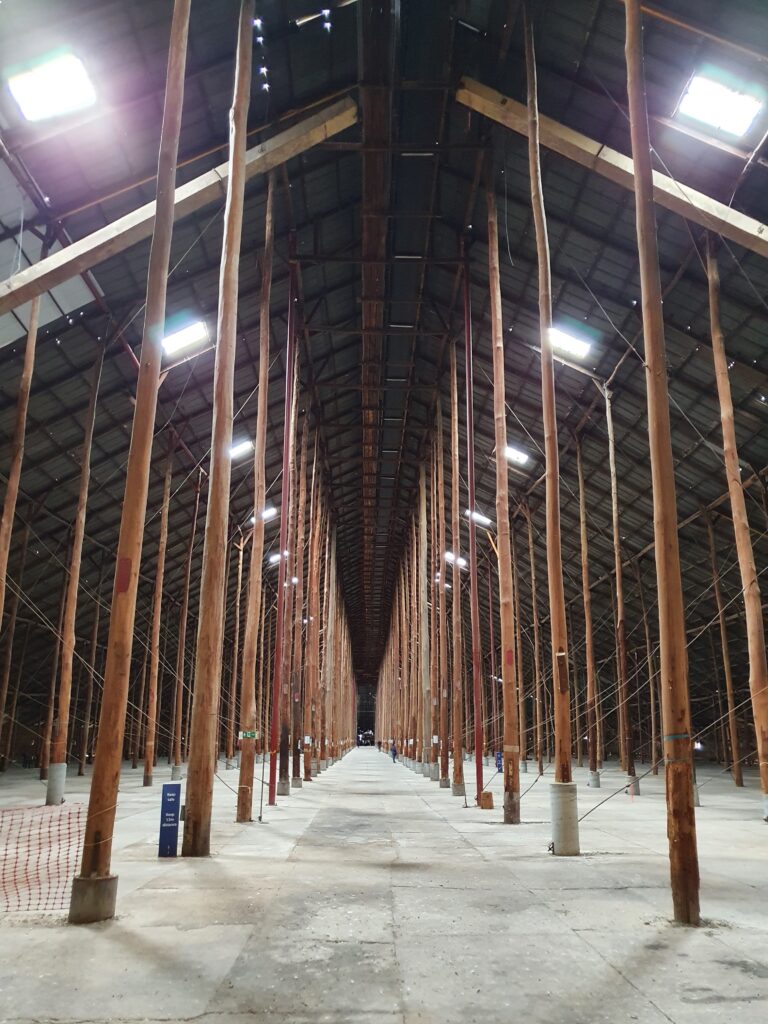
This was wartime and steel was also in short supply. So was labour. A call out for anybody available was made and men came when and if they were able. This was coming up to summertime, September to January and temperatures inside the construction site were often close to 40 degrees. Unmilled logs were used as the natural construction alternative to steel supports. Men scaled the logs to secure them. Wheelbarrow loads of concrete for the flooring make an almost flagstaff mosaic underfoot. Tall lofty timbers braced by minimal steel rod makes the structure appear like a soaring woodland cathedral. Row upon row of trees so tall it makes you wonder at the forests we never saw.
The shed’s unique shape sits as the shape a pile of wheat would make. A corrugated iron skin protects the steam-powered elevator and conveyor belt, a 1.6 hectare concrete floor and 3,381,600 bushels of wheat. The grain was deposited by hopper below the railway line and lifted by the elevators to the conveyor belt that ran the length of the shed, along the apex and could deposit wheat at any point along the belt. The shed was emptied by a full-length side conveyor belt back to the railway line.
This unique architectural building was a response in a time of need and Australians are always good at being inventive with what they have at hand. The architect is unknown, but the building is now included on the National Heritage List. It is the largest surviving timber-framed structure and the only one of its type left in Victoria. It is synonymous with the region’s wheat history and fundamental to Victoria’s cultural identity. I happened upon this shed by chance as I was travelling home from a work weekend and I am very happy I did. I would recommend driving out of your way for a unique gander and possibly a pie and beer in Murtoa. Regional Victoria will thank you for your support too.

Indre Kisonas – owner and principal designer – iok design
indre@iokdesign.com.au / www.iokdesign.com.au

April 14th, 2021Glen, about the house

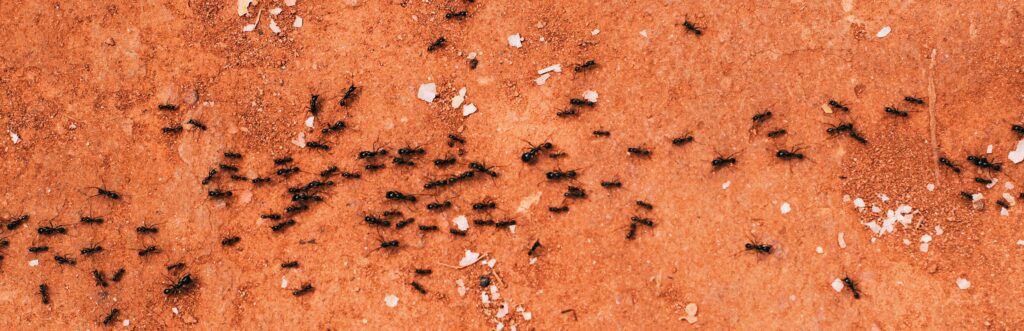
There is a botanic battleground happening in our own backyards. Behind the peaceful facade of our gardens lurk many constant and deadly battles for survival. Often, but fortunately not always, the casualties are the plants themselves.
The battles are constant and the participants many and varied, and not always the “bad guys”. In fact, it’s often hard to tell the difference and how to help the cause for good, other than to let nature take its course, in case you eliminate the wrong team.
A bug’s life
Among the plethora of leaping, flying and crawling little beasties that populate our homes or gardens, it’s more than likely that beneficial and predatorial ones would outweigh the nasties. Even bush, and blow flies unwittingly assist at pollination time, along with the bees, in their search for nectar.
Apart from those obnoxious European invaders, most other wasp varieties larvae feed on the young of other insects as do many spiders, centipedes, earwigs and preying mantis. The little black- and yellow-striped hoverfly, true its to name, hover in little swarms feeding on nectar and pollen. Their larvae eat aphids and scale insects, and cannibalise grubs and caterpillars. (A charming technique favoured by some species is to inject their eggs into live grubs to feed their maggots). Even cute little ladybugs’ young are voracious aphid eaters.
Almost all of these, in adult form, feed on the nectar and pollen of flowering herbs, vegetables and, of course, flowering annuals, perennials, shrubs and trees. So they obviously are attracted to and thrive in healthy, well-tended gardens, earning their keep by not only propagating our fruit and vegetable crops but by policing the critter population.
Slaters. Apparently we shouldn’t be too tough on those little grey, shield-like critters. While scurrying around in the dank and mouldy underworld of our life they are also prone to feasting on mould and fungal outcrops.
Good flies?

Yes, I’ve actually discovered some. The robber fly is a huge, world-wide family of asilidae – predator flies with huge appetites for whatever insect that happens to blunder or flutter by.
I shot this particular specimen sunning itself in our garden room, after it was munching on an obviously unwary blowfly. Big and ugly, they have been known to reach up to 8cm in length. This one would have been at least 4cm.
Also known as assassin flies, they can immobilise and eat wasps, dragonflies, grasshoppers and even spiders. Like birds of prey they perch themselves where they can see and catch their prey in mid-air, gripping them with their strong legs, then injecting them with a toxic saliva which paralyses and liquidises the body tissue.
Gastropods – all foot and stomach

This current spell of warmth and steady rains has brought with it hordes of the oldest of garden pests, snails. Belonging to the mollusc family, they have one large foot attached to their stomach, hence the name. They slide along on this “foot” in the cool of night, usually when there’s moisture about and gorge themselves on any available succulent young growth.
During long dry spells, they find a nice sheltered private spot and merely withdraw into their shell to hibernate until the next rains bring them back out again.
There must be plenty of ways of getting rid of snails, apart from the old hobnail rubber boot method. I’m sure you share my distaste for anything harmful to us or our pets. So, let’s hear your favourite household remedies.
Mine is the good old “beer trap” glass jar with several centimetres of beer in the bottom buried up to its neck in the garden bed. They easily find their way in but can’t get out again even if they wanted to! What a way to go.
For the next issue I’d like to hear your favourite methods.
Email glenzgarden@gmail.com

April 14th, 2021Local Lines

like fish
always wet
like tinnitus
that buzz that buzzes
all the time
when you think about it

tinnitus goes away
only when you don’t think about it
fish like trout go away
from wet
when they jump
but they have to think about it
(if indeed they do think)
and wet better not
be too far away
fish are probably not conscious
of being wet all the time
mid-leap they take just enough wet
with them
tinnitus sufferers are not always conscious
of peripheral buzz
but when it is not there
it still is
it is just that the brain has leapt
somewhere else

Bill Wootton
Bill Wootton lives in Hepburn Springs which is not to blame. He brought the buzz with him from Cottles Bridge and Ivanhoe.

April 11th, 2021Kyle’s Rant
I must admit to feeling a little twinge of paranoia when I heard this news, wondering as a 53-year-old man if I was being led down the garden path like a lamb to the slaughter or in my case a ram to the, well, you know.
Maybe I have done my best work in society and it is time to get experimental Frankenstein-style with those of us in the community who can no longer run as fast as we used to. But after digesting the information I am still keen to get this shit show over and get a jab alongside normal life returning.
I must admit the other night it was refreshing here at TL HQ to be once again under the Melbourne airport flight path. It has been a long time since I have heard the distant jumbos roar overhead as they line up for the Melbourne airport lights from 20,000 feet above my head. It does, in the words of Marie Kondo, “spark joy”. By the way whatever happened to her, that tiny little neat-freak rubbish remover who would commit acts of junk deportation from the hoarder society, leaving them mentally shaken and teary-eyed as she cut through their treasure-trove of clutter like a Samurai sword?

It was all OK for her to turn up at good, clean American families’ homes, which admittedly were a little chock-a-block with years of collateral, and reduce these poor simple folk to nervous wrecks as she committed to robbing them of their life’s custody, all based around the question of “does this spark joy?”.
(And why is it when the rich hoard, they are called eccentric, while if the poorer do it, it’s hoarding. Surely one man’s treasure and all that?)
But back to my inoculation point. Surely if it isn’t totally safe and we are only bringing good clean folk into our country, who have had a jab and then isolate for 14 days, we can wait until we get something in our arms with a 100 per cent strike rate and no kill rate?
Or has the government gone too far down the investment rabbit hole with the Melbourne company turning out this half-baked antidote? And is this whole fiasco playing into the hands of the anti-vaxxers?
Shit show rant over..

April 11th, 2021New dinner menu on offer at Chaplin’s
It’s so good to get back to our great state’s favourite pastime of heading out to sample quality food and beverages. We shucked our lockdown trackies in favour of our (now slightly dusty) evening wear and made the short but beautiful forest-laden drive from Daylesford to Trentham.

The first building you see coming into the main drag is the stately little building that houses one of my favourite cafes – now with a bar menu on Monday nights, Chaplin’s. The name’s a dead giveaway. The theme throughout is that of Charlie Chaplin’s quirk and humour, carried in spades by its proprietor Mel Thomas. (That’s Mel, below right, in Chaplin mode.)
I’ve spent decades working in the hospitality industry and Mel’s a great owner/operator. Her customer focus and eye for detail; from the art throughout to the presentation of the delicious fare, ambient lighting and the cleanliness of the amenities, is just so enjoyable and comforting after living in relative isolation.
Enough preamble, on to the main event, the food.
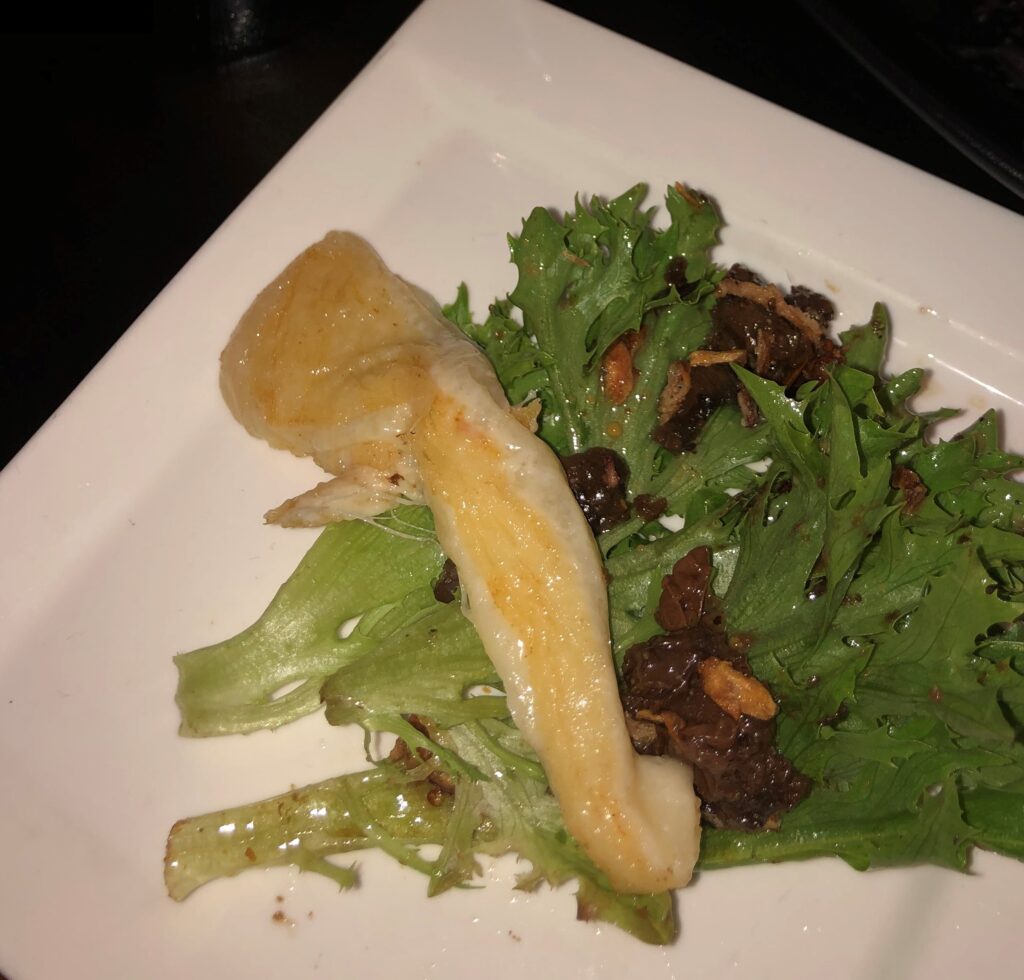
Juliet and I weren’t ravenous so we shared an entree of grilled saganaki with crisp leaves and pickled walnut, while situated in a comfy banquette. As a long-term lover of saganaki, the addition of pickled walnut was a revelation to Juliet and me.
Acidity has always been the key to cutting through the fats in the cheese, so why not use pickle as the balancer? Then there’s the earthiness of the walnut for an added dimension. Mel may not have invented this dish, but it was a first for me and I’ll be back for more.
On to mains. Mel’s partner crafts some excellent vegan meat alternatives and Juliet was keen to try the vegan beef patty with avocado, tomato, red onion, bio cheese and spicy orange mayo, on a vegan brioche. Not being vegan ourselves, we approached with unfounded caution. Until now, no-one’s nailed the texture of meat for me but this was bang on. Honestly, biting into it for the first time was a little surreal. If you’re a vegan, this is the Monday night dining spot for you without a doubt.
For myself, I’m always up for a good seafood chowder. This is so rarely on the menu in our neck of the woods, I had to try it. The seafood was fresh and not overpowering, with plenty of variety. The soup was the hero (as it should be), with its sweetness derived more from whole orange than lemon. This was another delightful first for me, and I was left impressed and satisfied. With entrees from $14 and mains from around $21 to $25 for the most part, it’s very reasonable.

Drinks. We were both in the mood for an ale, and Little Creatures brewery is a reliable go-to.
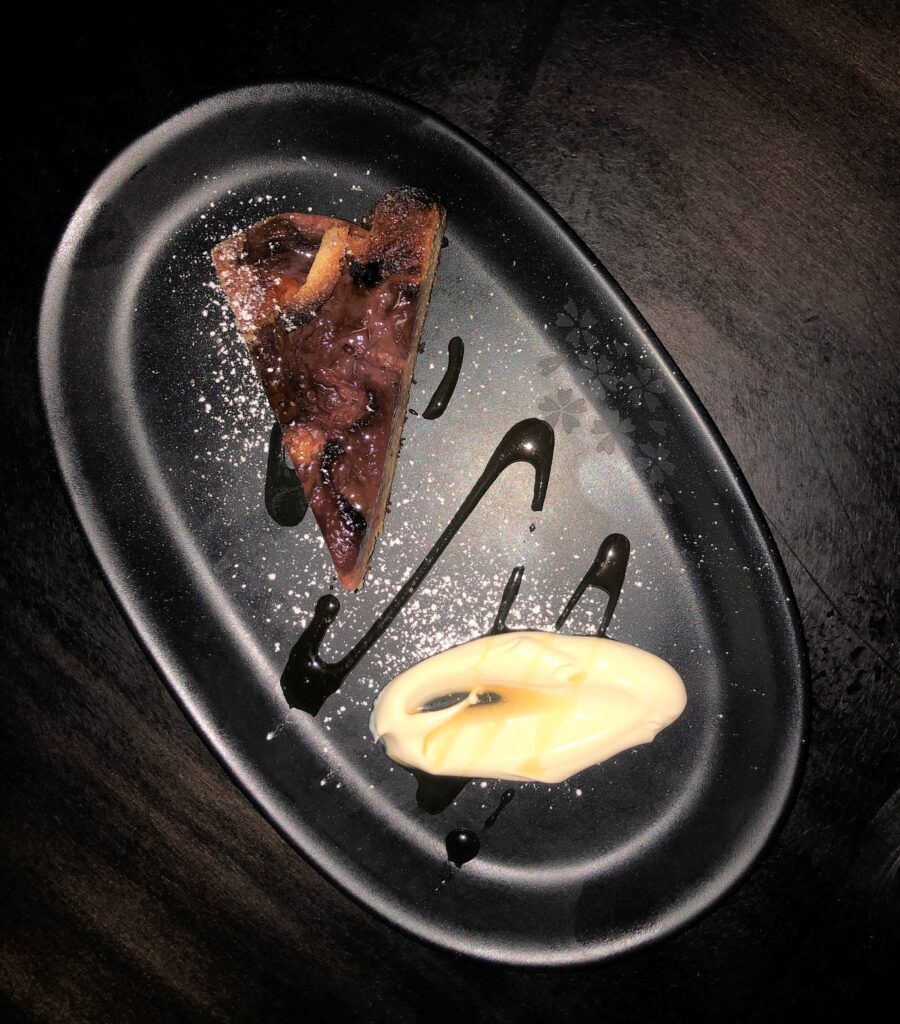
We shared a plum torte for dessert. Perfection. A caramelised gluten-free base and plump local plums won our hearts at $9.50. I had one of Mel’s excellent espressos while Juliet loved her tea.
Bookings are preferred, and I suggest you make one ASAP, whether you like meat or you’re all over vegan/vego good times.
Words & images: Henry Maxwell

April 11th, 2021Creating BOOM in Clunes to avoid a bust
But when those hard times hit, and never as hard as we witnessed during the COVID pandemic, paving a way forward is now the challenge faced by all rural communities.
When Clunes Neighbourhood House manager Lana de Kort, pictured, realised the COVID crisis would impact severely on her local community and the vital services provided by the centre, she not only ensured basic services and support would still be provided during the lockdown phases, but she and her committee also took the opportunity to accelerate their plans for the future of the town.

And plan she did, with her team of volunteers and board members working tirelessly to implement BOOM – a community action program that aims to boost the town’s economic status and provide a secure environment for its residents.
Lana said that working with local and visiting thinkers, Clunes Neighbourhood House identified that the creation of a space where community and business could work alongside each other to help nurture solid business behaviours and a healthy community – an ideal way of supporting a boom culture.
“BOOM Clunes is a social enterprise with two objectives: one is to make money so we can all explore how new thinking and diversity can be financially viable in a small economy and the other is to help incubate others’ thinking so they can do the same in their business,” she said.
“Even in good times, small towns can be vulnerable to the usual boom and bust cycles that tend to hit economies. Clunes is a community that typically punches above its weight. You can look back generations and see the careful progress that has been made to make Clunes as resilient as possible – from infrastructure decisions, to the preservation of our history and becoming a Booktown,” she said.

“Nearly two years ago we came to the conclusion that to break out of a bust, or even head one off at the pass, small towns have to think – and act – differently.
“At that time, COVID-19 wasn’t even something we could imagine, let alone plan for. But in some ways the pandemic has caused such a seismic disruption that it has accelerated our town’s need to take action.”
Lana, a professional writer and former corporate manager, moved to Clunes with her husband and two boys a few years ago. Her role at the Clunes Neighbourhood House combines years of corporate experience with hands-on practical program implementation which has seen the Clunes Neighbourhood House thrive.
“Clunes Neighbourhood House has long been interested in the role that community can play in tipping the scales towards a boom. Particularly a boom where the balance of focus encompasses all three markers of a strong and resilient system – community, economy and environment,” she said.
“Working with local people, businesses and other community groups, our goal is to contribute to the liveability of Clunes by supporting everyone to be an active part of the neighbourhood.”
In an average week, the centre has a team of 40. Lana believes the economic value of volunteer contributions each year is more than $600,000. BOOM Clunes is located in the old State Bank in Fraser Street and includes the shop, the business and employability centre, accommodation and an art studio and nursery in the garden.
“Using lockdown wisely and clocking up more than a few Zoom hours we explored how our vision could be realised and last. BOOM Clunes was launched last month with the group opening a shop delivering on the Clunes brand.
“We offer books – new and old, touches of gold with jewellery, collectibles and giftware. Even walking maps made by the community so visitors can get to know the town while the funds raised go straight back into the community.”
The next phase of BOOM will see the business employability centre open upstairs and will offer serviced offices and membership to a co-working space.
“We hope to encourage sole traders, businesses and those working from home to come and get a little bit of that ‘water cooler’ stimulation you miss when you don’t work in a big business or onsite. In the last census Hepburn Shire was identified as an entrepreneurship hotspot. We anticipate that many of these creatives, sole traders and business people will appreciate having a space within their shire where they can mix with others, get their work done and access basic facilities.”
But while a hive of activity is happening at the Clunes Neighbourhood House and BOOM Clunes, local residents will continue to enjoy the amazing services, free food initiative, delivered nightly meals once a week and a host of other programs and services that underpin the small but community-spirited and supportive township of Clunes.
Words: Narelle Groenhout | Image: Supplied

April 11th, 2021Celebrating 40 years of the Daylesford Sunday Market
It’s also a celebration for the historic Daylesford Spa Country Railway – the reason the market started back on Sunday, April 19, 1981.
Railway spokesperson Stuart Smithwick said it was a celebration of an important milestone in history. “The market concept was for it to be a fundraiser for the fledgling railway preservation group and while there were concerns it would not work, 40 years later it is bigger and better than it has ever been.
“In the early days it was more car boot style, but always weekly, and it has continued to grow over the years not only increasing revenue for the railway, because we would not exist as we are without the market, but it’s also a huge benefit to the community and a great tourism asset for Daylesford.
“People come to the region, stay in their B&B, have breakfast on a Sunday and come to the market, it’s just what you do here. And during COVID the market was a critical part of feeding people in Daylesford. It was amazing.”
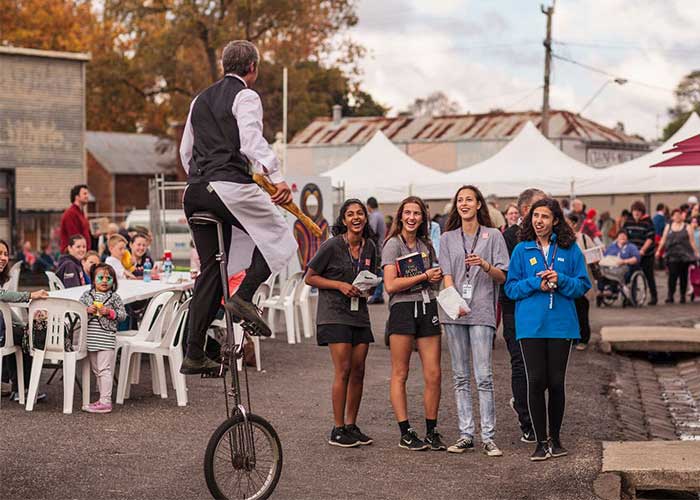
Market manager Raoul Benedict said the celebrations would include a free petting zoo, free face painting, entertainment including from the Daylesford Secondary School band and a birthday cake.
“Going forward the future is very bright. The market is always evolving. When I first started there was a lot more bric-a-brac and less local content but now we have a lot more produce and craft – although there will always be that car boot element.”
For those keen to add a train trip to their market visit, the historic trains run all day on Sundays to Bullarto, staffed only by volunteers.
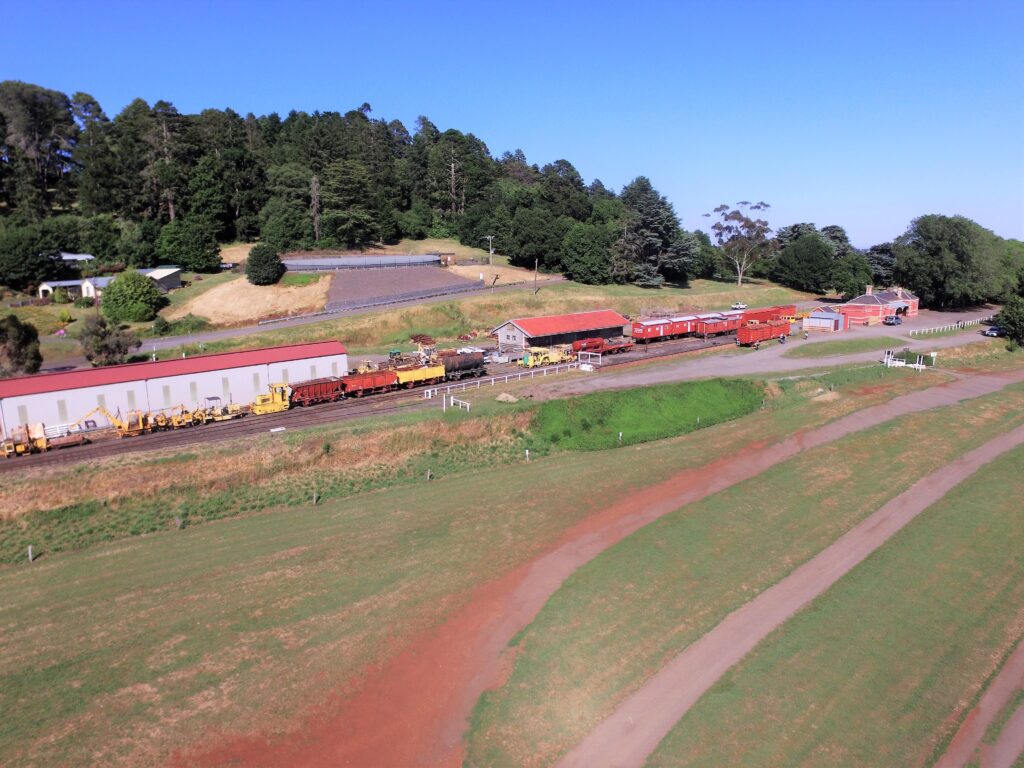
“Last Wednesday we also had trains running during the school holidays and had over 100 passengers so everyone is obviously enjoying it,” Stuart said.
“I would also like to acknowledge the hard work of the volunteers from those early days, establishing the market and all the managers we have had over the years, especially Bill McClenaghan, who was there week in and out, no matter the weather, just like Raoul. It’s not easy having a 6.30am start, every Sunday of the year.
“And we have some new volunteers now, which is great, along with the old guard who have been plugging away for such a long time.”
Stuart said a feasibility study was now under way for an extension of the rail to Trentham with “the right people saying the right things – so watch this space”.
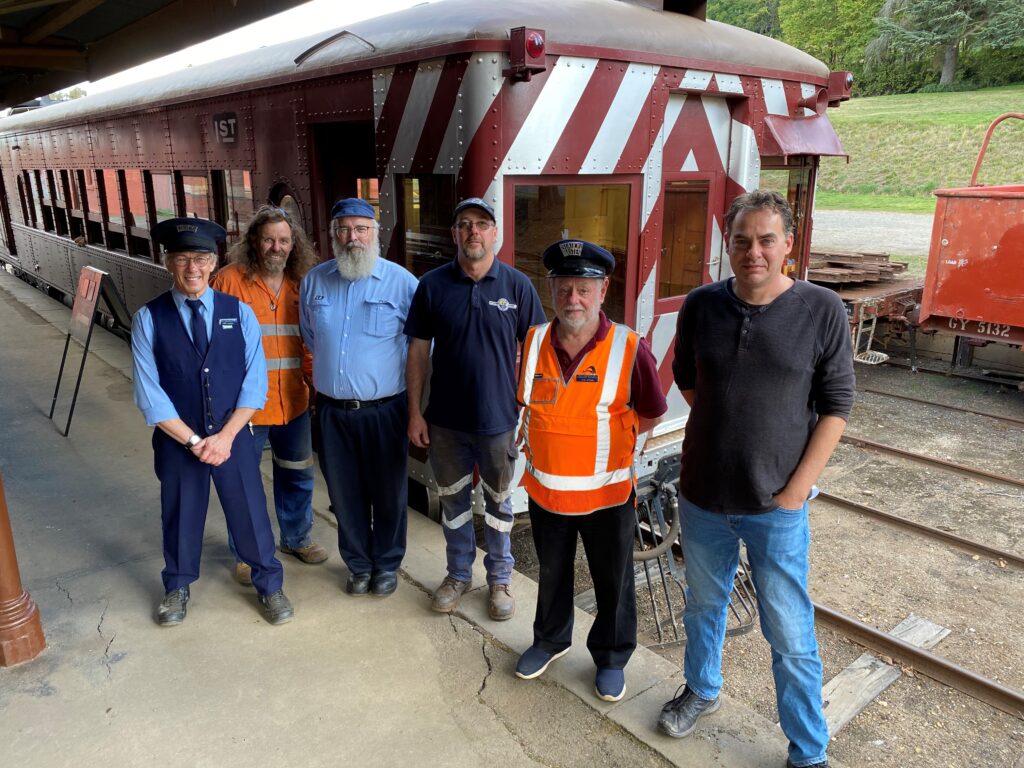
Above, from left, volunteers Ross Bullock, Ian Rowe, Gary Pallister, Stuart Smithwick, John Jeffkins and Raoul Benedict
Words: Donna Kelly | Images: Kyle Barnes

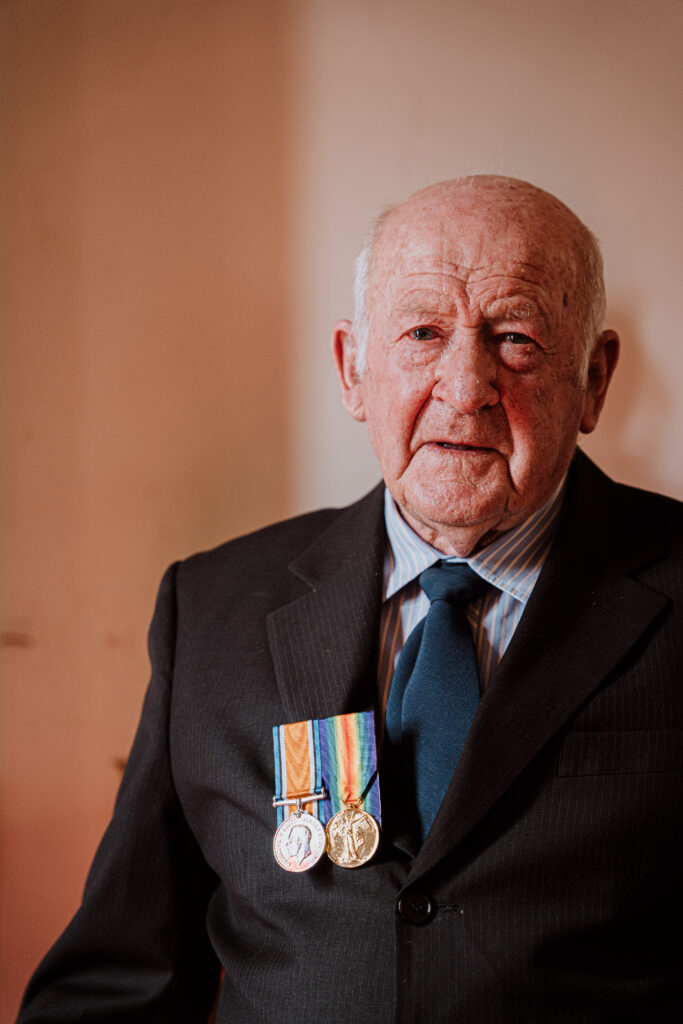
April 11th, 2021A century on, a dinkum digger’s medals glisten
To say this is Morrison country is an understatement. The rough old road to the house bears the family name. The Morrisons got 80 hectares for dairy farming in the first land ballot of 1856.
In his hand Don holds a strand of barbed wire. Mounted on it is a permanent replica of the Flanders Poppy, made by Robert, one of his two sons, which will go on the family grave in Franklinford Cemetery in memory of Alf. The barbed wire represents Alf’s farming background and the brutality of war.
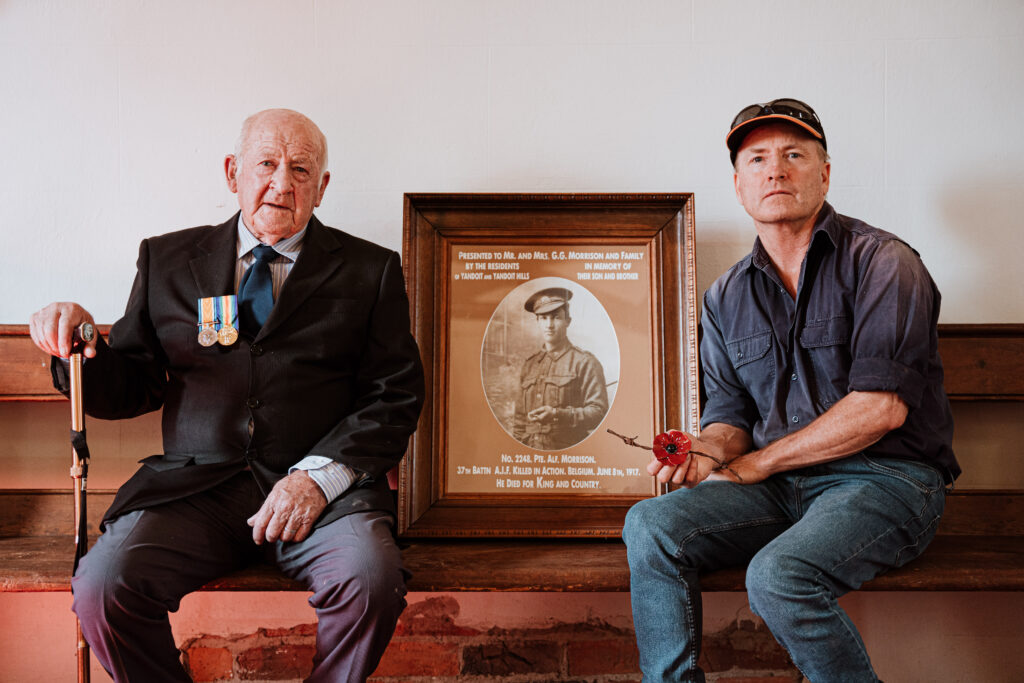
The world in which Alf grew up is caught in the book Letters Home, edited by another uncle, the late Geoff Morrison. The letters, bound in red ribbon, had been in the hands of three family members.
They show a world in which Alf and his brother Edgar, three years younger, roam the countryside, read and made up stories and games. Elder brother Frank was away working.
In winter the pair would sometimes copy stories and even invented their own motto, in Latin, “They were never idle”.
At 15, Alf was off picking grapes. Then he moved to general farm work, buying a rifle to shoot rabbits. A crack shot, he later pinged a hole in his grandparents’ metal weathervane, made by Yandoit blacksmith and store owner, George Fleischer. The weathervane was called Butzbach, from a town in the grandparents’ homeland, Germany. It was a savage blow when a WWI German bullet killed their grandson.

Alf wrote home from Glenlyon where he was milking, then from Ballarat, Kyabram and Macorna, a hamlet 22kms from Kerang.
Macorna, he records, played Kerang. “…the game was terribly fierce. Chas came home with two black eyes and he has to preach today. One of the Kerang men lost his temper and let him have both of them gratis…four Kerang girls were trying to polish off a Kerang barracker, also a girl and Taylor was trying to defend her while one of the Kerang girls gave him five or six uppercuts…”
By January 1915 Alf is reading in The Argus newspaper about the Light Horse and had “a great craving” to join up, which he did the next year.
In camp at Castlemaine he was happy when bugles arrived to replace cowbells.
Alf is away when he and two other soldiers are farewelled at Franklinford with a social and reception, the evening ending with “For they are jolly good fellows”, Rule Britannia and the National Anthem.
By December 1916 he is in London watching some bewhiskered warriors just out of the trenches “a shrapnel helmet strapped on their pack and one or two with a German helmet as well”. On Salisbury Plains he meets a bloke from Macorna.
He has no complaints about the food: “Porridge, sausages and bacon for brek., soup and roasts for dinner, stew occasionally for tea, margarine and jam, or Golden Syrup and sometimes pudding.”
Three days before Christmas he is in France where everyone is “anxious to do the dinkum thing”. The habit was to write your native town on your hatband for others from the district to see. Alf wrote Macorna.
Bravery medals are handed out at a parade. One of his mates is killed. “How little we thought of such a thing when the three of us left Port Melb.”
By March guns “are doing their best to break what windows are left” while he sleeps in a dugout “about the size of a kerosene case”.
May sees him in Belgium watching “a complete stomacher” when a German plane is shot down after a dogfight. “No need to buy Deadwood Dicks for thrillers here anyway.”
His final letter is dated May 17, 1917. “Everything looks beautifully fresh and green,” he writes, “and all sorts of garden flowers are sprouting up like grass…in spite of everything we always knock out a happy existence between ourselves and can always manage to laugh and joke over our hardships and disappointments.”
A letter sent by Alf’s mother from Clunes a fortnight later was returned.
He died on Messines Ridge on the Western Front, held by the Germans for almost three years. In the early hours of the day before his death explosions erupted from 19 huge tunnels dug over two years under German positions. The noise was heard as far away as England. An estimated 10,000 Germans died.
Anzac troops and the British attacked, with the loss of 7000 Australians and 5000 New Zealanders among the 26,000 casualties.

The victory after the week-long battle, possibly Alf’s first, is seen as one badly needed and a vivid if bloody example of the result of meticulous planning.
Back in Yandoit, Don Morrison tells of the devastation the death brought to Alf’s mother and the family.
Missing in the letters is any account of Alf’s four days absent without leave. Don believes he slipped away to Scotland to look once at his family’s old hometown in Aberdeenshire.
A happy aspect of this story is the speed at which the replica medals were obtained, something that Don attributes to Trish Tinetti, unofficial secretary to her husband, Daylesford RSL president Ian.
The original medals were somehow lost with the passing of the years and the fact that replicas could be obtained only became known during a chance conversation Don’s wife Joan had with a relative recently.
Words: Kevin Childs | Image: InkdFotogrfa

April 11th, 2021Pets@Work
Georgie Kent said the pooches, 12 and seven years respectively, kept everyone company as they worked and were also loved by visitors, getting lots of pats and being especially calming for children. “Everyone seems to really enjoy having them around.”
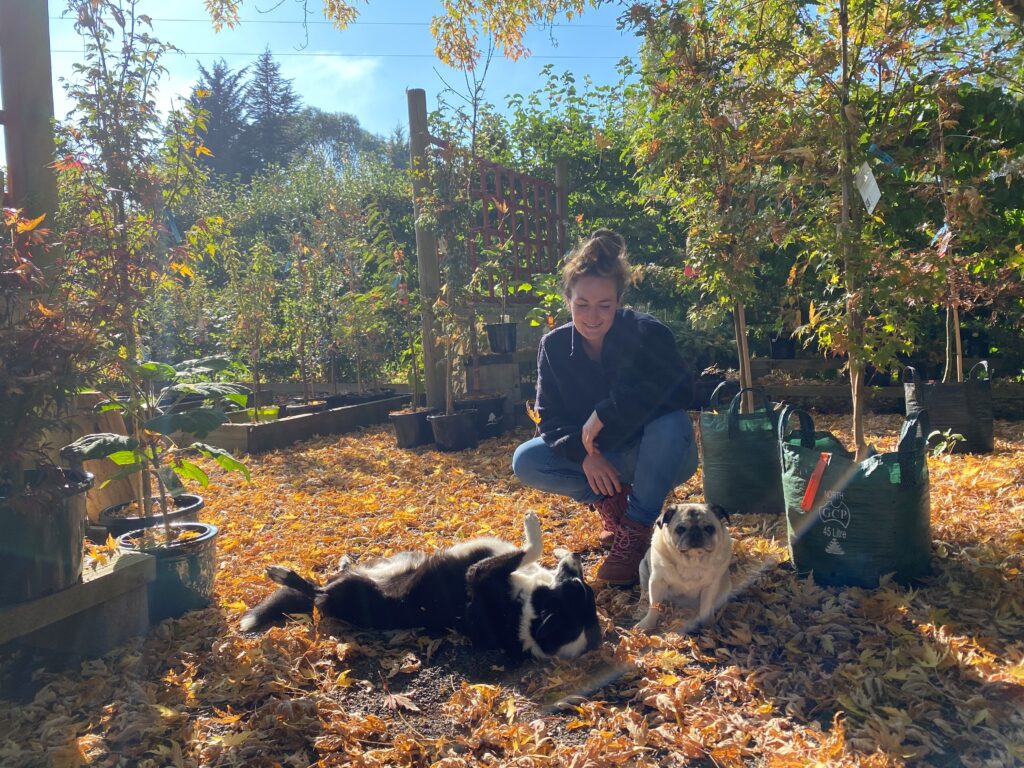
Georgie’s family took over the nursery last September and has been busy adding to the space with a new coffee bar, cafe and a winter fireplace – along with a great range of natives and perennials. Plans for the future include live music and picnic hampers to enjoy the “beautiful space created by former owners
Glen and Sandy”. Image: Kyle Barnes
April 8th, 2021It’s a grave job but Alan never lost the plot
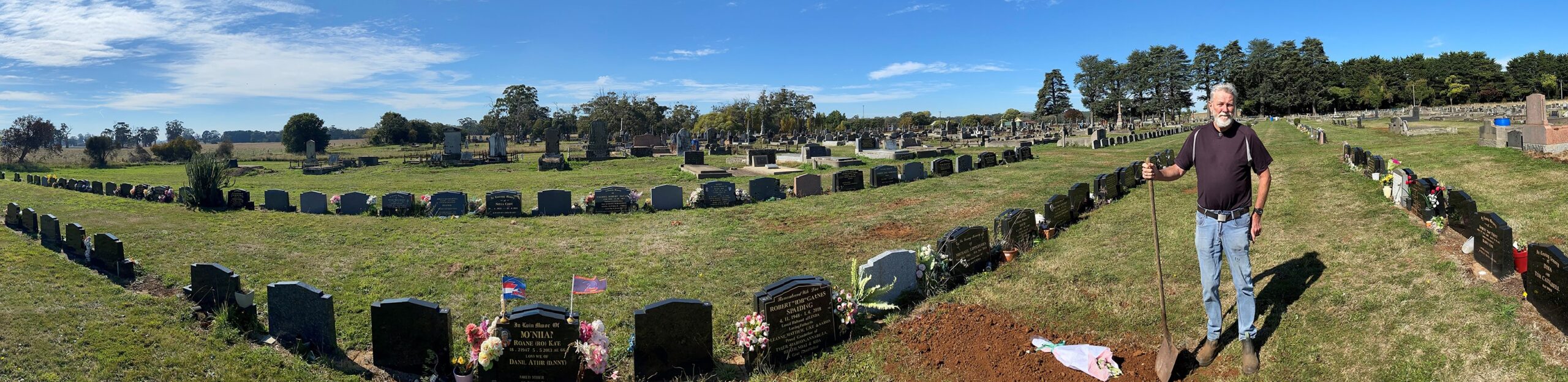
The 66-year-old will retire in May, having dug 3000 graves since taking on the job in April 1979.
For the first 30 years, he singlehandedly excavated the gravesites with the tools of his trade.
“I had a shovel, spade, mattock and a pick,” Mr Graham said.
He recalls how the position became his.
Mr Graham had registered for work at the abattoirs, one of the largest employers at the time in the district.
On his way home, he spotted Rowan McMillan, sitting in the back of his ute in the cemetery eating a sandwich.
“The conversation went, do you know of any work going, and he looked at me and said you can have my job if you want it,” Mr Graham said.
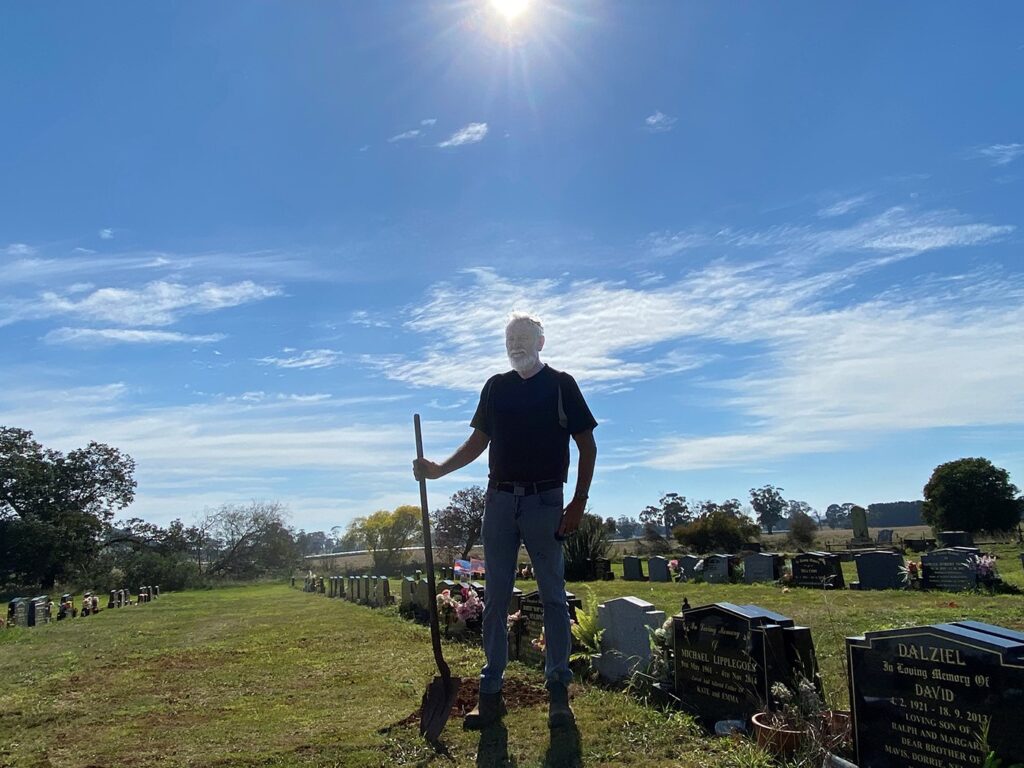
He worked with Mr McMillan for three months learning the ropes before officially taking over the role.
Mr Graham is comfortable in his role as a grave digger with a visible degree of pride in his skills.
He emits a sense of solitude and also an aura of precision evident in the surety that every grave he digs is meticulous
“I’m the one who has to get up and go to work and have the job done,” he said.
“I prefer to only have to worry about myself, so I can’t blame anyone else, I like being out in the open air, and I get to work on my own.”
He has a routine for digging a grave, whether standard size or three-foot wide to accommodate an American coffin.
It takes Mr Graham approximately seven to eight hours to complete a standard size gravesite.
“If there is a need for more than one coffin within the grave, you can add on a few more hours,” he said.
Three funerals in three different cemeteries on the same day was the heaviest workload he achieved.
“There was an early morning burial at Trentham, then I had to be here [Daylesford] around lunchtime and back out at Glenlyon for about three o’clock,” Mr Graham recalls.
While the backhoe has taken over a lot of the hard physical work, Mr Graham still needs to square the corners of the grave to ease lowering and fitting the coffin.
Mr Graham can proudly lay claim to his skill of fastidiousness as a gravedigger, a role which his wife Anne describes as noble.
Words: Carol Saffer | Image: Kyle Barnes

March 29th, 2021COVID vaccine roll-out in Hepburn Shire
In May last year resident Margaret Wheeler, pictured with nurse Akua Ed Nignpense, was forced to greet her granddaughter Alice through the window of the aged care facility due to COVID restrictions.
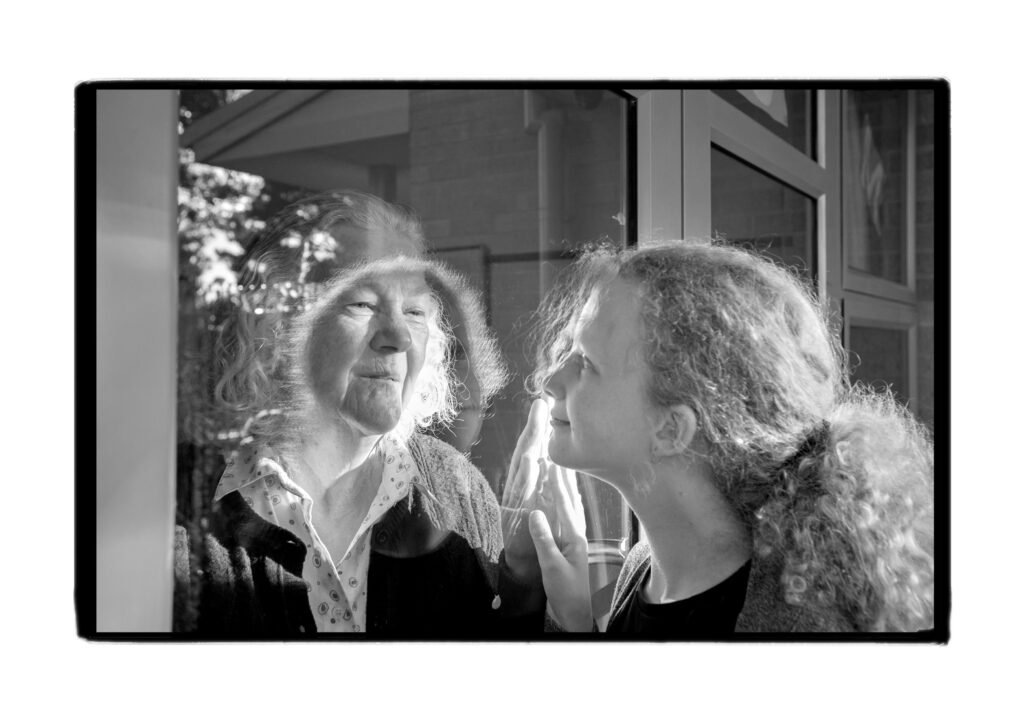
Now, almost a year later, she was one of the first to get the vaccine as part of Central Highlands Rural Health roll-out to residents in Creswick, Daylesford and Trentham aged care facilities. More than 70 residents across the three sites rolled up their sleeves to receive the vaccine.
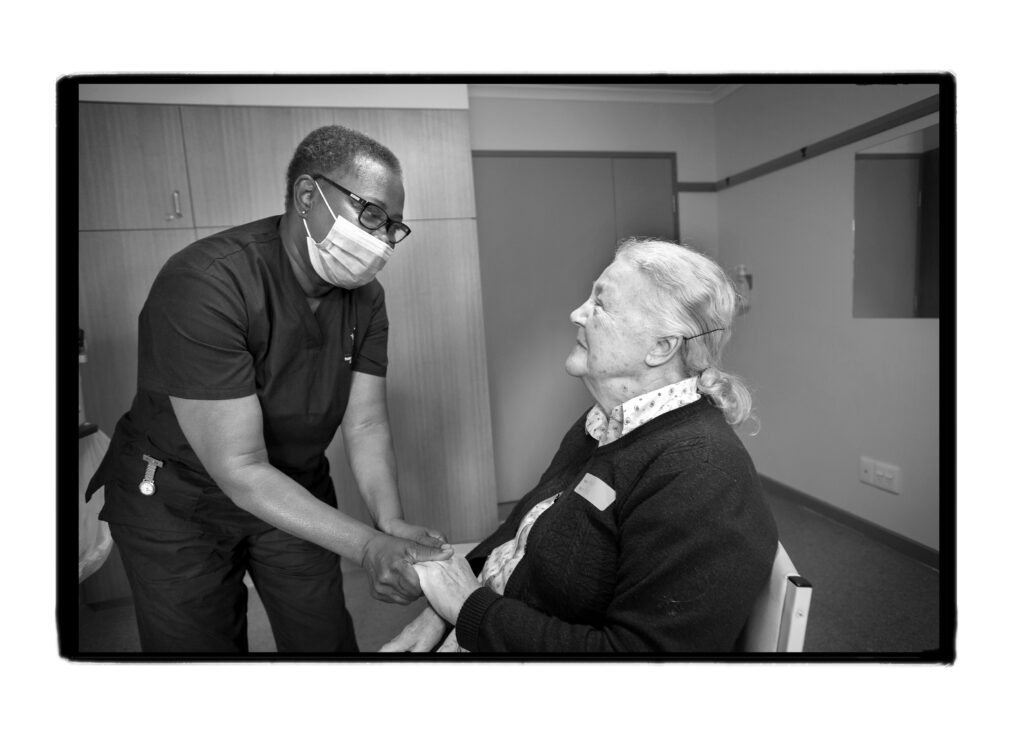
Margaret said the vaccine was a necessity. “I think it’s quite important, it keeps us safe. It’s one of those necessary things we need. We know we’re well taken care of. They (the staff here) try their very best.”
Specialist trained nurse immunisers administered the first dose of the vaccine to residents, which will be followed by a second dose in the coming weeks.
Central Highlands Rural Health’s CEO Maree Cuddihy said the lockdowns brought about by this pandemic had not been easy for residents, their families or the staff who care for them.
“We want to be able to welcome visitors to our homes without worry. The vaccine helps us protect our residents from the COVID-19 virus.”
Ms Cuddihy said Central Highlands Rural Health continued to work with the Grampians and Loddon-Mallee vaccinations hubs, as well as state and federal governments on the roll-out program.
In response to a query from The Local after contact from some older residents being told they were on a waitlist and would not be vaccinated until May, Dr Peter Sloan, a director of Medical Services at Central Highlands Rural Health said:
“We know in the early stages of the phase 1b rollout, the government has targeted general practices, GP-led respiratory clinics and Aboriginal and Torres Strait Islander community-controlled health services to provide the vaccine.
“In Phase 1b there are around six million people so not everyone will be vaccinated immediately, however the GP clinics will vaccinate their most vulnerable patients first. While distribution may seem slow it will be equitable and carefully managed to ensure that no-one misses out.”
Springs Medical manager Emma Johns said the clinic would be operating its dedicated COVID-19 vaccine phase 1b clinics from the Daylesford site and were expecting weekly deliveries of the vaccine.
“Our first clinics will be run from March 27 for phase 1b eligible people. For those people already on our wait list, we will contact you to confirm your appointment date and time. If you would like to reserve your place on our wait list, please visit our website or call our reception team. We ask everyone to remember to bring their completed COVID-19 vaccine consent form to their clinic appointment.”
Details: www.health.gov.au or 1800 020 080.
Words: Donna Kelly | Images: Sandy Scheltema
March 29th, 2021Just sayin’…
And we were told a vaccine would take about a year. And it has. The roll-out is a little slower than expected but we are getting there. But it’s been a strange year. So I thought I would tap out some of the stranger things I have heard this past 12 months, mostly earlier on.

March 2020 – A pharmacist in Frankston when I called to see if they had any masks available for mum: “You don’t need one, they don’t help.”
March 2020 – A staffer in a supermarket in Woodend, as they looked around the store: “I don’t think it will come up here.”
March 2020 – A cruiseline staffer as we tried to get a refund on a trip planned for May to China, Japan and Hong Kong: “You don’t have to get off the ship in China.”
March 2020 – A radiologist in Ballarat about to do a mammogram: “I am sorry but we are not allowed to wear masks – we don’t want to panic people.”
March 2020: A doctor in Daylesford when I wore a mask even though we didn’t have to: “Why are you wearing that?”
April 2020 – A staffer in a supermarket in Daylesford: “I don’t believe in germs.”
May 2020 – An acquaintance in a carpark in Daylesford, as our advertisers continued to call to cancel adverts: “Why do you look so worried, it’s all going to be OK. I’m not worried and I have immune issues.”
July 2020: Kyle’s sister who lives in Port Macquarie, NSW: “There is nothing here. We all hug all the time. COVID schmovid.”
And then, a big break. Everyone realised COVID was real and here for a while and we just had to hold tight and wait for a vaccine. And we mostly did. So you would think the strange comments would have stopped, but no. I heard one last week that I never could have even imagined.
March 2021 – Walking past a Castlemaine cafe, three blokes at a table, one holding court: “No matter what workplace you are in, w..king on someone’s desk is never OK.” Strange but true. Just sayin’…

March 29th, 2021Kyle’s Rant
Kevin Bloody Wilson had the right answer with his fabulous Stick that F…ing Phone song. Just follow the QR code to refresh your memory or create a new one but be warned it is a little graphic for those out there who don’t enjoy a good F-bomb.

The soothing recording on the other end of the phone breaks into my music revival telling me that they appreciate my patience and also it understands my time is important. Blah, blah, blah. But I am sure it is just lip service or is the artificial intelligence really starting to cotton on to my biorhythms?
Does the voice machine cyborg really understand how important my time is as it queues up another droll song it has handpicked just for me, probably based on my voice print – of an old bugger.
But then I do start to wonder how the bionic dude is selecting these songs, they are all very familiar to me. Is it a Happy Days style jukebox and the robot is a Fonzie-bot slapping the side of the record player? Again, if you don’t remember or have never seen that follow this QR Code.

One such call to a local bank’s HQ ended with an offer for the autobot to ring me back when I had got to the front of the queue. The offer included a time slot of between 14 to 24 minutes. Too easy, I thought as I left my number and recorded my name with the Terminator.
The call did come but I missed it because I had cleared the decks in terms of appointments for the next half hour and the phone finally chimed in around the one-and-a-half-hour mark.
What had happened to my place in the queue that I was promised? The mechanical human was very clear with my timeslot and allowing for a little leeway I would have thought half an hour would have done the trick, but alas not so. It seems like that particular organisation wasn’t interested in the $10 million I wanted to park in their coffers. (That was a joke.)

It will be interesting to see where the communication avenues go in the next decade with bots not only lining us up in the queue, but being able to answer even our most intimate questions.
Terminator rant over…

March 29th, 2021European wasps on the wane, or are they?
And while you’re waiting, sit and watch the dozens of European wasps hover around the warm radiators of parked cars. This year though, is it just my imagination, or have there been less around? Am I not looking closely enough?
Best to put this important query to the local social media groups and see what has been going on. “A couple of years ago,” says one, “you couldn’t dine out because they would buzz around you. Not many this year.”
“Less than usual on the northern edge of Daylesford,” observes another. “Definitely not as many in Hepburn this year.” “We’ve had next to none in Glenlyon!” “I live in Porcupine Ridge, haven’t seen any this summer.” “Haven’t had them here in Trentham.” “None in Spargo Creek,” and so on.
Hypothesis confirmed? Not by a long shot. Other residents were sure there were, “many more than usual, not less”. “Lots at our place in Bullarto.” “My backyard is full of wasps at the moment.” “Bloody everywhere in Newlyn North.” “We have had so many on Wombat Hill, they even get inside the house.”

In fact in some quarters, European wasps seemed to be gaining the upper hand. “My neighbour had two hives about 15 metres apart.” “Just destroyed a nest this week.” “I’m in Malmsbury and I have more than I bargained for.” And with hardware stores completely sold out of poison, homeowners were marshalling whatever tools and expertise they could access.
“I have a nest under my house which is inaccessible. I’ve tried using dog flea wash on chicken meat and they have ignored it. Also paid $800 for a Kyneton pest guy to eradicate them which hasn’t worked.”
“Hubby has had a large vacuum set up with water in it. For two weeks we have been continually turning it on to suck out as many as we can.” “We had a nest at the.side of our house. Husband dug into it and poured diluted petrol in. That sure got rid of them.”
It was time to consult an insect expert. Perhaps they could shed some light on the conditions of the past summer. Dr Jurgen Paar works at Rijk Zwaan, a commercial seed supplier situated in Musk and part of his work there is researching the use of beneficials to combat plant pests like lady beetles and parasitic wasps to combat aphids.

“I don’t think it is so much the cold summer but the coolish long spring and that early cold. Because that’s when the queens start producing eggs to build up their new colonies. We still had, especially in places like Bullarto or Lyonville, days where the temperatures didn’t go much above 10 degrees and wasps, like bees, are not active then. I think that was the major impact, it was quite cool when they would normally be busy building up new colonies.”
He draws a comparison here with his work with beneficials.
“We definitely saw it with the reduced number of beneficial insects around. We do a lot of integrated pest management especially with lady beetles against aphids. The aphids were still happy to reproduce but because the weather was so cool the development time of the beneficials was quite a bit longer and they never really caught up.”
Words: Tony Sawrey