


November 4th, 2020Love of all things fishing leads to kids’ club

“When it comes to fishing he has patience and focus like no other kid,” says Meaghan.
“It didn’t matter if he wasn’t catching anything, he could just be on the banks of the river with his dad all day without getting bored.”
There are many places around the region where fresh- water scaly critters can be found such as Lake Daylesford, Jubilee Lake, Wombat Reservoir, Bullarto Reservoir and many more. Finn has tried them all and has caught trout, redfin, carp and tench. Some have been so big he has had to call his dad over to help land them.
“I have been fishing for a long time,” says Finn, “and it’s a great thing pulling out big fish and eating them. My favourite style of fishing is lure fishing because it is more exciting to catch with a lure and more of a challenge.”

Finn is also keen to pass his enthusiasm on to other people and three months ago he started up a YouTube channel called Tailfinn. There, on regular posts, he discusses the lures he uses, his favourite fishing spots, the biggest fish he has caught and even how to cook them. Finn now also has a Facebook page, Daylesford Kids Fishing Club, and has just started holding lessons at Lake Daylesford for anyone interested in learning how to fish.
“I love fishing and I wanted other people to experience that, to enjoy a different pastime and try something different. I feel really good about teaching people about it. The first thing I teach is how to cast because that can be a little bit hard at first. The second thing is to know how to tie a knot to put a sinker or lure on your line.”
The Daylesford Kids Fishing Club is an idea whose time has really arrived. Interest has been strong and the Victorian Fishing Authority has even been providing resources such as information on recreational fishing and licences. So, the main problem is not folks turning up to get a lesson or learning the rules, but having the equipment to begin with, as Meaghan explains.
“Many people are glad to have an opportunity to fish but many don’t have the gear and so we have been putting the word out for donations or spare equipment. If anyone has any items sitting in the shed unused, then bring it to the club so people can have a try.”
For those wishing to donate their old fishing tackle or find out about the next lesson, go to Daylesford Kids Fishing Club Facebook page or email info@tailfinn.com.au
Words: Tony Sawrey | Image: Contributed


November 4th, 2020Finally, it’s time to smell (and taste) the roses

As usual, she sent a load to the wholesale market in the Melbourne suburb of Epping, which supplies the nation with flowers, fruit and vegetables. Like most other people Lauren knew of COVID, but of course “it was all happening overseas”.
Next day she rang to see what was happening. “We don’t have another order,” she was told. “We don’t know when there will be another one.”
Six weeks would pass before orders resumed.
With no income she pulled her children out of daycare, which meant she couldn’t work. None of her four staff qualified for Jobkeeper.

“There were lots of empty beds and dead flowers…crops with no market.”
And as if this was not hard enough, her husband David had just finished scheduling the season’s matches for the Football Federation of Australia at its St Kilda Road headquarters when COVID struck. Since then he’s been working at home four hours a day rescheduling in a project that resembles unscrambling an omelette.
For Lauren, the pandemic taught her to diversify and expand her customer base. So she moved into dried edible flowers and syrup, produced from elderflower, roses and lavender.
Diversify is what her family has always done in the six generations they have lived in the Central Highlands. Lauren’s mother’s family is from Leonards Hill and their history includes having a grandfather who helped build the railway line to Daylesford. And when the timber milling was gone, he saw the line pulled up.
Over six generations since the mid-1800s, her family have been christened and married in the Daylesford Uniting Church. She followed this tradition by getting married there in 2018. She and husband David have four-year-old Eve and 18-month-old Louise. The family moved from Glenroy in Melbourne in November 2018, while Lauren’s parents, Glenda and Colin Richardson, were well established in business here. Colin made the first Ned Kelly Wood Heater in his Daylesford Engineering business back in 1984.

Lauren’s path to flower farming was a winding one. She did her BA in arts and science, majoring in anatomy, at Melbourne University, then studied the history and philosophy of science, moving on to a degree in architecture, and finishing one semester short of her MA.
“I always worked in hospitality part-time and had friends with a wholesale fruit and vegetable business. Working with them I saw that there was a market for edible flowers.”
Flowers have been part of food for centuries, with rose petals used in the Middle East to make rosewater and syrups, as well as Turkish Delight, while the ancient Romans ate lavender, roses and violets. Eastern cultures incorporated orange blossom, chamomile and calendula, while edible flowers bloomed as a display of chic in the Victorian era, with nasturtiums, roses and elderflowers being eaten. Asian dishes featured banana blossom and varieties of orchids and chrysanthemum.
A huge revival in edible flowers arose over the last decade, says Lauren.
“I began with viola, marigolds, roses, rockets and peas.”
Apparently the flowers of rocket are much less harsh than the leaves. Then there are coriander flowers.
But not all parts of flowers are edible, she cautions. While the flowers and leaves of elderflowers can be consumed, the leaves and stem are poisonous.
After seven years in her business, Flowerdale, she now grows between 30 and 50 varieties, with viola the most popular and used in cake garnishes or on pancakes in café breakfasts, and even in cocktails.
Herbal flavours are sought after by top restaurants, she says, mentioning the famous Attica in Melbourne and Brae in the Otways near Birregurra. Flavours from sage and pea flowers are popular.
Lauren had always wanted to produce dried edible flowers, so the lockdown saw her growing them for syrups such as elderflower, roses and lavender.
A tour of her garden reveals voluptuous scents from roses, subtle perfumes from others. And an electric fence to keep the hares off a carnation patch. Ducks go for marigolds and cornflowers, apparently, while rosellas prefer the interior of roses.
Back at the house I taste a couple of nasturtium leaves, with a glass of water. Their echo of Japanese wasabi is remarkable.
Lauren tells of an intriguing development in her world, the Daylesford-Macedon Flower Trail. Flower farmers and getaways, among others, joined to promote the region and each other. They hold events such as farm gate sales and workshops, with details at www.consortiumbotanicus.net.au
The consortium wonderfully sets out to “grow, harvest, source, design and celebrate ethical, sustainable, beautiful ‘botanics’ for the cut and edible flower markets… working together to put truly-local, low-tox, bee-friendly flowers in Australia’s hearts, homes, vases, bouquets and boutonnieres!”
That would put a spring in anyone’s step.
Words: Kevin Childs | Images: David White

November 4th, 2020Chainsaws v. trees: the Buangor battle continues

World news was made last week when a much-valued tree was felled as part of a $157 million widening of the highway, with more than 50 protestors arrested by police.
Part of the disputed land is owned by sisters MairiAnne and Iona Mackenzie, whose family also have the Wombat Park historic house and gardens at the entrance to Daylesford from Castlemaine.
A Supreme Court order has stopped any more tree destruction for three weeks when a case to have the road follow a less damaging and, it is claimed, less expensive route will be heard. Another Supreme Court case is also running and there is a third in the Federal Court.
Protestors say one demonstrator suffered a broken arm in a locked device as $5000 fines were imposed under COVID laws.
Away from the courts the stand-off has become political with Premier Daniel Andrews receiving about 27,000 angry messages. And a move is under way for a Federal Parliamentary Committee, including indigenous MPs and the Greens, to examine laws from 1984 covering matters like this. Fourteen years ago jurist Dr Elizabeth Evatt reported on the need to reform these laws.
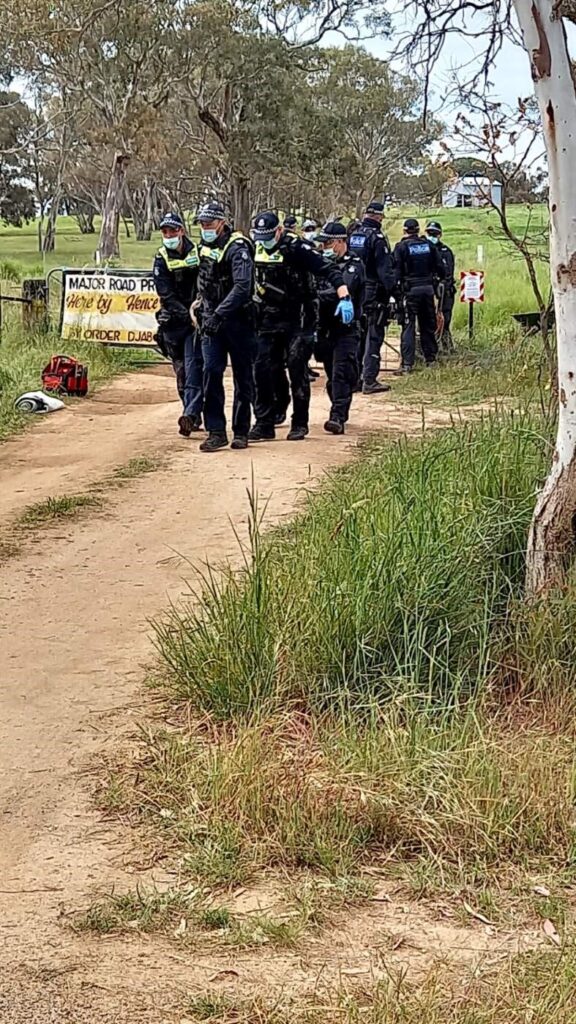
Police moved to clear an Aboriginal protest camp between Buangor and Ararat the day before the Premier announced Victoria was emerging from its COVID lockdown, a move that is seen to have backfired because of the resulting outcry.
MairiAnne Mackenzie told The Local: “The police went in before fencing was up, before their mobile chemical toilets arrived, before their security lights which blare all night, and this magnificent tree was chain-sawed. I live there and could hardly find out what was happening with roads blocked and a media blackout.
“The road authority, MRPV, keep saying it saved 16 trees, but the realignment saved only one tree from being killed, a twin-trunk hollow tree, which will still be desecrated with a freeway bridge towering over it.
“Another ‘saved’ tree, the 800 year-old hollow tree, is still very likely to die from the planned root damage, because there hasn’t been any effective realignment around it. Ten more ‘saved’ trees were never threatened, not even in the works area. Four more were only ever going to be trimmed.”
The Auditor-General has been asked to examine a staggering $30 million paid to a contractor when no work was done between July 2018 and January last year. A similar amount is believed to have been paid for the next six months.
Djab Wurrung leaders Aunty Sandra Onus and Marjorie Thorpe launched the latest case over the culturally significant land.
Former judge Ron Merkel QC told last week’s hearing:
“The battle goes to the heart of cultural heritage.
“It appears the defendants are approaching this not in the context of Aboriginal cultural heritage…but as if this is just an object like a museum object,” he said. “We say that is a total renunciation of Aboriginal cultural heritage.
“Djab Wurrung people [have been] excluded from their own country.”
Merkel was opposed by a QC representing the Victorian Government, MRPV, the Secretary of the Department of Transport and the Minister for Transport and Infrastructure. Merkel’s argument is largely that a 2013 Cultural Heritage Management Plan for the project has not been developed and is also out of date.
Merkel said a report by the Victorian Ombudsman highlighted a potential conflict of interest with Martang, the Registered Aboriginal Party, when it gave cultural heritage approval. While Martang rejects the value of the destroyed tree, an archeaological survey paid for by MRPV in December 2018 found that it was a directions or marker tree, noted by traditional owners because of its small round scar and a quartz blade fragment found nearby. This was among 10 Aboriginal sites found outside two areas centred around a pair of culturally modified trees.
In August this year, and after a seven month delay because of staff cuts, Federal Environment Minister Sussan Ley rejected an application for further protection of six trees for a second time. She now wants the states to take over such issues.
About 480 academics from across Australia, including historians, geographers, lawyers and scientists, condemned the loss of the directions tree and urged the government to stop works and protect the remaining trees.
Words: Kevin Childs | Image: Contributed

November 4th, 2020Hepburn Shire ready for Melburnians’ return

The plan, which will be in place from Friday, November 6, will see parking on the east and west sides of Vincent Street (south of the pedestrian crossing) repurposed to allow pedestrians to use this space. North of the pedestrian crossing will stay open to ensure access to services, provide loading zones and accessible parking and a taxi rank.
The speed limit will also be reduced to 20 km/h along Vincent Street to make it as safe as possible for pedestrians.
There are also escalation plans if more room is needed for physical distancing, which sees further changes – from making Vincent Street a one-way street to completely closing the street as the last step to ensure the safety of all.

“Businesses along Vincent Street have been consulted and the majority are supportive of the plan, and we will continue to check in with them to make sure our plan is doing what we expect it to do – slow the traffic, give pedestrians the space needed to maintain physical distancing and allow our hospitality businesses to use the outdoor space for dining,” Hepburn Shire Council CEO Evan King said.
Mr King said the council had been working closely with businesses and agencies to ensure plans are in place to keep the community and visitors safe.
“We know our shire is one of the most popular destinations in the State, and keeping our community safe is our top priority,” Mr King said.
“Over the Queen’s Birthday long weekend last June, Daylesford in particular was heaving with visitors wanting to experience the best of our shire.
“We saw that the footpaths on Vincent Street were not wide enough to cope with the pedestrian traffic and allow physical distancing at the same time, and that will be the case again, especially with businesses being encouraged to use footpaths for outdoor dining.
“To keep our community safe, we have devised a plan for dealing with potentially large crowds and consulted with the businesses along Vincent Street as well as with Victoria Police, Central Highlands Rural Health, Daylesford Macedon Tourism and the Department of Health and Human Services.
“We published that plan on our website a month ago and visited in person and surveyed our affected businesses to get as much feedback as we can. We heard their thoughts and have taken on board their feedback to produce the best plan possible.
“This feedback has resulted in a plan which balances the needs of our local businesses with the need to make Vincent Street as safe as possible for everyone.”
Council is also boosting cleaning and the number of bins on Vincent Street, Mr King said.
“We will have extra cleaners working the street at busy times and extra bins out as we know there will be extra takeaway being sold.
“There will also be extra signage along the street to remind everyone of their responsibility to be COVID-safe.
“We need everyone to remember the rules – maintain physical distancing, wear a mask, stay home if you are unwell – as these help us all stay safe.”
Trentham
Mr King said the council would also be monitoring Trentham to ensure pedestrian safety and had a traffic management plan ready to implement should it be needed.
“Trentham has wider footpaths and less on-street dining, so while it does get busy, our feeling and the feedback we have received from the businesses there is that it will be manageable. That said, we will keep a close eye on it and do what we need to do to ensure the safety of pedestrians.
Creswick and Clunes
“We have also considered the needs of Creswick and Clunes and while we don’t anticipate the congestion we see in Daylesford to occur there, we will be monitoring how the return of visitors impacts their main streets and consider changes if there needs to be any.”

Daylesford Macedon Tourism CEO Steve Wroe said the natural attractions, amazing accommodation and great restaurants and cafes were what made Hepburn Shire’s towns and villages attractive to visitors.
“Our shire’s appeal to visitors, combined with unprecedented pent-up demand coming out of Melbourne, means that a proactive approach to people and traffic management is essential as restrictions ease.
“We expect visitation to well exceed what we would normally see this time of year, likely several thousand people per week more than normal.
“We want to preserve our reputation as Melbourne’s favourite getaway spot, and ensure that the visitor experience is great, our community feels safe, and our businesses are able to trade in a safe, efficient, and profitable way.”
Link: www.hepburn.vic.gov.au/covid-safe-plans-for-shire-footpaths/
Words: Donna Kelly
October 26th, 2020Glen, About The House
Our house started out as three small office buildings at the Ophir Gold Mine in Doctor’s Gully, was hauled up to the present site under horsepower and then reassembled early last century. More recent extensions and renovations resulted in what we now call home.
We moved in near the end of the previous decade-long nation-wide drought, to a garden ringed with a collection of beautiful, mostly centenarian trees and a broad expanse of parched grass. A perfect blank canvas and a great headstart for a new garden.
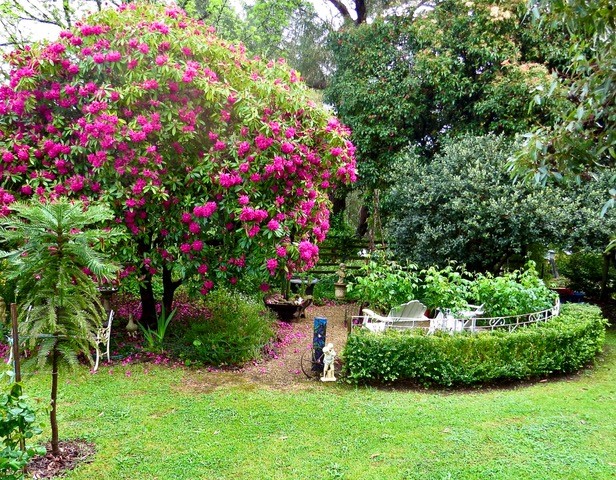
The photograph, below, features one of our beautiful rhododendrons. The ragged box hedge is a survivor of its first clipping and my first go with a powered hedge trimmer. Also at far left of the picture is the ‘main prize’, from prehistoric times, our Wollemi pine.
Survivors from our distant past
Around the same time as the Wollemi pine was established, 150 million years ago, is another of the few remaining links, the ferns, existing almost unchanged since forming the basic vegetation of primeval times. Botanically ferns differ from higher forms of plant life in that they do not flower but reproduce themselves from dust-like spores which form on the backs of their fronds in spore cases somewhat resembling scale insects, and are often mistaken for them. Pictured above is one of my three ancient native cycad ferns.
In spite of their delicate, even fragile appearance, ferns will grow quite readily if the conditions suit them. These conditions are moist air, damp porous soil and plenty of shade.
Remembering that most ferns originate from the banks of forest streams or the floor of rain forests, find them a cool spot under established trees and shrubs, or a dark corner of a shadehouse or enclosed porch.
Ferns do well in poorly lit rooms unsuited to other light-loving plants. They need little feeding especially if the potting mixture contains a liberal amount of well-rotted cow manure.
Ferns will usually grow quite readily from spores by following these steps. Collect the spores by holding a sheet of white paper under the spore-laden fronds and tap them lightly to dislodge the ripe ones. Dust them onto a mixture of equal parts of finely broken-up peat moss and coarse sand and put this in a pot.
Place the pot in a humid position in a glass frame or deep box and cover with a sheet of glass. To keep things humid, place a shallow bowl of water in with the pots.
Alternatively you may like to create a mini glasshouse from an opaque-sided, lidded plastic trunk. Drill four or five 15mm holes in the corners of the lid for air and several larger ones in the bottom for drainage. Keep the container in the shade at all times. (Obviously this would also be perfect for propagating other seedlings and cuttings.)
After two or three weeks you should see pinhead-sized green dewdrops on the surface of the soil. From these, small fronds should emerge after another two or three weeks. Once the plantlets are about 2-3 centimetres high they can be carefully lifted from the pot using tweezers and put into larger containers of the same mixture, spacing them 4-5cm apart.
The little ferns can be potted into individual containers once they reach 5-7cm high.
The potting mix should be friable, crumbly and slightly acidic. Mix it from equal parts of coarse sand, well-rotted compost or peat moss and good garden loam.
It isn’t necessary to repot them too often. Ferns prefer to be a little pot-bound. They also need minimal care: mostly cutting off any old or dead fronds and keeping any pests at bay.
Got a gardening question? Ask Glen.
Email glenzgarden@gmail.com

October 26th, 2020Design with Indre
There is a balance between restoring to complete authenticity and simply renovating. There is the mixing of new materials, technology and styles that must be blended.
Know the age of your home to research historical materials and styles. The features, colours and perhaps prints commonly used. Use new or salvaged materials of similar quality and style and if you can’t source these, the decision will have to be made about replication or whether new is close enough.
There are times you need to repair old with new. The colours will not be the same and will stick out like Collingwood supporters at a Mensa gathering. Fortunately, there are a couple of things you can do to age the look of the new material.
Age new wood by letting a piece of steel wool or a few non-galvanised nails sit overnight in white vinegar. Dilute the vinegar 1:1 with water. Test the solution on a scrap of wood or in a hidden area and let dry. Adjust the solution if needed. More vinegar will make the wood darker, more water will lighten. Brush or spray this solution on.
Modern mortar is a mix of sand, cement and water. Lime mortar pre-WWII consisted of lime and sand, lime making the mix strong but lighter in colour. The cement (or lime) paste coats the sand grains so you see the colour of the cement (or lime). Most cement is grey or white with pigment added when the mortar is coloured. Over time, the surface cement erodes exposing the sand grains, affecting the look of the mortar. By soaking pieces of old mortar in muriatic acid the cement dissolves, leaving the sand to reveal its size and colour. You are wanting to match this sand. This way the texture will be consistent. Rain and time should gradually dirty and darken the new mortar colour.

Removing paint is a task most often done in renovations. Using a heat gun is simple and effective. Point the gun at the painted area to make it heat and bubble, then scrape the melted paint off with a tool. Sounds easy.
For removing old, layered paint from hardware such as doorknobs, hinges, window pulls, railings or cast iron, make an old-fashioned paint remover. Pour two cups of water into a dish, add one cup borax, one cup ammonia and one cup washing soda (found at supermarkets). Mix thoroughly until a consistent creamy paste is achieved.
Brush over the paint with this mixture and let it penetrate for at least 20 minutes, then rinse with warm water while scrubbing with steel wool. Warning, when using borax do not inhale or ingest and store borax labelled, away from children. Use coveralls, safety glasses, a respirator and gloves when removing any old paint.
A pot of boiling water with baking soda added until the solution is milky will remove paint from painted hardware. It may not be quite as effective for the layer upon layer of old paint but it still works.
It has been said that immersing your old painted bits (hardware) into a tub of molasses will also remove the paint, but this does require a few months. If you’re not in a hurry it is a simple, environmentally-friendly solution.
Copper or copperplated zinc items, such as exposed pipes, boilers, handles, pots and pans can be cleaned with a solution of white vinegar or lemon juice and salt. Wipe with a soft cloth or finish with a silverware polishing cloth. Alternatively, use a baking soda and water paste. Brush or wipe on using small circular motions. Rinse and dry with a soft cloth.
Any renovation is an act of love and it takes time. Having a plan and knowing what you are in for will make all the difference. Enjoy the journey.
Indre Kisonas – owner and principal designer – iok design
indre@iokdesign.com.au | www.iokdesign.com.au
Ed’s note: The Local Publishing Group loves all AFL team supporters.

October 26th, 2020The Boathouse puts lake view back on menu
We have had a couple of lovely visits to the Cosmopolitan Hotel in Trentham, enjoying their gorgeous beer garden and from this Thursday, we can also get back to enjoying lake views with the re-opening of The Boathouse Restaurant.
The Boathouse is run by Susanne Devine and Claire Levine, who have been in hospitality forever and do it perfectly, and is well known for its great menu and location. We are already booked in for the weekend, well not the whole weekend, just a lunch, and looking forward to our go-to choices. Yes, it’s a pared-down menu but all your favourites are there.
I will be starting with the house cured ocean trout with horseradish cream, watercress and apple salad ($22). It’s a really great entrée, full of flavour and the crunch of the salad goes really well with the rich trout.
I reckon Kyle will choose either the onion bjahi – Indian spiced onion fritters with raita ($18), or the charcuterie platter of jamon, salami, olives, beetroot relish and toasted sourdough ($18). Probably the latter, because he does love cured meats, but I hope the fritters just because they are so damn good. But really filling, so great also as a share plate.
Onto mains, and fairly enough, everyone dining, including children, must order a minimum of a main course each. I reckon anyone who kicks up about that is exactly what Bob Hawke called any boss who had a go at workers not turning up after that America’s Cup win. But he was putting it politely.

Anyway, mains. Mine will be the steamed mussels with tomato, chilli, garlic and coriander with loads of buttered crusty bread ($29). I love this dish and have missed it. To be honest, I have bought supermarket mussels quite a few times over the past months but, and please don’t attack me on this, have had to mostly throw them out because I know it is just not going to be as good as The Boathouse. Even with a chardy.
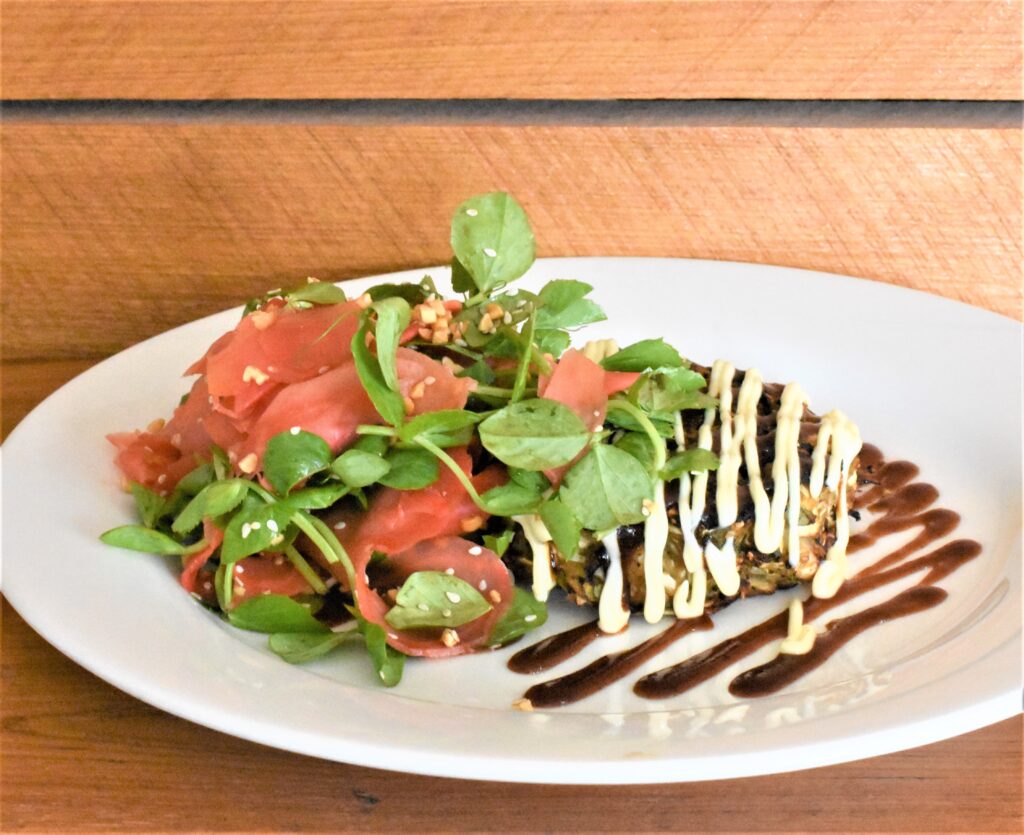
I do also love the okonomiyaki ($25), a Japanese savoury pancake which is as good as any you will find in Japan – and I know because I lived there for a few years and until the stupid pandemic, headed back every few years. I miss Japan.

Kyle, hmmm. He absolutely loves the prawn linguine with garlic, lemon, cherry tomato, white wine and parsley ($33) but it will be a close call with the roasted lemon and garlic chicken served with warm rice and a du puy lentil, almond, feta, spinach and dill salad ($32). Both are fantastic dishes, full of flavour and it will probably just come down to blurting out one or the other when asked what he wants.
And then desserts. I don’t think you can go past the saffron pannacotta with mango puree and toasted coconut ($14). Smooth and silky with the subtle hit of fruit and coconut. We generally just share, so my choice!
Great to have most of our venues back up and running and life returning to a new kind of normal. Next visit? Daylesford Hotel, of course.
Words: Donna Kelly | Images: Kyle Barnes

October 26th, 2020GROB

October 26th, 2020Kyle’s Rant
So, I accepted the invitation that I would somehow discreetly wind the product into my column in return for some free KOOEE jerky and a box of a thousand jerky flavours arrived. And even if I don’t like the jerky, which of course I do, in the words of Forrest Gump, “I just loved playing ping-pong with my flex-o-light ping-pong paddle”, it is OK because his mum said one little white lie wouldn’t hurt.
I have been bounced around a bit lately while driving on the roads just south of Anakie, on a recent trip to Lorne. I mean Anakie the town, not the current state of the US. There is a stretch of road that would be the envy of a rodeo rider. I am sure that if I did not get air, I must have been at the extension limit of my shock absorbers. And a little way along that stretch of road I saw a sign indicating “rough road ahead”. Wow, I wondered, what was that I had just been on? They would be better off placing a sign saying where the smooth bits of road are so I have half a chance to get up to the designated speed limit.
Oh, that all happened while I was chomping on my delicious KOOEE – the all natural, organic, original chicken jerky – and the bumps made light work of the need to chew and sometimes even helped in the swallowing process.
But back to roadworks here in the Central Highlands. This was a large stretch of road so, as well as traffic lights they had opted for a pilot van whose job was to lead the traffic through the works, avoiding potential collisions with the working vehicles. This, I imagine, would be a pretty repetitive position and easy to lose concentration.
I was three cars behind the pilot van when its driver pulled over, almost over a cliff, in order to give way to a machine. And, like that, with the only way the van could recover being by reversing, the car behind the van took the proactive move of making a bolt for it and went around him. This rebel went freeballing through the whole stretch of roadworks and because we are all only humans, we followed what was now the lead car.
By the time the pilot van got back in action it was at the end of the line. I reckon the driver would have lost a slab to his co-workers for that. After all, he only had one job to do and that was to lead us all safely through and he choked. And this was all while snacking down on that delicious 11-gram pack of KOOEE jerky.
Influencer rant over…

October 26th, 2020Just sayin’…
Now, like most right-minded people, I hate these meetings. I don’t have a camera on my desktop so have to organise the iPad at just the right angle so I don’t have five double chins. I made the mistake of holding it for a few meetings but after about 20 minutes you tend to lose feeling in your arm – and it starts to slip down. Never a good look for anyone over 50ish.
It also means I have to think about what I am wearing, well the top half anyway. If the pandemic has done nothing else it has been the best promoter of leisurewear – let’s call them trackies. Personal hygiene may have slipped as well. Kyle was talking to someone the other day, on the phone, and said “we change our minds more than we change our undies”, thought about that for a minute and added, “well, we change our minds a fair bit”.
Anyway, when I get up I tend to find whatever was left on the floor the night before and drag that on. Yes, of course, I later shower and change. But, you know, just for the start of the day. And then sometimes I look down and think “hmmm, that spag bol was a pretty tasty dinner”.
So an online meeting means changing into a nice top, maybe some earrings, brushing hair and putting on make-up. Even lipstick, which has pretty much gone the way of the dodo with the mask-wearing caper happening. My Mum always said a slick of lipstick meant you were ready for the day but all it means to me is that the inside of my mask is now a pinky-red.
And then the meeting itself. Believe it or not I am not an aggressive person. I tend to wait in line for my turn, and wait for my turn to speak. But with these platforms, and we are talking business not family, it can be hard to speak up. The loudest tends to win the mike and the loudest tend to be the blokes. And my meeting the other day was with five of them and just me. “Urgghhh” I got out one time, then boldly went with “wrrhhgh” and finally got up the courage and almost shouted “blurrggog”. Nothing. OK, I might have got a few sentences in when the aforementioned blokes were tiring of talking and reached for their coffees. And I made the most of it.
Talked for at least two minutes and I think I was making my point pretty well until a little blurb came up saying “someone has logged you out of the meeting”. WTH? By the time I found the email with the code and logged back in, I just managed to catch a few “great meeting”s and “see you later”s and it was over. We meet again in a fortnight and this time I will be ready. No change of top, no make-up, and while they are wondering what the hell happened in Glenlyon, I will take the floor. Pivoting never looked worse. Just sayin’…
October 26th, 2020Guiding a school in the time of COVID-19
Forced to take the unprecedented step of closing the school to students and staff (except for a handful of students with special circumstances or those with parents classified as essential workers) for the first time in history, the corridors and classrooms have been eerily quiet.
For many students and teachers there was a collective sigh of relief as they returned. For some parents and teachers, the pressures of working from home with children underfoot have been immense, the return to face-to-face learning is a welcome first step to normality during life in the time of COVID-19.
“We’ve been flying by the seat of our pants with the announcements coming from the Premier so fast – the constant shifting of sands and how we adapt has been the biggest challenge. A more important challenge however has been looking after every one of my students and staff. I’ve focused more on the human side of things. We’re usually focused on student outcomes and academics, but this pandemic has focused us more on talking to kids, teachers, staff and parents – the granular stuff of checking in with kids at home who may be struggling.
“We cut our timetable down to help our students and teachers to reduce the stress of working and learning at home. We virtualised our wellbeing team: it was setup online using video conferencing with a nurse, a doctor, two youth workers, an alcohol and drug counsellor, and a social worker available.
“No classes ran on a Tuesday and this was a wellbeing/check-in day. We made sure we spoke to our kids and their parents/carers and asked them what their experiences were of learning from home during COVID. The results were interesting, for example 15 per cent of students actually reported an improvement in their mental health while learning from home, and 32 per cent felt they learnt better online than in the classroom. Overall the feedback was very positive. Kids are pretty resilient and this shone through.
“We’ve tried to give the kids something to look forward to, we’re one of the few schools not to have cancelled their camps and the Year 7s are off to Alexandra in a few weeks. During lockdown staff and I drove around to every year 12 student and messaged them to keep an eye on their letterbox. We dropped off homemade cookies and masks made by the teachers, and inspirational quotes on cards. We provided care packages of homemade goodies for the staff, it helped raise their spirits. I knocked on a lot of people’s doors with a quick hello and a smile.
“Face-to-face contact is incredibly important. We’re social beings. Learning is a social exercise. I think the way our students weathered this is a real credit to them. I’m really proud of them. And proud of my staff because they’ve been such a big part of helping the kids cope.
“I felt excited about seeing the kids again. We go into teaching because we love hanging out with kids, that’s part of why this has been so difficult.
“I’m an optimistic person. I do think that COVID could result in some positive changes for education. It’s made us rethink everything we do. It’s shown us that our kids can be independent, and that’s a good thing.”
This story and photo is part of Sandy Scheltema’s Life in the Time of Coronavirus series funded by Creative Victoria and Regional Arts Victoria as part of the Sustaining Creative Workers Initiative.
October 26th, 2020Simple life and ethical farming
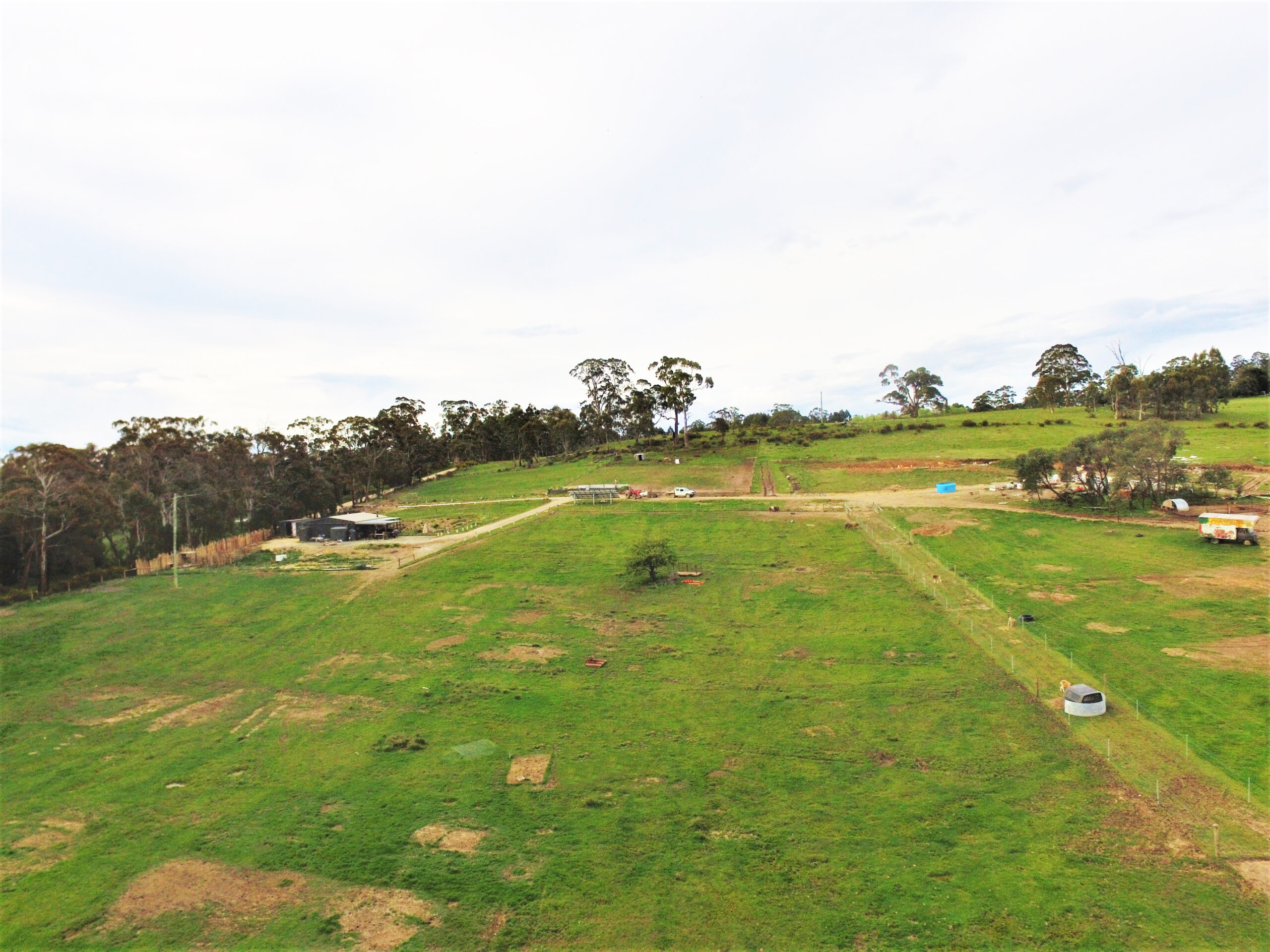
Bordering the hamlet of Glenlyon on Dja Dja Wurrung land they work in a way that Bohdan calls scale-appropriate. Put simply, that means never taking more than the land can provide, without the need for synthetic fertilisers and pesticides.
“When we took custodianship of the land two years ago there was absolutely no infrastructure except for two dams,” says Bohdan. “The rest of the 50-acre block (20 hectares) was divided between empty paddocks and regrowth eucalyptus forest. But one of the big reasons we chose to jump onto a bare canvas was to be off-grid. In order to do that you’ve got to rip the band-aid off and get away from all the services just given to you when you buy an established property.”
Today they have achieved their off-grid goal with the entire place run off solar including the house, sheds and pumps. Not bad in an area noted more for its rain and cloud than regular sun.
After two years on their block they have only had to use the back-up diesel generator once. And that was only for about 12 hours to recharge their batteries after a particularly lengthy run of grey days.
The number of small-scale farmers working in a regenerative ethical manner is growing and our region is a hotspot. The Central Highlands has a gourmet food culture, healthy soil and temperate conditions making it a desirable place to produce and sell niche market goods. Catherine Farm is a perfect example of the trend specialising in just two main products, free-range pork and eggs.
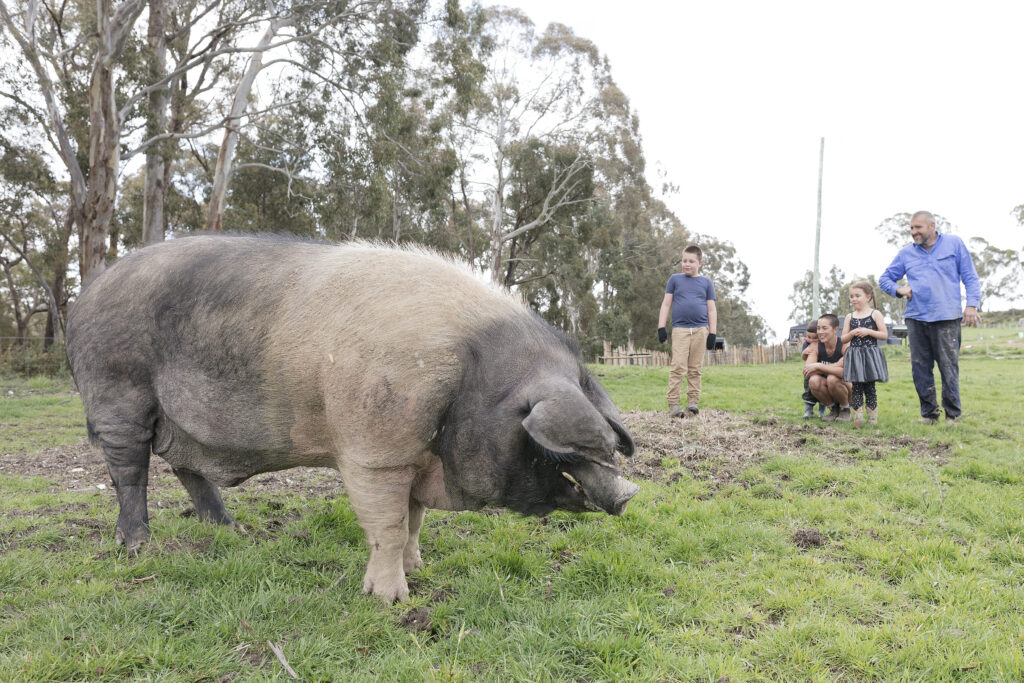
Catherine and Bohdan run around 30 pasture-raised pigs producing 100 per cent chemical-free pork and the hogs eat a balanced diet completely derived from waste stream food. This means that more than 20 tonnes of perfectly good fodder, normally destined for landfill, is diverted. Taking this waste from nearby businesses such as Shedshaker Brewing in Castlemaine and Honest Eggs in Yandoit helps keep the food production local.
While they are required to process the pigs in Laverton, the carcasses are returned to Jonai Farm, Eganstown for the on-farm butcher to prepare the cuts for sale.
Catherine Farm’s customers have the option of purchasing 5kg and 10kg pork packs which include nitrate- and gluten-free sausages, bacon and a range of cuts such as coppa steaks, sirloin, roast and mince just to name a few. With prices starting from $135 for the 5kg pack it is great value for a selection of premium free-range meat with larger quantities for share options available.
“We try to utilise what we can from the area because a big part of our philosophy is centred around reducing food miles whenever possible. Our local customers like to know not only exactly where their food is coming from but also the quality and care that has gone into the whole process.”
Free-range eggs make up the other half of Catherine Farm’s production. They have about 400 chooks roaming around the block serving as a dual purpose animal, providing eggs of course but also supplying the paddocks with fertiliser. Today the chickens roost in two A-frame style mobile sheds that are constantly in transit from one spot to another. However, taking pride of place among the chicken, pigs and humans is an old freezer van truck which served as the family’s first chook tractor, as Bohdan explains.
“The truck was the first coop we started with. We could drive it around to move the hens. In fact all the animals get moved once a week. It reduces stress on the ground and reduces worms and parasites in the animals.”
On its side is a colourful mural with the words moa + fo’imoa painted in the middle. The phrase is a nod to Catherine’s Tongan heritage and translates as chicken plus egg.
Chicken may very well equal egg, but egg plus pork also equals a secure place for Catherine Farm on the food map of the Central Highlands region. This comes via their healthy farm gate sales, regular customers through their Facebook page, support from Harvest Cafe, Spade to Blade Catering, The Surly Goat and the many customers visiting their stall at the Glenlyon Market every third Saturday of the month. Oh yes, Catherine is a sweet tooth and loves to bake so their stall is also loaded with vegan/GF brownies, cupcakes, cookies and slices as well.
Words: Tony Sawrey | Image: David White
October 19th, 2020Restoring Park Lake to its former glory
Retiring Friends secretary Val Lawrence said the day would include a birthday cake, a barbeque and plenty of native plants. There was also a plan for the Dja Dja Wurrung people to get involved with some planting of Aboriginal vegetables.
Ms Lawrence said the Friends group started in 1999 when a resident was shown some photos of the 64-acre park in its heyday and called for a public meeting to gather up people keen to restore it to its former glory. About 17 people attended, including Ms Lawrence.
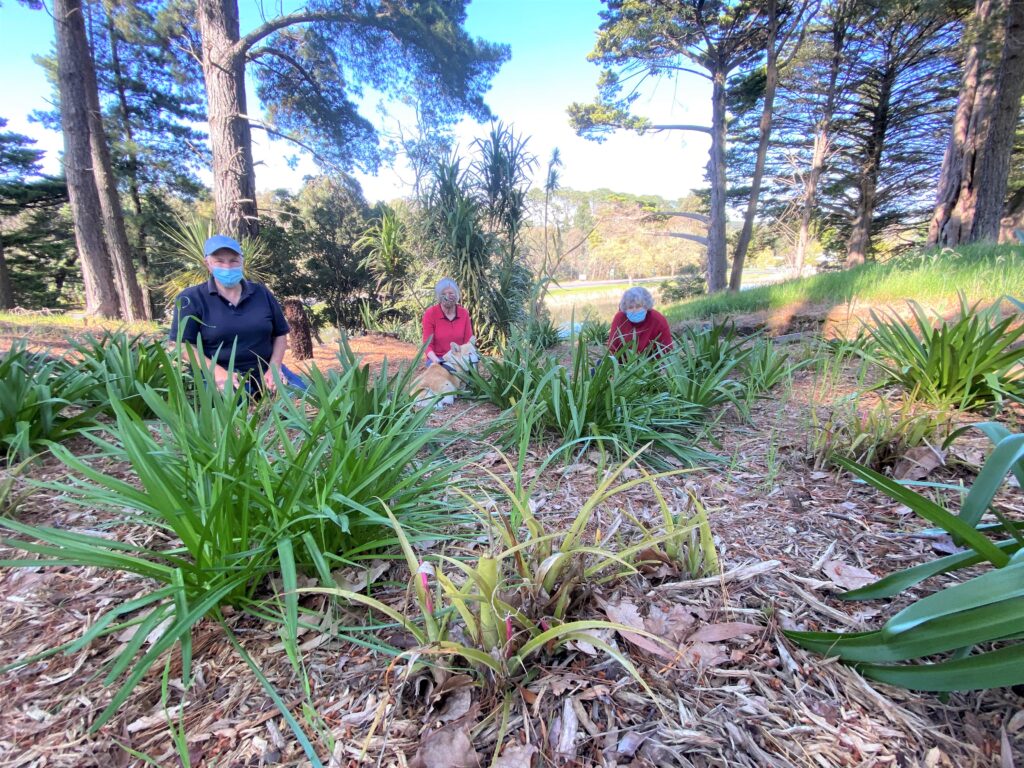
“People have come and gone and some of those original people have gone to God. There are four of us at the moment, the main workers, and we spend every Wednesday morning at the park, planting things, burning up rubbish, all the things necessary for maintaining a park.”
The four are Ms Lawrence, president Mena Turville, secretary Thea Laidlaw and treasurer Helen Cossenas – with assistance from their “boyfriends” Ron and Bill, who help out with the heavy lifting including felling dangerous trees.
Hepburn Shire Council also steps in to help out with mowing and any specific projects. The council has also provided funding for next year’s celebration with additional money coming from a commemorative calendar, already sold out.
Ms Lawrence said others to provide advice included landscape architect David Hay who had designed a plan for the long-neglected eastern side, with Dr Kevin Tolhurst later creating a planting plan which was now under construction.
“We have been working on that area for the past two years and it was absolutely covered in weeds and blackberries, all sorts of rubbish. We have done a part of that now. Former parks manager Andrew O’Connell is also someone we look to for advice. He is very experienced.”
The Park Lake Reserve includes the home of the Mount Prospect Tennis Club and has long been the site of Creswick gatherings from back in the war years to returned servicemen’s reunions and Australia Day breakfasts.
“Over the years it was the place to be seen, a beautiful park mostly full of European trees and with the most beautiful fernery. Our goal is to restore it to its past glory.”
The Friends are always keen for new members. Contact president Mena Turville at menaturville90@gmail.com

October 19th, 2020The quick brown fox always in Barry’s sights
However, over the past year or so he has made a substantial dent in the local fox population and has proved that with the right methods, their numbers can be kept at manageable levels. Good news for sheep and poultry farmers and the native animal population.
While there are many shooters in Victoria who do fox eradication for a job, collecting bounties and such, Barry does not see what he does as a vocation but a hobby.
He started out as a pig shooter but one of his friends had problems with foxes on their farm and asked if he could try to get them. He ended up bagging 52 foxes on that one little property and word soon spread regarding Barry’s skills. That was just over 15 months ago and he has despatched hundreds more since then.
He uses some pretty high tech gear to do what he does. His equipment includes a hand-held thermal imaging spotter, a thermal imaging scope and a rifle with a range of 280 metres.
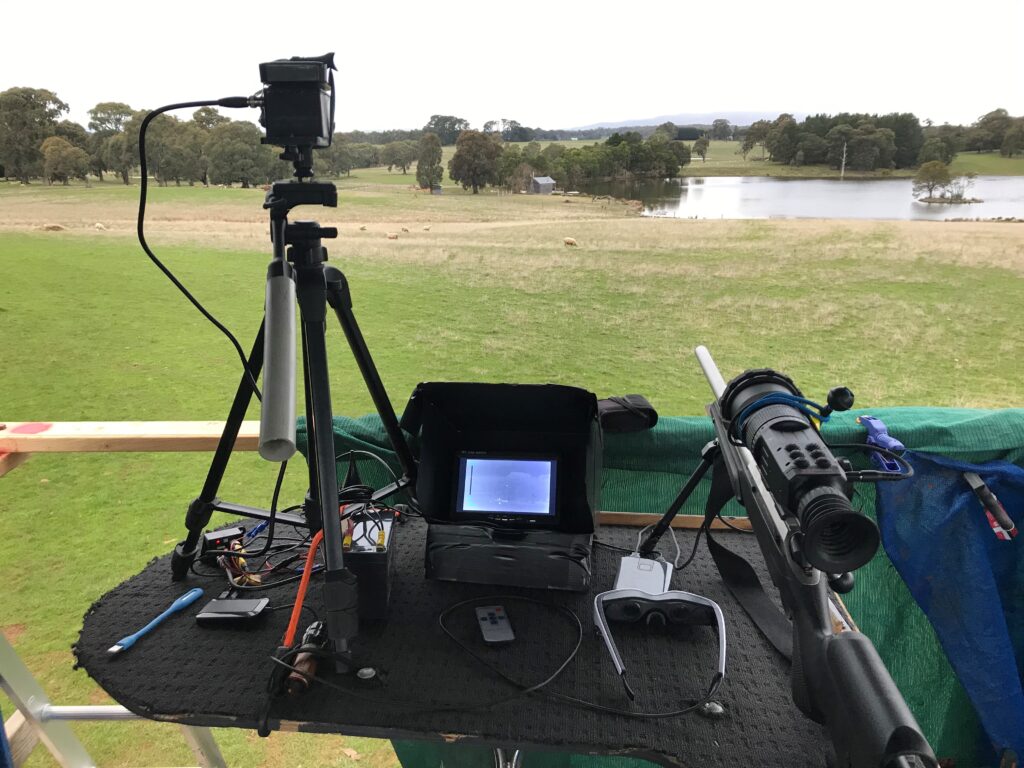
Initially he just parked his vehicle in a paddock and shot out of the window. But this evolved to sitting at a bench that swivelled 360 degrees. Next he constructed a rolling tower three metres high with a tent over the top to protect him and his gear against the elements. The height and canopy covering also obscured Barry’s scent and allowed him to shoot upwind.
“While any shooter can do what I’m doing using this technology, shooting upwind is the absolute game changer. And no other fox shooter I know of does that. They always work downwind.”
Barry is also different from other shooters in that he does not immediately remove the carcasses. If he leaves the body and keeps his own scent away from it, other foxes will be drawn and he can shoot several more. And over time he has also discovered many other habits and traits of this elusive animal.
“They have their preferences depending on the season. They will do the lambs when they appear, other times mice and right now they are starting on the wild ducklings. In some areas they actually live in the blackberries beside the road and I can guarantee, if you think you have two foxes you have more than likely 20 or 30 around the place.”

When he starts work at a particular site, Barry first picks a high spot to see where they are entering from. The following night he will move down into the area (a lambing paddock for example), do some shooting, go away for a few days then come back. He works in pitch black and the fox does not know at any point in time they are being hunted.
A typical night could be anything up to eight hours for Barry, especially when he starts on a new area. He climbs into his tower at dusk and may stay there until 2am. That does not mean that foxes are not out and active after that time, but the ones coming from further off will have left by then to get home before first light.
“Now most people don’t like shooters, they hate them. But at this time I now have three farmers I work for and they can see what I can do. With me shooting all year round I have taken out about six or seven hundred foxes. One farmer for example who lost a couple of hundred lambs to the pest in previous years, only lost three this season.”
Words & images: Tony Sawrey
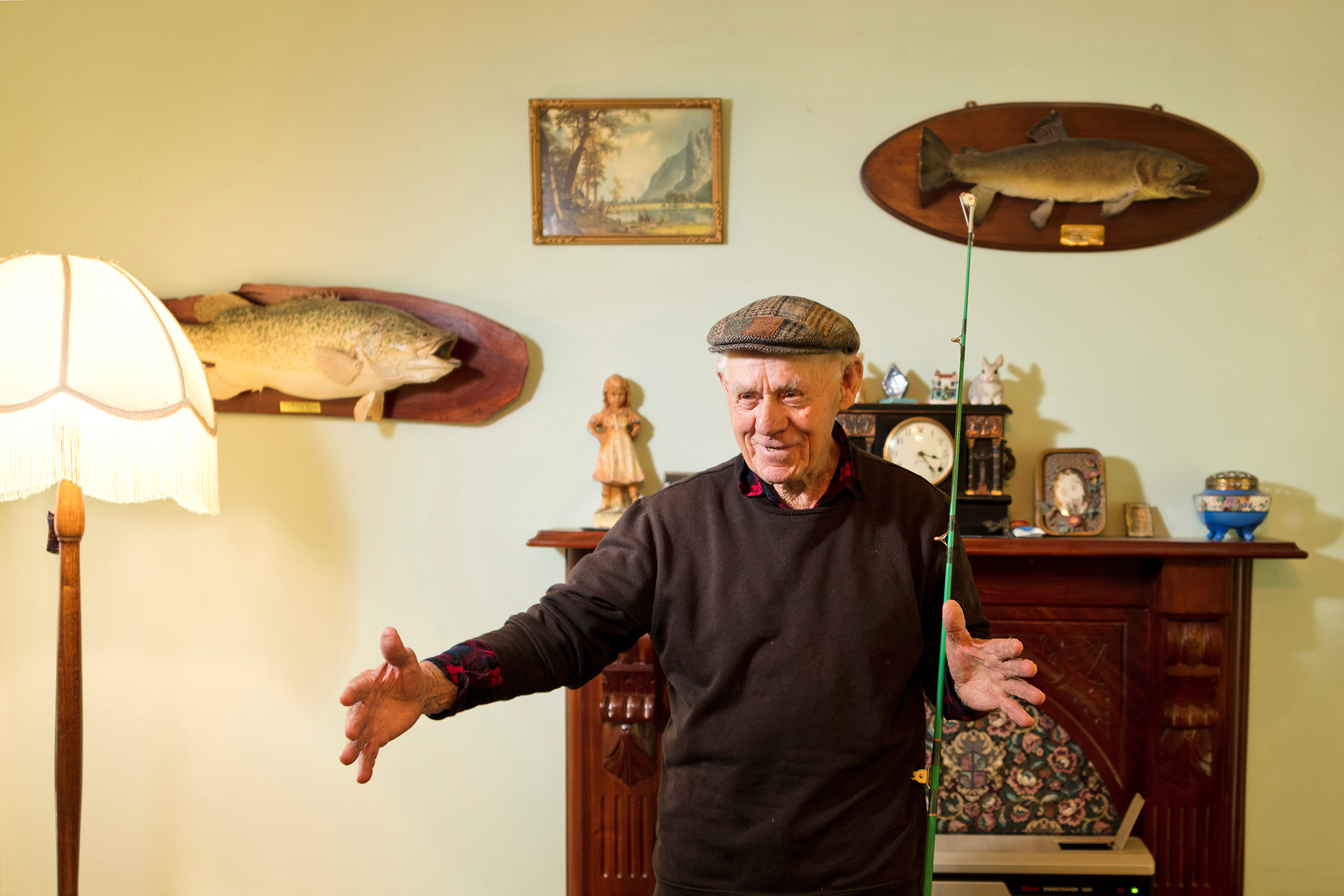
October 19th, 2020Of fish, massive gold and blackberries: Laurie’s world
Along the way we find out about using frogs as fish bait, his local paper nom de plume (“Whopper”) and how Angling Club records are not, contrary to his information, with a local couple because both have died. But they do exist, apparently, and should eventually find a home with the Daylesford & District Historical Society, telling the story of a club that was founded in 1919, burnt down with a loss of records and began again in the 1930s. Drought eventually killed it.
Meanwhile, Laurie’s got a cuttings book with snaps of youngsters with actual and whimsical pieces by “Whopper”, who tells of one Ron Chesterman seeing a fish in the Hepburn Lagoon so big his truck wouldn’t carry it. And Jess Hartup, last seen heading down Birches Creek through the willows hanging on to a whopper. Other fishing news was by “Small Fry”, now unknown, who warned in a footnote: “Look out for the Joe Blakes.”
Now 83, Laurie is brimful of stories. He helped run an angling club at Foster in Gippsland before returning in 1972 to the town of his birth. He and his wife Dorothy (“Dot”), who’s now in Hepburn House, had five children, so he set out to expand the local anglers’ club to include juniors. Success led to him becoming president of the Midland Anglers Association.
In this role he set up an annual competition held in the middle of a big dam at Hanging Rock. “A bus driver took a full load of us for nothing in Summer, in about 1972. The first year every kid got a trophy.”
They included a four-year-old girl with her 4 1/2lb trout. “Her father reeled it in. I said, ‘No rules! No regulations!’ and she got top prize.”
Apart from 16 years running a piggery in Gippsland, he’s always lived here, starting the district’s first garbage collection on a $14,000 contract in October 1974.
His father had a farm at Glenlyon and, having a fine voice, always claimed a relationship with another Mitchell, Dame Nellie Melba. Grandad was from Scotland.
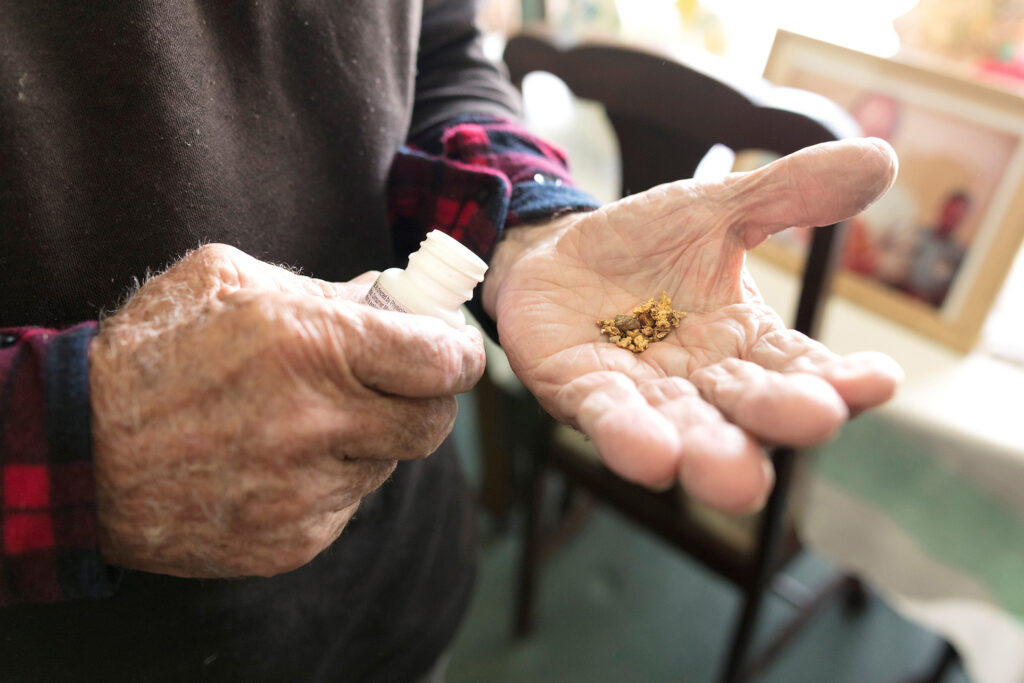
After 10 years as club secretary, Laurie gave it away when he had his first heart attack at age 42. He’s had a triple bypass and a couple of stents inserted but still shoots over to Talbot with his metal detector on the hunt for gold.
It’s a hunt that his offspring inherited. He shows a photo of his son, Robert, flanked by two security guards as he shows the 16kg Evening Star, found at night in 1992 among WA saltbush flats at Paddy’s Knob, a steep hill, eight kilometres north of Ora Banda, which is 66km north-west of Kalgoorlie. The fourth largest nugget found in Australia, it sold to a cattle king at auction in Sydney for $845,000 and is now thought to be in Germany. Its discovery sparked a gold rush when the news leaked out a year later.
Robert still hunts for gold from his home in Siberia, a once-abandoned goldfields town 86km north-west of Kalgoorlie. Gold was first found there in the late 1890s.
From gold it’s back to fishing: Laurie and his mates would jump the fence to catch frogs at the Water Trust tank in the Wombat Hill Botanic Gardens (it’s now roofed).
Among the best fishing spots were the Malmsbury and Cairn Curran reservoirs and over at Lauriston. Laurie’s successes are mounted in his living room: a 6lb 10oz trout from Omeo, a 16lb Murray cod caught near Swan Hill and a 4lb yellowbelly from Boundary Bend on the Murray River. There’s also a memento of when Dot won the trophy for the heaviest fish of the year.
Next Laurie shows us the hut he and Dot built. Well air-conditioned, he observes, as the sun shines through spaces in the hand-cut timber. Spread about is rusting gold-mining gear.
To finish, he reveals the art of blackberrying. He would hit the bushes with a bit of timber, forcing the berries into a baby’s bath with holes in its bottom. The bath would be put in a creek to clean the berries, which would fetch $200 to $300 at Ballarat.
Back outside, he shows his big vegie garden as he prepares to visit Dot (they’ve been married for 63 years), always with flowers for the Hepburn House staff.
Words: Kevin Childs | Image: David White