


May 7th, 2024Science podcast probes latest bushfire research
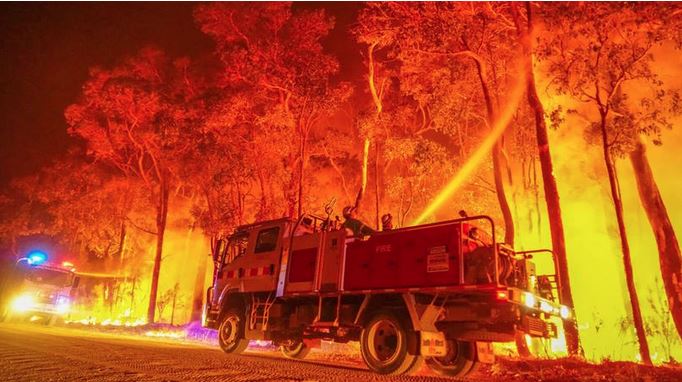
The severity, complexity and changing nature of Australia’s bushfire seasons and the research that informs planning and response are showcased in a new podcast series.
The Debunks series of podcasts, produced by Cosmos and 9Podcasts, speaks with Natural Hazards Research Australia’s (NHRA) CEO Andrew Gissing, as well as NHRA researcher Dr Hamish Clark (University of Melbourne) and previous Cooperative Research Centre postgraduate alumnus Dr Steve Sutton, to get to grips with issues such as the Australian Fire Danger Rating System, community and individual preparedness, fireproofing property, Australia’s fire history and the influence of climate change.
In the episode ‘Do I really have to leave when the rating is catastrophic?,’ Andrew discusses individual fire preparedness rates, as well as the psychological obstacles to people leaving at-risk areas early.
“Generally, people aren’t well prepared for natural hazards across the country. Most people are also unprepared to leave on the basis of a weather report,” Andrew said.
Following the 2009 fires in Victoria, where conditions were outside the bounds of the McArthur Fire Danger Rating system, research informed the establishment of a more flexible index that ensured continuity of messaging and actions across states and territories.
Andrew states the importance of being prepared, but also individuals’ responsibility to actively monitor emergency information.
“It’s really good to have numerous ways to get warnings, so it’s not just about the [emergency] app and it’s not just about the text messages you might be getting. It’s about having a battery-powered radio so you can listen to the ABC and other emergency broadcasters to get current, local information.”
Adjunct Professor Jim McLennan (La Trobe University and Black Saturday social research lead for the Bushfire CRC) raises the ongoing challenge facing emergency broadcasters and responders to leave early when conditions are dangerous, especially when residents haven’t faced a fire threat before.
“The challenge for community safety units in the rural fire agencies is a bit like that of painting the Sydney Harbour Bridge – you never finish. You get to one end, and you start again at the other,” Jim said.
In the episode ‘Do hazard reduction burns really work?’ Dr Hamish Clark outlines how prescribed burning works and why local details matter the most, such as fire regimes for any given area, the vegetation type and amount, as well as the terrain.
“A really important message is that the local landscape matters,” Hamish said.
He also explains the risks associated with prescribed burning and why the weather is one of the most important influencing factors of whether a prescribed burn can take place.
As fire seasons become longer due to the influence of climate change, the weather windows when prescribed burning can take place safely also are changing – too wet and the vegetation won’t burn, but too dry and prescribed burns can escape and become a bushfire. Hamish also outlines the amount of planning and strategy required for every prescribed burn.
“You’ve got a kind of Goldilocks situation where you need the right weather conditions,” Hamish said.
“That is the minimum bar to jump. You don’t want to be doing it under the wrong conditions. But within that there is a very big planning system that goes into it. You’re thinking about risk in the landscape and areas that you want to target. You’re thinking about where communities are and where resources are.”
Jim McLennan is featured extensively. He led the then Bushfire CRC’s post fire social research after the 2009 fires in Victoria, where more than 600 residents were interviewed about their responses to warnings, behaviour during the bushfires and decision-making.
Jim spoke at length about the findings from this research, which included post-fire interviews with residents after fires at Lake Clifton (2011) and Perth Hills (2014) in Western Australia, Tasmania (2013) and Yass, Shoalhaven, Coonabarabran, the Blue Mountains, Southern Highlands and Port Stephens (2013) in NSW.
There are a further five episodes in the series on a range of topics. You can listen to the podcast on the Cosmos website or on your preferred podcast platform including Spotify.
May 7th, 2024New fire investigation training facility unveiled
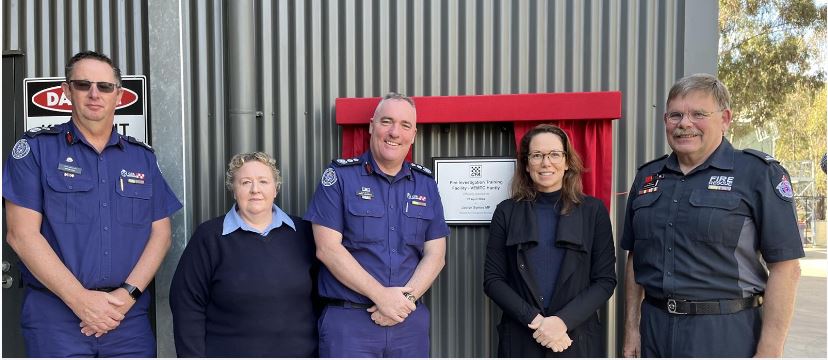
The CFA has unveiled its new state of the art and purpose built Fire Investigation Training Facility at the Victorian Emergency Management Training Centre (VEMTC) in Huntly in recent days.
The $3.4 million facility is the first of its kind in Australasia and will enable CFA firefighters and other emergency service personnel to learn how to investigate the origin and cause of fires in a safe and controlled environment.
CFA Chief Officer Jason Heffernan said the CFA is committed to providing its firefighters with the best infrastructure, training and support but it’s not just emergency service personnel who will benefit from this facility.
“Fires can be started as a result of everyday appliances malfunctioning such as fridges, toasters and battery chargers,” said Jason.
“In this new facility, our fire investigators will be trained to identify if something of that nature has happened which can help us prevent future fire emergencies and continue to protect the safety of Victorians.
“We’re also excited to be able to share these new facilities with our multi-agency colleagues across Victoria Police, Forensic Services, Fire Rescue Victoria (FRV), Department of Energy, Environment and Climate Action (DEECA), Energy Safe Victoria (ESV) and WorkSafe Victoria.”
The facility features four burn rooms which can be staged to replicate what happens when a fire starts within a home, garage or other residential environment.
The rooms are fitted with several technological features that can record the temperature of a fire at different levels within the room as well as a large-screen television that’s linked directly to the camera inside each room to observe and record the ignition and development of the fire.
This data can then be used to teach firefighters and fire investigators about fire dynamics and helps them piece together how a fire could have started.
The Fire Investigation Training Facility also has a carport where vehicle fires can be replicated for learning purposes.
Structure and vehicle fires are some of the most common types of incidents that CFA firefighters respond to. House fires are categorised as structure fires.
Fire investigation helps prevent other fires occurring and can result in product recalls if appliances and equipment are found to be unsafe.
For example, an investigation into a structure fire in 2022 identified that the origin and cause of a fire was an electrical failure of a fridge located in an outdoor kitchen at a residential property.
Details of the make, model and year of manufacture were documented as part of the fire scene examination process and ultimately through working in partnership with external agencies such as Energy Safe Victoria (Electrical) the investigations contributed to the identification of the fire risk, leading to a product safety recall of the fridge.
With a focus on environmental safety and sustainability, the training facility incorporates a $1.76 million thermal oxidiser to capture and treat the smoke and combustion gases produced from the burns.
May 7th, 2024Regional dwellers doing it tougher: relief agencies

Regional Victorians are doing it harder than their metro counterparts as the cost of living rises, reports suggest.
Data released recently by Lifeline Australia reveals around 500 calls each day are related to financial management, employment, or housing insecurity.
Cost of living pressures have been particularly hitting home in regional Victoria according to food and housing relief agencies.
Lifeline Australia CEO Colin Seery said it was important for anyone struggling to know that the organisation is available 24/7 to provide support.
“As well as telephone and digital support, Lifeline has 43 centres across Australia. Some of these offer face-to-face crisis support as well as counselling specifically focused on financial distress,” he said.
“What is concerning is that we know the true number of people identifying cost-of-living pressures as their primary reason for contacting Lifeline is actually significantly higher.”
“This data does not take into account the 900 help seekers contacting us via our text and webchat services each day, or those reaching to our Support Toolkit or specialised helplines.”
“Our centres are also reporting an increase in complex cases, with help seekers presenting in severe distress, having struggled to find relief and feeling like their options are increasingly limited.”
Lifeline Australia’s Chief Research Officer, Dr Anna Brooks, said that financial stressors are not isolated to those who have a mortgage, with cost-of-living increases flowing through to generate higher rental costs and other economic pressures.
“Financial stress and uncertainty can contribute to mental ill health. There is also a robust and growing body of evidence to suggest that people can experience increased risk of suicide when facing these challenges.”
May 6th, 2024Springs Reserve upgrade makes headway
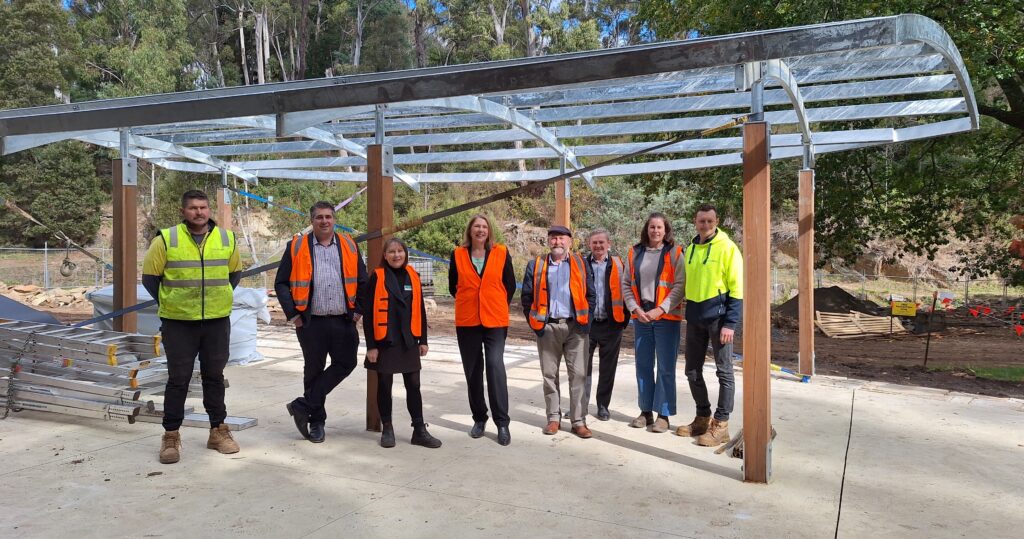
Good progress is being made as part of the first phase of work to upgrade the Central Springs Reserve at Lake Daylesford, the Hepburn Shire Council says.
On Friday 26 April, the Federal Member for Ballarat, Catherine King and Hepburn Shire Mayor Cr Brian Hood inspected ongoing work as part of the first phase of the upgrade.
Mayor, Cr Brian Hood, said the project will create a safer and broader space for visitors to the Springs precinct.
“The design was closely coordinated with Djandak, the working arm of traditional land owners Djaara, including elements such as the picnic shelter, signage, and mineral spring pump area design,” said Cr Hood.
This is the first stage of implementation of the masterplan which was adopted following community consultation in 2021 and sees three new mineral spring pumps (1 accessible), complemented by Djaara artwork. The project will also include:
- A paved picnic area with a BBQ, picnic tables and an indigenous-inspired shelter
- Rejuvenation of the hydroelectric pump infrastructure and the Hard Hills spring
- Directional and interpretative signage
- Landscaping with plenty of seating opportunities to take in the beautiful surrounds
- The design of the works takes into account the health and safety of the significant trees within the reserve.
“This wonderful upgrade is expected to be completed in time for Spring this year and was made possible by the Federal Government’s election commitments under the Investing in Our Communities Program. This beautiful area will further enhance our vital and growing tourist economy,” said Cr Hood.
The $1.47 million project was approved by Council at the December 2023 Council Meeting and is funded by $350,000 from the Federal Government, with the remaining funding from Council, particularly through our Mineral Springs Reserve fund.
Catherine King MP: “We’re delivering on this election commitment to upgrade the iconic Central Springs Reserve and support Daylesford’s vital and growing tourism economy.
“Central Springs Reserve is a perfect place for families and many of us have childhood memories of picnicking and pumping water from the springs here. This investment means that families in the future will be able to make the same great memories.”
May 6th, 2024Facelift for Malmsbury Village Green
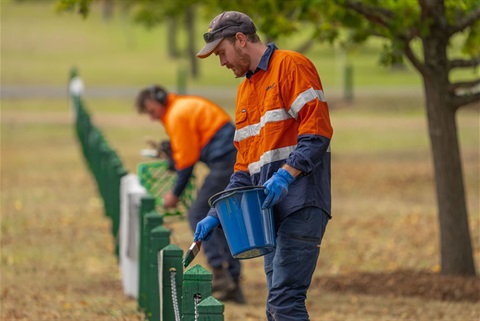
Malmsbury’s Village Green has received a makeover amid Autumn Festival celebrations, thanks to a Macedon Ranges Council trial seeking to refresh popular public open spaces.
The council’s Open Space team successfully completed a strategic maintenance blitz between 8-12 April within the heart of the town, with works including:
- repairing and refreshing existing assets such as bollards, chain fencing and park furniture
- greenery improvements such as mulching, new plantings, garden bed maintenance and tree works
- topping up paths and installing fresh gravel around signage and artworks.
The council’s Ryan Hughes was an Open Space leader involved in the initiative.
“We’re seeing if it’s cost-effective to have our Open Space crews step away from their normal maintenance roles, to improve council assets throughout the shire,” he said.
“The objectives of the blitz was to refresh and visually improve the area for the Malmsbury community, and our focus is on improving and maintaining these spaces for our residents and visitors.”
Malmsbury was selected for the trial due to its size, its identified need for a refresh and the ability to draw from existing budgets to complete the required works.
The council will now assess the trial’s effectiveness and confirm whether similar blitzes could be strategically undertaken at other sites throughout the shire.
May 6th, 2024Artefact find delays kinder build at Lancefield

Target timelines on the new kindergarten and Maternal and Child Health Centre in Lancefield have changed, due to the discovery of a cultural artefact during site preparation works.
In line with strict protocols around such unexpected discoveries, works were immediately paused and project managers the Victorian School Building Authority (VSBA) consulted with the relevant Traditional Owner Corporation, which then engaged a heritage consultant and began preparing a Cultural Heritage Management Plan to enable the works to progress.
The Macedon Ranges Council’s Director Community, Maria Weiss, said the delay to the opening of the facility was disappointing given the community need for increased local services.
“This means that the new kinder and Maternal and Child Health Centre will not open as scheduled,” she said.
“We will continue to work closely with the VSBA and update families – and the broader public – as the project progresses, including when we have a firmer idea of revised timelines.”
The project, located next to Lancefield Primary School, will feature a modern three-room facility which is largely built offsite through modular construction.
Words & Image: Supplied
May 6th, 2024Ballarat prepares for return of White Night
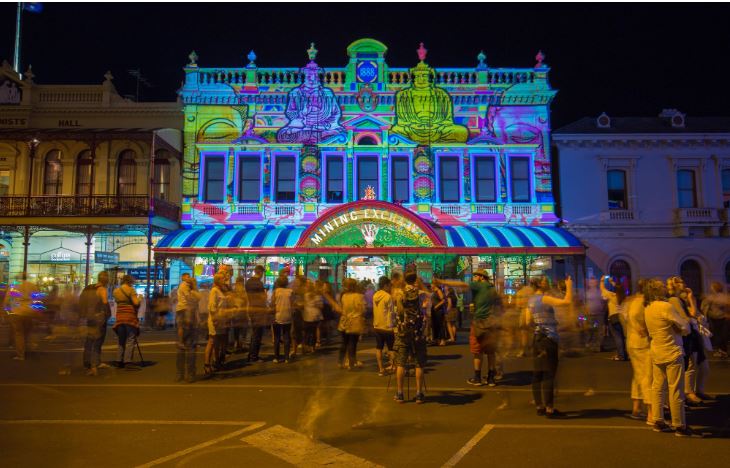
Locals and visitors to Ballarat are set to enjoy a visual feast for this year’s White Night event as the city puts on a radiant display on Saturday 1 June 2024 from 6pm – 12 midnight.
White Night will transform Ballarat with dazzling laser beams and projections illuminating the historic city, in a program featuring a light spectacular, music and interactive works.
The inclusive event is a celebration of immersive art and community participation, with something for everyone.
The late-night illumination will transform the streets, laneways and heritage venues of the Ballarat CBD grid, embracing the adventurous, encouraging the curious.
White Night Ballarat will feature almost 40 projections, over 100 artists and performers many of them from Ballarat and surrounds, a delicious selection of White Night Bites to be discovered across the city, family friendly entertainment and activities and two concert stages to get the music fan’s heart racing.
JAZZPARTY, Tek Tek Ensemble, The ReChords, Troy Firebrace, Parvyn, The Counterfeit, James Ellis and the Jealous Guys and local Ballarat artists Yacht Club DJs, Sami and Lashes will perform from two main stages on Sturt and Mair Streets in an all-night music program.
Featured artists around Ballarat during White Night include Still Here by the late Josh Muir whose work will be projected across Sturt Street, a series of joyful projections by local artist Deborah Klein and the sublime work Slow Curtain by renowned photographer Lisa Walker.
Stretching along Armstrong and Doveton Streets, Ballarat’s culinary delights will be in the spotlight with many award-winning eateries taking part in White Night Bites and providing a snack or two for the late-night adventurer.
Artistic Director and Creative Producer Andrew Walsh AM of renowned major events organisation Accolade.art said Ballarat’s White Night is for the adventure-seeker, attracting visitors and locals alike.
“This is a celebration of the unexpected,” he said.
“Ballarat is set for six hours of illuminated magic, ready to glow bright for this alluring winter experience. We encourage everyone to explore, discover and be dazzled and to take yourself, your friends, your family on a serendipitous adventure.”
Accolade.art’s first venture with White Night began in Melbourne in 2013 – the first Australian city to host the popular Parisian Nuit Blanche festival which started in 2002. Since then, Accolade has produced six White Night events in partnership with Visit Victoria, growing and developing the annual dusk-til-dawn event across the state.
Ballarat is set for a blockbuster this winter with White Night 2019 drawing more than 40,000 visitors to the region. Restaurants, businesses, and accommodation will once again be immersed in the energy of White Night with thousands set to embark on a Ballarat weekend adventure ready to enjoy the city and everything it has on offer.
“We are thrilled to welcome White Night back to the City of Ballarat for the first time in four years,” Ballarat Mayor, Cr Des Hudson said.
“This will be one of the highlights of the year as our city centre comes alive with spectacular projections, music, art and roaming performers and the best part, it is completely free to attend. I’d encourage our community to embrace this wonderful opportunity and invite your family and friends from near and far to Ballarat for a weekend not to be missed.”
White Night Ballarat is free to attend and takes place on Saturday 1 June 2024 from 6pm to 12 midnight in Ballarat’s CDB.

May 5th, 2024Wine notes

with Clive Hartley
Yangarra’s Rhône Crusade
Winemaker Peter Fraser from Yangarra Estate in the McLaren Vale is passionate about some grape varieties you might not be too familiar with.
His white wine is simply called ‘Blanc’ and is a blend of grenache blanc (80%) with splattering of roussanne, bourboulenc, clairette, grenache gris and piquepoul blanc.
All these varieties originated in the southern Rhône Valley and Yangarra planted them in 2014.
“These white grapes have a huge potential in the McLaren Vale as they like a warm coastal climate and are late ripening, in fact, last year we picked piquepoul later than our red wines,” Peter said.
Piquepoul blanc has been picked up by other producers such as Coriole and Lloyd Brothers. Both wines are highly recommended.
The Yangarra Blanc 2022 ($30) is not a fruity wine, but a fleshy, juicy, nutty wine with a lot of minerality. Grenache blanc and roussanne is also used to make their Ovitelli Blanc 2022 which is fermented and matured in a large ceramic egg. These eggs are a feature at Yangarra.
“Using ceramics gives the wine a sense of purity and brightness of fruit that is not achieved in stainless steel or oak. They allow air to penetrate, but not as much as a barrel does.”
A portion of the wine undergoes over 100 days on skins. The result is a fleshy, rich and complex wine that is firm and textured. It’s a more serious drink at $68 a bottle.
Yangarra Noir 2022 ($30) is another blend from the Rhône. This time they use grenache noir, carignan, cinsaut, counoise, shiraz and mourvèdre.
Blends are more fun than single grape varieties and this one is fruit driven with plums and floral notes. It’s a pleasant surprise to find a nice tannin spine in the wine that gives a bit more structure than one would expect.
Grenache is in the spotlight at the moment and when handled well, like at Yangarra, it makes wines similar to pinot noir or even nebbiolo. Sadly, Peter tells me it only represents 6% of plantings in the region.
“Grenache is drought tolerant and grows well in the sands of Blewitt Springs. There is currently a resurgence here and it will increase in plantings. Currently it has the highest grape price in the McLaren Vale and Barossa Valley.”
Yangarra Ovitelli Grenache 2021 ($80) is sourced from dry grown 1946 bush vine fruit that is fermented and aged in ceramic eggs. It has lifted aromas of red fruits and floral touches.
On the palate it is supremely elegant, textured with fine tannins and a long finish. These wines exemplify Yangarra Estate’s approach to winemaking. Their wines have flavour and texture with a lighter touch than most McLaren Vale wines.

Clive Hartley is an award-winning wine writer, educator and consultant. His 305 page full colour book Australian Wine Guide (7th ed) is available for purchase from Paradise Books in Daylesford or via his website – www.australianwineguide.com.au
May 5th, 2024Youth summit helps shape Macedon’s approach
The Macedon Ranges Council’s future plans and actions for young people in the shire are expected to be better informed, following a youth summit held in March.
“It was the first time I had been invited to an event like this and I have enjoyed being asked about my ideas and suggestions and I feel heard.” one participating Gisborne Secondary College student said.
On 21 March, around 90 young people from local secondary schools convened at Woodend Community Centre alongside the council’s youth services team, councillors, Sunbury Cobaw Community Health, Woodend Rotary, headspace, and Djaara Balaki Wuku, marking the first summit of its kind in several years.
The day-long summit provided an opportunity for young people in the shire to come together to have their voices heard and give valuable feedback on key issues including:
- Public transport and isolation
- Environment and global warming
- Physical activity, art and leisure
- Mental health and wellbeing, Alcohol and Other Drug (AOD) matters and body image
- Career and education
- School holiday program, tech space and coding
The council’s Director Community, Maria Weiss, says the council’s ELEVATE Youth Strategy provides a comprehensive roadmap guiding the council on how to effectively support and engage with the shire’s young population now and into the future.
“It’s essential that we actively listen to, learn from, and collaborate with our young people to ensure any initiatives we implement under the ELEVATE strategy are relevant to their needs,” she said.
“The summit has provided an excellent opportunity to do this and it was fantastic to see so many young people engage in it in such a positive way and contribute their ideas.”
The council is now analysing the summit findings to ensure the ideas, opinions, concerns, and aspirations raised are included in relevant future plans and actions, with the council committed to supporting ongoing engagement with children and young people.
May 5th, 2024Chance to help shape health outcomes for Hepburn shire


The Hepburn Shire Council is investigating key areas that directly influence the health and wellbeing of its residents with locals invited to participate in an online survey.
Mayor, Cr Brian Hood, said that the council is committed to maintaining best practice strategies on health and wellbeing for the shire.
‘We have established an online survey on our Participate Hepburn page, which residents are invited to complete. The results from this survey will provide valuable insight into issues that fall outside conventional data streams.’
“We have worked with Central Highlands Rural Health and the Grampians Public Health Unit to design the questionnaire. It covers areas such as general lifestyle, physical and mental health, nutrition, access to health services, community safety and climate action. It also calls for ideas on opportunities to improve services and programs,” said Cr Hood.
The current council’s Municipal Public Health and Wellbeing Plan was developed in conjunction with community and stakeholders, including data analysis concluded with the Victorian State Government.
The results of the survey, together with data and evidence from stakeholders, will provide the foundation for the council to develop its next Municipal Public Health and Wellbeing Plan, to be consulted with the community post-council elections in October.
“The survey is confidential and anonymous,” says Cr Hood, ‘and we hope that residents will take the opportunity to complete it.”
The survey closes on 17 June 2024 and is open to all residents of the Hepburn Shire. Those keen to participate can find it through the council’s website and Participate Hepburn platform.

May 5th, 2024Council formally opposes pokies bid for Romsey pub


The Macedon Ranges Shire Council has formally endorsed a submission to the Victorian Gambling and Casino Control Commission opposing an application for 50 electronic gaming machines in the Romsey Hotel.
In considering the submission at its recent April scheduled meeting the council noted that the proposal would have a net detriment of 0.66 on the wellbeing of the community under the ‘no net detriment test’ (a result below 1 (<1) indicates a negative impact, a result above 1 (>1) indicates no detriment has been concluded).
A community survey commissioned by the council – conducted by an independent company – received 1493 responses, with 60.36 per cent of respondents believing 50 electronic gaming machines in the Romsey township would have a negative impact on the broader community and 59.93 per cent of respondents not supporting the application.
The Victorian Gambling and Casino Control Commission will consider the application – including the council’s submission – at a hearing commencing May 21 this year.
May 4th, 2024Creswick bowling green re-opens

The Creswick Bowling Green has officially re-opened for use in recent days.
Federal minister and MP for Ballarat Catherine King, on Wednesday April 24, attended a ceremony marking the bowling green reconstruction, and the beginning of oval drainage and irrigation works.
Hepburn Shire mayor, Cr Brian Hood, said the full redevelopment of the bowling green was necessary after the storm and flooding event in 2022 irreparably damaged the venue.
“It was the rigorous planning and favourable weather that have allowed us to bring this project to completion on time and in budget,” said Cr Hood.
To combat future storm damage, the design incorporated new drainage and overflows, and 400 subbase screw piles for a suspended concrete slab base. This design combats the site’s reactive soil conditions.
“The bowling club is an important asset to Creswick. As well as bowling, it is used by local community groups, schools, and the broader community. We sincerely thank the Federal Government for their significant contribution towards this project,” said Cr Hood.
The restoration was managed by PM Building, a Ballarat-based construction contractor. Berry Bowling Systems acted as a sub-contractor responsible for installing the synthetic bowling green.
The bowling green formed stage 1 of the Doug Lindsay Recreation Reserve Sustainability Improvements Project. Stage 2, to occur in the 2024/2025 financial year, will include significant improvements to the drainage and irrigation of the main oval to increase use and enjoyment of the oval and reduce flooding.
The Australian Federal Government have provided $750,000 towards stages 1 and 2. The council’s contribution for the two projects is estimated at $540,000.
May 4th, 2024CFA celebrate International Women’s Day with inclusion
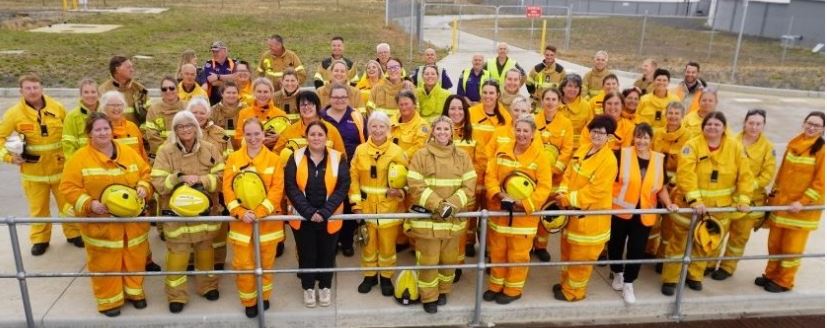
The CFA’s District 7 last month hosted an Inspire Inclusion event at the Victorian Emergency Management Training Centre’s Central Highlands Campus near Ballan, in honour of International Women’s Day.
“The Inspire Inclusion Day was brilliant – it was fantastic to see other female volunteers from across the district come together and learn new firefighting techniques, test knowledge and skills, and get to know each other,” Barwon Heads Fire Brigade Volunteer Libby Burnett said.
“It didn’t matter what someone’s skill level or capability was, everyone got something out of it. I loved that non-operational volunteers got to try the various drills and participate in the training too.”
With a full house, the day started with two phenomenal guest speakers. First up was Cherie O’Neill, VFLW Senior Coach – Essendon Football Club and Kangaroo Flat Fire Brigade member. Throughout her career, Cherie has been at the forefront of breaking ground, carving a space and place for herself and others to play football, initially in mens’ teams, and then leading other women into a new generation of women’s football as a coach.
Brooke Bailey from DEECA shared her childhood dreams of firefighting, and the barriers she overcame along the way to make her dream a reality. She shared her journey from initially becoming a project firefighter, then her progress up the ranks managing crews on the fireground, training new general firefighters, deployments abroad and leading people from diverse backgrounds to develop and excel in emergency management.
Both speakers shared a similar personal journey of the need to seek and create opportunities for yourself, building leadership skills and styles along the way and in doing so, carving their own path forward and helping others succeed.
They both embody the phrase ‘if you can’t see it, you can’t be it’, and are fantastic role models for anyone choosing a different path to the norm.
Following the speaker presentations, the attendees were divided into groups and rotated through a number of training sessions.
The newly created 4WD circuit was the hit of the day. The circuit provided a range of scenarios to test the limits of the drivers. There were a number of vehicles to choose from, including a manual medium tanker, an automatic tanker, and a number of field command vehicles.
The drivers took the vehicles through their paces along the circuit which included: gradient inclines of 10 per cent, 15 per cent and 20 per cent; moguls; up and over stairs; through a deep sandy path; along a boggy track; and through a water crossing.
The circuit is interesting and diverse, yet short enough for a good rotation of drivers.
Then there were a number of activities putting the wet stuff on the hot stuff at two of the hot fire props. Participants undertook sizing up, team drills, and choosing an approach to attack a tanker fuel leak and gas cylinders. A highlight was the five-person fog attack on the gas bullets.
The final two drills were to practise command and control of an incident and using fire extinguishers for a number of scenarios and a kitchen fire prop.
Volunteer Libby Burnett reflected that the day wasn’t about what we can’t do, but instead was very much focused on “what do you want to do and how can we help you get there”.
Assistant Chief Fire Officer Brendan Lawson reflected on the Inspire Inclusion event with enthusiasm. He noted how the day began with captivating talks from speakers.
“Their stories were powerful and engaging,” Brendan said, “and the afternoon sessions provided attendees with the opportunity to experience everything Central Highlands training has to offer, including hot fire props, off-road driving, and extinguishers”.
The event served as a valuable networking opportunity, bringing together women and senior leaders from District 7 to discuss ideas and foster connections in an inclusive environment.

May 4th, 2024Glen, about the house
Movement in the garden

I’m sure I’m not the only one who makes a daily tour of our newly planted trees or shrubs, looking anxiously for any sign of new growth.
We all know, of course, that any new outward or upward growth, except in a few ‘Jack-and the beanstalk’ plants, and a few vines, can be too slow to be considered as movement at all – unless you live in Far North Australia or in the tropics. But, as always, there are a few exceptions.
Some plants have a regular cycle for opening their blossoms each day to attract with their fragrance, bees and other winged pollinators, but closing again at dusk to evade the scavengers.
Many other more miserly plants such as some iris only open for business for just one day before closing forever – apparently preferring the ‘fast trade’.
Others open at certain times of the day in order to attract particular patrons. These include the four o’clocks (mirabilis jalapa) which true to its name, opens at the same hour and stays open all night. ‘Morning Glories’, like a few others, open at first light and close again at noon.
Many other more bloodthirsty plants are the insect trappers where you will see definite and fairly rapid movement, such plants as the venus fly trap (dionaea muscipula), a perennial herb from the swamps of North and South Carolina.
At the base of each 30cm long stem that produces white flowers, we will find a rosette of leaves consisting of two parts with a hinge between them.
Whenever an insect alights on a hairy leaf, the two parts of the leaf snap close to enfold the insect until it dies and its body juices are absorbed. The leaf closes within half a second after the insect touches it.
Twining
Twining vines present an amazing, although rather slow movement, with some twisting from left to right, while others prefer to twist from right to left.
No matter what you do in an attempt to reverse the natural direction of the twisting/twining the plant will persist in twisting around its support, but only in its own predetermined direction. This spiral twisting of a plant stem is called nutation.
Our good old garden friend, the sunflower, turns so that its large, flat blossom is at right angles to the sun. When each flower reaches maturity and its stem has become hard and stiff, no more movement is possible, but when it’s in bud it follows the sun across the heavens.
We can also see extremely fast movements in the method some plants use in dispersing their seeds. When a ripened balsam’s seed pod is touched, it seems to explode as the outer casing breaks into sections and curls back, sending the seeds flying in every direction over a wide area.
In late summer, violets develop pods that break open in three sections and send a great many seeds as far as one to two metres – and it seems that every one germinates, as we have found to our delight in the few years since we moved to our current garden.
But the king of rapid plant movement is the sensitive plant – mimosa pudica – which has entertained children and amazed adults for ages. The stems are spiny and the leaves are cut into many leaflets. Just the lightest of taps causes them to fold together – a heavier tap and the stem will droop down. A few minutes later they will resume their normal positions.
And finally, there are many other plants that close down for the night to reawaken in the morning sun’s light in what is called a sleep movement.
Got a gardening query? Email glenzgarden@gmail.com

May 4th, 2024Lily explores big benefits of using public transport …


Words: Kevin Childs
Public transport is a mystery for many people in Central Victoria. Yet nine buses leave Daylesford on most weekdays to link with trains to Melbourne and Ballarat.
Four go to Woodend, three to Ballarat and one to Ballan and Castlemaine, with an extra one to these last two towns on Fridays.
What’s more, concession fares for people such as seniors are $5.30 for unlimited weekday travel on train, tram or bus across Melbourne or the state. This drops to $3.60 at the weekend. And you can throw in four free travel days a year.
These insights come from Daylesford’s Lily Walden who has passionately taken up the cause of public transport by running free seminars for 70 people over five months and talking to local councillors and transport officials.
Her background in marketing services quickly becomes clear as her presentation starts. Up come reasons for using public transport: the main street of Daylesford is choked with cars, wildlife, the cost of
fuel, potholes and perhaps an attraction to beer or wine.
Then there is the ferocious freeway traffic. And the ease to reach places such as South Melbourne beach, the Victoria Market, Melbourne Zoo and films at the old Pentridge Prison.
Where it gets tricky, however, is that there are three transport ticket systems. V/Line runs trains and buses to the State border, regional services operate between V/Line and the Metropolitan system, which covers the city’s trains, trams and buses.

Daylesford passengers just need to ask for a regional extension ticket for their return journey at a station where they leave their bus.
And for people going to Ballarat for medical appointments there is even a medical zone bus. Daylesford’s buses leave from opposite the CFA in Bridport St, with the first leaving for Ballan at 6.15am. Three minutes later the Woodend bus leaves, with the Ballarat bus going at 7.15.
There is also a 7.25 to Ballarat, 10.23 to Woodend, 2pm to Castlemaine, 3.18 to Woodend, 4.45 to Ballarat and 5.23 to Woodend.
Lily explains that someone wanting to shop in Melbourne or Ballarat can easily be back in Daylesford by mid-afternoon.
And for people wanting help travelling, the century-old, free Travellers Aid offers volunteers and other support to get to appointments, events, work or education. Showers, luggage stores, and change tables are among the facilities at Southern Cross.
“They are available for everybody,” says Lily.
If public transport is not your thing, you may prefer a simpler, more energetic form of travel and do what Lily once did: walk. From Ballarat to Bendigo, as well as Hepburn to Castlemaine.