


November 10th, 2023Vale Tim Hayes

Timothy Kevin Hayes (1950 – 2023)
Tim Hayes was a community leader and internationalist who rejuvenated the township of Clunes and saw its population double.
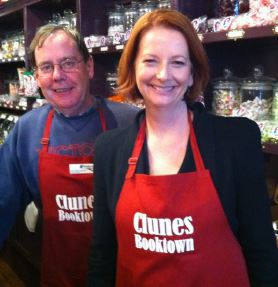
Tim (pictured above with former Prime Minister Julia Gillard) had strong family connections to the Victorian Labor Party, especially at the time of the DLP split of 1955 and wrote about this in his chapter ‘Faith of our Fathers’ in The Great Labor Schism: A Retrospective (2005) edited by Costar, Love and Strangio. This interest in politics shaped his public life.
In 1998, after working in local government, Tim and his partner, Michael Waugh, purchased an impressive historic building which was once the old Telegraph Hotel. It had been a Cobb & Co coach terminus and was one of the places the founding fathers discussed federation and the constitution. At the time the impressive building was known as Keebles Country House and was run as elegant accommodation and a restaurant. The pair continued to run this business for eight years.
Tim recognised the value of tourism in renewing country towns and called a committee together to form a sister city relationship with Coloma in the US. Like Clunes, it had been the place of gold’s first discovery. The sister city relationship was officially acknowledged by the El Dorado County Board in February 2000. Tim and his committee held annual celebrations in the extensive grounds of Keebles which raised funds for local clubs and groups. These had an American theme, were joined by US officials, and often celebrated Broadway musicals.
At this time Tim joined the staff as administrator of the newly created year 9 residential campus of Wesley College in Clunes. Tim was the interface between Wesley and the Clunes community. His background in hospitality and local government stood him in good stead as did his wickedly irreverent sense of humour and his impeccable understanding of how to make things work. Under his leadership Wesley and Clunes formed a strong relationship which endures to this day.
In 2001 he was instrumental in setting up a Clunes committee to steer the celebrations of 150 years since gold discovery. These were so successful the events won the Judges Award for Best Tourism Association Event in the regional section at the 2002 Goldfields Tourism Awards.
His love of theatre saw him form the local amateur society where its annual productions included the musical, The Boyfriend and the Australian classic, Dimboola.
He and his partner established Widow Twankey’s Confectionary Emporium and ice cream parlour as a fantastical shop on Clunes’ main street in the theme of Aladdin. The bright colours and magical display of confectionery created a tourism icon and assisted the reinvigoration of Fraser Street. They operated this business until 2021.
In 2006 he was elected councillor and in 2007 became mayor of Hepburn Shire. One of his most outstanding achievements was the $3.23 million redevelopment of the Clunes Museum and Interpretive Centre and significant renovations to the Clunes and District Agricultural Showgrounds.
In 2007 he, along with Graeme Johnstone, Linda Newitt and Tess Brady, was a founder of Clunes Booktown, a long-running project which significantly enhanced tourism and prosperity in the town. Its annual festival attracts around 15,000 visitors and is a highlight of the regional calendar.
For 10 years Tim ran the secretariate ensuring that the organisation was well-run but flexible enough to be creative and embrace opportunities. He oversaw the 2010 bid to join the International Organisation of Booktowns, the first membership offered to a town in the Southern Hemisphere.
He served on several community and local boards including as Chair of the Central Highlands Regional Libraries Corporation (2010-2012) and as a member of the Community Bank Creswick and District taking an active role on the board from 2014 until 2021 where he served as a member of the Business Development Committee and the chairperson of the Audit & Finance Committee.
Whip-smart, funny, and a person of great substance, Tim’s contributions to his community will be counted for many years to come.
Tim died on October 28, 2023 after an illness and is survived by his partner Michael Waugh.
Contributed: Tess Brady

November 9th, 2023Responsible building on bush blocks

Words & image: Tony Sawrey
In a region such as the Central Highlands, the natural environment is what attracts people to this area, it sustains our tourism industry and by extension, the real estate market as people seek a more permanent escape from the city.
But, of course many new landowners, especially those on bush blocks, must take into consideration the potential perils of the scrub that surrounds them and the possibility of forest fire.
With this concern in the back of the mind owners respond to the threat in various ways. The most extreme being to bring in the machinery, clear away and remove everything, wipe the slate clean. It is an approach that is pretty common and you don’t have to look too hard to see examples of such wholesale clearing.
But is this the only way to develop a bush block? Strip it bare? What about the creatures that live in that environment? Surely there is a middle path between preparing your place in case of fire and allowing the local wildlife some form of shelter and sustenance for the rest of the time.
On the other hand, while some commentators on social media might have you thinking the entire place is ready to be overwhelmed by rapacious development, the reality is nothing like those peri-urban regions where vast housing estates march to the horizon.
Here development advances quietly, often hidden and in piecemeal but persistent fashion. And while the Hepburn Shire Council does have specific guidelines relating to bush block development, it is not a straightforward matter as Bradley Thomas CEO explains:
“The removal of native vegetation is a complex matter. Native vegetation generally requires a permit to be removed, however, each property should be assessed on its own merits.
“Factors considered in determining whether a permit is required include zoning, the size of the land and any environmental overlays (eg, bushfire management overlays).
“Council continues to take enforcement action on native vegetation removal. Property owners who are unsure of the requirements for permits for the removal of vegetation on their own land can contact council for guidance.”
However Gayle Osborne at Wombat Forestcare feels that in some cases people have probably cleared more than they are legally allowed to. And there doesn’t seem to be any follow up to make sure that people have stuck to the guidelines.
“It is quite a distressing situation,” she says, “because we are clearing more native vegetation than we are regenerating. We are also losing mature trees that are needed as habitat for koalas particularly and possibly losing trees with hollows that affect creatures like gang-gangs which are now a threatened species.”
Another concern is when people strip away dead standing trees and undergrowth. But Gayle urges landowners to keep some perspective when doing such work. Dead trees are organic apartment blocks for nesting birds from parrots to treecreepers and suites for greater gliders.
Fallen timber is full of little insects, many of which are pollinators and sustain little birds such as blue wrens. The thin carpet of mulch on the forest floor has taken many generations to build on top of clay and much of the vital nutrients for growth are in it.
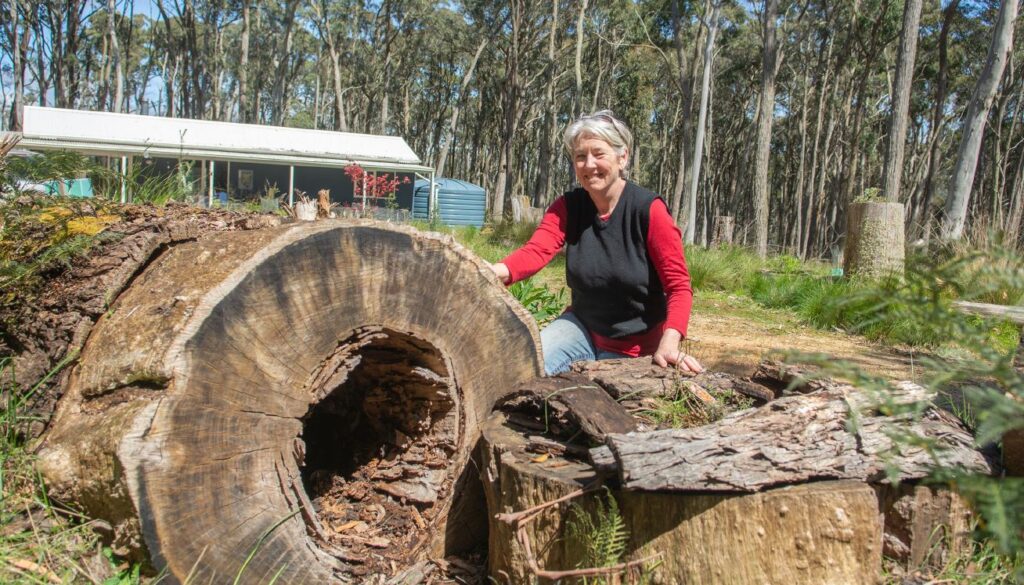
Maree Keating, pictured above, is a land owner with a small, pretty blue house abutting the north Wombat State Forest surrounded by native flowers and grasses. She lost many trees in the great storm of 2021 and fuel load mitigation is a constant concern, but Maree’s clean-up and maintenance approach keeps the native ecology firmly in mind and the native creatures that depend on it
“After the 2021 storm I had a team come over and clean up all the fallen trees at the front,” she says. “Some really wanted to flatten the land for me and remove the organic rubbish and tidy it up. I had to explain about weed infestations every time the tractors go into the land, and also that the roots and stumps and beheaded trees were all really valuable habitat for birds, snakes, wombats and so on.”
Today, her land retains much of this fallen timber, forming boundary fences and new habitat. Some of the larger logs are slowly hollowing out creating shelter for the many mammals that share her land from echidnas to tiny marsupial mice.
And while the possibility of fire remains a concern, Maree is more conscious of the needs of the original inhabitants of the surrounding forest.
“Ultimately owning a bush block or land with native habitat on it comes with it a responsibility to care for the creatures that share it with you.”
November 9th, 2023Eganstown Cemetery: beautiful bush setting

Words: Donna Kelly | Images: Beck Walker
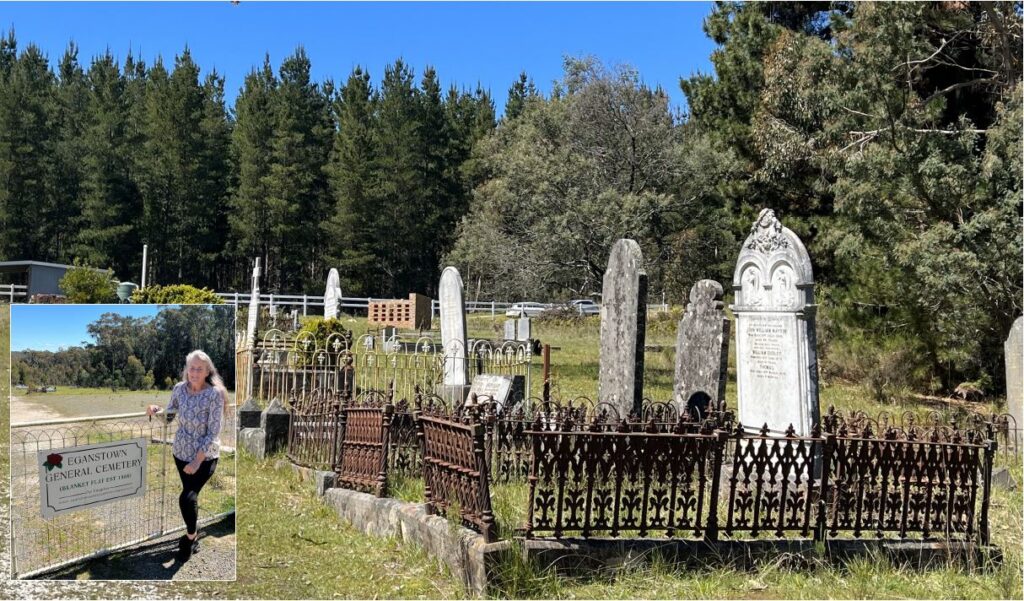
It was established in 1866 as the Blanket Flat Cemetery and in recent years, according to trust chairperson Loris Duclos, Eganstown General Cemetery has “really kicked some goals”.
The first project was building a crematorium wall so the cemetery can now take ashes. The project was funded by the Department of Health and trust savings, and built by local contractor Shane Moiler.
“Shane did a fantastic job for us and we have got our first ashes in the wall which is very exciting for our beautiful old cemetery,” Loris says. “In the past we had only had one or two burials a year, but we have had five or six in the past years, our business is getting busier.”
Loris said, like many old cemeteries, there had been a big pine plantation in the front but that had been harvested about a decade ago and was now a carparking area, much safer for those visiting the Cemetery Road site.
And while there are fortunately no grave robbers, there have unbelievably been water tank robbers, twice, but a local Smokeytown business stepped up after a Facebook post, and have donated and fitted, with locks, a new water tank.
“We feel like we have really had good input from the community and that is something worth celebrating for our really old cemetery.”
Loris said most recently new people had joined the committee and “helped us reinvigorate the trust and build a new fence from recycled plastics”.
“It is bloody beautiful and will never need to be painted – and our old fence was coming up to 60 years of age. That is our most recent project and it’s wonderful.”
Loris said the future was looking interesting with a ground-penetrating radar to be used to find unmarked graves.
“We know that during the goldrush, for example, if a baby died they would just be buried without a record, and we also have a section at the back for paupers and those graves remain unmarked.
“We are very excited by this new project and an initial review by Dave the Graveman has found about 100 unnamed gravesites. It is really wonderful and enables us to plan for our cemetery better.”
Loris said she had joined the Trust after her grand-daughter was buried at the cemetery. “The cemetery on the main road is St Francis Xavier, and one of the only Catholic cemeteries in Australia, ours is Eganstown General Cemetery and we took all religions and paupers.
“It lies a few kilometres up Cemetery Road and is a beautiful peaceful bush cemetery. It was a place where I could honour my grand-daughter and I love the bush. It just gives that feel of a quiet bush place where you can contemplate away from the traffic.”
“And I love being a part of the lineage of locals and a part of the history and those people who have done a lot of research to put names to people who might be there, based on newspapers and research at the (Daylesford) museum.
“Since being on the Trust I have learned a lot about how we bury people and care for their remains and how we keep track of records, it is all very interesting stuff particularly if you have a penchant for history and genealogy.”
Eganstown history snippet
Mr John Egan, the founder of the township which bears his name, and who throughout his life had proved himself a good Catholic, a patriotic Irishman, as well as an excellent colonist.
Mr Egan was a native of Borrisoleigh, in the County Tipperary, and arrived in the colony in 1841. Seven years later he founded the present Eganstown, which lies four miles beyond Daylesford, on the Creswick side.
Here he took up a large selection, as well as an extensive grazing area, and by his indomitable pluck and energy earned a name for himself that will live in the annals of our early pioneers.
He died in 1890, at the age of 85 years, he was the first to discover gold in the Daylesford district, in 1851.
November 9th, 2023Going Ga Ga at Clunes


Words & images: Eve Lamb
For those of us who’d never heard of a “Ga Ga Pit”, the special ribbon-cutting occasion at Clunes Primary School last week provided a quick learning curve.
For the school’s students, though, it was the culmination of some fairly impressive lobbying to get a Ga Ga Pit of their own.
For local members of the Historical Commercial Vehicle Club of Australia (Ballarat Branch) cutting the ribbon on the brand new Ga Ga Pit was a particularly satisfying experience after they’d earlier donated $5000 for it to be built, courtesy of their annual truck show held over the March Labour Day weekend at Clunes Showgrounds. The Local’s Eve Lamb headed to the school to find out more and snap a few photos.
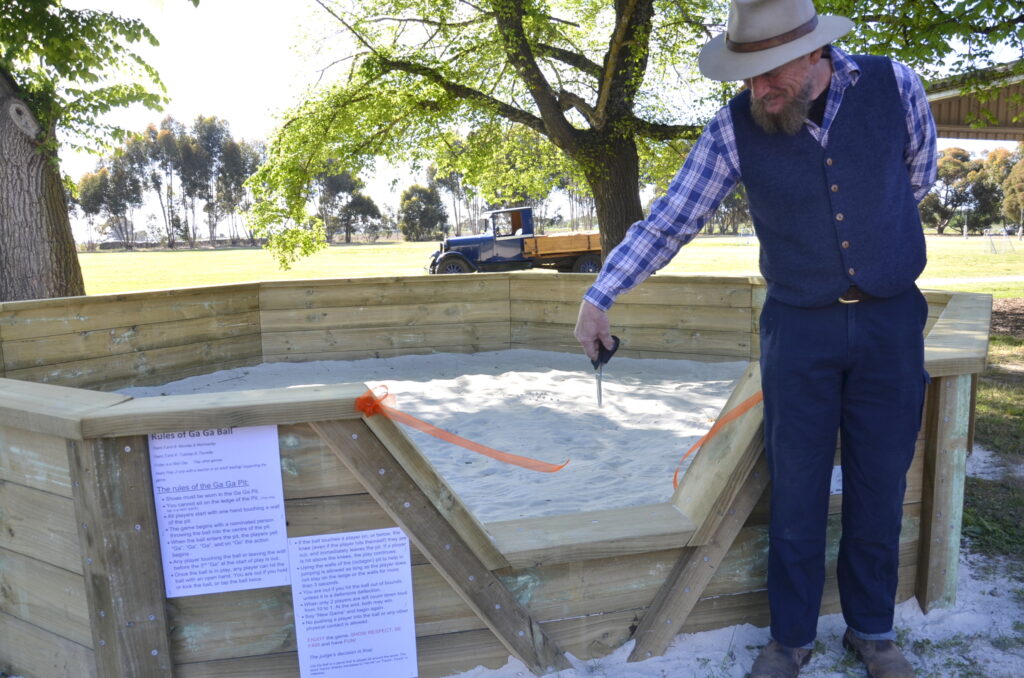
Above: Clunes Primary School students demonstrate how Ga Ga ball is played in the new pit that was purpose-built by school council members using the $5000 donation from the club. Turns out Ga Ga is a game played by children and big kids alike, a fast-paced form of handball or dodgeball played in a hexagonal or octagonal pit, with its own set of rules.
“Ga Ga is a Hebrew word that means Hit Hit and it’s been played all over the world,” school principal Sonia Jardine said, providing the uninitiated with a crash course on the finer points of the sport that’s recognised as especially valuable for building motor skills, fitness and social skills. “In Victoria they started through the YMCA camps.”
Below: Club committee member, Clunes’ Jon Paine cuts the ribbon on the Clunes Primary School’s new Ga Ga Pit. This year the club also donated $5000 to the Male Bag Foundation for prostate cancer, and another $5000 to help tackle motor neuron disease.
“Every year for the past 14 years the club has held its annual truck show at the Clunes showgrounds. We are a not-for-profit and all of the proceeds go to good causes.”
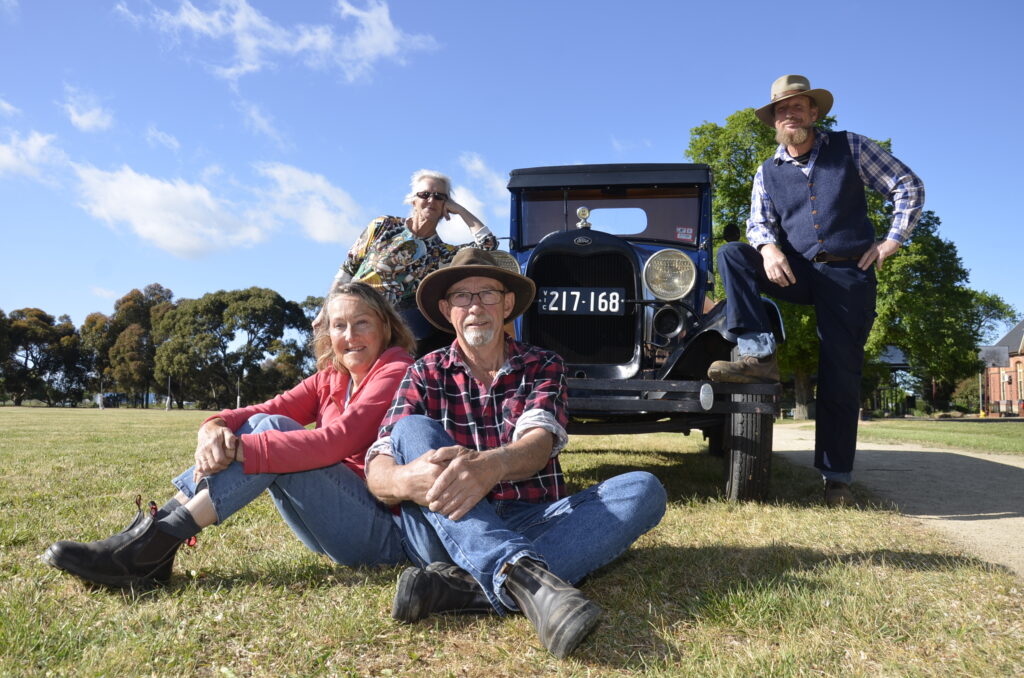
Below: From left, Clunes vintage truck enthusiasts Janet Braithwaite, Lorraine Hogan and Ken Corney (who rolled up in his 1929 AA Ford Truck) with club committee member Clunes’ Jon Paine.
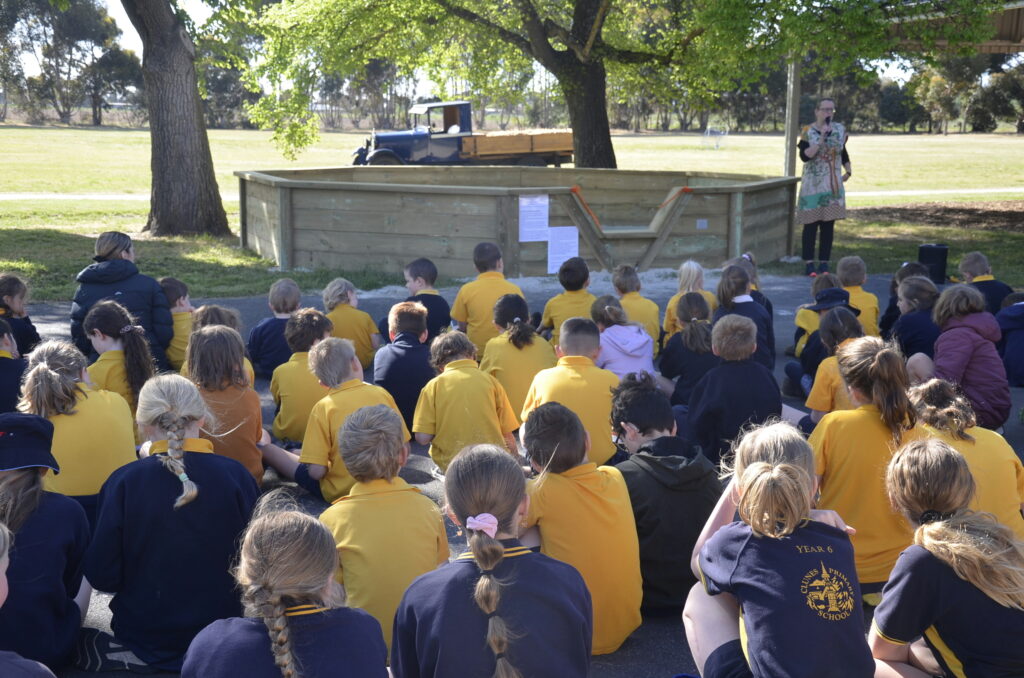
Below: Clunes Primary School principal Sonia Jardine tells all assembled for the Ga Ga Pit launch that receiving the donation from the club was a wonderful surprise.
“When the club secretary presented me with the cheque I nearly cried,” she said. Ms Jardine said
students had earlier embarked on a persistent campaign to get a Ga Ga Pit for their school, after
sampling one while on camp at coastal Queenscliff.
“They’ve written me persuasive texts…it’s been a very compelling argument and the decision was
made that we would listen to the voice of the students.”
November 9th, 2023Show goes on: Clunes to stage 160th country classic
Words & Image: Eve Lamb
The 160th anniversary Clunes Show has been along time coming but it’s finally looking like all
systems go for Saturday, November 18.
“It’s not just that it’s our 160th anniversary show but that it’s also been more than three years in the
making,” Clunes and District Agricultural Society secretary Gayle Wrigley says.
“It’s been stop-start, stop-start for the last three years, first with Covid and then last year with the weather.”
Having contended with prolonged precipitation in the lead up to last year’s attempt, they’d just managed to get the centrepiece arena to thumbs-up stage when the heavens opened again.
“We got 30mm of rain and there was just no way we could run it,” Gayle recounts last year’s eleventh hour disappointment. “That was devastating. I can tell you there were tears.”
This time there’s an even steelier determination among the volunteer committee to ensure the big 160th anniversary show will go on.
“The phones are ringing and we’re getting a sense that people really want to see it back and want to get through the gates,” Gayle says.
The longstanding event packs an enviable reputation among the state’s remaining true classic country show experiences, particularly for staging crowd-rousing old fashioned entertainment.
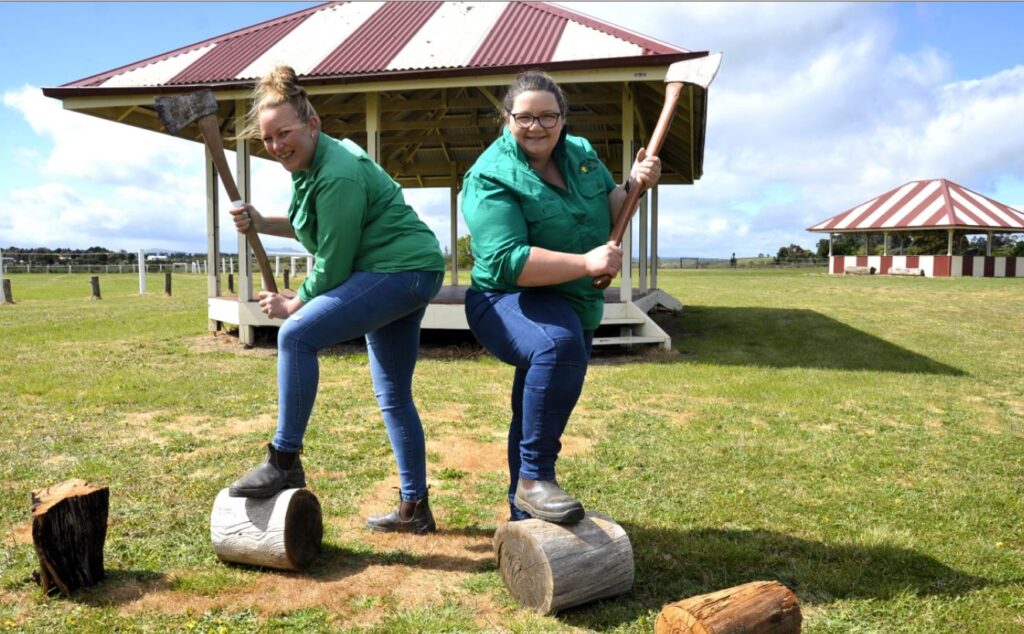
The gumboot throw, tug-o-war, keg throw and ladies’ wood splitting events are keenly contested by
locals and visiting ribbon raiders and just as keenlywatched from the sidelines.
“We’re now the only show in Australia that still runs the ladies’ wood splitting,” committee president
Jenny Redpath says. “We usually get anywhere from 12 to 20 women entering and there’s cash up for grabs.”
Among the local women with their sights set on taking home the wood splitting cash prize and ribbon
is Clunes’ Beth Campbell, a former winner. Jenny says all of the favourite show day attractions will be back, including time-honoured drawcards like the equestrian program, Midlands Axemen’s woodchop display, ferret racing, homecrafts pavilion, showbags, rides and grand parade.
There’ll be the full complement of agricultural competitions, shearing displays, the dog high jump, live acts including the Ballarat Pipe Band, a food and wine pavilion and the 25th anniversary running of the
Bute Ute Competition.
“We’ll also have some new attractions including the Strongman Competition, the Mediaeval Combat
Competition and the Header Simulator. That was a great attraction at the Melbourne show this year,”
Gayle says. “We’ve also got Sandy Creek Clydesdales coming. We haven’t had them before.”
Jenny says the majority of the community will be involved in some way or another.
“The CFA does the morning breakfast. The school does Devonshire tea and sandwiches throughout the
day, the cricket club runs a barbeque, the footy club does the bar and the school will also be running the cow poo lotto as well.
“We have also done a book which has a history and a timeline. One of our committee members and a past president have put that together and it will be available for purchase on show day.”
November 8th, 2023Community mourns loss of much-loved Serge
Words: Donna Kelly | Image: Contributed
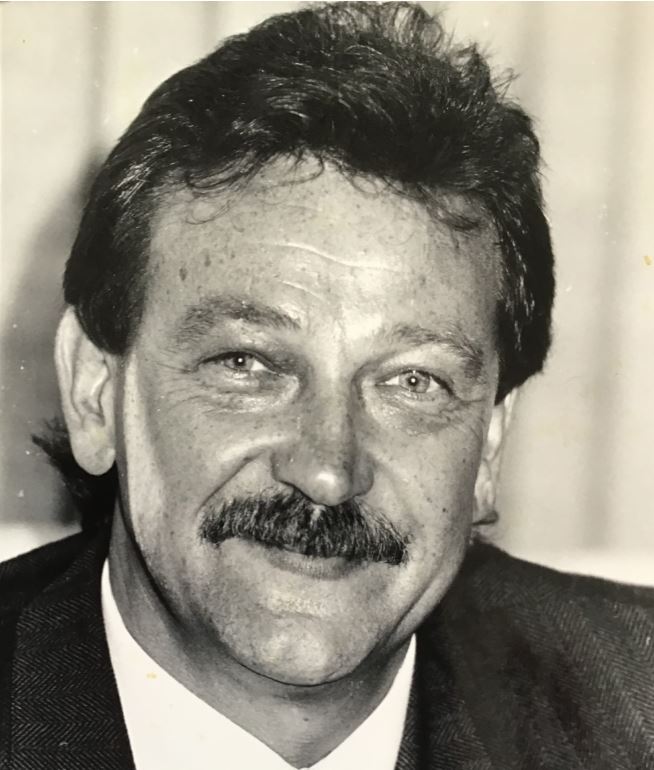
Popular Daylesford taxi driver Serge Kislinsky often told his daughter Natasha Waters he couldn’t visit the grandchildren in Melbourne because “the village needs me”.
And Serge’s sudden death early last week has left the Daylesford and wider community shocked with many taking to social media to talk about their love of the 73-year-old.
His family posted:
Forever loved by your ex-wife and angel, Sue.
Loved and adored by your Princess Natasha, Prince Edward, Billy and Floss.
Life will not be as colourful without you.
I am certain taxis will never be the same in Daylesford.
Natasha said while she knew her father was loved by many she had been amazed by the comments on Facebook. “It has been just beautiful for Mum and me to read that daily. It makes us laugh and remember lots of things about him, it is just incredible.
“We worked out that Dad had lived in Daylesford for 25 years and he went there because he had a hard life in Melbourne and was ready to move and make a new life for himself, and he did.
“He just loved his job and put that first before everything, it was the most important thing to him. He would often call and say ‘I can’t come and visit the grandkids, I have to look after the village, they need me’.
“And he took such pride in his job and his uniform. When we went up last Wednesday he had all his shirts and pants ironed and his shoes polished. Not many people would be proud of driving a taxi but he made that his profession and he loved being good at it and he loved that he brought such joy.
“I used to love hearing stories about him driving people, getting out and opening the doors for older women, carrying their shopping, taking one woman to different halls for dances. I just loved hearing his stories.”
Natasha said Serge lived a very simple life – with his family, job and the locals the most important things. He also had a passion for a good red wine, which he couldn’t really afford.
“Dad loved me, loved my mum and his grandkids and, with his job, they were the most important things in his life. Mum and Dad separated when I was 15 but Dad absolutely adored Mum, and Mum adored Dad. They just fell out of love but Mum said they married for friendship, not love.
“Dad would save up his pennies so he could take her to the finest restaurants, Lake House, Bistro Terrior…and I love that he would get dressed up – the most overdressed person in Daylesford – to take mum out and spoil her. He probably worked for two months just to be able to do that.”
Natasha said Serge was born in Russia and came to Australia by boat with his family when he was 15. He had a hard childhood with parents who were always battling to make ends meet.
“But when my friends met him they always thought he came across as the wealthiest man in the world and he was, but it wasn’t with money, he was wealthy with the pride and love he had for his family and his work. He gave everything he had, every day.”
Natasha said over the past few months, Serge had changed a little and perhaps knew deep down that he was not well.
“But he didn’t change and he wasn’t going to change his life. And I take comfort that he was not ill for a long time because my Dad would never have done that well. He has died a proud man and done it his way.
“And I also take comfort in how much people loved him. I always knew people did love and respect him but not to the extent we are hearing. It is a real blessing for our family. He never really talked about that – but I am sure he knew how much people cared about him.”
Natasha said there would be a private cremation, with Serge’s ashes to be scattered on Lake Daylesford, and a service which was still being arranged while family members travelled from interstate.
“Dad always said he could never walk around the lake ‘so just throw me in the middle’, which means he will be laid to rest there, which is beautiful.”
Serge is survived by his ex-wife Sue, daughter Natasha, son-in-law Edward and grandchildren Billy, 10, and Flossy, seven.

November 8th, 2023Pitch perfect..
Words: Kevin Childs | Image: Kyle Barnes
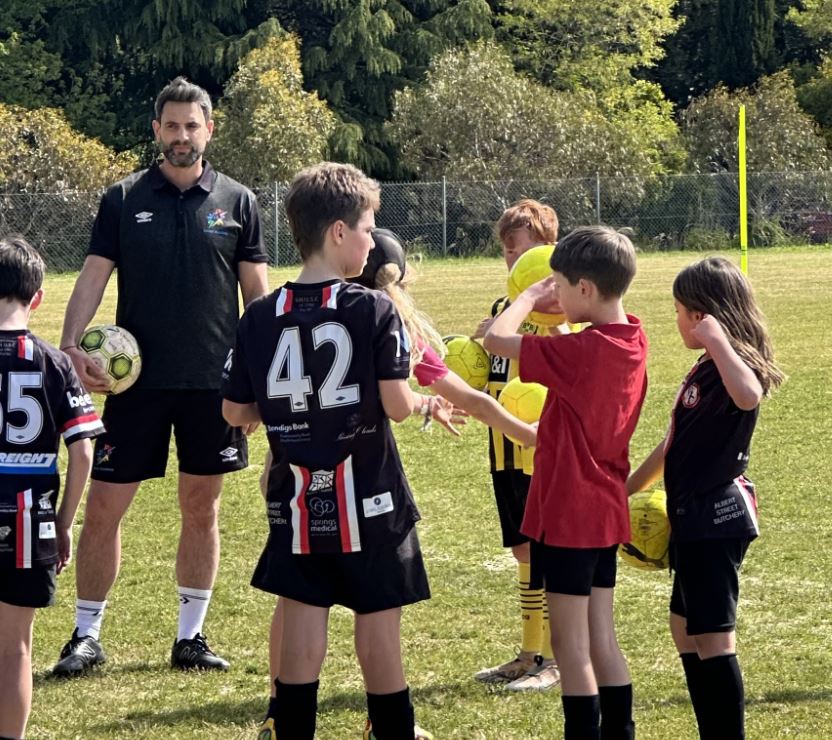
When it comes to playing soccer, many children learn bad habits. Lee Stevens wants to put them right. At 38, this Coomoora resident with two young children understands how some parents may struggle to coach their offspring.
He has set up a part-time soccer academy for youngsters in Daylesford and is pleased with the enthusiasm he has encountered, even though it only began two weeks before the latest school term.
The soccer season ends in August, leaving kids with nothing to do until February.
“That is where I come in. Parents are keen for their kids to be active and not in front of screens or on phones.”
When we talked, he has had five coaching sessions involving more than 100 children in the holidays, with local coaches helping, for which he’s grateful.
Next month it will be the turn of “little kickers” aged four to seven. Term four sees sessions for under eights and under 12s.
Otherwise, he says, his coaching is about structure and keeping it basic. When it comes to his academy, however, his passion bubbles over.
“Every child has a ball: there’s no waiting and no queuing. Make it fun and they listen. They learn and develop and, who knows, they might take it further.”
Lee runs birthday parties as well, with 90 minutes of entertainment and refreshments. A fair way from playing in front of 60,000 fans at Wembley Stadium.
His soccer story is one that possibly many from his home town of Swindon in England could but dream of. He began playing for Southampton before being chosen for England Youth, playing mostly mid-field and in defence. A scholarship took him to South Carolina, USA.
All the while he was coaching, having started at 16. “That was generally young to
start,” he says, “but I had a passion for it and wanted to give it a go. It essentially kept me involved in the game all year long.”
California drew Lee seven years later to continue coaching for Ventura CountyFusion Soccer Club, which plays in the Professional Development League, before moving to Melbourne in 2015. His Wembley Stadium game was for the FA Vase, competed for by 600 teams in the lower ranks of the English football league.
Away from the game he started working in recruitment and in 2020 launched his own Melbourne firm, Vivid Recruitment, specialising in architecture, engineering and construction.
And how does he get youngsters interested? Lee says marketing is involved and it’s important to get parents interested. “They need to see the benefits. Most of the children have mentioned it to friends (word of mouth) because they had lots of fun. Also my experience is unique for the area and this has a lot of weight.
“Generally if you keep it fun and light hearted, they are good as gold.”
His group sessions last 60 minutes and one-on-one is 45 minutes. “They’re varied sessions, but always structured with a warm up, ball skills, fun games and then small-sided games. Essentially we coach soccer fundamentals because it’s really lacking in the area and at grassroots. You are unable to progress in your game if you cannot control or pass a ball.”
Lee is also doing tailored coaching in the junior section of the national premier league. “It was meant to be small, but has taken off, which is not a bad thing.”
When he’s not coaching he straps on his gear for Daylesford Seniors, for whom he’s “scored some goals”.
Now he slips into his boots, while wearing the academy jersey, complete with ad logo (“The kids will eventually get them”). He readies training equipment. Next up is a 12-year-old, keen for a one-on-one session to sharpen his game.

November 8th, 2023E-‘waste’ now available to purchase at shire transfer stations

Following the success of the Hepburn Shire Council’s e-waste recovery pilot at Daylesford Transfer Station, electronic items are now available for purchase at all of the council’s transfer stations – Daylesford, Creswick and Trentham.
All items have passed safety inspections and are sold as is. This work is part of unlocking circular economy opportunities and increasing resource recovery locally in the shire.
Since commencing the e-waste recovery pilot in Daylesford in February this year, around 440 electronic items have been recovered and made available to the community.
E-waste electronic items with a cord can be recycled for free at all of the shire’s transfer stations.
November 8th, 2023Bright sparks: new lights for Newlyn
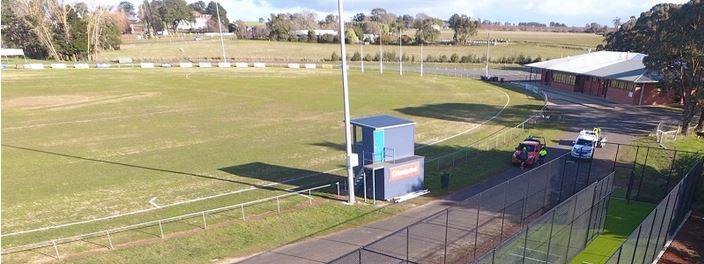
The oval lighting for Newlyn’s Recreation Reserve is about to be upgraded to compliant AFL competition standard 100 lux level LEDs, with works starting this month.
The lighting upgrade aims to increase programming opportunities, prioritise player safety and contribute to the reserve sustainability.
This project is being delivered in a partnership arrangement involving the state government ($185,000) through the 2022-2023 Country Football Netball Funding Program, the Newlyn Football Netball Club ($60,000) and the Hepburn Shire Council ($60,000).
November 7th, 2023Be aware of hydatids senior vet officer warns

You may have recently read that a living roundworm, suspected to have come from the faeces of a carpet python, was pulled from brain of a woman in New South Wales.
It was the first documented case of the parasite infecting a human. Needless to say, she was extremely unlucky. However, there are other, more common parasites that can infect both animals and humans known as zoonotic parasites. A zoonotic parasite of significant risk to rural communities in south-eastern Australia are hydatids.
In the past, hydatids were a significant cause of illness in Australian rural communities. This was largely due to the practice of feeding the offal of sheep to farm dogs, the absence of treatment of tapeworm in farm dogs, and the close physical connection between farmers and their dogs.
Abattoir surveillance data has shown that the risk of hydatids is still present, with one peer reviewed study showing that hydatid cysts were found in 8% of cattle carcasses at a major abattoir in eastern Australia.
To understand how you may become infected with hydatids it is useful to understand the hydatid lifecycle, which has two stages. The adult hydatid tapeworm lives in the intestine of dogs and dingos (and foxes to a lesser extent).
The adult tapeworm produces eggs that are passed in the dog or dingo’s droppings. When sheep, kangaroos and cattle ingest the eggs in contaminated dog or dingo droppings they become infected. The hydatids then develop into its immature stage as watery cysts in the soft tissues such as the liver and lungs of those animals. When a dog or dingo ingests raw offal or dead stock that contain the immature cysts, they become infected completing the lifecycle.
Humans can become infected in the same way as a sheep, cow, or kangaroo if they are in close contact with infected dogs. Children are at particular risk due to their close contact with dogs and their tendency to transfer eggs to their mouths.
When a person becomes infected, cysts may develop in the liver, lungs, or brain. The consequences of this may be fatal. The only treatment in humans is by radical surgery to remove the cysts.
Hydatid disease can be prevented by following several important steps: Worm dogs regularly with an all wormer that is effective against the hydatid tapeworm. Never feed raw offal to dogs. Promptly dispose of all dead stock. Keep dogs kennelled or chained when not working to prevent them finding offal or dead stock.
Restrict dog’s access to household vegetable gardens and wash all vegetables thoroughly Wash your hands after handling dogs and before eating, smoking etc. These steps are tried and proven and were used in a coordinated way to successfully eradicate hydatids in both New Zealand and Tasmania.
Words: Dr Jeff Cave, Senior Veterinary Officer, Agriculture Victoria. Image: Spplied
November 7th, 2023To be an exceptional tree
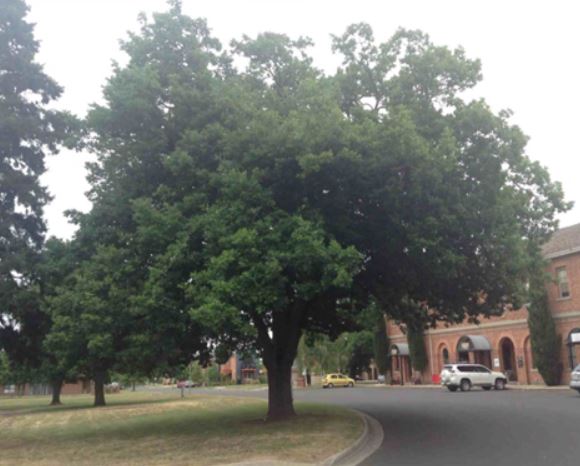
Nominations for exceptional Ballarat trees have closed for 2023, with the community highlighting 12 trees to be considered for the formal list of significant trees in the municipality.
The Exceptional Tree Register, which helps to identify and promote exceptional trees on private and public land, currently lists 4298 exceptional trees. This includes individual trees, groups of trees and tree-lined avenues from across the municipality.
This year the City of Ballarat received 12 nominations from passionate community members which will now be considered against 12 selection criteria. To be an exceptional tree, it must be recognised in at least three of the criteria.
The criteria includes but is not limited to; being of outstanding size or age, a curious growth or significant cultural value or even an unusual or rare species.
Several trees have been nominated this year that are located on private property, in people’s front and rear yards.
A group of trees have been nominated in the Lake Gardens Central Park on St Cedars Grove due to their historical connection to the Lakeside Psychiatric Hospital. The hospital was located there from 1877 until 1997 before the development of the suburb which saw the successful retention of a number of mature trees.
The trees will now be assessed and reviewed by qualified arborists and an expert panel. Recommendations will then be made for which trees should be included in the register.
City of Ballarat Mayor, Cr Des Hudson said he was looking forward to seeing the newest exceptional trees added to the list for 2023.
“The aim of this process is to celebrate Ballarat’s trees by promoting and raising awareness of existing exceptional trees,” he said.
“It is incredible to see all the significant trees across our municipality, and to uncover some hidden gems in people’s yards.
“The growing register is a helpful part of the target set by the Urban Forest Action Plan, to reach a forty percent tree canopy cover by 2040.”
The Exceptional Tree Register is a working document that continues to change to reflect the dynamic nature of the city’s urban forest.
November 7th, 2023Counselling services in wake of weekend tragedy, Daylesford

The Daylesford Interagency Response Group is extending its condolences to families and friends of those who lost their lives in the tragic weekend accident at Daylesford and wishes to reach out to any other members of the community impacted by the event.
Counselling services will continue to be available to anyone who feels they need mental health support following the accident. This includes members of the Daylesford community, visitors to the town, or anyone else directly or indirectly affected by events.
The Central Highlands Rural Health drop-in services will be open from 9am to 5pm today (Tuesday) at 79a Raglan Street in Daylesford.
Anyone is welcome to drop in any time between 9am and 5pm every day until Friday 10 November (inclusive, and including the Melbourne Cup public holiday). For more information please phone Central Highlands Rural Health on 5321 6551.
For other assistance including after-hours support, people can contact one of the following organisations, where appropriate:
Grampians Health Ballarat Access & Triage service – 1300 247 647
•
Beyond Blue – 1300 224636
•
Kids Helpline 1800 551 800
•
Headspace – 1 800 650 890
•
13YARN – 13 92 76
For people outside the Daylesford area seeking mental health support and/or counselling, contact Head to Health by phoning 1300 595212. This service is available Victoria-wide. Callers will be directed to relevant support service providers in their area.
The Daylesford Interagency Response Group has been established to coordinate mental health and counselling services for the Daylesford community and beyond. The group comprises representatives from Hepburn Shire Council, Central Highlands Rural Health, Uniting Vic Tas Ballarat Community Health, Springs Medical, Grampians Health, Western Victoria Primary Health Network, Victoria Police and the Department of Health.
Mayor of Hepburn Shire, Cr Brian Hood: “We offer our deepest sympathy and condolences to the victims, their families and friends. This is an absolute tragedy that is being felt throughout our community and beyond.”
“The community grief was palpable at the vigil last night in Daylesford. It was very moving to come together in this way and it’s so important that we continue to support each other and the emergency services personnel who serve us so well. I sincerely urge people to make use of the drop-in counselling service this week or reach out to Central Highlands Rural Health.”
November 7th, 2023Kicking goals for sportswomen in Ballarat
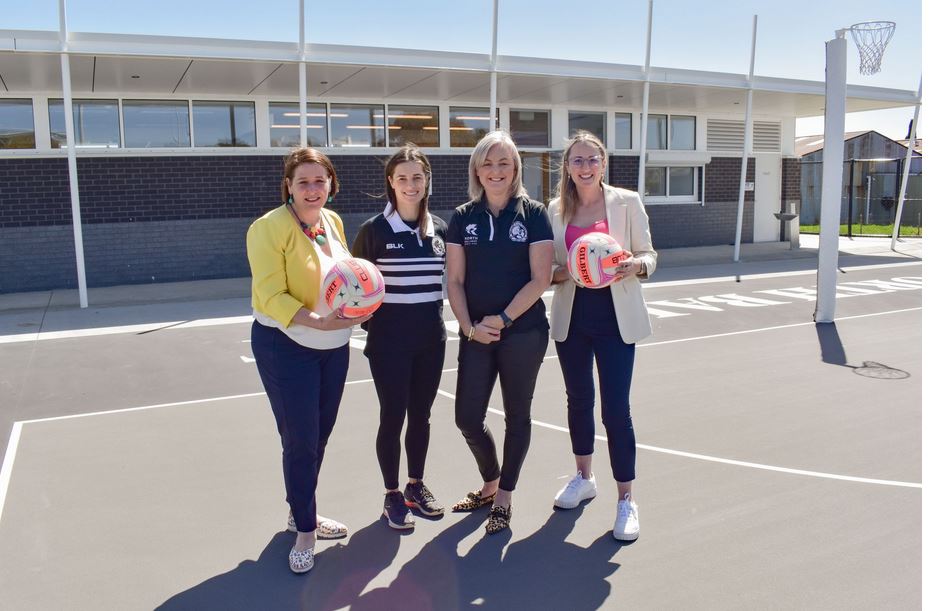
The City of Ballarat’s commitment to improved female sporting facilities has delivered another significant milestone, with the completion of the North Ballarat Football Netball Club Female Friendly Facility project.
City of Ballarat Deputy Mayor, Cr Amy Johnson and CEO Evan King were joined by Member for Wendouree Juliana Addison and North Ballarat Football Netball Club representatives to officially open the $1.1 million facility in recent days.
The project included the construction of female friendly netball changerooms following the recent delivery of two new netball courts at the Mars Stadium precinct.
The City of Ballarat contributed $690,610 to the project, the State Government contributed $395,940 via its 2021 Local Sports Infrastructure Fund – Female Friendly Facilities stream, while the North Ballarat Football Netball Club contributed $10,000.
The City of Ballarat’s Active Women and Girls Strategy identified the need for improved female-friendly sporting facilities in Ballarat to promote increased sport participation rates among females.
In line with the Strategy, the completion of the North Ballarat Football Netball Club Female Friendly Facility project follows similar projects also delivered at Alfredton Recreation Reserve, Marty Busch Reserve and Russell Square.
City of Ballarat Deputy Mayor, Cr Amy Johnson said the project was an example of the dedication Council had shown towards female-friendly sporting facilities and sport infrastructure more broadly.
“I’m incredibly proud to be part of a Council where we continue to unveil so many sporting facilities that mean so much not just to the sporting clubs that use them, but the community as a whole,” Cr Johnson said.
“There are about 130 female netballers at North Ballarat who will benefit from this project.
“We know that appropriate change facilities for females can be a big barrier that prevents active participation in sport, so constructing the right facilities is integral in addressing those issues.”
Juliana Addison said the facilities were crucial in increasing female participation in sport.
“Removing barriers to women and girls’ participation in sport is so important, that is why I’m so pleased to see that the Roosters now have these new facilities,” she said.
“The new facilities at North Ballarat mean that women and girls of all ages and abilities have access to appropriate changing rooms that will make them feel included and able to perform at their best.”
“Upgrading facilities like these means that even more participants can enjoy the health and wellbeing benefits that come from leading an active lifestyle and participating in sport and recreation.”
North Ballarat Football Netball Club director of netball Ali Driscoll said the project helped meet the club’s aim to increase female activity.
“North Ballarat Football Netball Club is pleased at last to have netball facilities that are suitable for the girls and women who play at Mars Stadium – not just our own members, but our opponents, visitors and the boarder community as well,” she said.
“These new facilities will support the strategic direction our club has to grow the participation of women in sport across our club. We are excited now to see them used to their full potential.”
The North Ballarat Football Netball Club Female Friendly Facility project is another demonstration of the City of Ballarat’s commitment to delivering a better Ballarat.
November 7th, 2023Networking night an end of year bash for local business
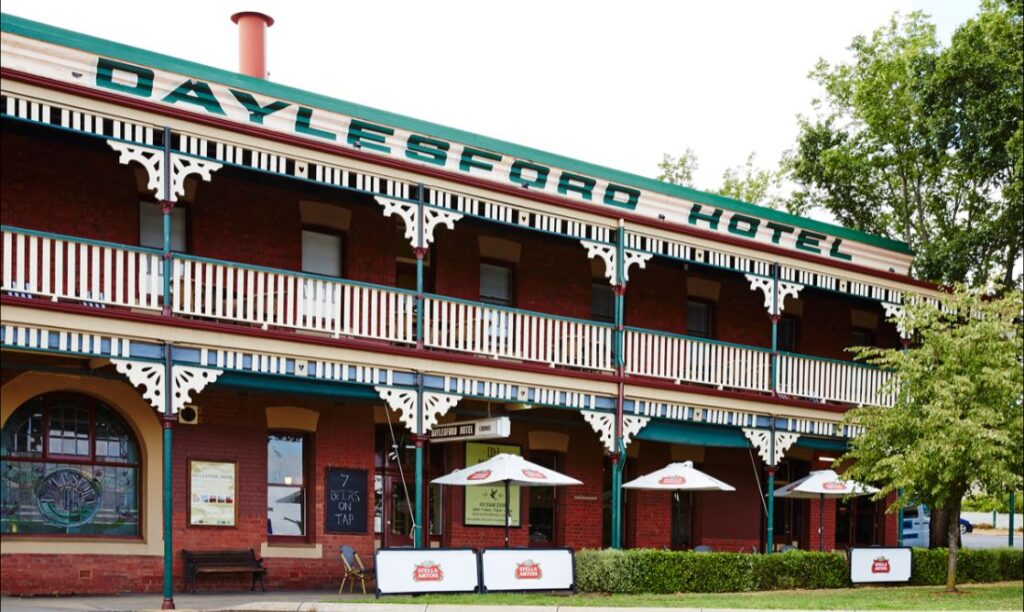
Businesses in Hepburn Shire are being encouraged to join a free business networking evening hosted by the Hepburn Shire Council on Tuesday 28 November from 5.30pm to 7.30pm at the Daylesford Hotel.
This event aims to bring together local business owners and operators from across the shire to celebrate the achievements of the year and to build future connections.
Mayor Brian Hood says the council is committed to supporting the growth and prosperity of the local community.
“Through initiatives like the end-of-year Business Networking Night, Council aims to support businesses and strengthen bonds that make Hepburn Shire a vibrant and prosperous place to do business,” said Cr Hood.
“Our region is home to a diverse range of industries. This evening provides an opportunity for attendees to network with fellow business operators, exchange ideas and establish connections and collaborations,” he said.
Attendance to the event is free, but registration is essential for catering purposes. Interested businesses can register online via the council’s website.
November 6th, 2023Outdoor pools prepare for new summer season
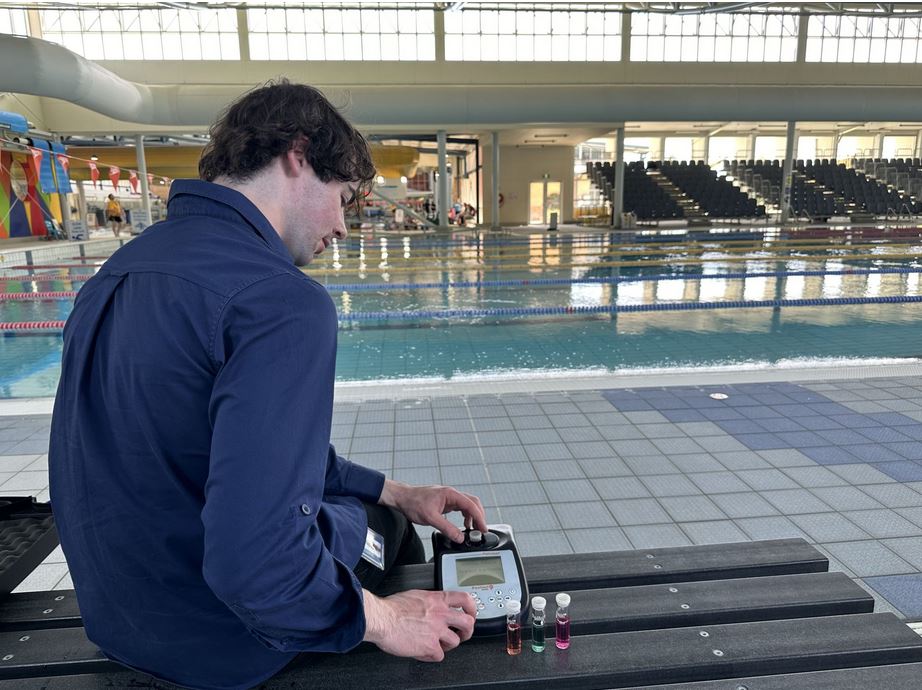
The City of Ballarat’s outdoor pools will begin opening from this month for the new summer season.
The Environmental Health Team at the City of Ballarat undertake routine water quality testing at public accessible pools to ensure operators are providing a safe environment for all users.
Whilst the team are busy testing all year round, once the weather starts to warm up, the importance of the testing does too.
The team monitors the water quality of more than 67 aquatic facilities including City of Ballarat managed pools and splash parks and has begun testing of the city’s outdoor pools, ready for the influx of visitors when the sun returns for the Summer season.
A team of eight Environmental Health Officers conduct regular water quality testing onsite at aquatic facilities providing independent, instant test results for operators.
The team works with operators, discussing results and providing advice to ensure the water quality at the facility complies with the Regulations and the Water Quality Guidelines.
All public aquatic facilities must have a water quality risk management plan in place to help minimise potential public health risks which includes the requirement for daily water quality monitoring.
Public aquatic facilities are important for maintaining and promoting active lifestyles and providing health benefits. However, if aquatic facilities are not properly managed, the health of the community may be put at risk.
Unsafe water areas can become breeding grounds for germs that can impact large numbers of people quickly, hence why testing is so vital.
City of Ballarat Director Growth and Development, Natalie Robertson said Ballarat is lucky to have many safe and clean aquatic facilities throughout the city.
“The Environmental Health Team works hard behind the scenes to ensure our city’s aquatic facilities are safe and clean for the community to confidently use,” she said.