
July 19th, 2023Care to tango: Ballroom dance beats the winter blues

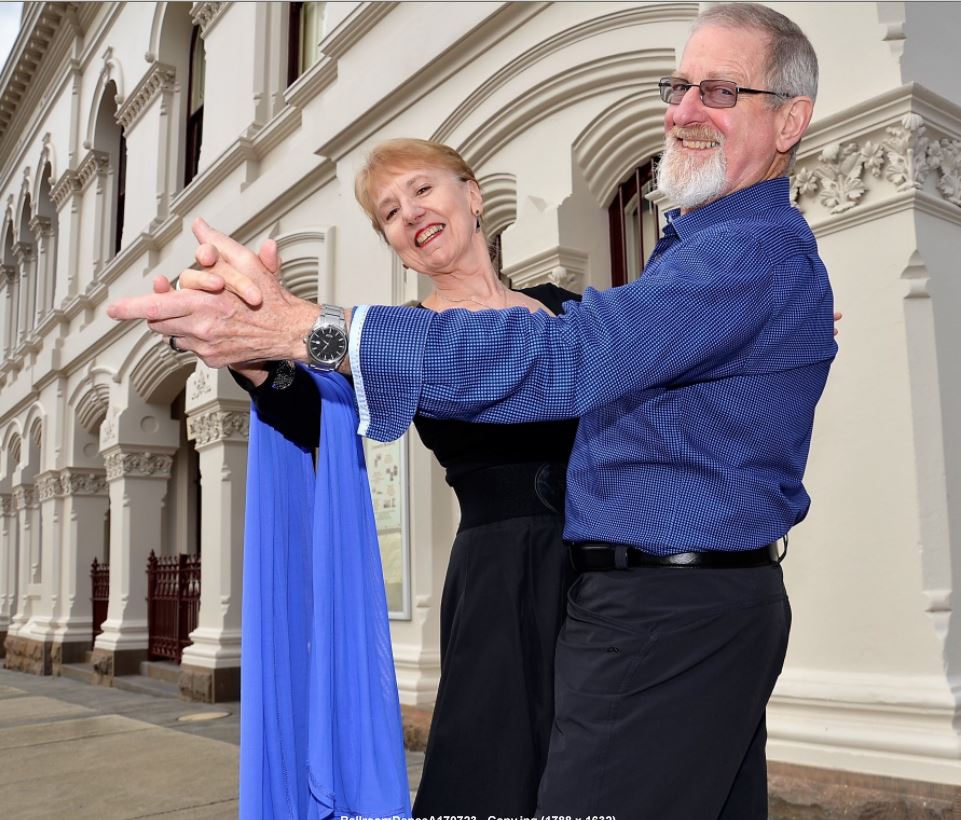
Words and Image Eve Lamb
You know those couples. The ones who, when called upon, can trot out a mean foxtrot, waltz or tango at the rellies’ wedding while you – er – improvise…
They glide across the floor, demonstrating superb synchronicity, smile smugly into each other’s eyes as they execute a tricky manoeuvre the way it’s meant to be done.
Well, chances are there’s quite a few of these types happily residing in the Creswick area.
I say ‘happily’ because taking the ballroom dance lessons that local instructors, Elizabeth Howard and Andrew O’Connell dispense each week through Creswick U3A, tends to boost participants’ happiness quotient considerably.
Partners in life as well as in dance, Elizabeth and Andrew have been teaching ballroom dance to the locals here for the past ten years.
Now, through Creswick U3A, they volunteer their time to take ballroom dance lessons every Tuesday, for all levels right through from absolute beginners to advanced dancers who can cut up the floor.
In fact a couple of those who regularly attend their advanced lessons have recently introduced a new monthly social ballroom dance at nearby Clunes. A bit more on that later…
For Elizabeth and Andrew, teaching ballroom dance is something they simply love to do.
Both have professional backgrounds as teachers and bring this to their ballroom dance lessons, patiently adapting the pace to match their students’ abilities.
The Tuesday classes through the local U3A take place in the Creswick Town Hall with beginners from 10am, transition from 11.30am, improvers from 1pm and advanced at 3pm.
For the participants the cost of the lessons is covered in their annual Creswick U3A membership which is $25 a year and provides members (aged 50 and over) with a wide range of other classes and activities to participate in as well.
Elizabeth says the focus of their ballroom dance lessons is firmly on having fun and socialising.
“It’s a happy-making activity,” she says.
“We love it. We teach foxtrot, waltz, tango and quick step, new vogue sequence and old time dancing.”
“We get compliments all the time,” Andrew says.
The couple, who reside at nearby Springmount, both started dancing fairly late in life but quickly discovered a natural aptitude.
Besides teaching the regular lessons through U3A at Creswick they also do occasional private lessons, typically for events like weddings, deb balls and the like.
Those who learn to dance with them can then take their skills to any of the social dances that happen around the region and beyond.
Clunes’ Graeme Grigson and Ballarat’s Helen Wallis are regulars in Elizabeth and Andrew’s Creswick U3A advanced class. But both had also studio-trained in ballroom dance previously and they recently took the lead in introducing a regular series of social dances to Clunes. These now happen on the first Friday night of the month from 7.30pm-11pm.
Helen says the new Clunes social dance is not just a great way for people who like to dance to come together and do just that. It’s also a great way of bringing life, and sometimes a dash of glam, to the “beautiful Clunes Town Hall”.
“We wanted to bring dancing back to Clunes. We both have a passion for dancing and for the town hall at Clunes,” says Helen.
The new series at Clunes started in June with the next dance set for August 4, and despite the chill winter conditions, devotees have been turning out in good number for this new social series.
“When we held our first dance we had 35 people turn up, and we had 26 last time,” Helen said.
“Yes people can just roll up, but it is sequence dancing so you do need just a little bit of experience.”
Graeme, an accomplished ballroom dancer, is also a member of the Clunes Tourism and Development Association which is supporting the new Clunes series of social dances.
Helen says participants bring supper, and any money raised through running the dance goes back into the community.
The new Clunes dance is among multiple social dance opportunities around the region including dances at Ascot, Newstead and Maldon.
“We’re not affiliated with the new Clunes social dance but we encourage our students to go to it,” Elizabeth says when we get to talking about its recent introduction.
It’s true to say that ballroom dance played a vital role in Andrew and Elizabeth getting to know each other.
“I started learning to dance in 2010 and Elizabeth started three years before,” Andrew recounts.
“We didn’t know each other. We actually met through TAFE college in Melbourne.”
“When Andrew asked me out, I asked him could he dance, and he said ‘Yes’… and then went straight down to the studio (in Ferntree Gully) to get a lesson,” Elizabeth chuckles.
“I got lessons for two weeks. I worked extremely hard, and I was then able to do a fairly complicated waltz that I’d seen Elizabeth doing with another chap,” Andrew says.
“So when it came on at the little social dance we used to go to on a Thursday I said -‘OK. I can do this’. And she said ‘What!’ and I said ‘Yes. Let’s do the Honeysuckle Waltz’. And we did!”
Andrew’s sporting background may have assisted in his ability to pick up the coveted dance moves after just a fortnight of dedicated practice. The effort clearly paid off.
While it cannot be guaranteed that you’ll meet a new life partner by taking up ballroom dance, it’s pretty much a certainty that many other benefits will accrue.
“Co-ordination is one,” says Andrew.
“Actually getting up and exercising. You are moving quite a bit. Your spacial awareness is really heightened. Gets your heart rate going. Gets your breathing going. When I was first learning I forgot to breath!”
“People have to be over 50 to be in U3A but we have students over 80. We have an 83-year-old,” says Elizabeth.
“Also with dance you’ve got to think, move your feet, remember the moves, so it’s cognitive in so many ways. It’s fitness and thinking and social all at once.
“It’s heaps of fun and it feels beautiful to do, and you don’t have to have a partner to participate.”
“We joined Brian McDowell’s Ballroom Dancing Class at Creswick U3A soon after he started teaching in 2014, and became co-teachers with him,” Elizabeth said.
“He is also a musician. He reduced his teaching work as a result of our volunteering and retired from teaching several years ago, but he continues to play for our classes on a part-time basis. We may never have become dance teachers if he had not already got the ball rolling.
“Many (who take the Creswick U3A lessons) venture out to social dances in the region. There are many in Hepburn and Ballarat,” Elizabeth says.
“We put on two dances a year at Daylesford Town Hall. They frock up.”
Frocking up is part of the fun, Helen says, and right now she and other dancers who take Elizabeth and Andrew’s lessons are among the many particularly looking forward to the dance set for Daylesford Town Hall on October 7.
More information about Elizabeth and Andrew’s lessons is available through Creswick U3A or 0402777852. More information about the Clunes social dance series is available on 0417233373 or 0418536189.

July 19th, 2023Council responds to Commonwealth Games cancellation

The Hepburn Shire Council is “disappointed” at yesterday’s shock decision by the Victorian Government to cancel the 2026 Commonwealth Games.
As host of the mountain biking events, the council was looking forward to the economic benefits that the Games would bring through visitation and tourism.
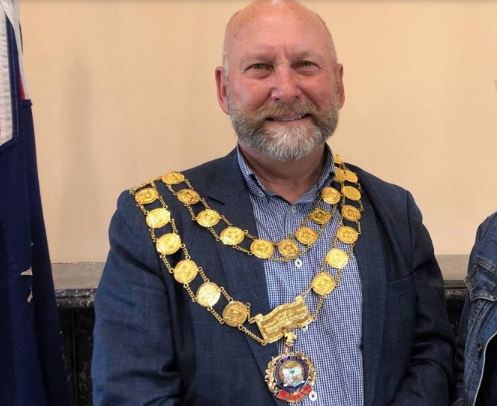
“While we understand and appreciate the financial challenges faced by all levels of government, we are extremely disappointed that regional Victoria will no longer host the games,” said Cr Brian Hood, Mayor of Hepburn Shire, following the shock announcement.
“Economic pressures are being felt at all levels of government and across the community. We acknowledge the Victorian Government’s announcement of the cancellation also comes with a regional support package, which we anticipate will bring other desperately needed benefits for our Shire and we look forward to further detail on this,” he said.
“Council itself has had to make difficult financial decisions, cancelling or postponing a number of projects over the last three years following the impacts of the COVID pandemic, natural disasters across the Shire and the economic conditions.”
Hepburn Shire was to host the Commonwealth Games mountain biking events at the 60km Creswick Trails Network. Last week’s announcement does not impact on the delivery of the trails network, which is expected to be finalised and opened in late 2024.
“Council remains fully committed to completing this project, which will deliver important economic benefits for Creswick and the wider region along with health and wellbeing outcomes. We invite further investment in this project from the State Government as part of the regional support package,” said Cr Hood.
“Council is also finalising our Affordable Housing Strategy and Action Plan and welcome today’s announcement of investment in housing for the Shire and across Victoria as proposed by the Victorian Government,” he said.
“As a key destination for tourism and events, we look forward to seeing the detail of opportunities that will help to boost this sector through the regional support package.”
“The Commonwealth Games have shown to be a major boost for grassroot sports. Council will continue to promote sport and active recreation throughout the Shire and work with local sporting groups to boost health, wellbeing and inclusion in our community.”
July 19th, 2023Fijian CFA members sign on
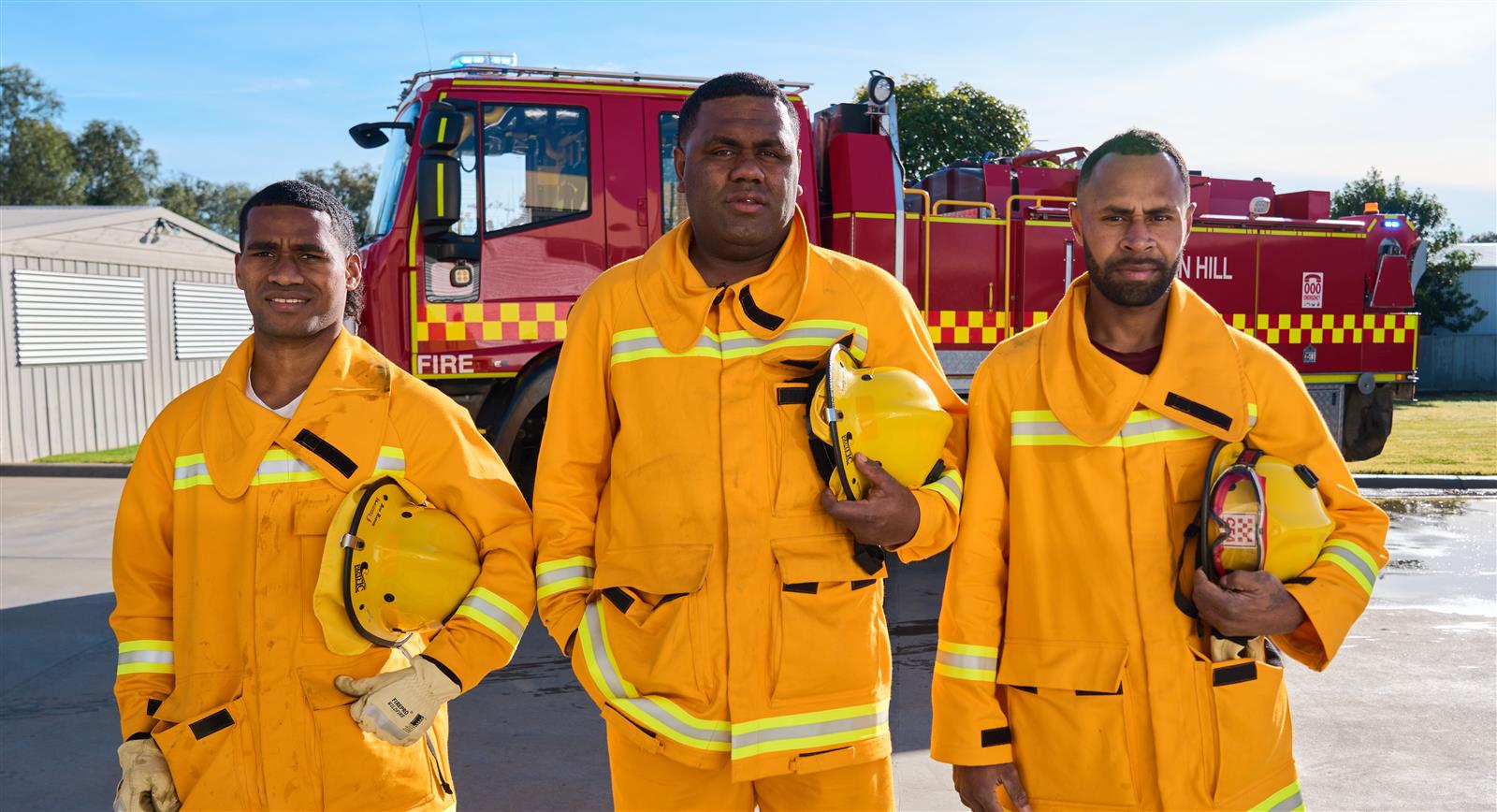
The Swan Hill community has added further strength to their emergency response this month, with eight Fijian CFA members receiving their General Firefighter Course certificates.
Gathered at the Italian Social Club in Swan Hill on Sunday, 2 July, Swan Hill Fire Brigade Captain Michael Howard proudly presented four Swan Hill brigade and four Woorinen South brigade members their operational credentials in a traditional service.
Hailing from Fijian villages, Captain Michael Howard said it has been fantastic to have such diversity within the brigade following their arrival in July last year.
“It’s been great to have the Fijian’s join us. They’ve brought a great deal of their culture to our brigade and imparted a different way of looking at things,” Michael said.
“It’s helped bring our community together and realise the different cultures we have.
“They’re always very happy and joyful to be a part of the team. We all work as one.”
Josateki Vunimasi joined the Swan Hill Brigade last year, moving from his village after COVID-19 impacted the availability of jobs back home.
“I came here under the Pacific Australia Labour Mobility program and was lucky enough to come and work at the Abattoir,” Josateki said.
“The Swan Hill community, the way they have welcomed us here, it’s like living back at home in Fiji. They’re so friendly, so kind and so helpful. Especially here at CFA, they’re our family now.
“Everywhere you go, they give us a ‘bulla’ smile.
“Even when I was a kid back at home I always wanted to get on the big truck and wear the uniform.”
Joseph Nacuva from the neighbouring Woorinen South Brigade said although he didn’t know anybody when he arrived at Swan Hill, he wanted to spend his time helping the people of the community.
“The fire safety in my area in Woorinen plays a very important role in helping people and distinguishing how we can put out the fires,” Joseph said.
“By the end of the program I just want to have spent my time helping the people of Swan Hill.”
Although the brigades didn’t actively try and recruit them, Michael’s brief discussion with their Fijian leader who approached him was more than enough to build their eagerness and excitement to uncover what CFA is all about.
“It’s been great to bring new people in and new blood into the brigade.”
July 19th, 2023Newcastle Airport international terminal upgrade gearing for take-off
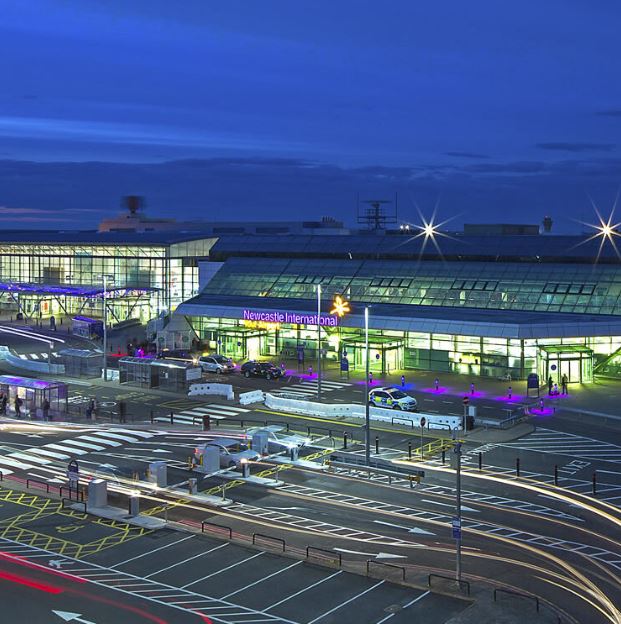
A funding agreement is now in place for the Australian Government’s $55 million election commitment towards upgrading international terminal facilities at Newcastle Airport.
The funding will support construction of an upgraded international terminal to increase the capacity, efficiency and effectiveness of international passenger and border processing at Newcastle Airport.
This will bolster air transport links and connectivity opportunities for the Hunter, the Member for Ballarat, federal transport minister Catherine King MP says in a media release published earlier this month.
Transforming Newcastle Airport into an international gateway will generate significant economic benefits for local and regional tourism and trade sectors.
The terminal works at Newcastle Airport are scheduled for completion in 2024.
Prime Minister Anthony Albanese: “My Government wants to see regional centres like Newcastle grow and prosper into the future.”
“We are ensuring that every dollar that is invested has lasting benefits for the Hunter region.”
“We understand how important tourism is to the Hunter. And these upgrades will connect the region, and its incredible products, to the rest of the world.”
Minister for Infrastructure, Transport, Regional Development and Local Government, Member for Ballarat, Catherine King: “Making Newcastle Airport an international gateway will unlock greater opportunities for local tourism while better connecting residents to the world.”
“The project will also support significant employment and economic stimulus during and after construction, providing even more of a boost for the Hunter.”

July 18th, 2023Mitchell Freeway extension to Alkimos now complete
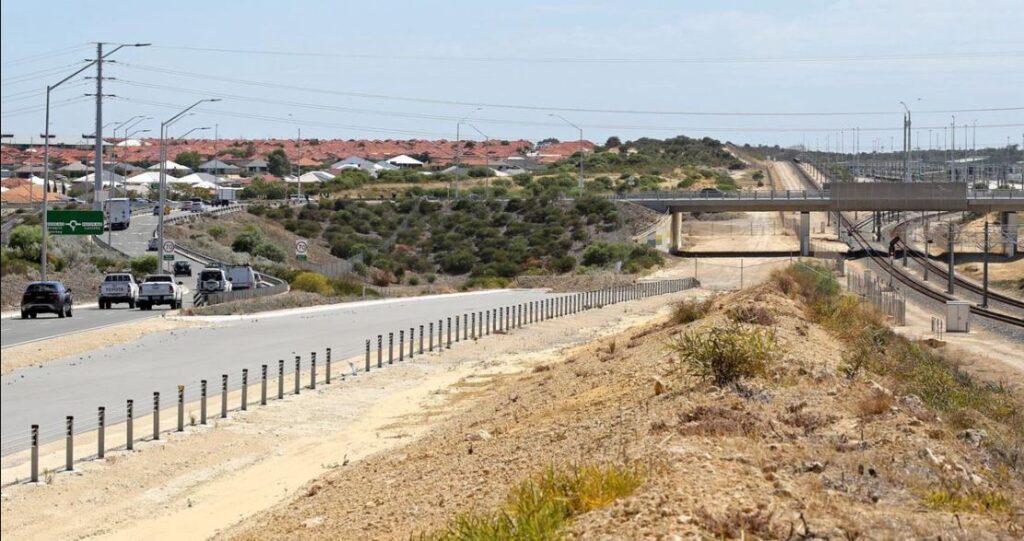
The $232 million extension of the Mitchell Freeway to Alkimos has been officially opened in a ceremony in recent days (July 9), with commuters now able to use the new section of road.
The project has extended the Mitchell Freeway 5.6 kilometres north from Hester Avenue to Romeo Road, creating a new, high-standard, north-south transport link in Perth’s northwest, including new freeway access points at Lukin Drive, Butler Boulevard and Romeo Road.
The extension and new interchanges will significantly improve access and reduce congestion for people living in Perth’s northern suburbs, and ease pressure on the Hester Avenue/Mitchell Freeway interchange – the northernmost on and off-ramp for the Mitchell Freeway.
The project is the first in a suite of road, rail and cycling improvements to be completed to support the expansion and growth of Perth’s rapidly growing northern corridor, including the METRONET Yanchep Rail Extension.
Collaboration with METRONET has seen the construction of Romeo Road, the new east-west road link from Wanneroo Road to Marmion Avenue. This includes a new bridge over rail on Romeo Road constructed as part of the Yanchep Rail Extension.
The project also used 560,000 cubic metres of surplus material from the METRONET Yanchep Rail Extension.
The project includes impressive public art on two underpasses and two bridge abutments, designed by school children, an Aboriginal artist and local Perth artists, giving the project a lasting legacy in the community.
The project supported around 1,200 direct and indirect jobs during the construction phase and was jointly funded by the Australian Government and the Western Australian Government, with each contributing $116 million.
Federal Minister for Infrastructure, Transport, Regional Development and Local Government, Member for Ballarat, Catherine King: “The Australian Government is pleased to be partnering with the Western Australian Government in this project to build the Mitchell Freeway Extension and new interchanges which will make travelling in northern Perth smoother, faster and safer.
“The Mitchell Freeway Extension will reduce congestion and improve journey times for Perth road users, and provide enhanced connectivity to Perth’s northern suburbs including Yanchep, Butler, Alkimos and Eglinton.”
WA Transport Minister Rita Saffioti: “This was one of our fast-tracked projects as part of a State Government infrastructure initiative to boost the economy post COVID-19.
July 18th, 2023First woman in the captain’s chair for brigade

When Catherine McAllister first joined Avenel CFA, she had no intention of jumping on a truck, now just six years later she has become the brigade’s first woman to sit in the captain’s seat.
“It’s exciting and a little nerve-racking, but I’ve got a great brigade and they all support me in what I do, so it’s going to be fun.” she said.
Having grown up with her dad volunteering for the New South Wales and Victorian fire services, Catherine has proudly adopted his giving outlook.
“I always grew up with the notion that if you can help by volunteering, you should give it a go.
“Small country communities like ours thrive off volunteer groups. If everyone does their own little bit, it makes for a great community.
When starting out, Catherine was at a stage in her life where her kids where under five and she wasn’t working, so the opportunity to connect with the brigade seemed like a natural fit.
“They were looking for a secretary, so I thought I would just join as a brigade member, and it evolved from there.
“The Minimum Skills course came up at our brigade, and they thought I may as well give it a go to build up my knowledge of the fundamentals.
“They thought even if I didn’t go out on the truck often, I’d be able to fill in when we had big fires and required a second crew.
“I then went on to turn out a couple of times, and now I’m there all the time.”
While Catherine praises the efforts of the brigade as it stands, she is hoping to recruit a few more younger brigade members into the mix and boost community engagement.
“We are an ageing brigade, with many hoping to hang up the boots soon, so it would be fantastic to get a few more up and coming members.
“We’re trying to get a bit more involved with local markets and events around the region. We’re also engaging more with the football and netball club too. “
Now a single mum of two and working full-time as an administrative assistant in Occupational Health and Safety, Catherine has found her CFA and work skills are interchangeable, reflecting fondly on her learnings while away on a strike team at Batemans Bay in 2019/2020.
“You really learn the different ways people do things and how to work together when you’re on a truck with those you don’t usually respond with. It didn’t matter what brigade you were from, we were all there to do a job and we had fun along the way.”
July 18th, 2023Thank God you’re here: perfect timing by fire fighters
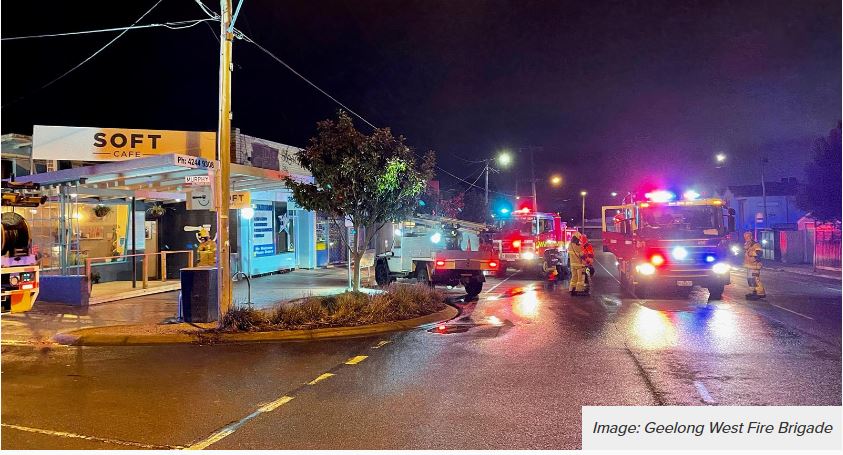
It was perfect timing for Geelong West firefighters earlier this month when they happened upon a fire in Herne Hill.
Returning from a false alarm in Geelong West, crews on the brigade’s pumper noticed puffs of smoke from a shopping strip.
Firefighters noticed the smoke was rapidly building, and found the rear of a shop alight.
Geelong West Firefighter Harry Williams was Incident Controller, and said while the fire provided some challenges, crews worked quickly and effectively.
“We faced challenges gaining access to the rear of the shop, and there was also the presence of asbestos which added some complications,” Harry said.
“The quick work of our crew in breathing apparatus saw the fire brought under control quickly.”
Further crews from Geelong West Fire Brigade and Fire Rescue Victoria were also on scene.
Harry noted that the convenient timing of the crews driving by likely led to much less damage for the shops.
“If it weren’t for us driving past, by the time the fire would’ve been found and called in, the damage would’ve been a lot worse and would have likely spread to multiple shops on the strip,” Harry said.
“Good timing and great work by all crews on scene, it was a fantastic save.”
July 18th, 2023Greater Glider families move into hi-tech nest boxes
Some uplifting news – cameras show Greater Gliders are moving into special hi-tech nest boxes installed last year to help them recover after the bushfires.
To the delight of researchers, in some cases not one but three Greater Gliders – likely a family – were found living in the same nest box.
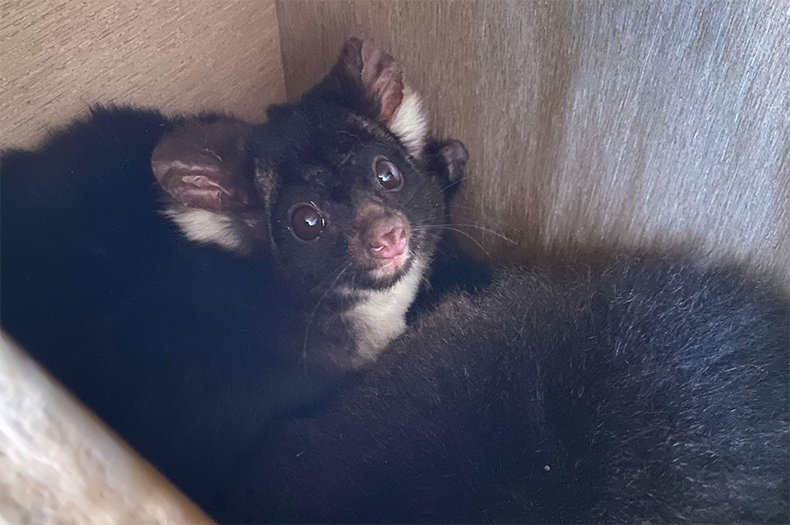
A Greater Glider found living in a Greening Australia, WWF-Australia and Australian National University special hi-tech nest box. © WWF-Australia / Dr Kita Ashman
In just six years Greater Gliders went from not being listed, to being classified as vulnerable, and then uplisted to endangered on 5 July 2022.
With close to a third of Greater Glider habitat burned in the 2019-20 bushfires, Australian National University, Greening Australia, and the World Wide Fund for Nature-Australia teamed up to design, test and install “goldilocks” nest boxes.
The boxes aim to keep Greater Gliders not too hot, not too cold, but just right by incorporating insulation, air gaps, and heat-reflective, fire-resistant, non-toxic coatings.
In February and April 2022, 120 hi-tech nest boxes were installed in fire-affected forests in Tallaganda National Park and state forest in New South Wales and a further 114 near Bendoc in East Gippsland, Victoria.
In mid-July, researchers returned to Tallaganda National Park to mount motion sensing cameras beside the nest boxes to monitor their use.
Dr Kita Ashman, Threatened Species and Climate Adaptation Ecologist, WWF-Australia was part of the team deploying cameras and looking inside the boxes for signs of occupancy.
As she approached only the second nest box being checked, a Greater Glider poked its head out. Dr Ashman then looked into the box to find a further two Greater Gliders inside.
“I just burst into tears, I was so surprised and so happy. The species had just been uplisted, highlighting how threatened they are, so seeing Greater Gliders using the boxes after only 10 weeks was joyous,” said Dr Ashman.
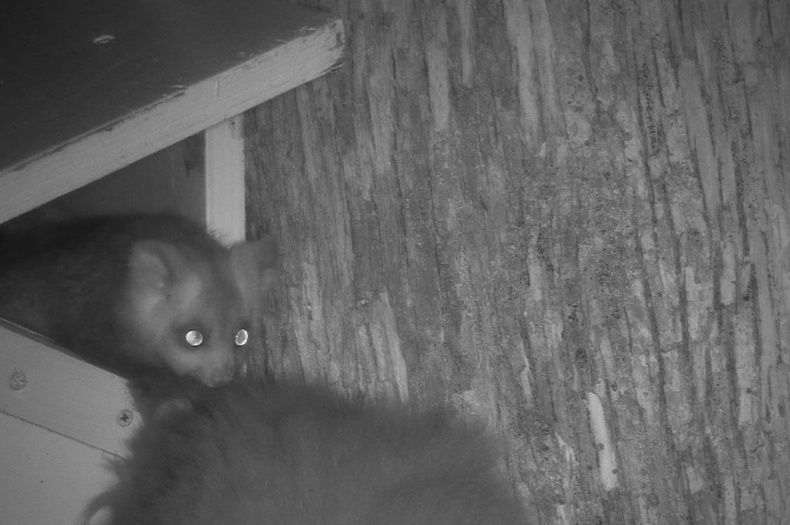
A Greater Glider joey peaking out of a nest box as it’s mother sits nearby. © ANU / WWF-Australia
“It shows Greater Gliders need this assistance after the fires and that the project team did a great job designing the nest boxes.
“But it’s not feasible to install nest boxes across the Greater Gliders’ entire range. It’s a stop gap measure to help them repopulate targeted forests after the fires.
“The only long term solution is to protect forests with hollow bearing trees from further habitat destruction,” Dr Ashman said.
Dr Ashman said the majority of occupied nest boxes observed during the camera installation were home to two and sometimes three Greater Gliders. Experts believe in cases of three residents this is likely made up of a mating pair and an immature offspring.
The cameras, operating at 26 sites in Tallaganda, are now providing further evidence Greater Gliders are moving in.
Senior Program Officer at Greening Australia Drew Liepa said that he’s delighted with the success of the nest boxes so far.
“Greater Gliders hold a special place in my heart. To know that our project is having a positive impact on populations that have faced such devastating habitat loss in recent years is an incredibly rewarding feeling,” said Mr Liepa.
“This is a step in the right direction for the Greater Glider, but much more needs to be done to make sure we can reverse the decline of the species and protect its habitat for generations to come,” he said.
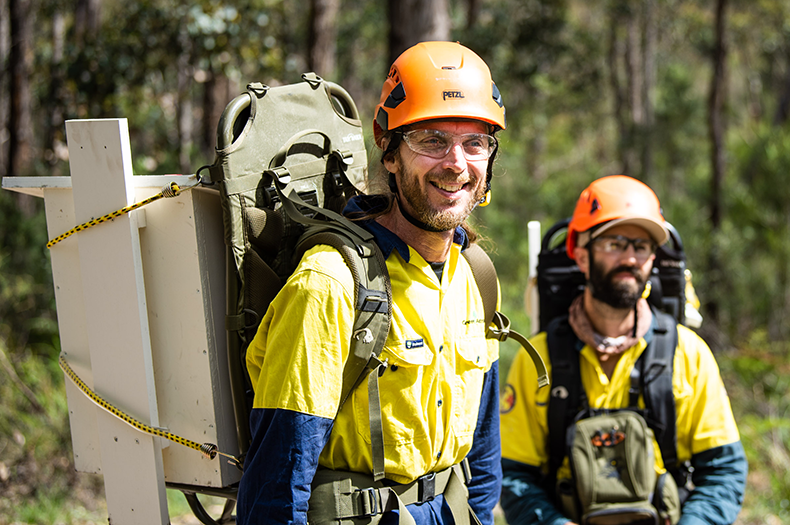
Greening Australia Senior Program Officer Drew Liepa (left) helped to install the nest boxes, and is now seeing their impact first-hand. Credit: Annette Ruzicka.
Jenna Ridley, an Australian National University PhD student, is researching the impact of the nest boxes on Greater Glider recovery in burnt landscapes. This involves spotlight surveys and monitoring with the motion sensing cameras.
“Setting up this project was a mammoth effort with so many moving parts, so to see Greater Gliders in situ using the nest boxes and also on the cameras, with mums and babies coming in and out and using the nest box as a home has been really exciting,” Ms Ridley said.
“I am keen to see what the results tell us now and into the future so that we can continue to conserve Greater Gliders on country in the best way possible,” she said.
Dr Kara Youngentob, research fellow at the Australian National University said: “The Greater Glider is an iconic Australian species that is now under serious threat. We are on a mission to learn more about them and what they need to survive.
“The Greater Glider is the largest gliding marsupial and it is at risk of extinction. Native forest logging, land clearing and devastating fires are causing widespread habitat loss and degradation.
“Greater Gliders depend on old hollow-bearing trees for shelter. It can take trees over 80 years to form these hollows. Old growth forests are rare now and the Greater Glider is disappearing with them. These animals are also really sensitive to heatwaves, which are increasing in frequency and severity due to climate change.
“It’s really pleasing to see greater gliders moving into our well-insulated nest boxes. These specially designed boxes are providing homes in areas that have been ravaged by the 2019-20 mega fires. They will also help greater gliders stay cool in forests that are getting hotter from climate change. These boxes alone won’t save the species, but they might buy some time to make the bigger changes we need so we don’t lose them forever.”
July 17th, 2023CBA partners with Greening Australia to expand native seed production
The Commonwealth Bank of Australia has recently made a minority equity investment in Nindethana Seed Service Pty Ltd (Nindethana) to support the expansion of Australia’s native seed market and help meet growing demand from carbon sequestration and biodiversity restoration projects.
The investment sees CBA enter into a strategic partnership with Greening Australia, not-for-profit environmental enterprise and majority shareholder of Nindethana. As part of this partnership, CBA and Greening Australia are collaborating on a broad program of work to explore opportunities to support Australia’s carbon market with a focus on carbon credit supply.
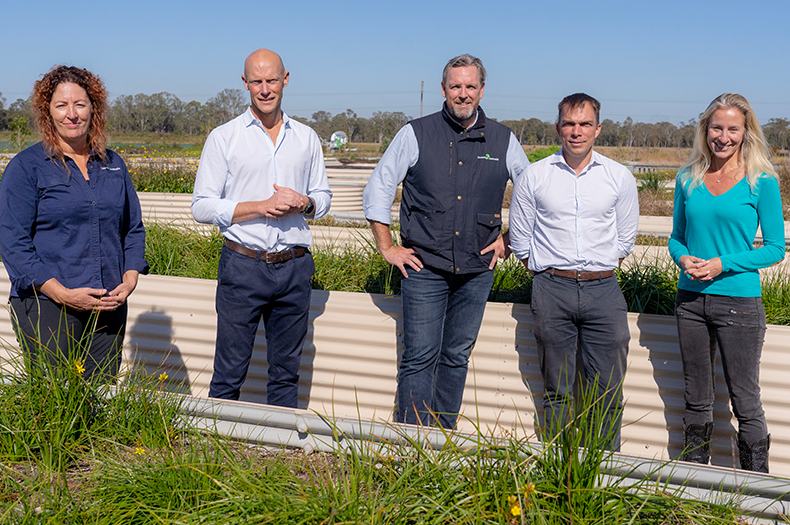
Partners in native seed production. L-R: Sam Craigie, Operations Manager Seed, Greening Australia; Andrew Hinchliff, Group Executive Institutional Banking & Markets, CBA; Brendan Foran, CEO, Greening Australia; Alex Toone, Executive General Manager – Commodities, Trade & Carbon, CBA; Yasmina Elshafei, Managing Director Global Carbon, CBA.
Native seed is a crucial input for large-scale land restoration projects, maintaining ecosystem function and diversity, providing habitat for native wildlife, and boosting landscape resilience. Through native environmental plantings, native seed can unlock the supply of high quality, high integrity carbon credits.
Demand for native seed significantly outstrips supply at present.
Nindethana is Australia’s largest native seed merchant, with facilities in Western Australia and New South Wales. The company works with seed collectors across the country and is well placed to help develop and expand Australia’s native seed industry, including supporting the development of existing Indigenous-owned native seed businesses.
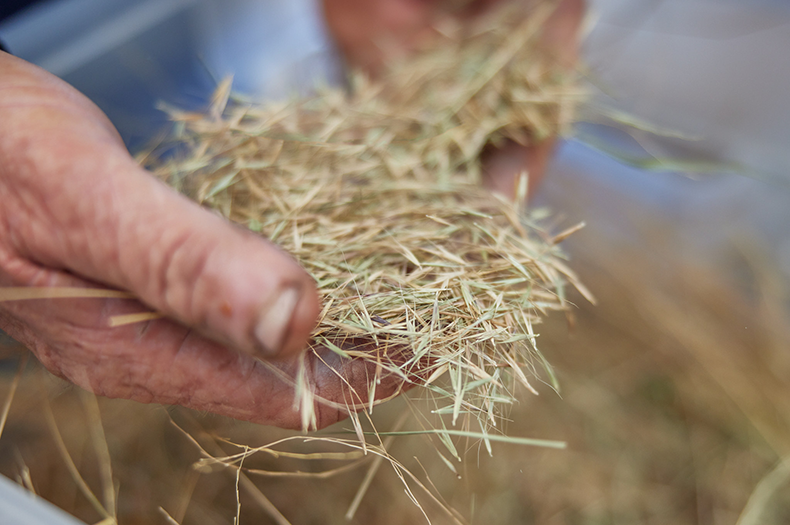
High quality native seed is key to Australia’s ambitions to be a global provider of carbon abatement opportunities and accelerate ecosystem restoration. Photo: Toby Peet.
Andrew Hinchliff, CBA Group Executive Institutional Banking & Markets, said the bank’s investment in Nindethana aligned closely with its commitment to supporting the development of high integrity carbon credits, fostering economic opportunities for local communities and helping clients manage climate change risk.
“As the world focuses on meeting carbon reduction targets, the issues of biodiversity and natural capital are increasingly in the spotlight. Australia’s unique ecology and vast land space give us the potential to play an important role in this global dynamic.”
“Our investment in Nindethana will help to address current supply constraints in native seed, as demand grows from both carbon abatement projects and organisations seeking to help restore land that has been impacted by natural disasters or heavy industrial usage.”
“We want to play our part in helping to preserve and foster Australia’s biodiversity and unique ecosystems while also helping grow an industry that will play a critical role in helping to meet national climate commitments.”
“Our wider partnership with Greening Australia will allow us to collaborate in carbon abatement projects with biodiversity co-benefits and generate Australian Carbon Credit Units (ACCUs) from Greening Australia’s native reforestation and Blue Carbon projects,” Mr Hinchliff said.
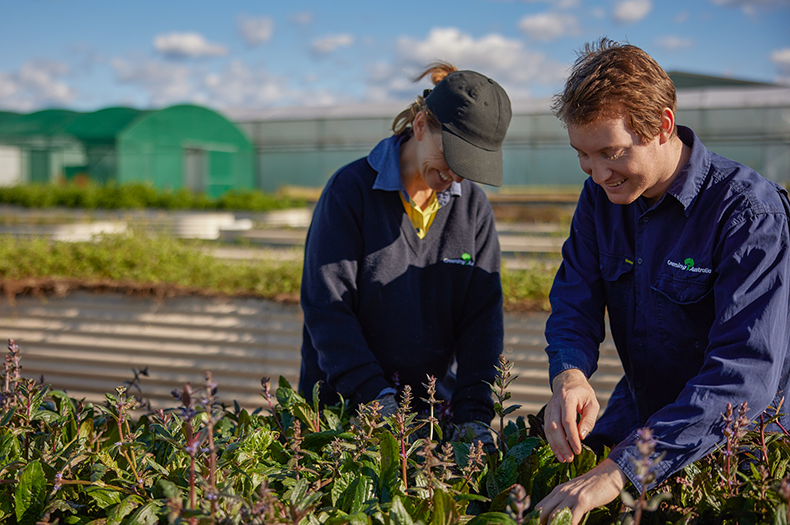
Broadscale investment in seed production infrastructure is sorely needed to meet the demand for native seed and lay the foundations of a nature-positive future. Photo: Toby Peet.
Greening Australia CEO Brendan Foran said there was currently a ‘disconnect’ between aspirational goals for biodiverse restoration and the availability of native seed.
“Native seed is a key enabler for large-scale restoration projects, but the industry cannot meet growing demand and is in dire need of investment in infrastructure, technology and working capital.
“CBA’s investment in Nindethana brings the capital needed to help transform this market and ensure that environmental restoration work undertaken in future years also benefits local communities, the economy and ecosystems,” commented Mr Foran.

July 17th, 2023From Motown to the Blues Bros: sweet soul music to play The Palais


From Motown to “The Blues Brothers” and everything in between – MOTOR CITY SOUNDS pays tribute to the classic era of Soul music.
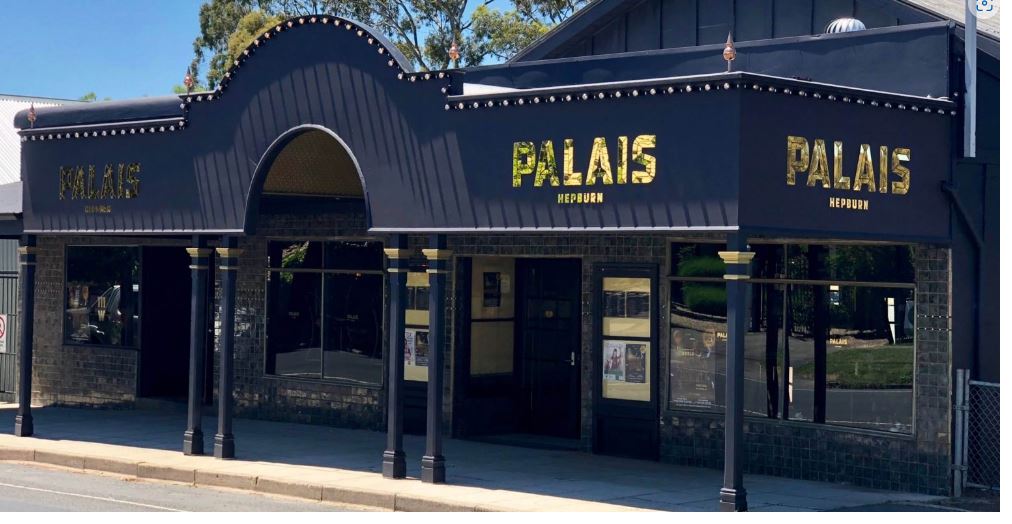
Packing dance floors wherever they play, MCS bring an energy that can only be created by a live 10-piece band and they’re headed to The Palais, Hepburn to do their funky thing next month.
Performing songs from artists such as Stevie Wonder, Jackson 5, The Supremes, The Temptations, Aretha Franklin, Marvin Gaye and Otis Redding, MOTOR CITY SOUNDS recreate the essence and atmosphere of Motown and Soul from the 60s and 70s, with authentic arrangements and instrumentation.
Performance credits include: Melbourne’s “Soul a Go-Go”, White Night (Melbourne & Ballarat), Memo Music Hall in St.Kilda, Backing “The Merindas” at Crown Casino, CluBarham, Ballarat’s Begonia Festival and warm-up band for ABC TV’s “Q & A”.
The line-up features top-class musicians from across Victoria, including an X-factor finalist, a former member of the John Butler Trio.
MOTOR CITY SOUNDS will be bringing their tribute to the greats of Soul music to The Palais-Hepburn on Saturday, August 19th.
July 17th, 2023Triumph for rescue team
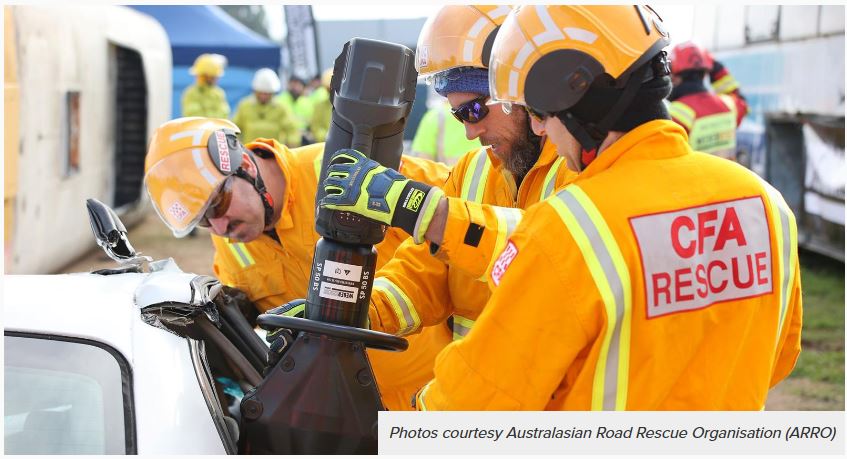
Werribee Fire Brigade’s road crash rescue team has taken out third place at this year’s Australasian Road Rescue Organisation (ARRO) Challenge in South Australia.
The team earlier this month competed against 23 rescue teams, taking first place in Entrapped Rescue and Time Critical Rescue and third place in Industrial Rescue and Best Commander (Team Leader) to finish third overall.
The team also came fourth overall in the Best Technical Team category.
This is the second event Werribee members Daniel May (Team Leader), Dom Trifilo, Neil Davie, Anthony Hill, Scott Green and Trevor Weston have placed in so far this year, with the team winning the 2023 NSW State Road Crash Rescue Challenge in May.
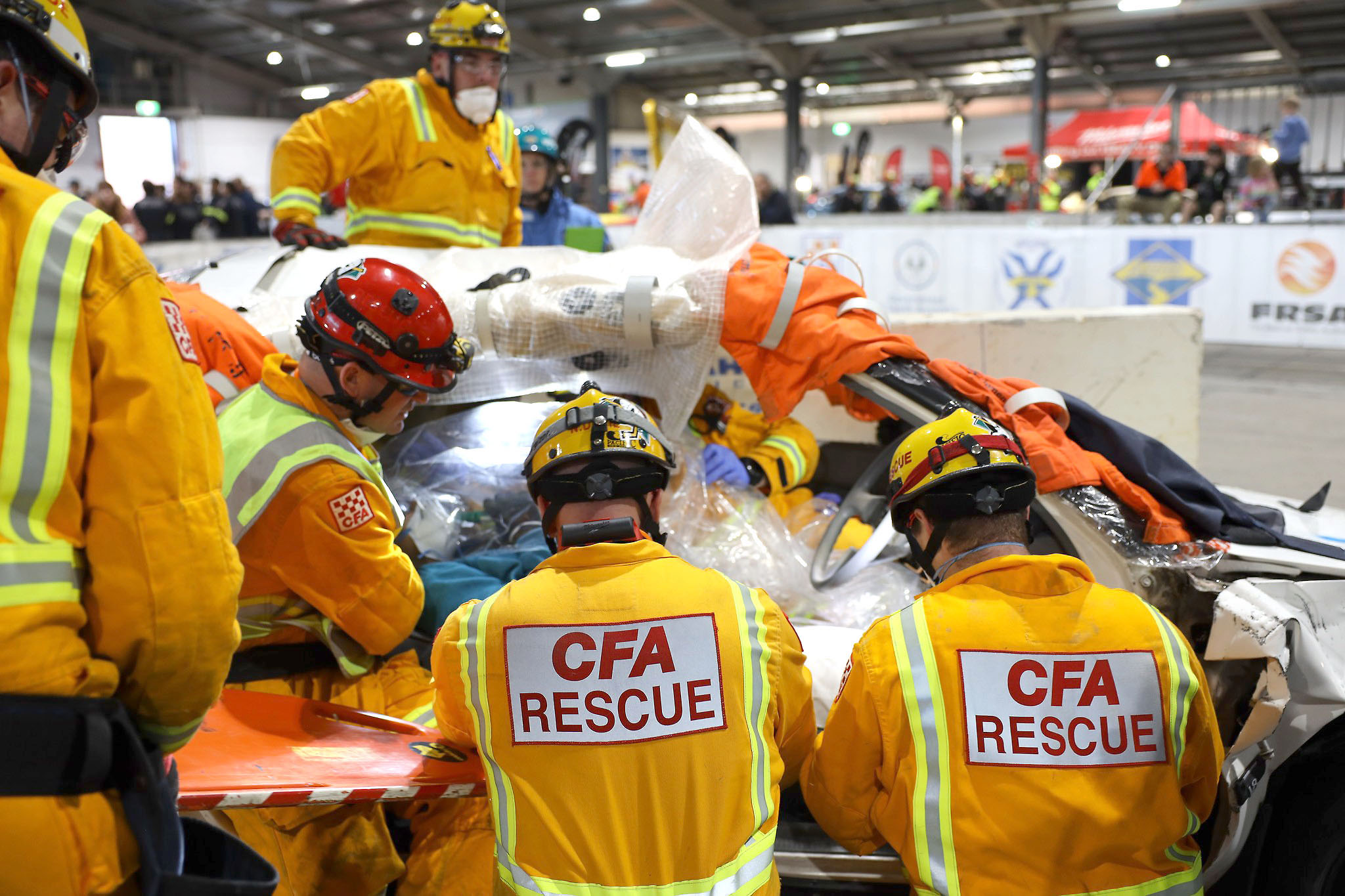
Held in Adelaide from 29 June to 2 July, the annual Australasian Road Rescue Organisation (ARRO) challenge pits rescue teams from across Australia, Asia and New Zealand against each other across multiple scenarios in three categories: Time Critical, Controlled and Entrapped.
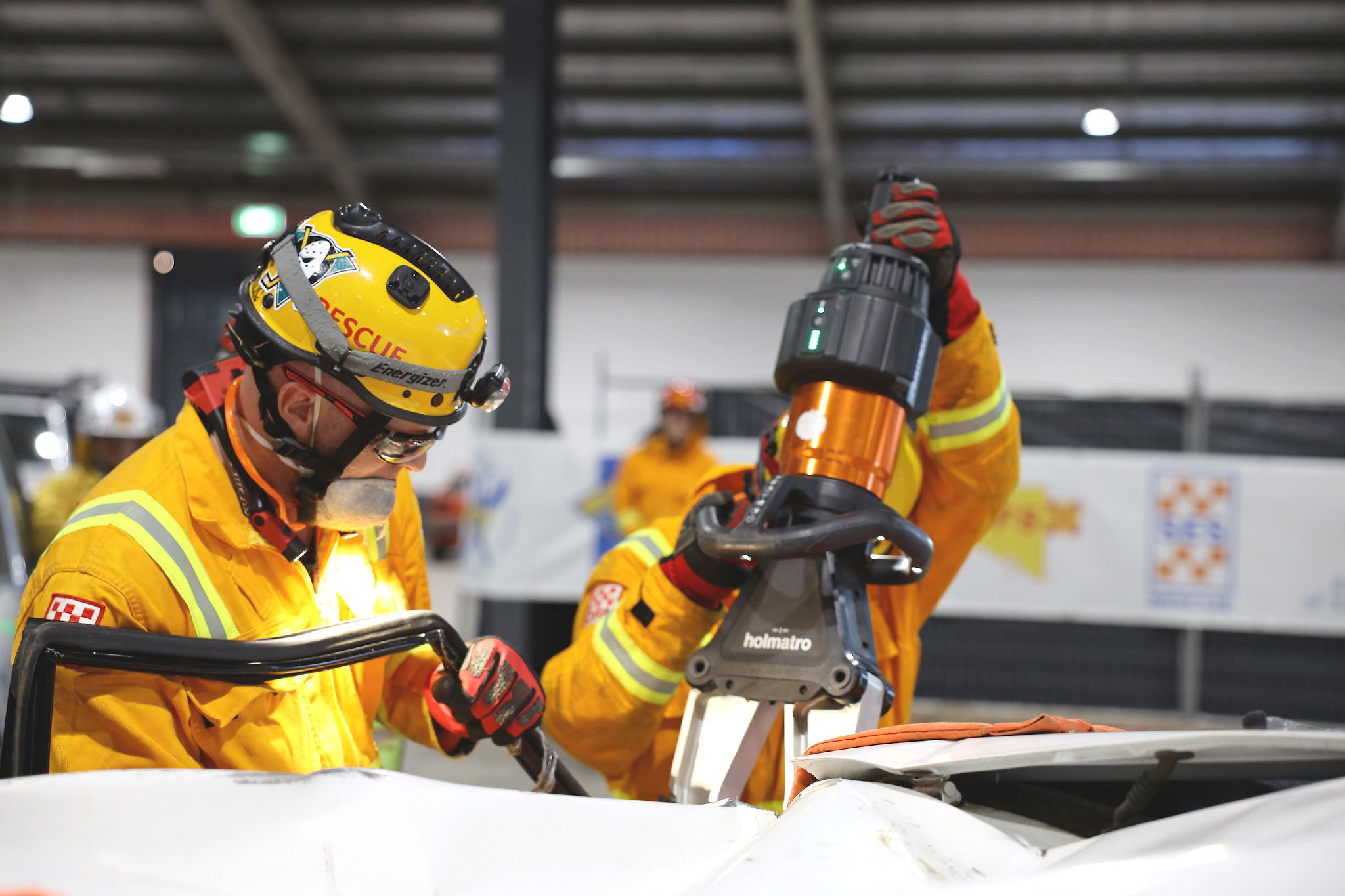
These challenges include extricating people from vehicles, dealing with trauma and a CPR Challenge.
The scenarios use real vehicles that are crushed beforehand to simulate the actual outcome of a crash. Accident ‘victims’ are played by actors and teams needed to consider and treat their injuries as part of rescue operations.
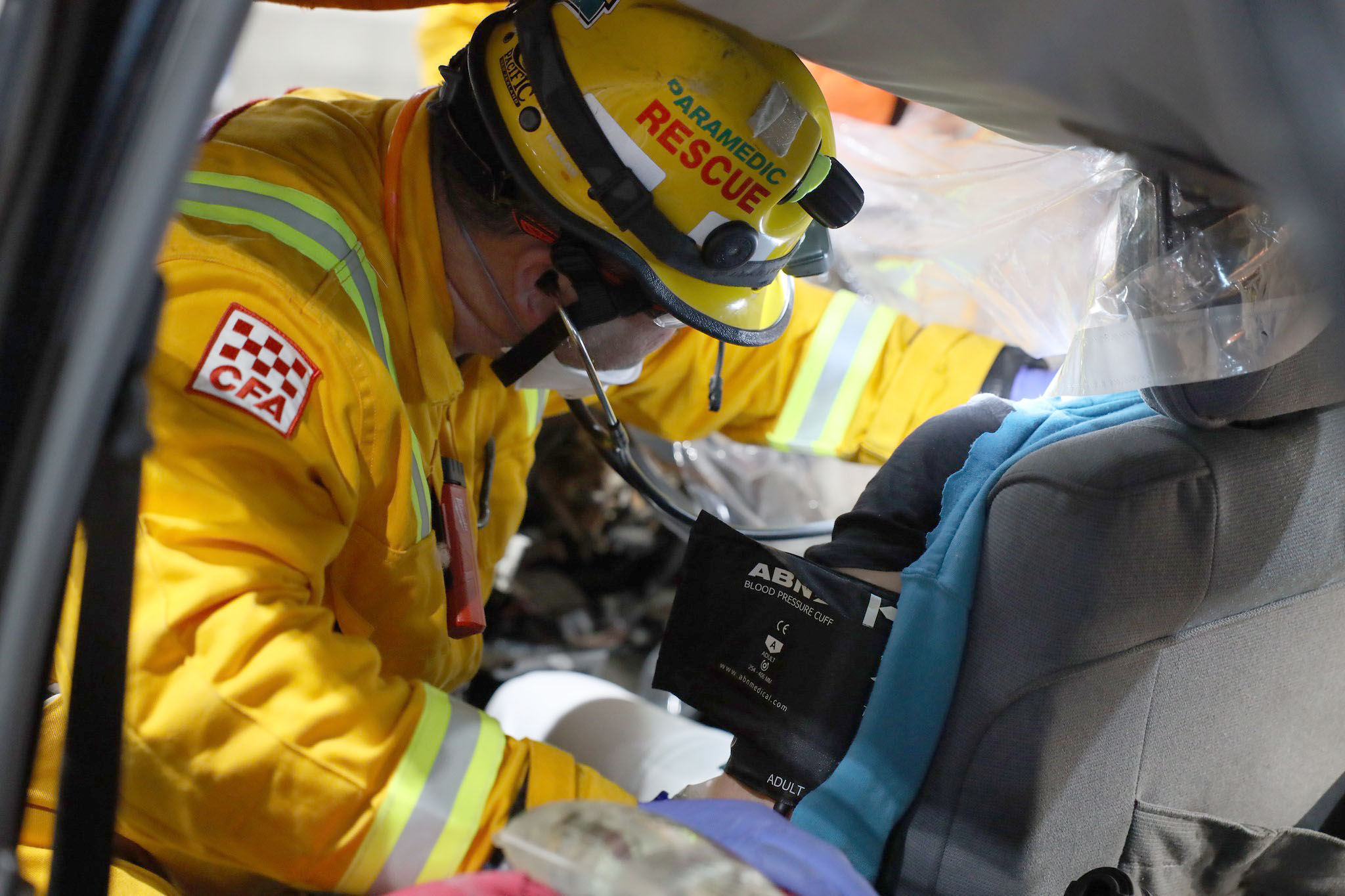
Werribee has fielded a team in the event for several years.
“Participating in these types of events sets a benchmark as to where we are compared to other fire and rescue organisations,” Werribee Team Leader Daniel May said.
“Each challenge focuses on specific areas of expertise and exposes us to new knowledge and techniques that broadens our depth to work with other agencies.
“Ultimately it’s the community that benefits as we return better operators and we share what we have learned with our brigade.”
July 17th, 2023New Bridgewater bridge concrete facility expected to boost jobs

A new purpose-built pre-cast concrete production facility, that will produce more than 1,000 segments needed to build the new Bridgewater Bridge, has opened in Bridgewater, Tasmania.
Major construction is already underway on the $786 million Bridgewater Bridge, the biggest transport infrastructure project in Tasmania’s history.
Over the next 18 months, the facility will produce the 1,082 concrete bridge segments that will form the deck of the 1.2-kilometre-long new Bridgewater Bridge.
Each weighing between 50 and 90 tonnes and measuring 15 metres wide, the segments will be cast from five moulds and stored on site before being transported two kilometres down the road to the construction site, where they will be lifted into place on the new structure.
At peak production, the facility will produce up to five bridge segments each day, employing about 90 people, and will remain in place following the completion of the project for use on future projects in the state.
Construction of the project’s temporary bridge is due to be completed next month, with work underway to build the bridge abutments on the northern and southern shores, and the first of 42 concrete bridge piles to be poured in coming weeks.
The $786 million project is jointly funded by the Australian and Tasmanian governments, with the Australian Government committing $628.8 million and the Tasmanian Government $157.2 million.
Traffic is expected to be driving on the new bridge by the end of 2024, with the overall project complete early in 2025.
Federal Minister for Infrastructure, Transport, Regional Development and Local Government and Member for Ballarat Catherine King: “The Australian Government is pleased to be co-funding this much-needed bridge replacement, improving safety, streamlining passenger and freight travel, as well as providing employment opportunities for the construction of this and future bridges.
“Upskilling and employing locals on a project of this size and scale will provide improved job and career opportunities for Tasmanians.”
July 16th, 2023Growing best practice in native seed production
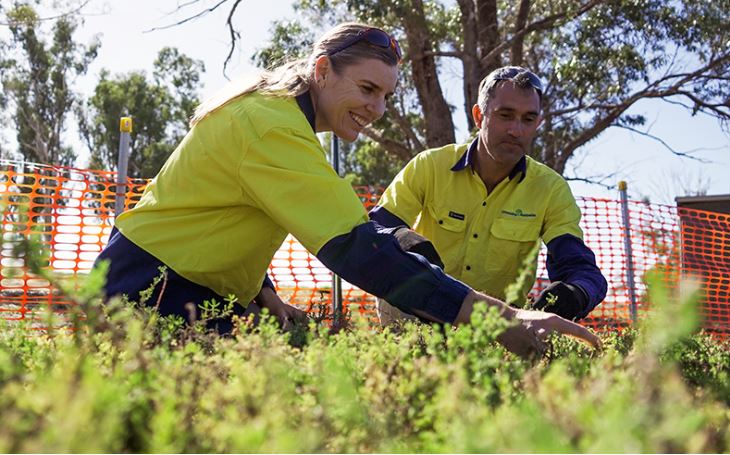
A research project led by Greening Australia and funded by The Ian Potter Foundation is set to significantly expand the national native seed sector’s practical knowledge on how to establish and manage effective, climate-ready seed production areas (or SPAs, as they are known in the industry).
The project comes at a crucial time, as shortages in native seed significantly hamper Australia’s efforts to address biodiversity loss and climate change through ecosystem restoration.
The authors of Australia’s first national native seed strategy, released in 2021, acknowledged that wild collection of native seed would not be able to meet the increasing need for seed. They recommended establishing SPAs to help fill the growing gap between supply and demand.
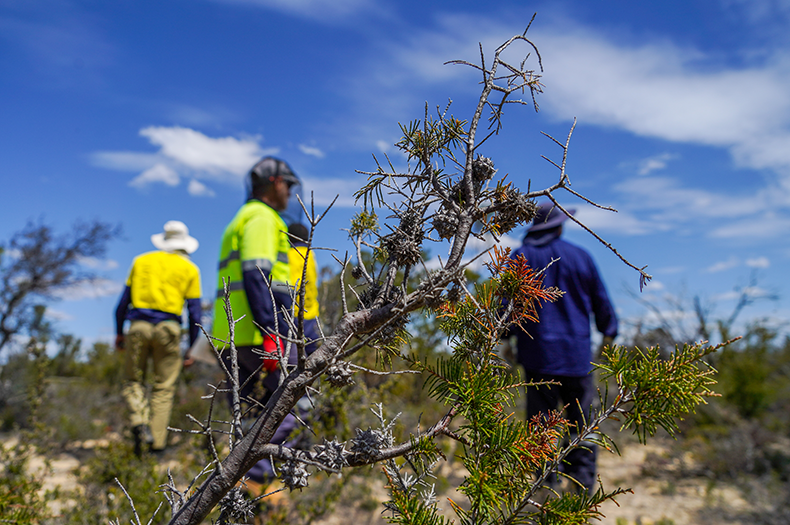
Most of Australia’s native seed supply comes from wild harvest. However demand is outstripping sustainable collection limits. Photo: Jesse Collins.
A snapshot of seed production in 2021 found that only a very small proportion of the native seed sector is working to establish and develop SPAs. Factors driving the low uptake include a lack of resources, and lack of confidence in how to establish a SPA to produce healthy, high quality and genetically diverse seed.
“Establishing an effective SPA can be very complex, as it involves understanding genetics, ecology (e.g. pollinators), horticulture and plant ecophysiology,” said Melinda Pickup, Manager of Seed Science at Greening Australia.
“So we need practical research and development to help ensure that the planning, establishment and ongoing operations of SPAs will contribute to, and be based on, the best available science for restoration in a changing climate. That, in turn, will guarantee the seed produced is resilient and healthy in future climates.”
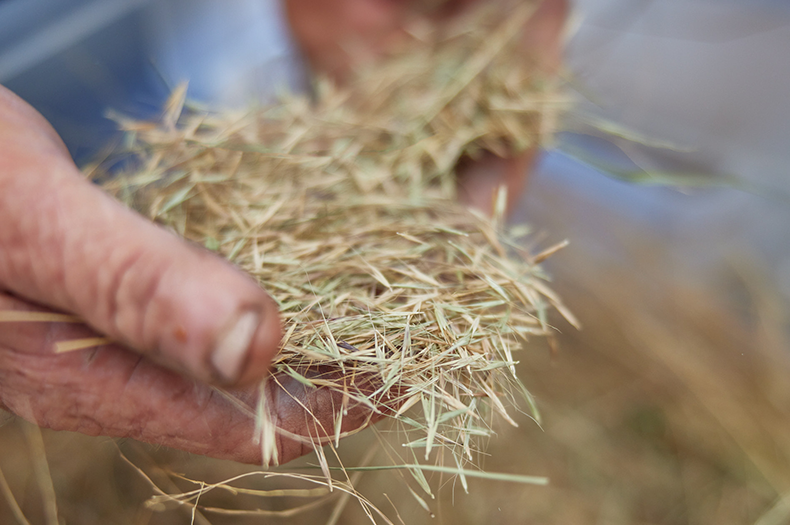
Seed production areas could support restoration in a changing climate by producing high quantities and qualities of native seed. Photo: Toby Peet.
With its current investment in SPAs, Greening Australia is in a unique position to provide a live testing and training ground, bringing together key skilled collaborators and research partners to plug core practical knowledge gaps in all aspects of SPA development and how this relates to on-ground restoration.
The five-year project has several objectives, including:
- Developing science-led seed quality assurance and control frameworks for SPA-produced seed to provide certainty on its quality
- Developing resources to help standardise and guide SPA development to improve the likelihood of success and the production of genetically healthy seed appropriate for changing climates
- Developing and testing seed treatments to increase germination and establishment success
- Researching how to optimise production and seed yields through horticultural practices and create optimum environments for pollination.
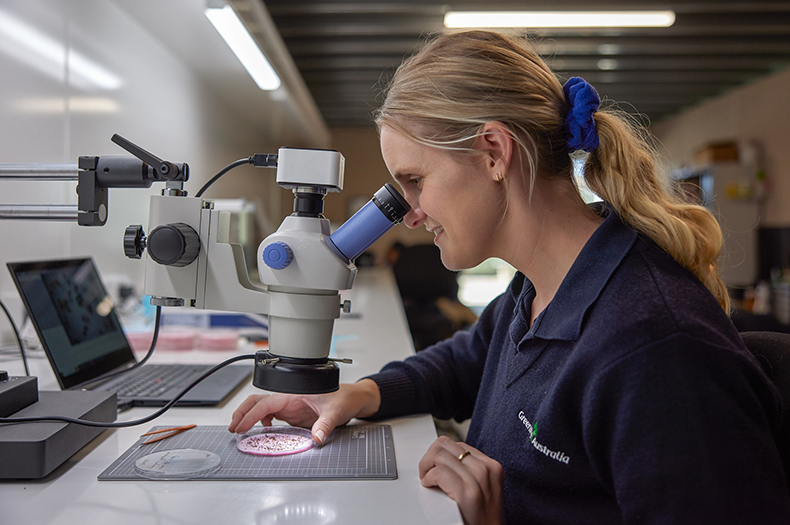
Research and development is needed to increase practitioner and investor confidence in establishing SPAs and to improve seed supply for restoration. Photo: Toby Peet.
Insights from this project will be shared across the whole native seed sector to help make developing and managing SPAs less complex and more accessible for practitioners, ultimately improving seed supply and science-led restoration outcomes in a changing climate.
July 16th, 2023Blood orange brings music plus laughs to The Palais
After two years of award winning comedy dealing with the personal and global effects of COVID 19, Paul McDermott + 1 return with their new show Blood Orange.
Described as “a dynamic and awe-inspiring collection of verbal and musical absurdity” it’s headed to The Palais, Hepburn on Friday August 18.
A conceptual odyssey chronicling, (through comedy, song, and liturgical dance) the bizarre world we find ourselves in. No stone is left unturned as Paul, and his unnamed collaborator, walk through the fires of a contemporary hell-scape to bring joy to others, and a smile to face of the living. Controversial, bleak, and hilarious – Join Paul + 1 for a delightfully dark journey towards the light.
Australian comedy legend Paul McDermott has been fighting tyranny, injustice, and ennui for over 40 years, armed only with comedy and a pretty voice. Paul McDermott Plus One is the brainchild of Australian comedy legend Paul McDermott (Doug Anthony All Stars/Good News Week/THE SIDESHOW/JJJ).
Onstage, the maestro” is joined by Glenn Moorhouse, the “plus one”, Tasmanian born musical director, guitarist, and comrade. The mix of Paul’s angelic choir boy vocals with Glenn’s signature vitriolic incision they create an unmissable evening of fervour and delight.

July 16th, 2023The Local Podcast July 17, 2023

The Local crew talk about what to expect in the upcoming edition of The Local