


February 1st, 2022Small businesses are taking on the climate crisis
While often lacking the resources of larger organisations, Australia’s small businesses appear to be taking meaningful action when it comes operating sustainably.
Though 17% of SMEs admit to not knowing where to start on their sustainability journey, more than two thirds (70%) claim they are both actively exploring how to operate more sustainably and taking steps to improve their practices within the next year. Many small businesses are finding efficiencies by joining existing initiatives to give back to the planet, with 77% looking to support community-led initiatives such as tree planting collectives, local clean up days and recycling programs.
Recognising the impact that networks can have in tackling climate change, Mastercard’s Priceless Planet Coalition enables organisations of all sizes to contribute in a meaningful way to the collective fight against climate change. By contributing to the Coalition or joining likeminded organisations such as 1derful, Archa and Frank Green as members, local businesses can contribute to the future of our planet by supporting a combined effort to restore 100 million trees by 2025.
February 1st, 2022A new era of sustainability
A new era of sustainability is rising, and consumers are increasingly motivated to be more environmentally conscious and are exercising their power and voice through the products they buy.
Victorians are leading the way when it comes to green shopping. Compared to the nation, more consumers in VIC:
- Purchase sustainable products and services when available (80%)
- State they would actively avoid shopping with a business if they knew it did not source its products sustainably (50%)
Business leaders in VIC are prioritising sustainability too, with 54% actively looking for ways to operate more sustainably, and 50% who changed their product or service offering in 2021 to make it more ‘environmentally friendly’ or ‘sustainable’.
Key findings:
- 50% are actively looking for ways to reduce their businesses’ carbon emissions or environmental impact
- 58% of business leaders in VIC have made it a priority or high priority to improve sustainable practices in the next 12 months
- The top priorities in 2022 for VIC business leaders are increasing their yearly revenue (51%), increasing sales of goods and services (44%) and improving sustainable business practices (38%)
- 56% of VIC business leaders are very confident or confident that sustainability initiatives will increase their profitability in the next five years
- 82% of VIC consumers actively reduce or do what they can to reduce their carbon footprint
January 31st, 2022Breakfast with the Birds
North Central Catchment Management Authority’s Breakfast with the Birds is back for another year.
The popular event in the northern part of the catchment is returning to Lake Murphy, near Kerang, early in the morning on Sunday, February 13.
“The lakes in the Kerang area are some of the most species-rich in southern Australia, and we want to show them off,” North Central CMA Catchment Restoration Officer Emma Wolters said.
“Both locals and visitors appreciate the importance of these wetlands, and Breakfast with the Birds is a great opportunity to see why.”
The North Central CMA delivered water for the environment into Lake Murphy throughout winter and spring 2021, which resulted in a lot of interest from native waterbirds.
“We’ve seen about 60 different species at Lake Murphy enjoying the water for environment, including brolga, glossy ibis, and little bittern,” Ms Wolters said.
“And we’ve been doing a lot of complementary work to keep rabbit and fox numbers down around the lake to make it an even more attractive place for birds to feed and breed.
“So, we really want to show that off.”
Breakfast with the Birds runs from 5am to 10.30am, is free, and includes coffee, tea, and a light breakfast.
This year, Birdlife Australia Science and Research project officer Darren Quin and ecologist Damien Cook will be on hand to help with bird identification and to share their knowledge.
“Bring a hat, a water bottle, binoculars, camera, and chair if you want one, and dress for all weather,” Ms Wolters said.
“It’s a great morning and a great chance for people to get back outside again and enjoy the benefits of water for the environment to the region.”
Registration is essential. Search Breakfast with the Birds in Eventbrite, or click on the News and Events section of our website – www.nccma.vic.gov.au
This event is supported by the North Central CMA, through funding from the Australian Government’s National Landcare Program and River Basin Management Society.
January 31st, 2022Putting more food on the shelves
The Victorian Government is helping to keep supermarket shelves stocked by linking thousands of jobseekers with food suppliers to reduce critical workforce shortages.
Jobs Victoria is working with major supermarkets including Coles, Woolworths and Aldi as well as wholesaler Metcash, to fill staff shortages with people looking to find work. The program started earlier January and has already had an overwhelming response, with more than 2,000 people expressing interest in the jobs.
The roles available include pick-packers to assemble online orders, night-fillers to re-stock shelves, cashiers, delivery drivers and forklift operators.
Roles are available for anyone looking for work, especially those whose employment has been heavily affected by the pandemic. Employers will provide any training needed including induction and OH&S.
Jobs Victoria is streamlining the hiring process by undertaking initial screening support to get people on the job as soon as possible.
The Government will also begin distributing 25,000 rapid antigen tests, on a cost recovery basis, to critical utilities and food supply chain services including meat and poultry suppliers.
The $250 million Jobs Victoria Fund is supporting businesses with wage subsidies and large-scale employment programs.
Other Jobs Victoria services include a 600-person-strong force of advocates, mentors and career counsellors to help people in their job hunt.
Jobseekers across Victoria are encouraged to sign up to the Jobs Victoria Online Hub to express interest in these vital roles by visiting jobs.vic.gov.au.
Premier Daniel Andrews said:
“We want to keep food on the supermarket shelves and Victorians in jobs – and this program does both.”
“This rapid response to workforce issues along the supply chain will help minimise disruptions to the food and essentials Victorians rely on, which is critical as we navigate Omicron.”
January 31st, 2022Giving water quality a boost
Water for the environment is being used to improve water quality in lower parts of the Campaspe River, and help native fish and platypus move up and down the waterway.
During times of low flows, saline water can pool in lower sections of the Campaspe, from Rochester to where it meets the Murray at Echuca.
The more saline water table can interact with the river, causing dense salty pools that are low in dissolved oxygen.
This low oxygenated water diminishes habitat and forces fish into shallower and warmer parts of the river, making them easier prey.
“Flushing these areas in summer is key to protecting the health of the river. For the past five or so years, irrigation water has delivered the flush as it moves down the Campaspe and into the Murray River,” North Central Catchment Management Authority Environmental Flows Project Manager Darren White said.
“But this year, with lower irrigation water deliveries through the Campaspe, the flush will be managed with water for the environment.
“The salinity levels have begun to cause potential water quality issues in the lower reach in the past few weeks, so the time to act is now.”
Up to 950 megalitres of water will flow down the Campaspe for about six days, in late January and early February.
The flow will also provide a boost for native fish such as Murray cod, and the river’s important platypus population.
“The Campaspe is a vital breeding ground for platypus, especially as there are very few populations left in the Murray downstream of Echuca,” Mr White said.
“And cod numbers have been increasing about seven per cent a year since 2016, on the back of good river flow management and revegetation of riverbanks which provides the right conditions for breeding, on top of native fish releases.
“This flow will help them move up and down the river and access different food and habitat.”
The flows are authorised by the Victorian Environmental Water Holder in line with its Seasonal Watering Plan 2021-22. The Plan is available for download from www.vewh.vic.gov.au, with regular watering updates posted on the North Central CMA website www.nccma.vic.gov.au.
January 31st, 2022Managing Covid at home
Victorians who have mild COVID-19 symptoms are being encouraged to recover safely at home, with a new campaign being launched today to highlight the support available for those who are slightly unwell.
The Get the Right Help for Your Recovery campaign aims to support Victorians experiencing mild symptoms using measures such as rest, hydration and pain relief, so they can feel confident managing their recovery at home.
More than 550,000 cases of COVID-19 have been diagnosed across Victoria since 1 January. With only 0.71 per cent requiring hospital care, for many Victorians recovery has meant rest in the comfort of their own home.
For those that experience more severe symptoms, the campaign explains what signs to look out for and what to do if you need additional help – such as speaking to your GP, pharmacist or the National Coronavirus Hotline.
The campaign – which will run across TV, radio, digital, social, print and outdoor media – also serves as another reminder to keep Triple Zero calls for emergencies so hospitals can help Victoria’s sickest patients.
To reach as many Victorians as possible, the campaign will be translated into 41 languages, have versions targeting Aboriginal Victorians and reach people with a disability through Auslan translation and ads on Vision Australia radio.
Victorians are also being supported through the COVID Positive Pathways program – which has helped 545,000 people safely isolate and recover at home since its launch last October.
People who test positive are assessed via a survey, which helps determine the level of support they require based on their circumstances – with the majority of people being managed through the self-care and low pathways.
The program links COVID-19 positive Victorians with community health services, GPs and other providers depending on the level of clinical care and support they need after testing positive.
The program also connects people to other important social services they may need while they’re unwell, including emergency accommodation, food relief, alcohol, drug, mental health and family violence support services.
For more information about COVID Positive Pathways visit coronavirus.vic.gov.au/covid-positive-pathways. Coronavirus patients can also get information and support by calling the National Coronavirus Hotline on 1800 020 080.
Minister for Health Martin Foley said:
“We’re helping people get the right care for their recovery and know what to do if they start to experience more serious symptoms.”
“For most Victorians who catch COVID, what they’ll need is a few days of rest and some pain relief – not an ambulance or an ED.”
“Our COVID Positive Pathways program has already helped thousands of Victorians recover safely at home – easing the pressure on our busy health system.”
January 28th, 2022COMMISSIONER APPOINTED
Victoria’s new Local Jobs First Commissioner will champion local businesses and workers getting roles in the state’s big infrastructure, manufacturing and services projects.
Moana Weir started as Victoria’s new Local Jobs First Commissioner today and brings a wealth of experience to the role. She has been a senior officer at companies including SEEK, REA Group, and an executive at Bupa.
An experienced lawyer, she is currently Chair of the Victorian Equal Opportunity and Human Rights Commission.
The Local Jobs First Commissioner advocates on behalf of Victorian small and medium-sized enterprises and promotes the employment of Victorian apprentices, trainees and cadets on government construction projects.
The role also oversees compliance with local content commitments that maximise opportunities for local industry.
Ms Weir replaces the inaugural commissioner Don Matthews, who retired in 2021.
The Victorian Government is the largest procurer of goods, services and construction works in the state and helps to develop local industries, create jobs and boost economic activity.
Under its Local Jobs First policy, the Victorian Government has set local content requirements for 227 strategic projects since December 2014.
Victoria’s Local Jobs First Act 2003 is Australia’s oldest legislation on mandatory local content, requiring all Government departments and agencies to apply local content for contracts valued at $1 million or more in regional Victoria, or $3 million or more in metropolitan Melbourne. It also requires job opportunities to be created for Victorian apprentices, trainees and cadets on projects worth over $20 million.
For more information about the role of the Commissioner, visit: localjobsfirst.vic.gov.au/commissioner
Minister for Industry Support and Recovery Martin Pakula said:
“Ms Weir’s expertise will help to deliver the Government’s Local Jobs First policy as we continue to put Victorian businesses and workers first.”
Minister for Employment Jaala Pulford said:
“I would like to welcome Ms Moana Weir into her role as the Local Jobs First Commissioner as she supports our state’s economic and social recovery by getting more Victorians into local jobs.”
Quote attributable to Local Jobs First Commissioner Moana Weir
“I look forward to working closely with industry and across government to help drive economic recovery and promote opportunities for local workers through Victorian Government procurement.”
January 27th, 2022VACCINATION CLINIC OPENS KIDS APPOINTMENTS

Central Highlands Rural Health’s vaccination clinic at Kyneton Health has opened its doors to 5-11-year-old children on Tuesday and Friday mornings. Children will be welcomed by our friendly nurses as they make their way through the Enchanted Forest themed vaccination clinic. We are thrilled to have state of the art virtual reality headset on site for children to enjoy however use will be subject to availability. All children will receive a goodie bag and lollipop available when they attend their appointment.
Working with the Loddon-Mallee Vaccination Hub based at Bendigo Health, Kyneton Health’s COVID-19 Vaccination Clinic administers the Pfizer COVID-19 vaccine to children aged between 5 and 11 years. They will receive a smaller dose of vaccine created specifically for their age group, as per government guidelines.
Central Highlands Rural Health Director of Clinical Services, Susan Jennings said:
“We’re really pleased to invite families into our clinic so that children aged 5-11 years can receive their COVID-19 vaccinations. This is an important step in reducing the spread of COVID-19, protecting children from getting sick with COVID-19 and keeping schools open.”
“Now is the time to pick up the phone or jump on the website and make a booking – whether that’s with our clinic, a state-run vaccination centre, a pharmacy or your local GP. The important message stays the same – everyone in our community should ‘Get the Jab Done’!”
We have a range of resources to assist parents and children through the process. If you have questions about vaccinating your child against COVID-19 please book a consultation with your GP for medical advice.
The COVID-19 vaccination clinic at Kyneton Health offers a limited number of appointments on Tuesday and Friday mornings at 7-25 Caroline Chisholm Drive, Kyneton.
Bookings can be made online https://portal.cvms.vic.gov.au/ via the booking hotline on 1800 675 398. For more information about the COVID-19 vaccine, visit https://www.chrh.org.au/covid-19-vaccines/
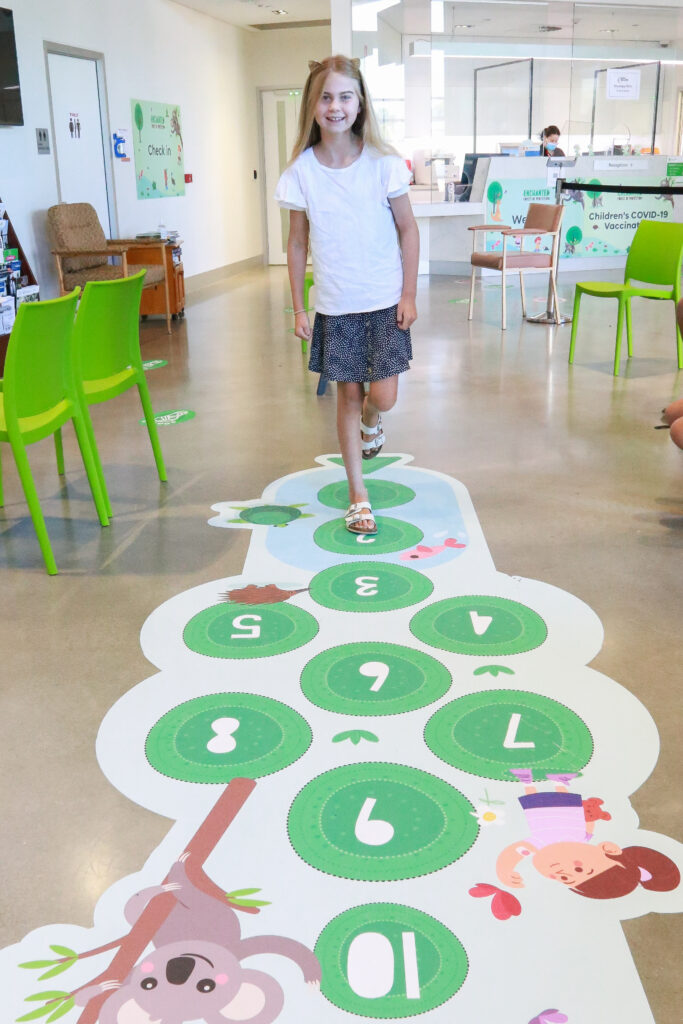


Children received a warm welcome to the Enchanted Forest of Protection from Central Highlands executives.
Susan Jennings (Executive Director of Clinical Services) Ivy, Lewis and Phil Catterson (Executive Director of Community Operations / Deputy CEO)
Smileyscope: Lewis and Kathryn Kosloff
Hopscotch: Ivy
Vaccination: Ivy and nurse Mary

January 26th, 2022ADF high-tech training
The Federal Government has signed a $5.13 million contract with Deakin University to continue its development of a cutting-edge augmented and virtual naval firefighting system for the Australian Defence Force.
Researchers at Deakin, in partnership with technology companies Kellogg, Brown & Root and FLAIM Systems, will seek to develop an immersive training system for naval firefighting, combining virtual reality and augmented reality with artificial intelligence.
Minister for Defence Industry, Melissa Price, said the investment could significantly improve the ADF’s naval firefighting training capability.
“Deakin University’s new system will provide the ADF with a more diverse and realistic range of naval firefighting and training options that could significantly improve learning outcomes and safety,” Minister Price said.
“This investment highlights the innovative research and development that Australia’s sovereign industry is capable of producing and exporting.”
Senator for Victoria, Sarah Henderson, said this contract will build on Deakin’s international reputation for ground breaking research and excellence.
“Deakin University has executed more than 165 contracts with the Australian Defence Department, highlighting the important role our region’s institutions can play in driving innovation and generating cutting-edge capability in support of the ADF,” Senator Henderson said.
“This contract follows the signing of the $1 billion agreement between Hanwha Defense Australia and the Morrison Government to produce Howitzers for the Australian Army, cementing our region’s position at the forefront of Australia’s defence industry for decades to come.”
Industry and research organisations can submit innovation proposals through the Defence Innovation Portal at: www.innovationhub.defence.gov.au.
January 26th, 2022Historical societies receive a boost
Community museums, galleries and historical societies across regional Australia are receiving an important boost under the Federal Government’s $3 million Culture, Heritage and Arts Regional Tourism (CHART) program, with the first batch of successful applicants announced.
Senator for Victoria Sarah Henderson said the funding from the CHART program will assist two local volunteer organisations preserve historical material.
“With the Federal Government’s support, we are helping rebuild our local economy through the development of collections or exhibits, improved facilities for visitors, and the digitisation of local heritage collections for future generations to enjoy,” Senator Henderson said.
“Congratulations to the following local community groups in the Bendigo electorate on their CHART grants:
- $1,600 to Taradale Historical Group to restore ten information panels around Taradale; and
- $2,500 to Maldon Museum and Archives Association to upgrade the Association’s digital equipment and storage capabilities.
“I encourage community-run arts, cultural and heritage organisations to apply for a CHART program grant today – this will assist us to continue offering appealing cultural tourism experiences in our regional communities.”
Minister for Communications, Urban Infrastructure, Cities and the Arts, the Hon Paul Fletcher MP, said more than $135,000 in grants would flow to 50 organisations across the country to support activities that encourage cultural tourism in regional, rural and remote Australia.
“These grants will support the reactivation and ongoing sustainability of these successful applicants, with each playing an integral role in telling the stories of their local communities and preserving Australia’s cultural heritage,” Minister Fletcher said.
“This first batch of grants marks an important milestone in the benefits that CHART will provide to regional communities, including the promotion of regional arts tourism across Australia, which in turn will enhance arts access and increase local expenditure.”
The Australian Museums and Galleries Association (AMaGA) is delivering the program on behalf of the Government. Applications are open until 29 April 2022, or until allocated funding is expended.
January 25th, 2022Hepburn Shire Australia Day events update

Events
Each year Council provides funding and support to community groups to run events on Australia Day with this years Australia Day being Wednesday 26 January 2022. Many of the community groups have made the difficult decision to cancel their Australia Day events due to the continuing challenges of COVID-19.
The following events will NOT be proceeding on Wednesday 26 January 2022:
Clunes
5.30pm – Collins Place, Fraser Street
Flag lowering ceremony with Community BBQ and live entertainment
Creswick
8.00am – Park Lake Reserve
Breakfast and Flag Raising Ceremony
Glenlyon
5.30pm – Recreation Reserve
Flag lowering ceremony with Community BBQ and live entertainment
The following events will still proceed as planned with COVID safety measures in place:
Clunes
5.45am – Mt Beckworth Reserve Walk (meet at the Dam)
*There will be no breakfast or formal ceremony
Trentham
10.00am – Town Square
Flag Raising Ceremony with Community BBQ and entertainment
January 25th, 2022Helping tourism
The state government is backing Victoria’s tourism industry with up to $8 million available to help plan and develop new attractions to encourage more visitors to the state.
Minister for Tourism, Sport and Major Events Martin Pakula has announced the opening of a new round of the Enabling Tourism Fund, which provides support for feasibility studies, design work and business cases for high-potential regional and rural attractions.
The fund delivers grants of up to $500,000 per project, focusing on four growth sectors – nature, epicurean, arts and culture, and First Peoples’ led experiences.
This latest round of the Enabling Tourism Fund follows an earlier targeted round of grants that delivered $1.9 million for eight projects across the state. The fund helped progress the expansion and redevelopment of the Bendigo Art Gallery, and development of the business case for the Institute of Gastronomy and Good Food in Daylesford.
Applications to the Enabling Tourism Fund are encouraged from private sector businesses, incorporated associations, not-for-profit organisations, Traditional Owner Corporations and Aboriginal-owned businesses.
There has also been strong interest from investors putting forward projects to the $100 million Regional Tourism Investment Fund – with applications currently being assessed.
For eligibility details and information on how to apply, visit business.vic.gov.au/grants-and-programs. Applications close on Friday, March 4, 2022.
Minister for Tourism, Sport and Major Events Martin Pakula: “Tourism is critical to Victoria’s economy and that’s why we’re supporting the industry to plan and develop new projects in regional and rural areas of the state.
“We want new attractions and experiences to encourage more people to visit Victoria – which will help support local businesses and create jobs.”
January 25th, 2022Better Kindergartens
The State Government is supporting kindergartens in Macedon to help plan their future infrastructure projects, creating extra places for three- and four-year-old children in growing areas across the state.
Member for Macedon, Mary-Anne Thomas today announced the Macedon Ranges Shire Council is one of 39 recipients sharing in $5 million worth of Building Blocks Planning Grants of up to $150,000 each, helping them plan and design infrastructure projects that support the Labor Government’s statewide roll-out of Three-Year-old Kindergarten.
The Planning Grant will support Council’s Early Years team to conduct scoping, feasibility and pre-planning work in preparation for applying for Building Blocks Grants.
The funding will be used in two ways:
• Scoping and feasibility of suitable land for new builds in relevant townships.
• Pre-planning work such as architect designs, soil testing, quantity surveyor reports and other testing as needed.
Grants can support the preparations for a project, or a pipeline of projects, that might seek future Building Blocks construction grant funding. The grants can be used for work such as planning scope development, design preparation, soil investigations or construction costing works.
In an Australian-first, the Government has invested almost $5 billion to deliver a full 15 hours of Three-Year-Old Kinder to children across the state over this decade, with the roll-out beginning in selected areas in 2020 and expanding in 2022 to support five hours of Three-Year-Old Kindergarten statewide. To find out more, visit schoolbuildings.vic.gov.au/Pages/Building-Blocks-Grants-Planning.
Member for Macedon, Mary-Anne Thomas said:
“Congratulations to the Macedon Ranges Shire Council for their Planning Grant – I can’t wait to see their projects come to life to provide more kindergarten places for our 3 and 4 years old.”
Minister for Early Childhood Ingrid Stitt said:
“The new planning grants will help kinders plan projects that increase places for more kids, while removing the financial burden of planning costs that may be a barrier to important projects getting started.”
January 25th, 2022Queenscliff Ferry Terminal sailing ahead
The $15.9 million redevelopment of the Queenscliff Ferry Terminal is taking shape with the foundations and cement poured for the ground floor and level one.
The project is on track for completion later this year and will improve services between Queenscliff and Sorrento offering passengers a world class, enjoyable experience with modern facilities and bathrooms, safer access, improved car parking and opportunities for retail such as cafés and tourism ventures.
Federal Minister for Communications, Urban Infrastructure, Cities and the Arts, the Hon Paul Fletcher MP, said the new ferry terminal was a key project being funded through the Geelong City Deal.
“The Geelong City Deal is delivering over $500 million in investment across the Geelong region as part of a 10-year partnership between all three levels of government to revitalise the city and unlock the potential of the Great Ocean Road visitor economy,” Minister Fletcher said.
“The project will not only improve services across Port Phillip Bay to Sorrento, it will generate local employment opportunities by supporting up to 85 new jobs during construction and an additional 25 new ongoing jobs within the ferry operations.”
Victorian Minister for Regional Development, the Hon Mary-Anne Thomas MP, said: “This project will be a game-changer for the community, driving more visitors into the region while addressing the needs of our ferry service passengers.”
“The Geelong City Deal continues to provide both social and economic benefits for the whole region.”
Senator for Victoria, Sarah Henderson, said tourism infrastructure funded through the Geelong City Deal is unlocking the region’s potential.
“From the Great Ocean Road to the new convention and exhibition centre to this important tourism gateway for Queenscliff, the City Deal is transforming our region,” Senator Henderson said.
“I congratulate Searoad Ferries for its vision and commitment to such an important service which carries nearly 1 million passengers a year. The upgrade of the Queenscliff ferry terminal is a game changer for tourism in our region and reflects the growing investment confidence we are seeing across regional Victoria.”
City of Greater Geelong Deputy Mayor, Trent Sullivan, said: “The redevelopment of the Queenscliff Ferry Terminal will ensure that passengers have a safer and more enjoyable experience when visiting our special part of the world.”
“Council is proud to be a City Deal partner, as key projects such as this encourage more visitors to Greater Geelong and support our thriving community.”
Member forBellarine, Lisa Neville MP, said: “This is an exciting development for the region and will improve visitor experiences at the Searoad Ferry site.”
“The redevelopment will help drive economic diversification and jobs growth, building on emerging strengths for Geelong and the Great Ocean Road region.”
Searoad Ferries CEO, Matt McDonald, said the development of a new ferry terminal at Queenscliff offers significant benefits to visitors, including safer access for pedestrians, high quality experiences and improved disability access.
“The terminal will deliver new jobs in the construction phase, and a major economic boost for the region,” Mr McDonald said.
“It will give ferry passengers a world-class experience.”
For more information on the Geelong City Deal visit www.infrastructure.gov.au/cities/city-deals/geelong/.
25 January 2022
January 20th, 2022Managing dairy effluent
Agriculture Victoria has developed informative and useful online resources to assist dairy farmers to manage the dairy effluent on their farms.
For a full range of information notes visit: agriculture.vic.gov.au/livestock-and-animals/dairy/managing-effluent
Choosing a dairy effluent management system
Agriculture Victoria also has some handy online information to assist dairy farmers when deciding which dairy effluent management system is best for their farm.
Find them at: agriculture.vic.gov.au/livestock-and-animals/dairy/managing-effluent/choosing-an-effluent-management-system
Developing an effective dairy effluent system requires detailed planning and often expert technical advice and guidance.
It’s important to consider the soil type, distance to waterways, how the system can be integrated into existing infrastructure, management strategies such as fertiliser application and irrigation management. It is also important to conduct the appropriate geotechnical investigations to guide site selection.
Choosing the most appropriate effluent system will depend on what is: more practical, easier to maintain, considering other activities around the farm and has the potential to return the most benefits.
Components to consider in a dairy situation may include:
• Minimisation of effluent – The more effluent generated at the dairy or feedpad, the more that requires storage and application
• Solid separation and fibre removal – separating the coarse material from the liquid stream (such as manure solids, fibre, debris, sand, gravel and stones) reduces the likelihood of problems with other components within the effluent system that may include the pumping, storage, conveyance and application stages
• Conveyance – How will effluent be conveyed from the point source? Where will it be conveyed too? Can gravity be utilised? What distances are involved? These questions will assist in determining the most appropriate conveyance method for the system
• Storage or containment – What is the most practical and effective method to contain effluent within the property boundaries over the wetter months of the year?
Media article
Thursday, 6 January 2022 | Media contact: Helen Vaughan 0409 255 140
www.agriculture.vic.gov.au
• Application – Determining the end location for where effluent will be applied is often a good starting point when designing an effluent system. A key principle in the application stage is ensuring effluent can be applied over a significant percentage of the farm paddocks. Application of effluent should be strategically linked to the farm soil fertility targets and fertiliser applications
• Management – The overall management and ongoing maintenance of an effluent system is often overlooked.
Types of dairy effluent systems
All effluent systems have their advantages and disadvantages. It’s a matter of choosing the system that best suits the farm variables, location and labour capacity.
System types can include direct application to pastures and crops (although a higher risk system), single storage ponds, multi-pond systems or tanks.
Due to the large number of considerations required when planning an effluent system, technical assistance is often recommended.
As the lead agency in effluent and manure systems design and management in Victoria, Agriculture Victoria provides technical resources and training through the nationally recognised Design Livestock Effluent Systems (Unit AHCLSK 506A) in partnership with Dairy Australia.
The Effluent System Designer List
This is a list of service provider businesses who have achieved a level of competence based on successfully completing all assessments and course requirements for the Design Livestock Effluent Systems Course. They are able to offer farmers relevant services with respect to planning, design and management.
Find out more at: agriculture.vic.gov.au/livestock-and-animals/dairy/managing-effluent/effluent-system-designers