


October 9th, 2021Water future
WORK is under way on the next Central Highlands Water Urban Water Strategy.
The strategy looks ahead to the next 50 years and includes actions to manage the future impacts of population growth, climate change and other influences on our region’s water and sewerage systems.
CHW managing director Paul O’Donohue highlighted the importance of community input in future water planning.
“As part of our future focus, we’re considering long-term water supply and demand scenarios,” Mr O’Donohue said.
“An integral part of our planning is talking to our community about how they currently use water and their understanding of the local water cycle, as well as what is important to our customers from a water and wastewater perspective.
“We’re inviting our community to provide input into this strategy via an online survey.”
The UWS Future Water Planning survey can be found at www.chw.net.au The strategy will be released in mid-2022.

October 8th, 2021Funding for Talbot

NEW outdoor exercise equipment has been installed at a park in Talbot, thanks to funding from the state government.
Minister for Regional Development Mary-Anne Thomas opened the Activating Talbot project last week. It was given a $150,000 investment from the Healthy Heart of Victoria initiative.
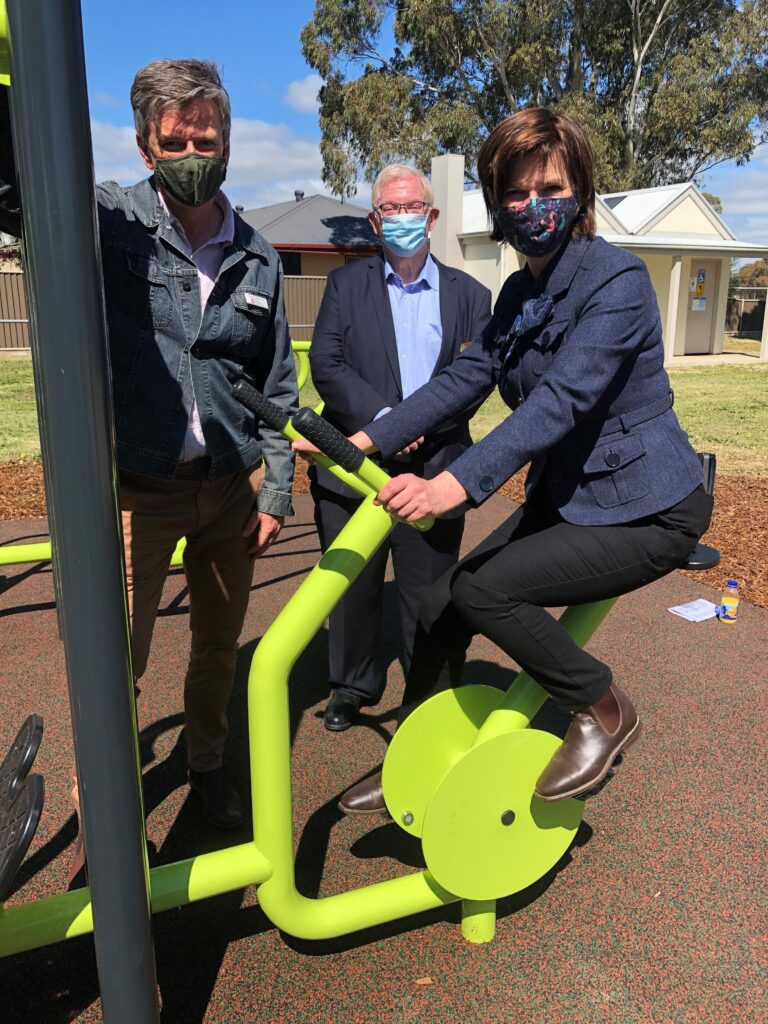
Ms Thomas also announced funding of $630,000 to go towards future development in the town, which has been identified as a growth corridor for the region. The Growing Talbot program will enable Central Goldfields Shire to plan for a centralised sewerage system in consultation with the community and to identify Talbot’s future subdivision and development zones.
The exercise equipment initiative is a Loddon Campaspe Regional Partnership priority project and supports communities to be more active by investing in small infrastructure and activation programs. The project is part of the Victorian Government’s $5 million investment in Healthy Heart of Victoria.
Talbot now has six new pieces of outdoor gym equipment at Pioneer Park, providing the community with free and accessible options to exercise and keep fit.
The new equipment includes a cardio bike, stretch station, body pull- and push- up equipment, chest press, leg press and elliptical trainer. The local community provided input on the selection, design and location of the equipment.
The Growing Talbot program arose after the pandemic resulted in unprecedented numbers of people moving from metropolitan Melbourne to regional and rural Victoria, increasing demand on the already tight housing market in many areas.
The Victorian Government has previously invested in the Talbot Station upgrade which has positioned the town to support growth and provide affordable land and housing options for nearby towns including Maryborough, Ballarat and Castlemaine.
The Growing Talbot project complements the Victorian Government’s $5 million Regional Workforce Pilots which are strategically located across the state to help regional and rural communities attract the workers they need to grow.
The pilots have been designed to tackle housing shortages and other barriers to regional workforce attraction, which are threatening economic recovery and growth.
Words: Donna Kelly | Image: Contributed


October 8th, 2021Glen, about the house

SPRING persists, even if it’s only vacillating between icy rain and those fleeting wind-cooled sunny spells.
At least the soil is being kept moist and friable, a bonus for newly-planted or awakening plants. And the worms are having a time of it, going about their business, cultivating the soil and recycling and distributing the mulch and compost into precious plant food for us.
On the bright side, our shrubs and trees are quietly bursting into new growth, especially noted are the deciduous varieties, with their multi-coloured clusters of new leaves and flower buds in gardens and footpaths everywhere. They are all just itching for the first real warm weather to really get on with the business of growing and flowering.
In the meantime it’s a matter of dodging the showers to grab some time to tend to things.
For a start, the roses. Now that spring growth is under way and roses bushes are a mass of new bronze and dark green leaves, it’s time to give them a good feeding to push them along. And, for that matter, all of your shrubs. The winter rains would have leached most of the plant nutrients down from the topsoil and out of reach of the hungry, searching new roots, so consideration will have to be given to replenishing these as soon as possible to have a good crop of new growth and blooms this summer.
The plant foods most needed are nitrogen, phosphate, potash and calcium. The organic plant foods provided by mulching and top-dressing with well-rotted compost and animal manures will usually play their part in providing for most of their needs, but in some situations, such as sandy or alkaline soils, it can pay to provide the extra boost of a complete fertiliser.
The mulching materials dug in during autumn should now be replaced. Rotted compost, leaf mould or animal manures can be used just as they are. Pea or wheaten straw are good also, but with those it may be necessary to replace the nitrogen that will have leached out of the straw during its rotting-down process.
Camellias, azaleas and rhododendrons, being surface-rooting plants, will especially need this care because they will suffer more than most from the leaching effect of the winter rains.
They also suffer very badly when the soil is alkaline or heavy clay which locks up the much-needed nutrients. In these circumstances the plants will respond to a dressing of iron chelates or sulphate of iron. This would also be a good time to give them a light tidying trim to remove any dead or spindly wood.
Hydrangeas will be entering a critical stage in their growing year as the hot weather approaches. It is important that they are never allowed to dry out once their flower buds begin to form. If they are left to dry and wither for any length of time from now until summer, their flowers may be lost for this season. To be on the safe side, cover the soil around each plant with a good, thick layer of organic mulching material and water regularly.
Spring is also clean-up time for citrus trees. Time to remove weak, spindly growth and dead wood from the tree. As citrus trees grow, they tend to accumulate dead, woody twigs and light growth towards the centre of the tree. By using a sharp pair of secateurs and a little patience, you can open up the centre of the tree and allow ample sunlight in, thus preventing the buildup of moulds, fungus diseases and insect pests that normally thrive on weak, shaded growth.
Got a gardening question? Ask Glen at glenzgarden@gmail.com

October 8th, 2021Japanese artists’ connection with Trentham

VISUAL artists Akiko Nagino and Takahiko Sugawara met in 2006 and they are still together, travelling and making works. Growing up in Tōhoku the remote and scenic north east region of Honshu, Japan’s largest island, they both completed studies at Tōhoku University of Art and Design in the city of Yamagata.

While Takahiko focused on the fundamentals of sculpture and exhibiting in group and solo shows across Japan, Akiko pursued an arts and crafts degree majoring in urushi or lacquer art; a process originating in China, more than 3000 years ago, before spreading throughout East and Southeast Asia.
In 2014 they moved to Melbourne, which must have been a significant change after the mountainous beauty of their home on Honshu. For Akiko the relocation led to a change in direction for her work.
“I wanted to get out of that kind of traditional style when we came here. When I studied lacquer I learnt lots of traditional skills, but it is very difficult and very delicate. And I thought it would be very interesting if I try another skill or material that is more easy. For example, my current artwork is just cutting paper.”
Her delicate and ephemeral pieces are often modelled on clothing including traditional Japanese kimono and 19th century western women’s dress. They incorporate traditional symbols of good luck, prosperity and patterns found in the everyday: from clouds to masses of leaves to the shapes found in butterfly wings.
It is extraordinary that Akiko considers her intricate paper cutouts to be a primitive and easily executable respite from the complexity of lacquerware pieces. Especially considering the response to them in the numerous exhibitions she has taken part in since coming to this country including several awards. One cannot look at her objects and not be in awe, imagining the process required to bring them to completion.
Takahiko also has a profound interest in the patterns of nature and it greatly informs his sculpture practice. But so does his being a tuba player at high school. As quoted from an exhibition catalogue in 2019: “Sugawara’s attention to space, form and line is deeply rooted in his teenage years where he played in Japan’s number one high school marching band. Required to make rigid lines and shapes whilst playing his instrument, these formative experiences have shaped a practice that explores ideas of layering and overlap.”
Such influences just go to show how diverse artistic input can be, ranging from the mystical intricacies of the natural world to social experiences grounded in everyday life.
The couple, in Akiko’s words, decided to come to Victoria first because they were advised that Victorians were more friendly than NSW which is, of course, absolutely true.
Takahiko was subsequently sponsored by Trentham sculpture artist, the late Matthew Harding and the couple lived in Redesdale while he was working with Matthew. Since then Takahiko has continued to show in various exhibitions. These include the Lorne Sculpture Biennale and the Deakin University Contemporary Small Sculpture Award showcasing his interlocking minimalist installations in both metal and wood.
“My ideas come from when single or multiple elements come together to make a new shape,” he says. “Basically I begin with small pieces and put them together to make something that just keeps on expanding.”
Today, Akiko and Takahiko live in Ballarat but maintain their connection with the Central Highlands region including exhibiting works at the Little Gallery in Trentham and Stockroom Kyneton.
Takahiko also worked with East Trentham artist Ian Neyland on the memorial sculpture to Matthew Harding which can be seen today as you come into Trentham from the east. And as restrictions inevitably ease they will be looking forward to more exhibitions around the state into the future.
Words: Tony Sawrey

October 8th, 2021GDTA guidebook for walks and bike rides

MOST people heading out into the bush for a walk or a mountain bike ride don’t have all day, so the Great Dividing Trail Association has produced a new guidebook, consisting of walks and bike rides within the Daylesford region, all short enough to complete in four hours.
President Gib Wettenhall said the association had, for many years, wanted to make Daylesford’s varied terrain more easily accessible “from the vastness of the Wombat Forest to the Central Highlands’ lakes and riversides, from its abandoned railway lines to gold rush era ruins”.
“The solution is now here – a new guidebook with 20 walks and 10 bike rides – and all of the routes presented are circuits, so there’s no fiddling around with car shuttles.”
Mr Wettenhall said a team of five GDTA members with vast collective experience had specifically devised the new Central Victorian Highlands Walk and Ride Circuits guide.
“Each of the walks and rides is supported by full colour, large-scale contour maps alongside detailed accompanying track notes. Graded from easy to hard, the circuits are all within a 25km radius from Daylesford.”
The guidebook received $8000 funding from the Community Bank Daylesford & District and it is for sale for $24.99 from www.gdt.org.au/shop or the Daylesford Regional Visitor Information Centre.
Bank board member Margaret Hodge said the bank supported the project because it was a wonderful boost for locals and visitors who enjoyed the outdoors.
Bank manager Melanie Tudball said the bank was owned by local shareholders and had provided more than $100,000 in grants and sponsorships each year over the past couple of years.
“The GDTA is an amazing group of volunteers who have for almost 30 years focused on building, maintaining and promoting trails in our region. The Community Bank is pleased to support them and many other local groups.”

October 7th, 2021Supporting events for young Victorians
The Victorian Government is providing a significant funding boost for youth programs, offering more opportunities for young people to reconnect with their community as pandemic restrictions ease.
Minister for Youth Ros Spence has announced $15 million over three years for the Engage! Program, providing opportunities for skill development and leadership, and $10.2 million for creative youth-led events through FReeZA.
Grant applications are open now for community organisations and local governments to deliver youth-led events and programs that harness the potential of Victorians aged 12 to 25.
The programs build on extensive consultation with young people and the youth sector across the state over the past 12 months to inform the upcoming Victorian youth strategy.
Engage! grants are available for organisations to co-design and deliver a broad range of activities with young people including mentoring, building life skills and showcasing creativity and talents.
FReeZA grants support the delivery of youth-friendly live events across the state in environments that are drug, alcohol and smoke-free.
The Government is also extending its successful partnership with youth music organisation The Push, committing almost $1.4 million over three years to ensure FReeZA events continue to meet the contemporary needs of young people and the music and creative arts industries.
To find out more about Engage and apply, visit youthcentral.vic.gov.au/engage.
For more information on FReeZA, visit youthcentral.vic.gov.au/freeza.
Applications close Friday, 29 October.

October 7th, 2021Tutor program to continue
The Victorian Government will make sure that not one school student is left behind in the wake of the pandemic, with the state’s extraordinarily successful tutor program to continue until the end of 2022.
Minister for Education James Merlino announced $230.4 million will extend the single biggest boost to individual learning support in the state’s history – allowing Victorian schools to retain the tutors that have supported students throughout 2021.
The tutor program has called on pre-service teachers, teachers on leave, retired teachers and casual relief teachers to sign up and get back in the classroom – with at least one tutor in all government schools to ensure every Victorian child comes out of the pandemic with the confidence that their learning is on track.
While the past two years have seen some students thrive with the flexibility and self-direction remote learning gave them, for others this period has been profoundly difficult – and the tutors have worked both in the classroom and through remote learning to identify and support the students who needed extra help with their learning.
Students who struggled most during the pandemic included those with low levels of English, those already at risk of disengaging from school, or those with home environments not conducive to online learning.
The tutors have had a hugely positive impact on hundreds of thousands of students, with Victoria recording nation-leading NAPLAN results in August, and an independent evaluation by Deloitte concluding the initiative improved attendance, achievement, and engagement among students – and had a positive impact on their confidence.
Schools are responsible for employing their tutors based on the needs of their students, with tutors offering a range of expertise, experience and support to the students who need it most.
Tutors work in small groups to provide tailored support for identified students who need assistance to catch up – regardless of their circumstances or background.
The extra support for onsite tutors in 2022 will also ensure teaching teams can continue to provide dedicated and individualised support for students who need help.
Small schools will also see their funding allocation increased from a minimum of $15,000 to $25,000 per school – allowing them to hire more support for their students after the challenges of 2021.
Individual schools will continue to determine how tutoring support is best implemented in their school, ensuring the program is tailored to the needs of each student – with a focus on ensuring all students have caught up on key skills in numeracy and literacy.
Mr Merlino said there was no question that this pandemic has been a challenge for many students.
“But we’re making sure no Victorian child is left behind, with thousands of dedicated tutors to make sure everyone can catch up and prepare for a much better 2022.
“Our tutors have done incredible work throughout this year helping students succeed, and Victoria’s nation-leading NAPLAN results are a testament to their dedication and hard work in schools across the state.”

October 7th, 2021New female-friendly pavilion at Hepburn
The Hepburn Burras Football and Netball Club and Hepburn Cricket Club now have more room to grow, with the completion of their new, female-friendly pavilion at Laurie Sullivan Reserve.
Member for Macedon Mary Anne-Thomas joined members of the Burras to officially open the new pavilion, made possible by a $100,000 boost from the Victorian Government’s Country Football and Netball Program.
Membership at both the Hepburn Football and Netball Club and Hepburn Cricket Club has grown to almost 300 in recent years, however, the previous facilities failed to meet modern standards and expectations.
The new pavilion modernises the club’s facilities and includes female friendly change rooms, umpire facilities, accessible toilets, storage and a community space.
The new building provides the perfect venue for local participants, especially women and girls at the Burras keen to get involved in netball, football and cricket.
The extra space will allow more players and community members to play, train, compete, develop and celebrate.
The Country Football and Netball Program is a partnership with Netball Victoria, the AFL and AFL Victoria to help netball and football clubs across the state, because everybody deserves equal facilities, no matter where they live.
Applications for the next round of the program will be open again soon.
Better sport and recreation facilities make it easier for players, coaches, umpires and supporters of all abilities to get involved in local sport and lead healthy and active lifestyles.
Ms Thomas acknowledged the Hepburn Shire Council and the Burras for their commitment and financial contributions to the project.
The recent launch of Victoria’s roadmap has provided a more secure pathway for a return to play. The new pavilion will go a long way to inspiring even more locals to join in the fun and clubs like the Burras can also welcome more women and girls, train longer, and compete at quality facilities.
“Better facilities make it easier for Victorians to get back into local sport and recreation and live active and healthy lifestyles.”

October 7th, 2021Have your say on dogs and cats in the Macedon Ranges
Macedon Ranges Shire Council is calling on residents with and without pets to help shape its new Domestic Animal Management Plan.
Council’s Director Planning and Environment, Angela Hughes said the new plan would provide a framework for council’s animal management services for the next four years.
“We value pets and the role they play in the community and are keen to hear from everyone to ensure we develop a plan that balances the needs of pet owners with the wider community,” she said.
In Victoria, councils must develop a new domestic animal management plan every four years to set out services, programs and initiatives that promote responsible ownership of dogs and cats in the community.
A number of key initiatives were delivered as part of the previous Domestic Animal Management Plan 2017-2021, including:
– new dog on-and-off leash rules
– cat curfew requiring all domestic cats to be contained on their property and enclosed from sunset to sunrise
– designated sensitive environment areas where cats and dogs are prohibited (Gisborne Marshlands, Hanging Rock Reserve, Malmsbury Common, Mt Gisborne Reserve, and Woodend Grassland Reserve).
Council will use the feedback gathered to inform the development of the draft plan, which will be released later this year for public comment.
Link: mrsc.vic.gov.au/yoursay
Feedback is invited until 5pm on Thursday, October 21.

October 6th, 2021Social and affordable housing
The Victorian Government is calling on all developers and landowners in regional Victoria to put forward any developments or vacant land that could be turned into social or affordable housing.
All Victorian regional areas will be considered, with a preference for the Greater Geelong, Latrobe, Moorabool, Golden Plains, Greater Shepparton, Baw Baw, Mildura, Wellington, East and South Gippsland, Macedon Ranges, Bass Coast, Surf Coast, Mount Alexander, Horsham, Swan Hill, Alpine and Mansfield local government areas.
The Government is investing $80 million to address a critical shortage of housing in regional Victoria, with recent rental market data showing housing affordability has fallen to its lowest level since data was first collected in 2000.
This is an opportunity for landowners and builders to contribute to the future of their communities by growing the supply of housing and creating jobs under the Government’s landmark $5.3 billion Big Housing Build.
This round of funding will focus on purchasing new homes, house and land packages and developable land that is zoned for residential use. Strict guidelines for proposals will need to be addressed including proximity to retail, schools and transport.
Landowners and developers are encouraged to partner with community housing providers, local government and other organisations to submit proposals to Homes Victoria. They can tender more than one proposal, with submissions due no later than 2:00pm on Thursday 7 October 2021 through tenders.vic.gov.au (Buying for Victoria).
The Government is investing $1.25 billion into new social and affordable housing in regional Victoria as part of the Big Housing Build, which includes minimum investment guarantees for 18 regional Local Government Areas.
Up to $485 million is set aside for projects outside the 18 priority LGAs, and Homes Victoria is working hard to create new opportunities for social and affordable housing in all parts of regional Victoria.
The Big Housing Build will provide more than 12,000 new homes across the state – boosting social housing stocks by 10 per cent – and create 10,000 jobs a year.
Minister for Housing Richard Wynne said as Victoria continued to grow, so did demand for social and affordable housing.
“That’s why we’re delivering more housing for Victorians in need, as well as low and moderate income households, while creating thousands of jobs.
“We are calling on landowners and developers to put their hand up to help make a contribution towards the future of their community, create jobs and put a roof over heads of Victorians who need it the most.”

October 6th, 2021Free Xmas workshop for local retailers
Macedon Ranges Shire Council is encouraging local retailers to sign up for a free visual merchandising workshop during October.
At the one-hour workshop, participants will learn how to think creatively, add value to a product range and pull out all the stops for impactful window displays in time for Christmas; and also inspire fresh ideas for 2022.
Focussing on the why, when, what, where and how, visual merchandising expert Jennie Kelly from A Creative Space, will deliver the top 10 retail tips for customers and how to maximise sales.
Workshops will be held in Macedon,Romsey and Riddells Creek.
Limited spots are available and bookings are essential.
Workshops will be moved to online delivery if COVID-19 lockdown restrictions are in place.
Link: mrsc.vic.gov.au/business-events

October 6th, 2021Prepare for summer with safe burn-offs
Macedon Ranges Shire Council, in consultation with local CFA brigades, is advising residents to begin clearing their property and burn off any debris in October ahead of the summer fire season.
In October, property owners of land less than 4000 square metres (one-acre) do not need a permit to burn off leaves, twigs and small branches, to minimise fire risk.
A permit is required from the Fire Prevention Officer outside of October for smaller property owners wishing to burn off.
Residents must ensure that when burning off they do not create a nuisance for their neighbours and should continue to monitor any burn-off for at least seven days to ensure it is fully extinguished.
Council also reminds residents to consider the safety of wildlife and check their piles for animals before they burn tree debris.
Wildlife officers recommend residents use a torch and a broom, or pole, to carefully check the centre and bottom areas of the bonfire. A spade or fork could cause serious injury to an animal.
Large loads of green waste (excluding noxious weeds) can also be taken and tipped for free at council’s transfer stations. Residents are also encouraged to make use of their green waste bin.
Residents wishing to burn off must monitor weather conditions before starting any fire and must register their burn by calling 1800 668 511. For more information about burning off, visit mrsc.vic.gov.au/fire-ready or call council on 5422 0333.

October 6th, 2021Upgrading public care aged care facilities in Creswick
The Victorian Government is upgrading public sector residential aged care services in Western Victoria, creating new jobs and ensuring hundreds of older Victorians continue to receive the care and comfort they deserve.
Minister for Disability, Ageing and Carers Luke Donnellan today announced the 21 successful public sector aged care recipients of the $10 million Rural Residential Aged Care Facilities Renewal Program.
The renewal program supports improvement projects delivering significant enhancements for aged care residents and help meet the growing demand for quality services in regional and rural Victoria. The program is helping regional public sector residential aged care services from Bairnsdale to Horsham.
Recipients in Western Victoria include Creswick Aged Care which is receiving $2,559,000 to complete the Creswick Residential Aged Care Centre enhancement project. This project is being undertaken to complete the enhancement of facilities at Creswick Residential Aged Care Centre to be in line with best practices in integrated care for aged care residents of the newly amalgamated Central Highlands Rural Health. The project includes:
- Upgrading 6 bedrooms with ensuites and all fixtures and fittings
- Extending the residents’ common areas
- Installing overhead tracking in all rooms to support ageing-in-place
- Upgrading of heating and cooling systems
- Paint work, carpets, fittings and furnishings
- IT and Infrastructure upgrade
Western Victoria MP Jaala Pulford said the government was ensuring older people across regional Victoria would have the quality facilities and services they need to age well.
“This funding will create jobs right here in Hepburn Shire while also delivering modern public sector residential aged care facilities.”

October 6th, 2021Business recovery support for agriculture industry
The Victorian Government is fast-tracking the road to recovery for agriculture and food supply chain businesses in rural and regional Victoria.
Macedon MP and Minister for Agriculture Mary-Anne Thomas this week announced a new $5.2 million Agriculture Resilience and Recovery Program while visiting Mt William Advanced Tree Nursery in Lancefield. The nursery received $35,000 last year as part of the Government’s Agriculture Workforce Plan – Business Adaptation program.
The grant enabled the nursery to build a portable lunchroom and expand the existing lunchroom to provide suitable space for workers. Prior to this, staff were forced to split shifts, restrict work days, rotate lunch breaks and work across multiple sites.
The new program provides grants of between $10,000 and $300,000 to support on-farm infrastructure, business upgrades and new facilities to enable businesses to adapt their operations to COVIDSafe settings.
The program provides three types of business support:
• Business Resilience and Recovery – to support businesses to adapt their operations to maintain production and manage risks.
• Place-based Worker Support – to support the development of COVIDSafe worker accommodation.
• Training and Education – to provide support for farm and food processing workers to access information and services and ensure businesses are providing COVIDSafe work practices.
The grants will provide support for businesses as they prepare for upcoming peak seasons including spring shearing, grains harvest and meat processing, and horticulture’s peak picking and packing season.
The Agriculture Resilience and Recovery Program is part of the Government’s comprehensive $84 million support package to assist industry to address workforce challenges brought about by the coronavirus pandemic.
More than $30 million has been provided through the Agriculture Workforce Plan, which has awarded more than 380 grants to assist businesses to create COVIDSafe workplaces, provide worker induction and training, and create additional accommodation and transport facilities.
Businesses have been supported to build COVIDSafe lunchrooms, kitchens, washrooms and other worker amenities, make modifications to processing, packaging and manufacturing lines, create automated entry points, build partitions for workspaces and install temperature checking facilities.
Ms Thomas said the support would help more agriculture and food supply chain businesses manage the challenges created by the pandemic and fast-track their recovery.
“We’re supporting industry to create long-term solutions to workforce challenges – this new program will help local businesses to adapt and thrive into the future.”

October 5th, 2021Community grants open for Hepburn Shire
With COVID restrictions easing, this is an opportunity for community groups to apply for Round 2 of Community Grants.
Council is offering $65,000 in Community Grants across the financial year to not-for-profit community groups or organisations for the benefit of the Hepburn Shire community.
Mayor Cr Lesley Hewitt said that community grants helped groups bring ideas to life.
“Community grants help community groups and organisation with projects that they may not be able to deliver otherwise,” said Cr Hewitt.
Round 2 categories include: Active and Engaged Communities; Quality Community Infrastructure (including small equipment); Sustainable Environments; and Children’s Program (specifically for 8 – 12 years).
Round 2 closes October 29.
Council officers are available for community groups to contact and discuss ideas on 5348 2306.