


October 5th, 2021Creswick trails update
The planning work is continuing on the Creswick Trails Network, a project which will see delivery of 60km of mountain bike paths and a trailhead at Creswick, with council expecting to begin works next year.
Along with the world class mountain bike trails, the trailhead at Hammon Park will serve as a community and youth precinct focusing on accessible play, cycling safety, cyclocross, and a site for local, regional and national events.
Permits and consents for the trails to be built are going through the required process, and Mayor Cr Lesley Hewitt said council was looking forward to constructing the projects once approvals are in place.
“This will be a great asset for our community, both offering locals the opportunity to get active and explore our beautiful bushland, and the economic benefits that come from people visiting our Shire,” Cr Hewitt said.
Council has publicly advertised the planning permit and received a number of submissions.
While the planning permit process is undertaken, work is under way to finalise the construction documentation for tender. Once a permit is considered and approved, a construction tender will be advertised at the end of January 2022. The council will consider awarding the contract at a council meeting shortly after that.
“A lot of the process for constructing trails relies on approvals from other agencies, so we’re doing what we can to keep this project moving,” Cr Hewitt said.
“While the process may seem slow, it is a legislated and necessary part of the pre-construction work to ensure that what is built meets or exceeds requirements associated with constructing on Crown Land.”
The detailed design of the masterplan for the Hammon Park Trailhead is proceeding and is around 80% complete. This necessary step provides the detail required for construction firms to quote and construct the trailhead.
The masterplan includes details such as the precise location of features, services and paths, materials and testing details against known estimated costs.
Link: www.creswicktrails.com.
October 5th, 2021Proposed renaming of Jim Crow Creek
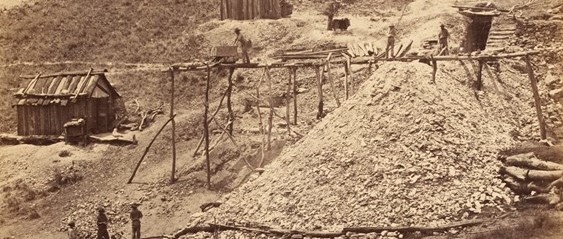
Hepburn Shire Council is working with project partners, Mount Alexander Shire Council, North Central Catchment Management Authority and Dja Dja Wurrung Clans Aboriginal Corporation trading as DJAARA, on the proposed renaming of Jim Crow Creek to Larni Barramal Yaluk.
Larni Barramal Yaluk means ‘Home or habitat of the Emu Creek’. The renaming of Jim Crow Creek is being proposed in recognition of Aboriginal heritage and the reinstatement of Dja Dja Wurrung language into the landscape, and the removal of a name that is offensive and derogatory.
Mayor Cr Lesley Hewitt said that the council was committed to reconciliation and working positively with the Dja Dja Wurrung (traditional owners) and other Aboriginal and Torres Strait Islander community members.
“The history of the term ‘Jim Crow’ is rooted in racial segregation and racism. We want to learn, acknowledge and move forward together. By reinstating a name that reconnects our community with the Dja Dja Wurrung culture and language that spans many thousands of years, we are setting the standard for how we can support the Dja Dja Wurrung Peoples,” Cr Hewitt said.
Rodney Carter, CEO at DJAARA, said the proposed renaming was really positive because it was putting language back into the landscape, and therefore puts People back into the landscape.
“Naming places in our language opens up conversations so when people say that word, it is talking to Country. You create a degree of fondness and care of a place,” Mr Carter said.
The name “Jim Crow Creek” will be reserved in the state’s geographic names register as a historic name and will remain a part of the region’s history.
There are strict protocols that govern the renaming outlined in the maming rules for places in Victoria – statutory requirement for naming roads, features and localities 2016.
The engagement phase of the project will be until November 12.
Link: https://participate.hepburn.vic.gov.au/proposed-renaming-jim-crow-creek.

October 5th, 2021Celebrating Macedon Ranges Seniors
The Victorian Seniors Festival Reimagined is back in 2021 and to celebrate, Macedon Ranges Shire Council will deliver ‘celebration boxes’ to 30 older residents who have made significant contributions to the Macedon Ranges community.
Council’s Corporate and Community acting director Gina Lyons said this year’s festival theme of ‘keep’n on’ recognised the resilience of older people and the many different ways they contribute to our community.
“This is our opportunity to say thanks and celebrate the wealth of local knowledge and wisdom in the Macedon Ranges.
“If you know an older person in the shire who has gone above and beyond, make sure you nominate them today.”
Residents of the Macedon Ranges Shire aged over 65 (or Aboriginal and Torres Strait Islander people aged over 50) are eligible to be nominated.
Nominees will be considered on the basis of their contribution to the local community, how they demonstrate active ageing and promote a positive image of older people.
Nominations are open until Sunday, October 10.
To submit a nomination, visit mrsc.vic.gov.au/seniors-festival or call 5422 0333.

October 4th, 2021Stories of the Storm

SANDY Scheltema’s Stories of the Storm series is supported by Hepburn Shire Council, Trentham & Districts Community Bank and the Trentham Lions Club. The series aims to showcase stories of courage, tenacity, bravery and resilience within the community from people who experienced the terrifying storm of June 10, 2021.
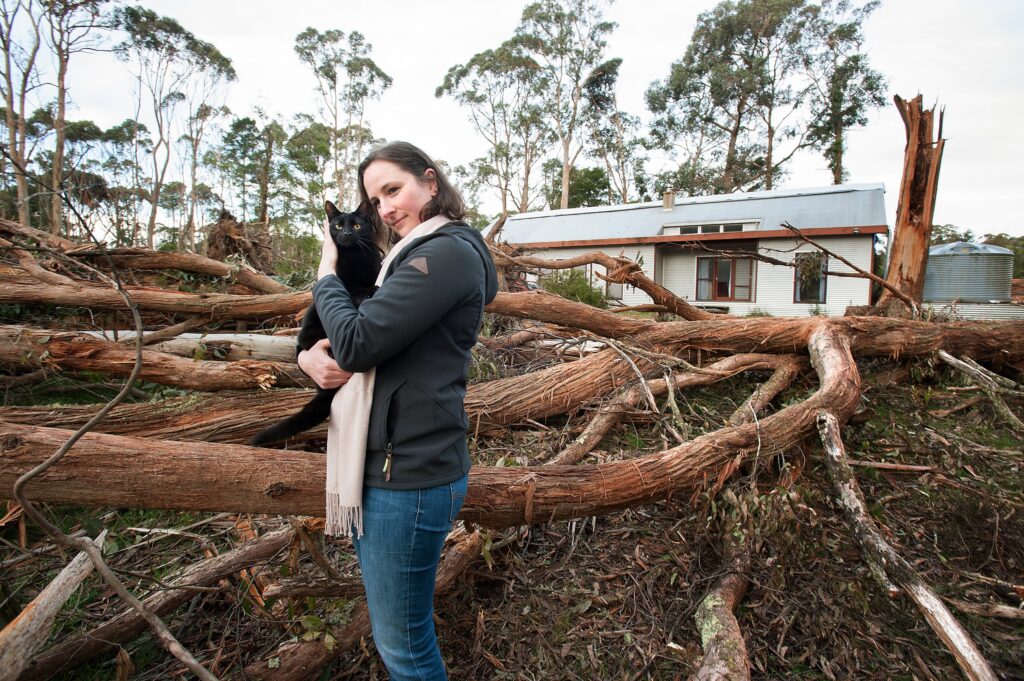
BULLARTO resident Ingrid describes her terrifying ordeal on the night of the great storm – alone, with trees crashing down on her house and emergency services unable to reach her.
“I waited anxiously. I remember having the thought it’s bad for Dan (Ingrid’s partner, stuck on the Kyneton-Trentham Road). I was worried a tree would fall on his car. He kept on getting turned around by trees, he came up against a fallen tree and turned around and came up against another fallen tree. He was trapped. He called his mate Brendan.
“They pulled the tree out of the way and the cars that were stuck managed to go a bit further before being stuck again. There was a tree down in front of the old church as tall as a double decker bus. Brendan and Dan managed to get out. Brendan was in hero mode and very excited, Dan was very practical.
“Meanwhile I’d gone to bed and was furiously trying to relax. I was scared. I could hear trees falling and sticks and branches flying into the windows. I didn’t know where Brendan and Dan were. I was worried about Dan’s low phone battery and my own. About 12.30 I heard a big tree come down behind the house. It hit the big canopy, hit our water tanks, and knocked the gutters off. Literally I was trembling and scared. I called my dad again, went out and had a look and said, ‘I don’t want to be out here’. I felt reassured by him. I know now he was terrified, wishing he could be with me to help.
“At that point I called the SES – I couldn’t get through – I felt like I should call and register. A part of me thought ‘It’s a priority, right now!’ I told myself ‘My flight or fight response will kick in if I need it’. A tree landed on the southern side, full across the house. I heard the tearing noise and then the big bang. I didn’t know if that was the sound of the tree or the ceiling collapsing. So I got up, had a look – tentatively, in my nightie.
“By that point my black cat Luther was jammed under my bed. I saw about three square metres of ceiling on the ground and on the couch. I checked the other rooms, you could see structural damage. I didn’t feel safe for a long time after. I called 000. Luckily, I still had reception. They said, ‘We’ll put the call out to police, SES, ambulance’. The call went out to the CFA in Musk to Wayne. He started driving until a tree came down in front of him and he thought ‘Oh no, I’m going home’.
“When I found out he was trying to get here I felt a huge comfort. I felt an internal switch, my mindset shifted – ‘Now it’s time to get prepared’. I didn’t want to keep the SES waiting. I got into some clothes, got a bag for the cat, then shut the door so I wouldn’t have to find him if people came to rescue us.
“I lay down on the floor between the bed and the chimney. I thought that was the safest place. I thought about trying to pull the mattress over myself to protect myself. I looked at the cat and thought ‘He’s safe under the bed but I don’t fit under the bed!’
“I was there for 15 minutes, hearing trees falling. I heard one really close to the house and I thought ‘Alright, this is it’. I got a call from Michael from the SES in Daylesford.
“I told him I was terrified, and he said it was best I should leave. I think my reaction was ‘Are you mad?’ While I was talking to him, I managed to pull Luther out from under the bed and zipped him up in the bag, with some struggle.
“I called my dad and he tried to call our nearest neighbours. Their phone was disconnected, then he called a neighbour about a kilometre away who answered, they had a landline. The neighbour, Paul, said he’d drive down to the main road, but I’d have to get there.
“I made sure the cat was in the bag, and I got my phone, my charger, my super-powerful bike light and I grabbed my bike helmet and put it on. I had planned to cut through our neighbour’s field, but there was a huge tree down creating a new fence. I went around the house but there were more trees down.
“I was on the phone to my neighbour, and I remember saying to him ‘I don’t want to climb those trees,’ and he said, ‘Well if they are fallen down, they are not going to fall on you.’ I climbed maybe five or six fallen trees of shoulder height. I heard a tree falling and started running. I made it to the point where there were no more big trees and got to the disused petrol station.
“It was cold and wet and windy, standing in the dark for 10 minutes under the awning of the disused petrol station. I wanted my neighbour to be there – right then and there. I ran into his car when he arrived. He took me to his house and safety and a cup of tea. I felt relief and appreciation. I felt safe. I felt their warmth and compassion. It took Dan two days to get back through the road to me.
“My neighbours housed me and then Dan for three nights, and then installed us in their B&B. I felt grateful that the people who rescued me then housed us. The insurance said it will be nine months before we can get back in. We’re lucky because it’s not easy to get a rental around here.”
“Because of the Covid lockdown I couldn’t see my parents. We desperately wanted to see each other. We’ve had working bees of friends and families but we had to stop because of the lockdowns. We’ve got years of work ahead of us clearing the trees that are down. I feel overwhelmed. One of my friends said our garden is now ‘cyclonic chic’.
“I believe this storm happened because of climate change. The trees weren’t equipped to deal with a force of 160km winds coming from an unusual direction. Helping one another helps our community get through events like this – caring and being compassionate and not blaming people for things which are outside their control.”

October 4th, 2021BlazeAid: Ready to help but hit by red tape

WHEN the Black Saturday Fires ripped through Kevin and Rhonda Butler’s farm at East Kilmore in 2009, their immediate concern was the safety of their sheep.
East Kilmore in 2009, their immediate concern was the safety of their sheep.
Kevin, a former school teacher, put out a call for help to urgently repair three kilometres of fencing. Friends and strangers alike turned up, working tirelessly for a week to repair the fence.
“On my own this would have taken me three months to complete but the support we received was overwhelming. My wife then said we had to pass this goodwill on and help neighbours and others affected by the fires,” he said.
“As a former school teacher with 25 years spent coordinating infants, I was highly organised but I asked my wife if she was prepared to cook morning, noon and night for the volunteers. She was of course and out of the goodness of strangers and a need to help those straight after a fire, BlazeAid was born.
“We were the lucky ones in those fires and it almost felt like we had survivors’ guilt. We knew we had to set up a volunteer group to go into devastated communities, with no red tape, just willing workers ready to help anyone at any time.”
And that they have done ten-fold. Since setting up the group thousands of long- and short-term BlazeAid volunteers have helped rebuild fences for bushfire, flood and storm survivors.
Volunteers have come from all parts of Australia, as well as New Zealand, Switzerland, England, Afghanistan, Canada, Germany, Austria, America and France.
Kevin was adamant the BlazeAid volunteer organisation would be set up as an Australian charity with any donations and sponsorship funding going directly into setting up base camps across the country.
“We were determined to set up an extremely effective system from day one and over that time I have had some tremendous mentors. The people involved in the committee are good people wanting to make a difference and ensure every penny (there are only two paid positions) goes directly back into the charity,” he said.
“We have kept records and tracked data from day one and run to a very successful business model that has seen BlazeAid help thousands of families in need.”
Melissa Jones is the operations manager and has recently taken over the reins from Kevin. A former school teacher herself, with her own young children, she said the hard work and time involved in running BlazeAid is a privilege.
“My entire role centres around helping people in need and what a gorgeous job. It’s extremely hard work but I have tremendous support and wonderful mentors around me and being able to make a difference in the lives of strangers in need is incredibly humbling,” she said.
BlazeAid is currently working across Australia in response to flood damage and more locally in Yinnar and Heyfield in Gippsland. More than 300 fences, hundreds of hours in volunteer work and hundred of thousands of dollars in fencing has been the result of the Heyfield basecamp.
Melissa said BlazeAid volunteers not only repair damaged fences but also help to lift the spirits of people who are often facing their second or third flood event after years of drought, or devastating losses through bushfires.
“BlazeAid volunteers work in a disaster-affected area for many months, not only helping individuals and families, but also helping rebuild the local communities,” she said.
Blocked by bureaucracy
Red tape and buck passing have prevented BlazeAid volunteers setting up camp in the Hepburn Shire despite repeated calls to do so.
To date BlazeAid has helped two families, one in Trentham and one in Tylden, but founder Kevin Butler and operations manager Melissa Jones both agree they have been stonewalled by red tape.
“Our business model is very clear. We make sure we are invited into a community and that is always through local government. We need to set up base camps and that usually happens on campsites, in community halls and at showgrounds so it is always on council land,” Melissa said.
“We have attempted on two occasions to speak to Hepburn Shire about BlazeAid (following requests from residents) and on both occasions had no luck and that’s when the red tape began,” she said.
“We had volunteers that were ready to set up and help rebuild fences and told them that. At one stage I was told they were too busy.”
BlazeAid could easily bypass local government and go directly to committees of hall management but Melissa believes being invited in is imperative to BlazeAid’s work.
Hepburn Shire Council chief executive officer Bradley Thomas said it was up to Bushfire Recovery Victoria.
“BlazeAid first contacted council in August. As the storm damage was not specific to one local government area we informed them they would need to liaise with BRV about establishing an operations centre, and we look forward to working with BRV and others agencies in partnership on this large clean-up,” he said.
“We know many residents are struggling with the clean-up. We understand that BRV is engaging with a number of organisations, including BlazeAid, on behalf of the storm-affected communities in Hepburn, Macedon Ranges and Moorabool shires. The Central Highlands region is working together to find ways to further support our communities.”
It’s believed the Hepburn Shire Council has nine dedicated roles employed specifically for the post-storm clean up and Melissa contacted one of those employees twice – in June – days after the storm, at the same time BlazeAid volunteers were working in Hepburn Shire.
“I spoke to the same officer twice and both times was hit with red tape. I explained our need to be invited in by the shire and would have expected that if that officer thought it was BRV’s call then they would have liaised with that agency.
“But here we are three months down the track and for those three months we could have been working in the shire, helping rebuild farm fences and helping many residents in need.”
BRV has confirmed it is in contact with BlazeAid and is now working on identifying locals across the Central Highlands who are still in need of farm fencing repairs.
It needs to be stressed, BlazeAid repairs traditional farm fencing on a large scale given the time and effort needed to complete the work. You can register to be a volunteer or seek support by emailing admin@blazeaid.com.au
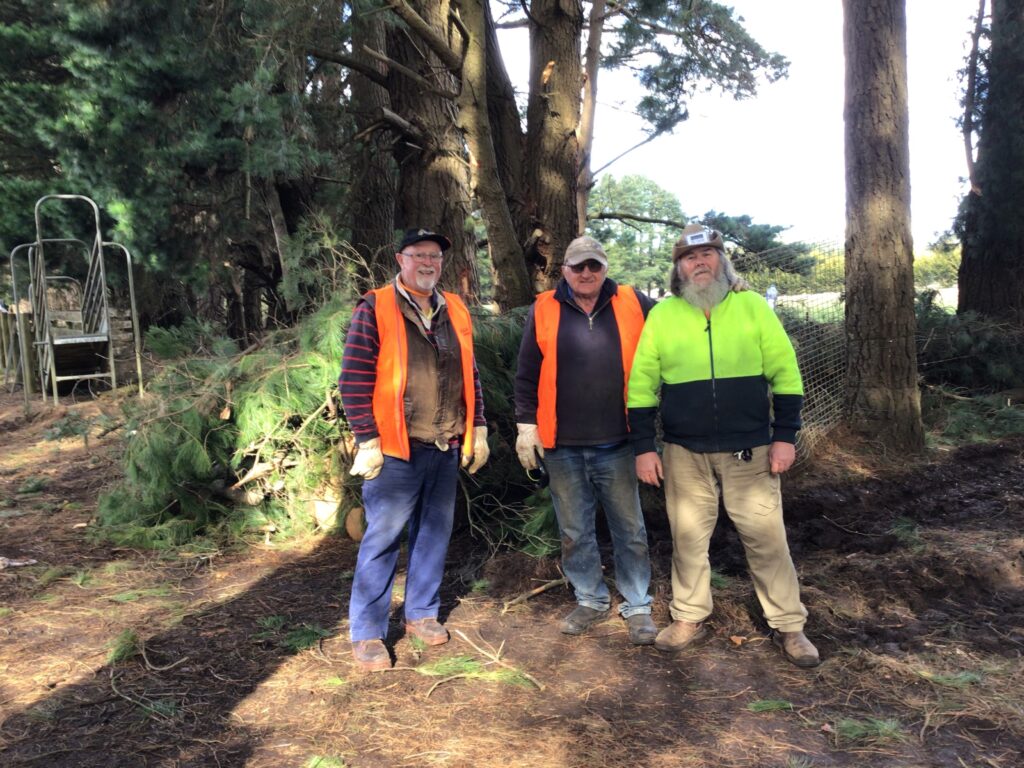
Above, BlazeAid volunteers Kevin, Bob and Peter repair a fence in Trentham days after the June storm Words: Narelle Groenhout | Image: Supplied

October 4th, 2021The Lighthouse
The waving line between shore and sea
dissolves footprints like friendship and time
The way ahead is dark and uncertain
A lighthouse on the cliff illumines the black sea
where white birds hover as heralds.
Tether me to a lantern so I can see
the colours of sky, my first love
never so with people but loved many cats
simpler in their ways and soft
Today is a good day to die watching flocks of ibis
fly in formation in a winter sky
The Egyptian god of writing and language
bore that curved beak dipped in blood or octopus ink
scribing hieroglyphic instructions in stone
on how to make the sun rise
Strange how fear projects such errors
Here at the end of all things once again
Thanatos rages as starving women
give birth to babies in dust while men kill each other
in futuristic battle gear and weapons
gifted by some power or other, hard to know why
but it dries up the river Nile at its source
while the ends of the earth melt and catch fire
Now a plague to each other with disease in the air
gasping and greedy, we devour life itself
Here in this safe harbour the boat’s engine shudders
plowing through waves bearing empty seats and a passenger
I breathe and wait, aware of millions gasping for breath
Or going mad in lockdown
when suddenly this grim thought melts
as the sky softens to luminescent pink
When the ferry docks I chase the sunset in my car
but flirtatiously true love fades without trace
the road ahead forks to the left
a dead end going round in circles
and the other way blocked by consequences
further down the road a neighbour’s voice shouts
outrage at the lack of a want
like a child digging a deep hole in the sand
she strides on carrying six children with unhealing wounds
What power can free me from this burden?
The inner sun illumines a fool
in a jester’s hat, mask and costume
willing to perform any part
unrehearsed for no pay

October 4th, 2021Battles continue for hospitality businesses

HOSPITALITY businesses around the Central Highlands are doing it tough as Melbourne remains closed and inside limits remain at just 10 people per building.

Many have chosen not to reopen, or to continue with just takeaway, while others are doing all they can to keep their doors opening by extending outdoor spaces for another 20 patrons.
But with the fickle weather of spring, it is proving difficult to serve customers outside with sudden rainshowers, and limits already met inside, meaning patrons may have to leave their meals and drinks and head home.
There are also many concerns about owners and staff acting as quasi bouncers when it comes to checking identification and eventually vaccine passports. There have also been reports of patrons refusing to wear masks with the excuse they have an exception – but then refusing to show that exemption due to privacy issues, apparently backed up by the Victorian Equal Opportunity & Human Rights Commission. (Read the end of Just sayin’… on page 22.)
Daylesford Macedon Tourism chief executive officer Steve Wroe said many hospitality businesses were “deeply unhappy” about the 10-person limit.
“It really means they can’t trade profitably and the restriction is so onerous there is no point in opening. Even if the business is open for takeaway and they have staff and power on, it still doesn’t make sense for them to open indoors.
“The reason the government has put that level of restriction on is the public health justification and it is not for me to second guess that or argue against that but what we are saying is fine, if you want to put the restrictions in place for God’s sake make sure the business support packages are maintained.
“The overriding fear among tourism businesses is that the government says regional Victoria is open so we can pull that funding support.”
Mr Wroe said he met regularly with state government ministers and had made it clear ongoing support was needed. He said if Melbourne was closed, from a tourism point of view, regional businesses were unable to trade profitably.
Mr Wroe said he, and other tourism leaders, were also asking for a wage subsidy to be put in place for tourism businesses.
“I am saying to ministers that the reason for this is that we are 18 months into this pandemic and businesses have burnt through all their cash reserves. They don’t have anything else to lean on and they need something in place to keep their staff.
“With Melbourne closed the biggest risk is that the support is pulled, they have to let staff go and then they are not in the position to handle the volume that comes from Melbourne. If that support does not stay in place until Melbourne opens up then the shit will hit the fan.”
Mr Wroe said he was open to the idea of vaccine passports eventually being trialled in regional Victoria but not until there was a clear plan in place on how it will work, and with strong support for businesses.
“My concern is there was enough grief with businesses just doing the ID check on whether people were from Melbourne, and while that is not a particularly contentious issue, it’s pretty black and white, something like vaccination is different.
“We know there is a percentage of people who are anti-vax and a percentage of them are pretty militant about it. It is a much trickier situation for business owners and staff to manage. It only takes one anti-vax militant to get in front of some poor young person and it could blow up.”
Daylesford Boathouse Restaurant co-owner Susanne Devine said the new density limits had caught her and partner Claire Levine by surprise. “We thought we were going back to the same density limits but then heard it was only 10 people inside. I thought it might have been a joke.”
The pair decided not to reopen their business with limits making it impossible to trade profitably. And while they have an outside area it could not be relied on with spring or even summer weather.
“If we had people outside and it got cold, or rained, we can’t bring them in. And we are a restaurant, we have to cook food and serve perhaps three courses.
“Our patrons might be with us for a couple of hours. Everyone knows what spring is like in the Central Highlands and we couldn’t have even relied on last summer.”
Ms Devine said the latest limitations had been the most difficult, leaving many hospitality owners in limbo and unable to take forward bookings. But she said most people were very understanding. “People are fantastic and as soon as they realised we could only have 10 people inside understood it was just not viable.”
Ms Devine said the introduction of vaccine passports would be welcome but difficult, using up time and labour to police.
“But we had that with licences for ID and people became very good at having them ready for you to look at when they arrived. They were really getting better and better at that. And while I think there will be a little bit of a kickback with the passports, it is just something we will get used to. It will just work.”
Meanwhile, the state government’s roadmap out of Covid includes making vaccines mandatory for a range of workers including hospitality staff.
Premier Dan Andrews told media that the specifics of how a vaccine passport would work were still being worked on by the National Cabinet, but there would be provisions for people without smartphones.
Words: Donna Kelly | Image: Kyle Barnes & Pexels

December 23rd, 2020Glen about the house – A waterlogged garden?
It’s been a long time since I’ve written that line but, judging by this year’s promising start, we could be faced with the double-edged benefits of that long-awaited wet Winter. At least, we have got off to flying start.
I said double-edged because copious rainfall after extended periods of drought can not only cause flooding and even washaways, but it can also bring harm to established trees and shrubs, especially in heavy, poorly-drained soils.
This is especially so when after several years of drought many beautiful old trees simply collapse and all too often die, overcome by the sudden rush of water. The lack of water causes the fine, water nourishment-seeking hair roots to wither and in many cases die, and the tree to virtually shut down and almost hibernate until better times. Then it becomes susceptible, in its weakened state, to attacks from predator pests and fungal disease. The real problem comes, especially in heavy and poorly-drained soils, when what’s left of the root system can’t cope with the sudden flood. That would be a bit like force-feeding a Sunday roast to a starving castaway.
Fortunately most of our local soils are well drained, but there still could be low- lying problem areas or those with heavy, impervious clay subsoil. Plant roots can’t survive in waterlogged soil as they are unable to get sufficient air. Worse still, wet soil restricts the activity of earth worms and beneficial soil organisms. Besides, the garden beds take longer to warm up in Spring.
Hydrophobia
The other problem created by extended periods of drought is water-repellent soil. Simply put, the surface of the soil, even well-drained sandy loam, becomes hydrophopic or waterproof. You can soon tell by the way the water pools on the surface and then runs off. In areas where you can simply cultivate the surface, working in fibrous organic material such as compost or well-dried lawn clippings etc, the problem is easily solved. Where digging or hoeing is impractical, the answer is to let a wetting agent break the surface tension of the soil particles to let the moisture in. A liquid wetting agent is available from most garden stockists and can also be available in powder form from health food shops.
Down the drain
There are several ways to overcome most soil drainage problems. On shallow soils that lay over heavy clay, shale or rock, garden beds can be built up simply by adding friable loam, straw and compost to the area so that you have at least 60cm of growing material over the impervious layer. This works well for small beds or where the ground slopes to provide natural drainage.
On slower-draining areas, the effects of heavy downpours can be permanently reduced by installing large-diameter slotted PVC drainage pipes. These merely need a narrow-slit trench dug down to the surface of the subsoil, or even further if necessary. The trench floor should be flat and even, with a slope of 25mm for each 10 metres of length.
Lay the pipes in the trench and cover them with at least 15cm of gravel, scoria or rubble and fill the trench with sand or screenings to prevent the slits from becoming clogged.
If a large area is to be drained, you may need to direct the water to a main pipeline from several pipes in a grid pattern.
If the drainage problem is localised and without an outlet, it may be wise to direct the main pipe to a rubble-filled sump at the lowest point, 2 metres wide and deep, and filled with gravel or similar coarse material to allow the water to soak away.
Pictured, cotinus coggygria purpurea, (purple smoke bush) luxuriating in the first of the many autumnal downpours
Got a gardening question? Ask Glen. Email glenzgarden@gmail.com

December 18th, 2020Tour the Daylesford Rex


December 6th, 2020Croquet. They look nice…
But everyone I talk to at the club seems just nice.
Dave knows better though. “The basic skill is hitting the ball straight, which seems easy, but your opponent is always trying to push you out. They are always willing to do something nasty to stop you winning a hoop. It’s a very strategic game, very psychological.”
The club has about 30 members, starting with a few in their 40s and rising up to 88, which is the age of the current club champion, John Teed.
Mind you, Dave says, like bowls, the game is attracting many younger professional players, with the Australian national champion just 22. At Kyneton, each year one of the local schools send their students to play as part of their physical education – and they love it.
The club, which is private and owned by the members, dates back to 1866 with a reference in a newspaper of the day.
Then in the 1890s the club was a joint member of the current Kyneton Bowls Club land but in 1929 the members fundraised and bought land and built a clubhouse on the corner of Ebden and Donnithorne streets, where they are today.
It’s a great spot and players are often found chatting over the fence with passers-by. It also means older members can walk to the club but there are those who travel from Woodend, Daylesford and Trentham to play.
The grass is in perfect condition, so good it looks fake, but it is very well taken care of and, Dave says, the best croquet ground in the district.
Anyone who wants to join can come along to a social day where they are given basic skills and then teamed up with seasoned players to give them tips.
The mallets are not heavy and anyone who can swing one is welcome. There’s also a gentle walking workout involved as balls are knocked towards hoops, other players’ balls or just out of the game.
Games last about 40 minutes and two are played before afternoon tea, with one more after players have been fortified by tea and biscuits.
For information and membership queries call 0422 125 622.
image: From left, Dave Wauchope, Milla Meehan, Michele Groves and Bill Caddaye
Words: Donna Kelly | Image: Kyle Barnes

December 6th, 2020Local Lines – hell, fire
how much is it the fear
of the bright suddenness
how much the heat
the crazed path
or the threat
when the smoke clears
of the powdered quotient
the nothingness
that remains
in the ashes of effort
– Bill Wootton
Bill Wootton lives and writes poetry in Hepburn Springs and is endlessly appreciative of the sterling work of local CFA and other fire management groups.

Poems for Local Lines come predominantly from a group of poets. However, other locals who would like a poem considered for publication can contact Bill Wootton – cottlesbreedge@gmail.com
November 2nd, 2020Floral feast
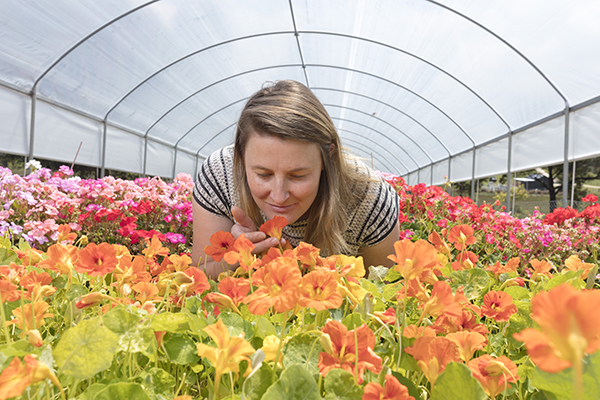
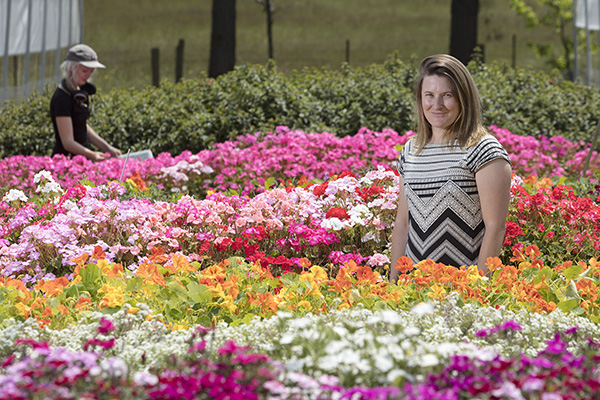
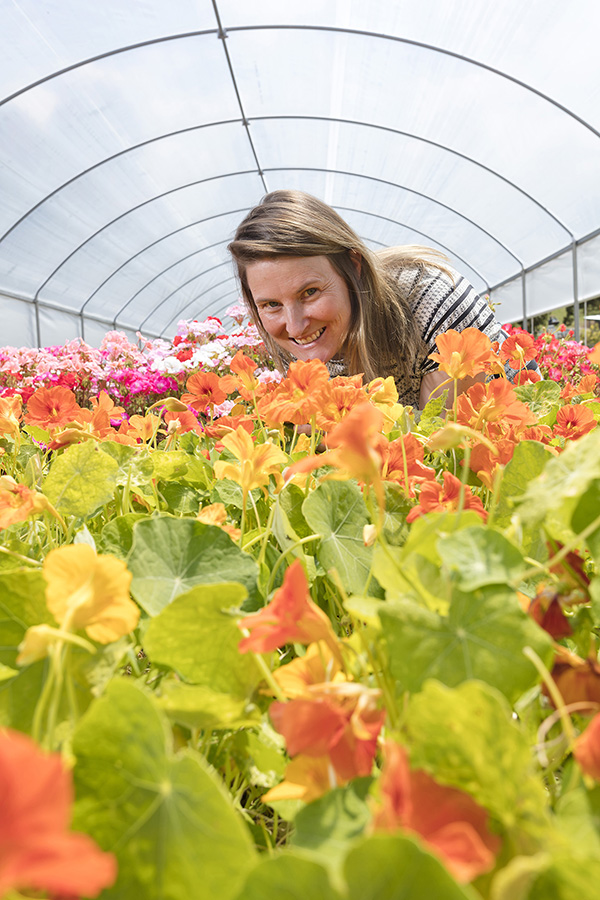
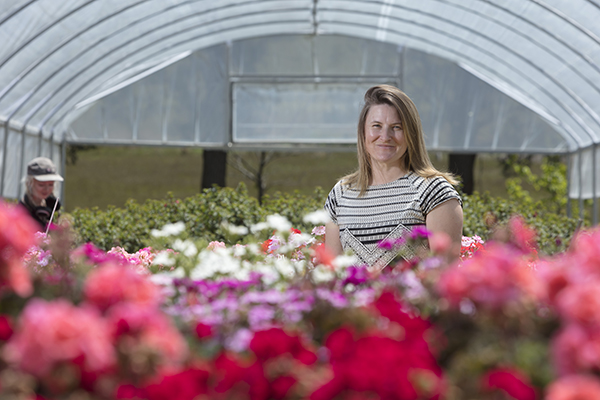
MARCH 18, 2020. This date is stamped into many people’s memories as the day everything shut. Among them is Lauren Richardson, grower of edible flowers in Glenlyon.

As usual, she sent a load to the wholesale market in the Melbourne suburb of Epping, which supplies the nation with flowers, fruit and vegetables. Like most other people Lauren knew of COVID, but of course “it was all happening overseas”.
Next day she rang to see what was happening. “We don’t have another order,” she was told. “We don’t know when there will be another one.”
Six weeks would pass before orders resumed.
With no income she pulled her children out of daycare, which meant she couldn’t work. None of her four staff qualified for Jobkeeper.
“There were lots of empty beds and dead flowers…crops with no market.”
And as if this was not hard enough, her husband David had just finished scheduling the season’s matches for the Football Federation of Australia at its St Kilda Road headquarters when COVID struck. Since then he’s been working at home four hours a day rescheduling in a project that resembles unscrambling an omelette.
For Lauren, the pandemic taught her to diversify and expand her customer base. So she moved into dried edible flowers and syrup, produced from elderflower, roses and lavender.
Diversify is what her family has always done in the six generations they have lived in the Central Highlands. Lauren’s mother’s family is from Leonards Hill and their history includes having a grandfather who helped build the railway line to Daylesford. And when the timber milling was gone, he saw the line pulled up.

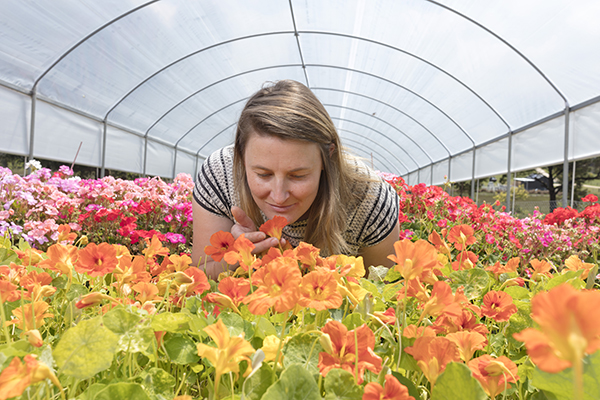
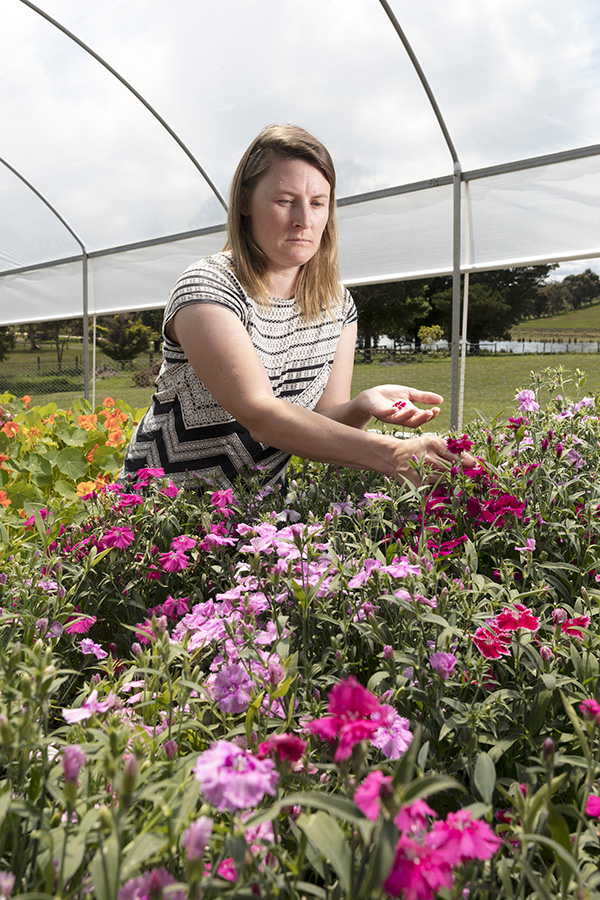
Over six generations since the mid-1800s, her family have been christened and married in the Daylesford Uniting Church. She followed this tradition by getting married there in 2018. She and husband David have four-year-old Eve and 18-month-old Louise. The family moved from Glenroy in Melbourne in November 2018, while Lauren’s parents, Glenda and Colin Richardson, were well established in business here. Colin made the first Ned Kelly Wood Heater in his Daylesford Engineering business back in 1984.
Lauren’s path to flower farming was a winding one. She did her BA in arts and science, majoring in anatomy, at Melbourne University, then studied the history and philosophy of science, moving on to a degree in architecture, and finishing one semester short of her MA.
“I always worked in hospitality part-time and had friends with a wholesale fruit and vegetable business. Working with them I saw that there was a market for edible flowers.”
Flowers have been part of food for centuries, with rose petals used in the Middle East to make rosewater and syrups, as well as Turkish Delight, while the ancient Romans ate lavender, roses and violets. Eastern cultures incorporated orange blossom, chamomile and calendula, while edible flowers bloomed as a display of chic in the Victorian era, with nasturtiums, roses and elderflowers being eaten. Asian dishes featured banana blossom and varieties of orchids and chrysanthemum.
A huge revival in edible flowers arose over the last decade, says Lauren.
“I began with viola, marigolds, roses, rockets and peas.”
Apparently the flowers of rocket are much less harsh than the leaves. Then there are coriander flowers.
But not all parts of flowers are edible, she cautions. While the flowers and leaves of elderflowers can be consumed, the leaves and stem are poisonous.
After seven years in her business, Flowerdale, she now grows between 30 and 50 varieties, with viola the most popular and used in cake garnishes or on pancakes in café breakfasts, and even in cocktails.
Herbal flavours are sought after by top restaurants, she says, mentioning the famous Attica in Melbourne and Brae in the Otways near Birregurra. Flavours from sage and pea flowers are popular.
Lauren had always wanted to produce dried edible flowers, so the lockdown saw her growing them for syrups such as elderflower, roses and lavender.
A tour of her garden reveals voluptuous scents from roses, subtle perfumes from others. And an electric fence to keep the hares off a carnation patch. Ducks go for marigolds and cornflowers, apparently, while rosellas prefer the interior of roses.
Back at the house I taste a couple of nasturtium leaves, with a glass of water. Their echo of Japanese wasabi is remarkable.
Lauren tells of an intriguing development in her world, the Daylesford-Macedon Flower Trail. Flower farmers and getaways, among others, joined to promote the region and each other. They hold events such as farm gate sales and workshops, with details at www.consortiumbotanicus.net.au
The consortium wonderfully sets out to “grow, harvest, source, design and celebrate ethical, sustainable, beautiful ‘botanics’ for the cut and edible flower markets… working together to put truly-local, low-tox, bee-friendly flowers in Australia’s hearts, homes, vases, bouquets and boutonnieres!”
That would put a spring in anyone’s step.
Words: Kevin Childs | Images: David White

September 5th, 2020Sault @ Home
LOTS of restaurants have pivoted over the past few months, offering takeaways and deliveries, but Jodi Flockhart at Sault has come up with a unique idea for our region – Sault @ Home.
It starts with an emailed order for either two or three courses, with the components, some ready to go, some needing a tiny amount of prep, then put together by head chef Hugh Maxwell and his team. You can then either pick up or ask for delivery. And then, best of all, you head to Sault’s website and watch the video on how to create your dishes at home.
We chose three courses and the pick-up option – who would not want to drive out to Sault at Sailors Falls and take a few moments to enjoy its beautiful surrounds as the sun sets.
The menu is small but perfect. I chose the cured ocean trout with a green tomato and buttermilk sauce as my entree, followed by the barramundi fillet, spanner crab, nasturtium seeds, fennel and white bean skordalia for my main and the chocolate, rum, raisin and walnut for dessert.
Kyle, who loves his meat, opted for the pork belly with sage, carrots and a hock glaze for entree, the eye fillet with bresaola, onions, horseradish, pickled garlic and jus for mains and the Holy Goat “La Luna” lavender scone with Sault honeycomb.
Oh, don’t forget the house-baked ricotta whey sourdough bread with confit garlic butter and the Sault garden salad with a green tomato dressing.
Back home, we whacked the oven onto 180 degrees Celsius, opened a bottle of chardonnay, did the “cheers”, watched the first run-through of the video featuring Hugh and Carmen Burns and then put together all the ingredients for our first courses on the island bench. Then I went hunting through our crockery to try and find something inspiring for plating up. (Note to self, need to shop one day…)
Finally, after a glass of wine, we started on our entrees – and it was fun. Mine was easy, no cooking, just beautiful strips of 12-hour cured ocean trout placed on the plate with the buttermilk, green tomato and fennel oil emulsion neatly spooned over the top and then decorated with squid ink tapioca, trout roe, sea grapes, broadbean flowers and salty pigface leaves. I didn’t have tweezers for the fiddly bits but chopsticks were the perfect swap. And every mouthful was an explosion of taste and texture.
Kyle’s was a bit more involved, but still easy. The pork belly had already been cooked for 16 hours, he just had to bring a frying pan to a medium heat then add about 30ml of olive oil.
The pork belly is then cooked about one minute on each side before reducing the heat and then adding the hock glaze to the pan. Then it’s just a matter of basting the pork until the glaze becomes sticky.
Once that’s done, you do a nice smear with the carrot puree on a plate, add the pork, layer the pickled carrots over the top and then finish off with the carrot tops and the sage and pork crackle crumb.
Again, delicious. The pork belly has very little fat and is just so tender – with the crunch coming from the pickled carrots and the crumb. I won’t go into details for the rest of the meal, you get the picture, and you can get the videos by heading to www.sault.com.au It was a great way to spend a Friday night with some delicious food, a few laughs, well a lot of laughs, and some kitchen inspiration.
Jodi said the Sault @ Home idea really came from her husband Damien Aylward after they saw Melbourne restaurants doing similar things.
“They are places we adore and we thought why can’t we give it a go in regional Victoria. We are cutting edge up here with our produce so Damien broached the idea with Hugh. Then Damien and I decided to utilise our background in acting for the videos and because we have been doing remote auditions as a family, Damien has learned to edit and splice videos, so we could make it look good and easy to watch, not clunky.
“We made it personal with our introductions to each video and it is really our way of people being able to reach into Sault, and for us to reach out to them at home. People love being in our kitchen and seeing the process behind the creation of dishes.”
Jodi said she was then approached by staff member Matt Phillips, who had a permit to travel from Melbourne to continue working in the produce store, who offered to deliver where permissable to locked-down Melburnians. So every Friday and Saturday Matt heads down to Melbourne with eskies loaded with local produce to provide a taste of the region.
“Matt didn’t have to do that but we are so lucky to have the team around us that we do. We are doing all we can to keep up morale and keep everyone upbeat – even holding fortnghtly working bees in our kitchen garden.”
And the next move? Father’s Day @ Home, of course. Check out the website, pre-order and Happy Father’s Day!
Words: Donna Kelly | Image: @connieandluna

September 5th, 2020Glen, about the house
Once the young seedlings have reached a manageable size, with sturdy stems, there are several courses of action. Those sown directly into the garden bed will need little attention for now, except for thinning out tight clusters and using the discards to fill any gaps where seeds may have failed. And, of course, remove any weeds. Don’t allow the beds to dry out, water them regularly with a fine mist spray to avoid disturbing their still-fragile roots.
Those sown into boxes or large pots will need to be planted out as soon as they are large and stem-strong enough to handle, either into individual pots, or directly into the garden bed. Most varieties will fare better in the garden after a time to really become established in a pot before facing the elements. Others more sturdy, such as onions, chives and most leaf greens such as cabbage, lettuce etc. prefer as little handling as possible.
When “pricking out” (an old nursery term) the seedlings from the seed box, try using an old kitchen fork to prise them apart and lift them from the soil to minimise damage to their roots.
I spent countless hours for many childhood years in our nursery potting shed transplanting literally millions of tomato, capsicum and other annuals from seed boxes into those little strawberry punnets. Just one of the many mind-numbing tasks – including the daily handwatering of several acres of potted plants. (In those days South Australian water restrictions forbade the Summer use of sprinklers). It all helped strengthen my resolve to choose another career path as soon as I was able.
Considering the short time the plants will spend in pots pre-planting, they needn’t be particularly large. In fact, they needn’t be pots in the traditional sense. Smaller seedlings could be put into egg cartons which can then be planted out in situ without further disturbing the roots.
In fact, there is really no need for pots at all, as you will see in next week’s column, when I feature ways to create self-composting plant containers out of newspaper etc. A small hint, save up your toilet paper and paper towel inner tubes. Another fun family project.
Allow the plants to develop to the second- or third-leaf stage before going into the garden to give them plenty of time and minimise any chance of loss. Shade them on hot days until they are established or they could have their foliage burnt. Although I think with the way the season is moving, they might need the protection from frost.
One way to protect young seedlings is to spread a 2cm layer of well-rotted compost as a mulch along each row. Take care though to keep the mulch away from each seedling or it may rot and die. If they are actually planted out during the hotter months they could be protected by covering the bed with shade cloth, supported by garden stakes, during the hottest hours. But that hopefully won’t be for some months yet.
Mossy dish gardens
The rainy winter months have brought on masses of verdant moss on the rocky outcrops in our gardens – and elsewhere, rekindling my interest in terrariums and similar garden-type projects, including the mossy lawn dish garden (pictured above).
All that’s needed apart from moss is a shallow dish, a few stones and a 2-3cm layer of peat moss or something similar, and a little imagination.
Bendigo wax flower
Philotheca verrucosa, formerly known as eriostemon, is a delightful indigenous compact shrub, (pictured bottom right) growing to around a metre in height and spread, and smothers itself in beautiful waxy flowers around this time every year.
Got a gardening question? Ask Glen. Email glenzgarden@gmail.com

September 5th, 2020The tail of three dogs
We’d gone into Woodend one Saturday to shop. We’d been talking about finding a companion for our dog Gizmo – you know; a pet, for our dog. We wandered into the pet store and there she was: bright, energetic and friendly – just what you want from a sales clerk. The puppy was fine too. We did no research, asked no questions, just said, “we’ll have her” (the puppy).
Turns out her breed tends to be smart and stubborn, which makes them difficult to train – a month of puppy school in Newstead confirmed this to be true.
Carol and I have form in this spur-of-the moment pet buying.
In 2001 we’d moved into our home in Wheatsheaf, making the transition from holiday-house owners to full-time residents.
That same year we attended the Bendigo Heritage Wine Festival, in which local winemakers set up inside some of the city’s beautiful old buildings and visitors walk through the streets enjoying the delights of the region. Passing Clouds winery had their tasting in one of the old trams as it rattled around the town – fantastic!
There were four of us and we’d become well acquainted with the region’s wines. While walking to our next destination, we stopped to look in the window of a pet shop – see the pattern emerging?
The puppy in the front window looked as if he’d been groomed using fingernail clippers. He had gooey eyes, upright ears and a crooked face. He captured our hearts in an instant, although we resisted his charms and continued our wine tasting.
But we didn’t forget him. One of our wine-tasting friends pestered us about him the remainder of the day and well into the night. So, the next morning, we drove back to Bendigo and bought the dog.
He hadn’t been well cared for in the pet shop. Apart from the miserable grooming, he hadn’t been fed properly. He was tiny, sitting easily in the cupped palms of two hands. His teeth were bad and his eyes were infected. But he had a magical personality and, with those funny ears, we immediately knew his name was Gizmo, from a character in the Gremlins movie.
At the time, Carol and I were commuting to Melbourne, via V/Line from Kyneton, for work, five days a week, and we felt bad leaving Gizmo home alone for that many hours a day. Which is where Scout enters the story.
We cleaned up Gizmo and put him on a healthy diet – he ate like a pig but never grew much bigger than a mid-size chihuahua. He was well-mannered, had a lion’s heart, but was frail. Scout was a Jack Russell through and through: strong, fast, wiry, stubborn; but Gizmo ruled her pack, and they made a great team.
Over the years, Emma Tomkins from Hepburn Veterinary Clinic did a superb job helping us keep Gizmo happy, but he wasn’t a robust dog and in 2016 we lost him; he was in terrible pain from pancreatitis. Even now, I am crying as I type this, remembering how Carol held him in her arms while Emma gently administered the final injection.
Scout seemed to be in shock without him for a while but we tried to compensate with daily walks around the track at the Glenlyon recreation reserve.
In 2018 we decided to move back to California, after more than 30 years in Australia. My parents are quite old now, and it’s time for me to step up and be here for them.
Scout flew here in a large, custom-built crate, and soon settled into her new life, where the dogs have funny accents, pronouncing the hard “R” in bark.
We’ve been here more than two years. Scout is 17 and has slowed considerably. Her eyesight is poor – she has cataracts – and her hearing is greatly diminished. She sleeps 18 hours a day. Two weeks ago she had a sick spell and had trouble standing, but she came good. Then, last week, she was again sick and shaking, and seemed to be having some pain.
We’ve been fortunate to find a good vet here, so we took Scout to see her – her name is Nina. We were prepared for this to be Scout’s time. But Nina examined Scout, caressed and cuddled her, and declared that her heart and lungs remain strong – she comes from good Aussie stock, after all. Nina devised a strict diet for Scout and sent her home.
So now Scout has deposited a tidy package on the lawn and is romping around the yard – it always makes her feel good to leave one of these fragrant piles. Last year we bought a puppy for Scout – her name is Joey, because she looked like a baby kangaroo when we first brought her home. She and Scout play, groom each others’ ears, and are great mates.
Thus, life goes on, in California.
Words: Jeff Glorfeld (An Aussie in America)