

August 8th, 2020Bonsai – miniature magic
The growing and care of bonsai requires a little skill, a lot of patience and year-round interest for success. The main thing to remember though is that a bonsai plant is not an indoor one and must be grown outside in much the same conditions as a normal-sized version would need.
Bonsai can be brought indoors for a few days at a time – perhaps as decoration for a special occasion but must be given at least three or four weeks to rest outside between “visits”. Take special care to keep them away from gas or oil heat fires and especially aerosol sprays.
The true art of bonsai is not just growing trees in pots and restricting growth, but also giving the effect of great age and the natural surroundings of a wind-swept mountain top of craggy rock outcrop where the tree would have been weathered, stunted and distorted by the elements.
This effect can be enhanced by your choice of a suitable container, preferably shallow, with good drainage holes. For depth a good rule of thumb is 2cm of depth for every 10-12cm of plant. Shallow plastic punnets as used for growing vegetable seedlings make good starter pots.
Grow your bonsai in a fairly open, friable mix to allow for good drainage. Most better commercial potting mixes should do though ideally it needs to consist of one part friable garden loam and one part leaf mould, peat moss or compost. This should be spread over 1cm of fine gravel.
Almost any tree or shrub can be used for bonsai if you remember the final effect has to be of miniaturisation. It is a good idea to start with some small-leafed, fine-stemmed plants to achieve a proportioned look. Some of the easiest to handle are Chinese elm, miniature pomegranate, Japanese maple (a firm favourite) and dwarf conifers.
Start with a healthy young plant about 10-15cm in height and select a naturally distorted one by all means. These are usually lurking at the back of the store display.
Plant your specimen as you would any other plant in a pot by placing a layer of gravel over the bottom and covering this with 1cm of potting mix. Knock the plant out of its pot and wash the soil away from its roots. Cut off any dead or damaged roots and about one third of those remaining. Place the tree in position in its new container with the roots spread evenly over the soil, then fill the container to within 5mm of the top and tamp it down firmly.
Place the pot in water almost to its top and leave it to soak until the soil is completely saturated. Take it out and prune away about one third of the foliage to help the reduced root system supply adequate food to all that’s above the soil.
Obviously this can take the form of shaping to begin creating the weathered, aged appearance.
Place it out of the wind in a shady spot and don’t allow the soil to dry out. As the little tree grows, continually trim it to develop your desired shape.
Once it has reached a stage where it looks”‘right” you can place it in an ornamental pot with rocks, moss and other artefacts to create a miniature landscape.
Got a gardening question? Ask Glen. Email glenzgarden@gmail.com

August 8th, 2020Network protesters urged to use their voice
The network upgrade project, awarded to AusNet Services last December, gives the largely foreign-owned company responsibility for designing, constructing and running an overhead powerline linking renewable energy projects in the state’s northwest to the national energy grid.
The majority of concerns are focused on the section of network east of Creswick through Dean where 75m towers and high-voltage power lines will run across forests and farmland.
“There is no doubt they will have a significant visual impact,” Ripon MP Louise Staley told The Local. “AusNet has applied to the Planning Minister asking if an Environmental Effects Statement (EES) is required. So far we have had no indication of what the Department is thinking.
“The Victorian Government is very much the decision-maker in this process. But people need to be very involved. They should be flooding (Planning Minister) Richard Wynne’s office with requests for an EES which will require a formalised consultation process.”
AusNet’s Executive Growth and Future Networks general manager Chad Hymas says the company is keen to incorporate community input into its plans. However, initial attempts at consultation – including six online community Q&A sessions and extensive cyber surveys conducted through the company’s website – have been met with anger and frustration by residents who say they are not being provided with adequate information or assurances that their concerns have been fully understood.
Landholder Andrew Maher said AusNet was over-estimating residents’ ability to use technology and was not providing answers to questions.
“We’re not getting the information we’re looking for,” Mr Maher said. “They have given us a number to call which I rang. An officer noted my questions but that was three or four weeks ago and I still haven’t heard back.
“The idea that they can set up Zoom meetings or hold online public sessions won’t work. Many farmers out this way don’t have that kind of experience with computers. People’s hands are tied, our mouths are gagged.”
Creswick resident Emma Muir said she contacted AusNet a week ago (July 20) and got a recorded message promising that questions would be responded to within two days.
“I still haven’t heard back. I’m not sure where to go or what to do next,” Ms Muir said.
Ms Muir’s husband is a fifth-generation farmer whose family have been working their property since 1863. Whether the next generation will have the opportunity to carry on the family heritage is now uncertain.
The Muirs’ property covers around 800 acres, 570 acres of which is likely to be diagonally dissected by the proposed line impacting irrigation, aerial spraying and stock movements.
“It will make farming the land here unprofitable. We’ll hold on until the end, but we believe that ultimately we’ll be forced from the land,” she said.
While the effect on individual families may be devastating, of even greater concern is the repercussions the high-voltage lines will have on the surrounding environment including the Wombat and Creswick forests and Lerderderg State Park.
“This is one of the state’s most bushfire-prone areas, what happens when aerial fire-bombing is needed?” Ms Muir asked. “There’s also wind issues. The wind rates up here are enormous. There doesn’t seem to have been any common sense in the decisions. It seems someone sitting in an office in Melbourne has drawn a line identifying the quickest and cheapest route without even coming out to see the terrain where the power lines will go.”
She said it was likely that thousands of trees planted as part of the State Government’s Vision for Werribee Plains initiative would need to be removed.
Like the Muirs, Kevin Maher’s family have been farming land outside Ballarat since the 1850s. He now runs one of the area’s biggest potato farms and is concerned that the three-metre restrictions along the proposed easements will make it impossible for potato harvesters to reach the crop.
“Harvesters sit four metres above the ground and require another one metre clearance,” Mr Maher said.
He also noted likely issues over quality of vegetables from electrical seepage into the soil and increased risk of bushfire.
“The findings from the Black Saturday Royal Commission are being completely ignored. It seems there is one policy for government and another policy for everyone else.
“Residents can’t link homes to the grid using overground lines, we’re required to dig a trench and put the wires underground. Why doesn’t the same apply here?”
Words: Jane Williams

August 8th, 2020The world needs hippopotamus magic
It was the early 70s and life was a lot simpler. Younger kids believed in fairies and magic and built cubby houses and made, and probably tasted, mud pies. Books didn’t have ulterior motives or agendas, they were just good stories with lots of wholesome adventures and happy endings.
Fast forward to 2020, and Claire was looking for a few presents for her granddaughter, Audrey, set to turn three in June. Wandering around the shops, many months earlier, Claire spotted a little plastic hippopotamus and thought Audrey could add that to her farm animal collection. Next was a wooden doll with blonde hair – just like Audrey.
The two toys spent the next few months sitting on Claire’s computer and every time she passed by she wondered about them. Could Audrey sit on Hippy? And if yes, could Hippy actually be a grounded but magical flying hippopotamus?
Claire, an abstract artist of some note, but new to writing apart from a manual on how to relocate a house, realised she needed a third character. Cue in the golden-tipped glass echidna sitting on top of her fridge, a gift from Australia Zoo from friends she had collected mail for while they were on holiday – and the new children’s book trio was complete. Princess Audrey, Hippy and Master Spike, who between them solve Hippy’s confidence issues with flying, and then head out on a few adventures of their own.
Claire, who moved to Glenlyon 18 years ago with husband Brian, from Geelong, said the book, The Magical Flying Hippopotamus, happened quite organically.
“I used to sit down and think what happens next, and it felt like I had gone back into childhood a bit, because bad things might happen in a child’s book back then but there was always a resolution.
“They were always tales of overcoming your problems, courage, friendship and never giving up – and I think the main thing was believing in your dreams. I wanted something, really just for my grand-daughter, that was simple and magical and fun with positive life affirmations. I am really a bit tired of authors who write stories about farts.”
The book is illustrated by Claire’s daughter’ Kiara’s boyfriend, Gerard Horvat, who just happened to be sitting at their table one day drawing visual novels, or cartoons for grown-ups. “I said to him ‘hey, you don’t want to have a go at a hippopotamus, do you?’ And his illustrations were perfect – a really simple organic style.”
Claire said she originally just printed a few copies for her family but interest from others led to a short print run of just 200 for the book, which suits children up to about eight. She is also keen to do a public YouTube reading of the book in four parts with all the voices “otherwise there is no point”.
“I just wanted to put out the message to kids that you can have whatever you want, you just have to work out how to make it happen, that is the hard part and the fun part. Kids need a bit of escape, especially now, and the whole world could do with a bit of hippopotamus magic.”
Next up is a book for her grandson Lonnie “to make it fair”. Audrey and Lonnie’s parents Jonathan and Kerstin are, naturally, the king and queen, and Lonnie’s title is only fairly prince, to match Princess Audrey. Claire is also busy, halfway through, writing her own life story, something she hopes her family, right down to great-grandchildren and beyond, will read one day.
“I would love to pluck a book off the shelf and find out what my great-grandmother did in her life, what school was like, what her first job was…
“But, you know, I don’t really know what’s next and that’s probably one of the good things. I am just having fun doing what I am doing right now.”
For a copy of the book, with a price of $17.50, email Claire at Brewster_claire@hotmail.com and check out selected outlets in the region.
Link: www.ebay.com.au/str/Abstractions-Art-for-the-Soul
Words: Donna Kelly | Image: Kyle Barnes
This article is supported by Hepburn Shire Council’s COVID-19 Community Support Grants.

August 8th, 2020Local Lines
7 Haiku and Senyru
reading –
spending words
saved by others
a bouncing twig
after the wren flies off
– change of plans
spotted pardalotes
flicker in the leaves
… reversing beepers
a quick-stepping crow
on the lawn after rain
– my fresh mind
join the dots
for adults
– house extension
each morning
standing on a cliff face
– bathroom scales
pale blossom
through venetian blinds
– vanilla slice
- Bill Wootton
Bill Wootton lives in Hepburn Springs and has pretty much gone to ground
but he tries to keep his senses open.
August 8th, 2020Balancing community work with paid work
GINA Lyons says that she lives in a can-do community – and as her story shows, she is certainly a can-do woman.
She moved to Daylesford from Melbourne eight years ago – it was one of those situations where the “weekender” became home and ever since the move, Gina has been helping to make things happen in the town.
She is the chair of the Committee of Management for the Daylesford Neighbourhood Centre, which also manages The ARC – the centre runs courses and art sessions among other activities, adjusting well so far to the restrictions caused by the global pandemic to continue providing for the community.
“It gives people a space to get out of the house, really,” Gina says with her beautiful Irish accent.
“We have a very committed, passionate group of people on the committee, a fantastic group of staff. We’re just delighted to have this space that we can continue to use. We’re very embedded in the community.”
Gina has also been on the former Hepburn Health board, as well as the UFS Dispensaries board. She helped in the fight to allow existing long-term residents to stay at the Victoria Park caravan park – and won – and she’s also been involved with the Daylesford & Hepburn Springs Business & Tourism Association for many years and last year she also found the time to try to fight the removal of the geese from Lake Daylesford.
But it’s another passion project of Gina’s, one of the most loved passion projects in the community – that is now her biggest campaign – the re-opening of the cinema. Gina joined the committee in charge of the cinema back in 2014 and has served as president for the past three years.
“It’s been the same committee in place for the past three years and we’re working to see the cinema re-opened. We’re still hoping to see construction finish in April next year, but that’s dependant on a lot of factors. But given that none of the timelines for this project have come to pass, we wouldn’t be surprised if it’s not until the end of next year. Then we can get back into sorting out the back-of-house work and training volunteers.
“The volunteers love to work there because we’re part of a team, we make friends, learn skills, contribute to our community, and we feel that sense of connection that is gone now.”
In the meantime, Gina is keeping the committee together, working and hoping that they will again be back in the cinema home that they, and the community, miss.
“We’ll have a few run-throughs before we re-open to the public, which we’re all looking forward to, as the community is. That’s why the committee is hanging together monitoring the project very closely.
“We’re all passionate about it because for local people, what else is there to do in Daylesford? The cinema offers all the latest movies, and some arthouse movies, we could do special screenings for fundraising and so on, and it was something else for holidaymakers to do, and especially during school holidays, because we had all the latest kids movies…it was a coming-together place.”
Gina also runs her own consultancy business, advising on workplace issues from organisational development to bullying investigations – and she has now found a happy medium between work and…well, more work.
“I’ve arrived in a position where I can balance my community work with my paid work.”
Words: Kate Taylor | Image: Contributed
August 8th, 2020Roger McLean – a Legend of Lockdown
HERBAL Lore and Terra Australis Distillery founder Roger McLean has been nominated by a number of people as a Legend of Lockdown.
One person wrote to The Local saying Mr McLean “supplied, free-of-charge from his distillery to the locals of Daylesford and surrounds, ethanol-based hand sanitiser to correct standard”.
“Yes…for nothing. He supplied his time and opened his door to all that took up that offer. A true hero.”
Another person seconded the nomination saying Mr McLean had supplied, at no charge to the community, bottles of hand sanitiser over weeks in April and May this year.
“It was offered to the local community to come in and just bring an empty bottle to obtain this legal sanitiser that was produced from his distillery using his ethanol. People were also welcomed with a smile and correct distancing measures applied with ease.
“He lovingly gave his time and product for free, for all us to take up if we wanted to. I see this as a true hero act in this time when so many other places were capitalising on the COVID-19 with 200 plus per cent and more mark-up on items of personal protection equipment (PPE).”
The Local ran a story about the free hand sanitiser in April with Mr McLean saying at the time that Herbal Lore and Terra Australis Distillery had a foundation, Medicines of the Earth, which was all about humanity and this was one of its projects.
“When we thought about it a few weeks ago and realised there were no bottles and no glycerine and lots of obstacles, but decided if we worked with refills we could really crank up our still and get the most beautiful alcohol to make a really crackingly good sanitiser. I have driven 5000km in the past three weeks to get what we needed, some from the back blocks of Queensland.
“It means there will be no people home with young kids, or the elderly, or anyone that really needs a sanitiser and just can’t get it or can’t afford it.”
Now, that’s a legend!
August 8th, 2020An Aussie in America
ONE of the many facts about the modern world that I don’t understand is the existence of people who make their living as influencers.
What I want to know is, how can influencer be a job when it’s not even a proper word?
But you know what? A story in Wired magazine in 2019 mentioned a person named Luka Sabbat, who apparently has two million followers on Instagram and “can charge upwards of $US40,000 to promote products” – promote being another way of saying he tries to influence people to use certain products.
Closer to home, young Australian fitness guru Kayla Itsines in 2016 was proclaimed by Time magazine to be “one of the top 30 Most Influential People on the Internet”, and, according to Wikipedia, by 2018 had turned that influence into a multimillion-dollar fortune. She’s said to have more than eight million Facebook followers and about six million followers on Instagram.
I guess that makes her an influencer.
I remember, as a kid, hearing a lot about something called peer pressure, usually related to doing something you shouldn’t, such as smoking cigarettes or drinking booze. Most baby boomers at one time or another were probably admonished by their parents, something like, “If Jimmy jumps off the roof, does that mean you have to jump off the roof?” (Answer: uh, yes.)
Jimmy must have been an influencer, ahead of his time.
Now, Kayla Itsines might have eight million Facebook followers but I’m closing in. Maybe. Are followers the same as Facebook friends? Because I have more than 500 friends, probably as many as 10 or so who occasionally show interest in what I’ve posted.
Some time ago on my Facebook page I posted about an event that returned Australia to the world stage (it’s been on the map for quite some time, with or without Tasmania).
What happened was, I saw an advertisement on television announcing the “New ‘World of Wiener’ Hot Dogs Arrive at Wienerschnitzel”.
What’s Wienerschnitzel, you ask? It’s a typically American fast-food chain, with stores in several states – and Guam, in the western Pacific Ocean – that claims to sell more than 120 million hot dogs a year. But none in Australia.
Don’t worry if you haven’t heard of Wienerschnitzel, because it has heard of you.
Here’s the thing. The “World of Wiener” varieties include (I’m quoting the company website here):
“The Cuban – A hot dog with a pickle spear, Swiss cheese [a typical Cuban condiment], and Cuban mustard (basically, it’s the hot dog version of a Cuban sandwich).
“The German – A hot dog topped with sauerkraut and beer mustard.
“The Aussie – A hot dog with horseradish aioli, bacon, cheese, grilled onions, and jalapenos.”
Yep, that’s correct, folks. Wienerschnitzel sells hot dogs branded as “Aussie”, which feature Mexican chilli peppers and a sauce that originated in the Mediterranean region, and American-style processed cheese. I’m OK with the grilled onions and bacon.
I don’t know if I was infuriated or just deeply confused about this so-called “Aussie” hot dog, so I took to Facebook and vented.
It’s ridiculous, a travesty, an insult to our national pride, I might have said (it was several weeks ago – who can remember?).
A surprising number of my “friends”, sensing my pain, responded. I must say, quite a lively discussion ensued, largely centred on the sanctity of the Bunnings sausage sizzle (grilled onions, yes or no; barbeque sauce or tomato sauce or both; etc).
No one was impressed by this so-called “Aussie” hot dog.
So anyway, a few days ago the hot dog chain ran a new ad on TV, in which a young actor in a Wienerschnitzel uniform, and a person dressed as a two-metre-tall hot dog, re-enacted the naming of these “World of Wiener” varieties.
How it went was, to choose the countries that would be accorded bespoke weenies, the giant hot dog threw darts into a world map tacked to a wall. But being encased in a huge bun didn’t allow the giant hot dog much manual dexterity and the third dart wildly missed the map altogether, so the kid in the Wienerschnitzel uniform randomly jabbed it into Australia!
This new ad came not long after my Facebook campaign in which I expressed my disgust at Wienerschnitzel’s heinous degradation of Australian cuisine.
Turns out, it wasn’t intentional, and this new ad can easily be regarded as an apology.
Does that make me an influencer? You be the judge.

June 29th, 2020Our history: The Convent Gallery
THE Central Highlands region boasts all manner of historic buildings and they are some of the principal attractions for visitors. Journalist Tony Sawrey is writing a series on a number of them, starting with the building now known as the Convent Gallery in Daylesford.
Looking north over the town centre the Convent Gallery has received thousands of visitors since its refurbishment and opening to the public in 1991.
As of 2020 the site has been occupied for 158 years. A house was first built on the slopes of Wombat Hill in 1862 for James Daly, the gold warden and magistrate at the time.
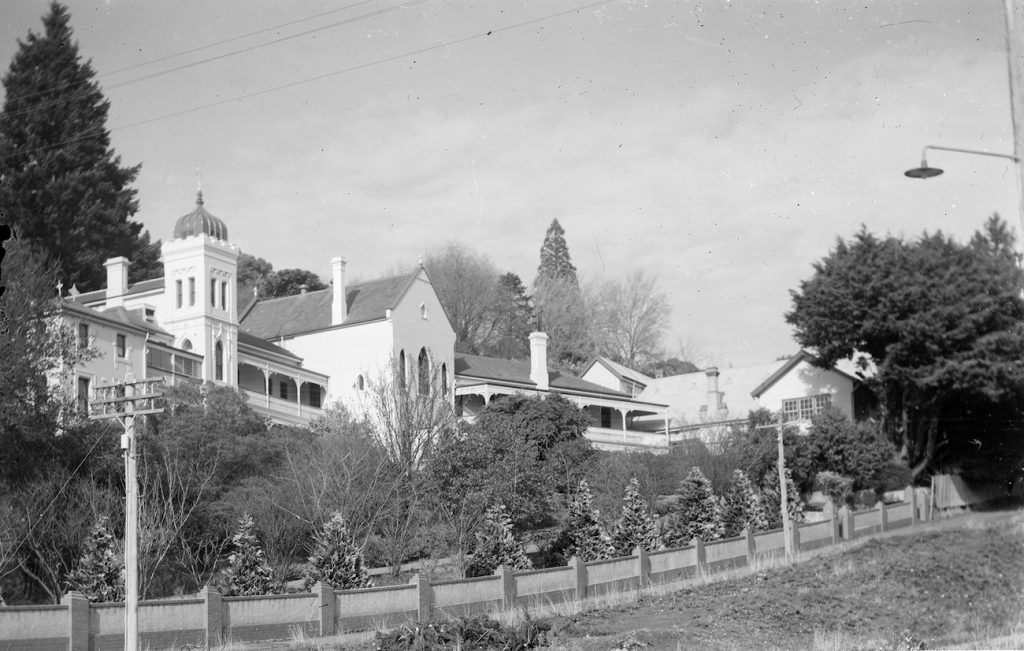
It passed through a number of hands over the next 20 years with all the excesses of classic Victorian architecture incorporated into its numerous renovations and extensions. However by 1882 it lay vacant before being occupied by local priests as a presbytery.
In 1891 Archbishop Carr of Melbourne envisioned a “source of light and edification” for the Daylesford community. He decreed that the house should be renovated (yet again) to prepare it for use as a convent and boarding school. A further building was added and St Michaels Primary School moved to the site as well. It was then opened as The Holy Cross Convent and Boarding School for Girls and the relocated school commenced classes with 27 students.
For the next 75 years the Convent operated in this manner with further renovations and additions to a sprawling complex of dormitories, dining rooms, classrooms and chapel. By 1966, St Michaels was moved across the road and a new secondary school was built. However, in 1973 Holy Cross Secondary School was closed due to lack of numbers and by 1974 the building had been appropriated as a community education centre. The remaining four nuns moved to a new convent next to St Peter’s Church in Duke Street.
By the 1980s the site, like much of the town, was in serious decline, the gardens were rough and the building needed some serious TLC. It was put on the market in 1988 and bought by Tina Banitska who still has it today.
Working with local heritage architect, Vladimir Chernov she restored the building to its former glory, retaining its religious and historical significance. Today the complex consists of seven individual gallery spaces over four levels, exhibiting the works of both local and national artists. Open to all, it is one of the most popular destinations for visitors to the region.
“The Convent is a rich and beautiful tapestry of history and art,” says Tina, “and I’ve been given the privilege of looking after this building, to make it a place for the community. I don’t own anything, I’m just the custodian of it.”
Above, Holy Cross Daylesford mid-C20th
(Rose Stereograph Co, courtesy of the State Library of Victoria),

June 29th, 2020Line Concerns
HEPBURN Shire Council is extremely concerned about the proposed Western Victoria Transmission Network Project, to be delivered by AusNet/Mondo, says Mayor Cr Licia Kokocinski.
The project proposes 190 kilometres of transmission lines, starting in Sydenham and travelling through to Bulgana. The lines will be supported by a new terminal station north of Ballarat.
“Council has only been provided with very limited information on the proposal and is very unclear of the proposed alignment, location of the terminal station (approximately 50-hectare footprint north of Ballarat) and generally how the ‘developer’ will effectively communicate and compensate impacted landowners,” she said.
“We are requesting that a public community session be held to help the community better understand what is being proposed.
“In addition to this, council has developed a working project group, including surrounding impacted councils – City of Ballarat, City of Melton and Moorabool Shire Council, in an attempt to coordinate the best outcomes for the community and at a minimum continue to seek genuine consultation from the developer.
“We will also be writing to the local member and relevant ministers. We call on AusNet/Mondo to be more open and transparent with their information and work collaboratively with the impacted councils to get the best results.”

June 29th, 2020Adjustment to rates valuations available
HOME owners in Hepburn Shire receive their first rates notice for the 20/21 financial year in August and will have 60 days to object if they disagree with the value placed on their property.
Some ratepayers have contacted The Local saying their last year’s rates bill was 20 to 30 per cent above what their property could actually be sold for. They say in the past it has been 20 to 30 per cent lower and have also queried if the Victorian Government’s two per cent rate rise cap is being applied.
Hepburn Shire Council’s Community and Corporate Services director Bradley Thomas said rates notices were broken down into three components with the first being the valuation which is rated – taking into account the two per cent rate cap.
The second and third are the waste charges and the fire services levy.
“Where it gets a bit confusing for people and I one hundred per cent get this, is then how to split that total rates across all of the properties that we’ve got in the shire. We do that based on the valuation, so the higher the value property the more they pay in rates than in a lower valued property.
“For instance, if we have two properties with exactly the same valuation, for example both worth one million dollars and then we do the revaluation the following year and one property goes up ten per cent and one only goes up five per cent that’s where you can get their rates going up by more than the two per cent because of the average increase.
“What has happened now is that state government decided that it would take on responsibility for doing the valuation through the Valuer-General, and instead of valuing every two years, they now do it every year.
“Last year was the first year we went to an annual cycle and that will continue going forward. We had a bit of a double whammy last year as the valuer that did the valuation last year changed, and like any valuer they have different methodologies they use to value, based on different data and how they assess and come up with the data.
“(But) I think by doing it every year, hopefully the percentage movement, will smooth out a little bit, and hopefully we won’t see the fluctuation in increases.”
Mr Thomas said the backup process, if people disagreed with their valuation, was to report it to the council who will put it back to the valuer. The valuer can then do a detailed valuation onsite and could end up with an adjusted valuation.
“The other thing that happens on the rate charge is the waste charge, which is not part of the two per cent cap. This is determined by council. And the third thing that appears on the rates notice is the fire services levy which was introduced in 2013 which is set by state government and out of the control of the council.
“Budget information comes out in April, so ratepayers can get a feel from that in terms of what that means around the waste charges but until you get your rates notice in August, you won’t know your exact rate bill. The council is happy to work with individuals in terms of payment plans, so you don’t have to come up with the money quarterly.” Words: Kyle Barnes
June 29th, 2020Rex artwork
MASTER weaver Aunty Marilyne Nicholls (Dja Dja Wurrung/ Yorta Yorta/Baraba Baraba/Wadi Wadi/Jupagulk), in collaboration with Canberra Glassworks, has been selected to complete a major permanent public art commission in the Hepburn Shire.
The cost of the commission is $30,000.
Council accepted the recommendation from its Public Art Advisory Committee to commission Aunty Marilyne and Canberra Glassworks’ combination of two hand-woven and three glass-blown fish traps to be installed at the Hepburn Hub at The Rex building in Daylesford.
“The techniques used by Aunty Marilyne in her weaving enhances the characteristics of the natural reed fibres. Aunty Marilyne produces woven art from that trace, through the weaving itself, understanding of place, community and identity,” a council spokesperson said.
“Canberra Glassworks will create an interpretation of Aunty Marilyne’s traditional fish traps using blown glass as the medium. Produced from moulds of the fibre traps, the artwork will have rich texture that will mimic the weave of dried reeds.
“The commission connects contemporary art and design practice with traditional Dja Dja Wurrung culture and way of life. Council is thrilled to commission this significant artwork as part of the shire’s recognition of the traditional owners in the new civic space.”
There are already two artworks in The Rex, painted on the walls, by artist David Bromley.
June 29th, 2020Eat more veg in Macedon Ranges
THE 2019 Active Living Census results paint a picture of the Macedon Ranges of a community that relies on meat as the main form of sustenance.
Veg Action and Eat More VEG, Macedon Ranges Facebook co-founder Lucy Campbell says only 13.9 per cent of residents get their recommended daily intake of vegetables, and more than half of the community are overweight.
“A plant-rich diet is usually linked to healthy weight and less incidence of heart disease and colorectal cancers. It also has a positive impact on the environment by reducing pollution, erosion, land clearing, water use and CO2 emissions caused by livestock production.
“If you fall into the 86 per cent of those veg-starved and want to do something about it, why not join the Facebook group, Eat More VEG, Macedon Ranges?
“Veg Action is a subgroup of the Macedon Ranges Sustainability Group. Our FB community can help you eat more local, seasonal and delicious plant-based dishes.
“We celebrate Meat Free Monday, have a weekly test recipe, encourage recipe swaps and run events and activities to bring the community together over good food. People of all dietary persuasions are welcome.
“One of the Facebook group members, Brittany Tyne Cushing, has described it as a ‘solid resource for those that need inspiration and advice on vegetarian and vegan- friendly cooking, produce sourcing and takeaways. From locals, for locals’.
“Veg Action is also running a Winter Veg Recipe Challenge. You can submit your favourite plant-based recipe for a chance to win a $100 voucher to spend at the Woodend Farmers Market. Just head to the Eat More VEG, Macedon Ranges FB page for more details or contact us at veg@mrsg.org.au”
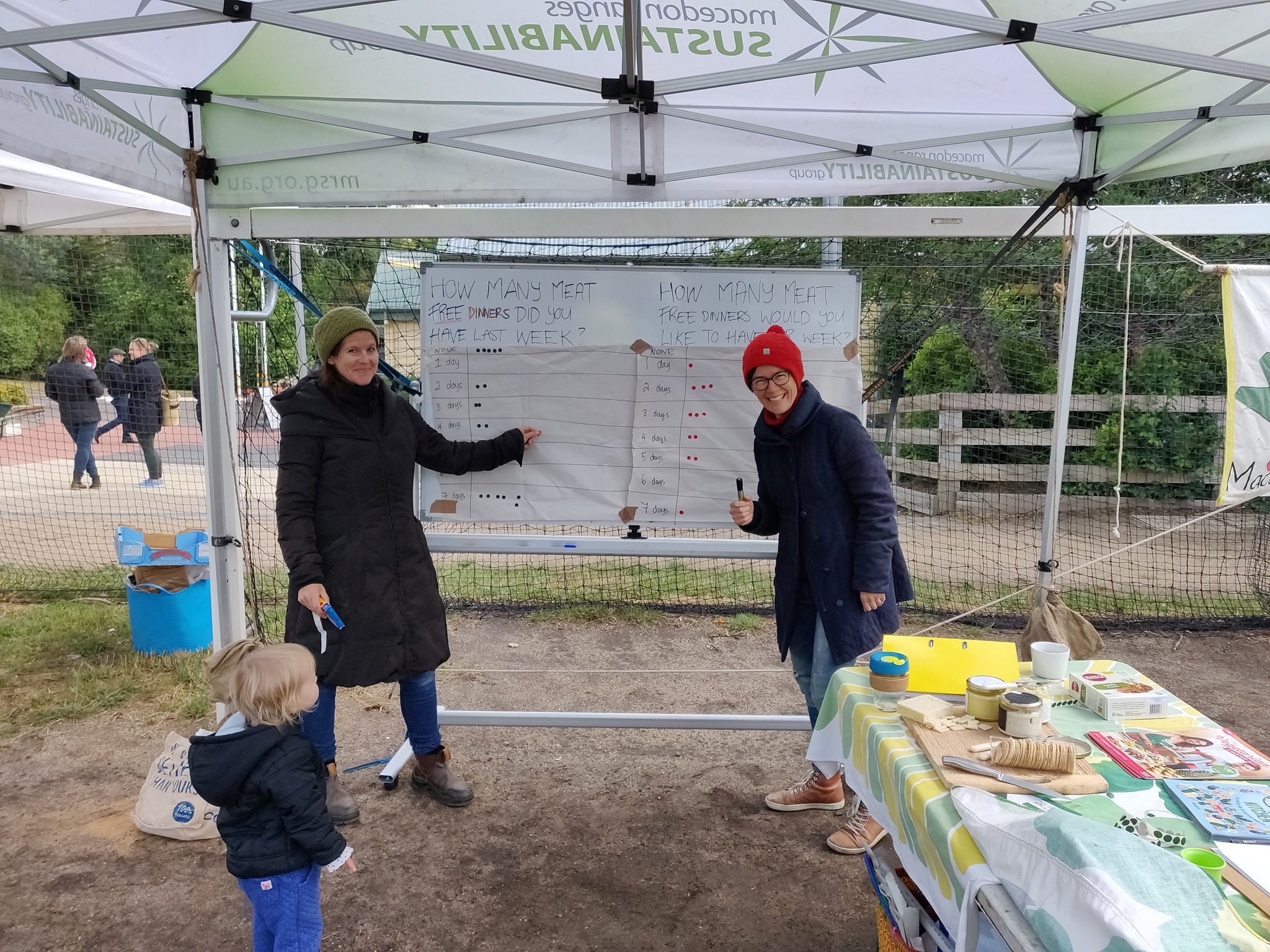
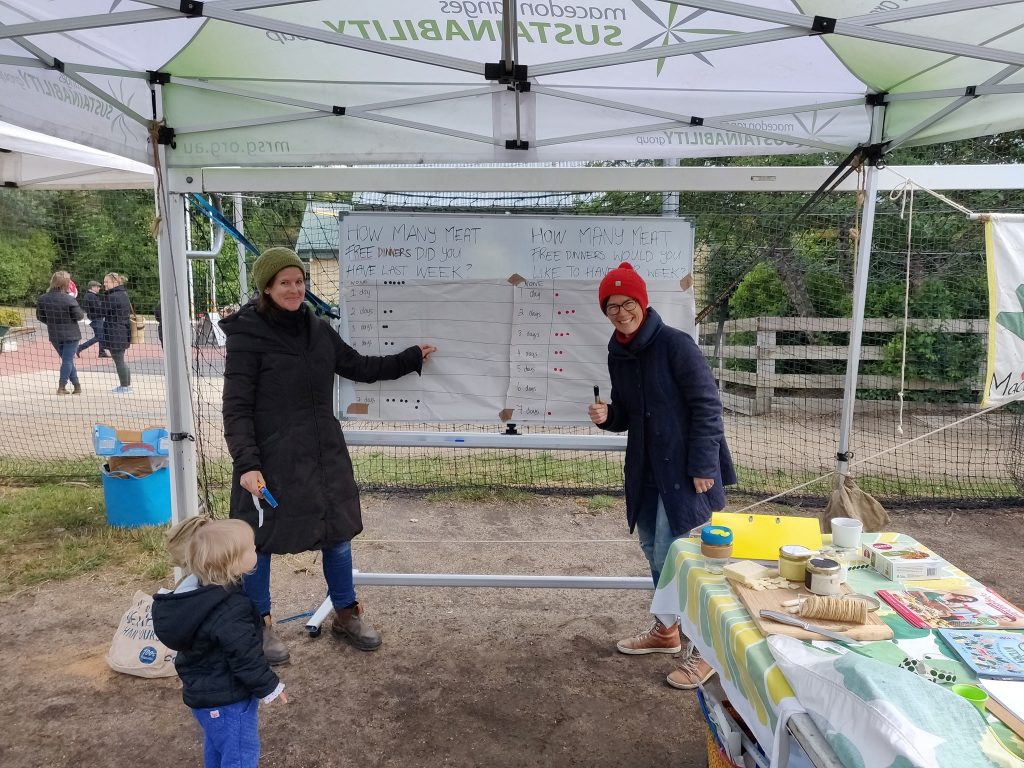
Pictured, left, Lucy Campbell and Veg Action group leader Claire Rowlands
June 29th, 2020Cows of the Apocolypse
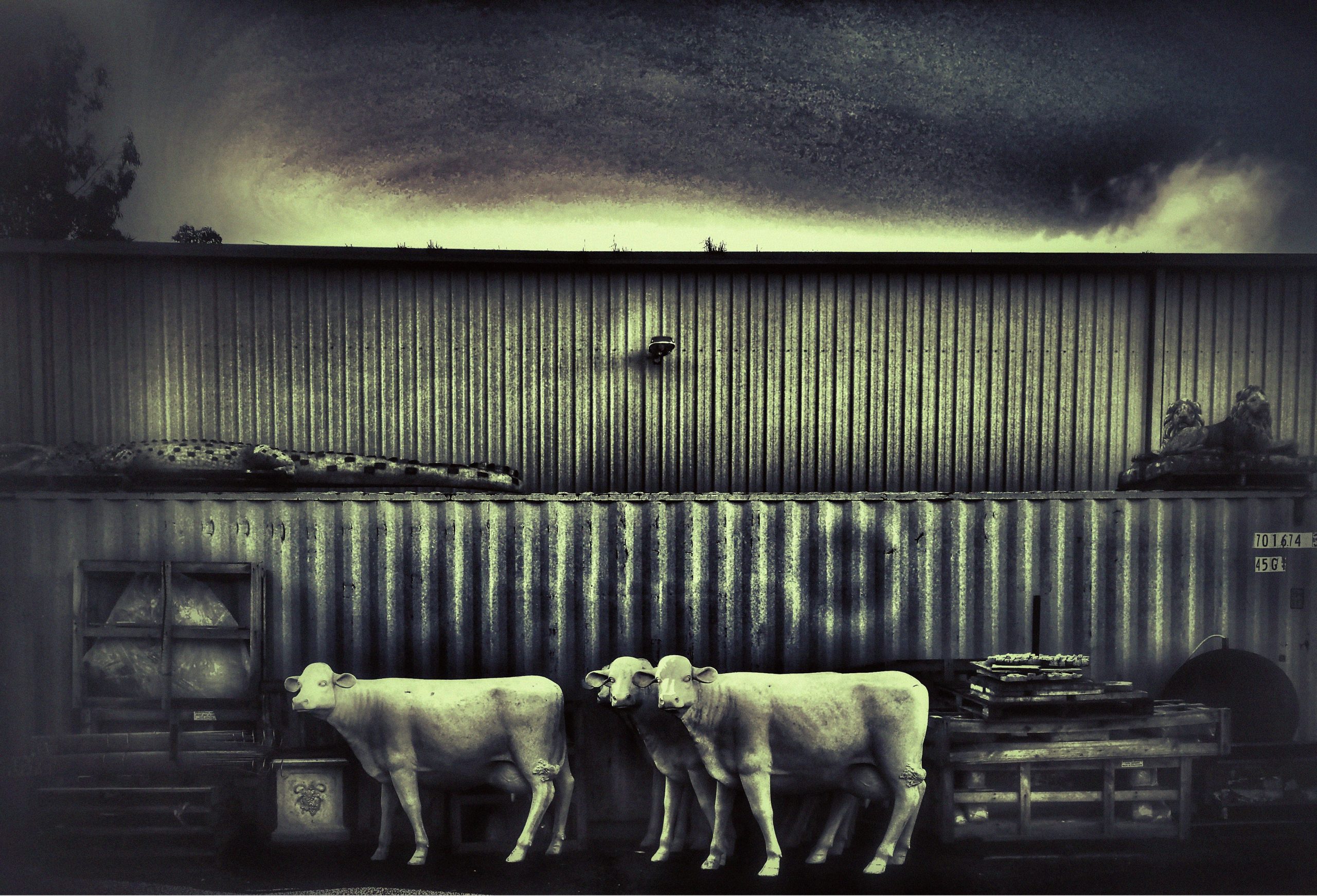
TRENTHAM photographer Mike Rutherford was very surprised to be notified this month that he had won a gold award in the prestigious San Francisco Bay International Photography Awards.
He hadn’t known that his partner had entered the photo, Cows of the Apocalypse, without letting him know. “It was a pleasant surprise,” he said.
Fresh from a long-running exhibition at Trentham’s Cosmo Hotel, Mike saw what became his award-winning photograph while strolling through Trentham’s disused railyards.
A former UK, US, Singapore and Melbourne freelance commercial photographer turned art photographer, Mike said many of his striking images started as scenes he glimpsed while out walking.
“I often go back several times to get the image I’m after,” he said.
He likes creating works that make people look twice, stopping to think about what they think they might be seeing.
He took up art photography relatively recently and has achieved critical success, including recently being a finalist in the major Percival Prize and also being accepted as a finalist in the esteemed Chania International Photography Festival in Crete.
When not making photographs, he is fairly busy with the seemingly endless tasks involved in restoring an old Trentham cottage.
Words: Peter Young
The Local‘s artist features are supported by a grant from Hepburn Shire Council’s coronovirus community support program.


June 29th, 2020Up in the air with epiphytes – a whole new world of gardening
Last week’s column featured orchids, particularly those that are epiphytic, a title covering a broad spectrum of plant life in rainforests especially but totally in tropical climes.
Epihpytes are those plants whose roots are literally “up in the air”. They are often mistakenly called parasites, but parasites actually feed from their host plant, whereas epiphytes merely use the host plant as a support, living from the decayed leaves and other organic matter, including their own, that collects in forks of branches and hollows in the trunks of their hosts.
Apart from orchids there are many native epiphytic species, most of which are easily grown and provide an attractive addition to porches, pergolas and shaded areas of the garden. These include ferns – the most notable being stag and elk ferns, bromeliads and quite a few succulents.
The best host for these plants would obviously be a large spreading evergreen tree but it is possible to create artificial homes for them. Stag ferns and similar plants can be encouraged to wrap themselves to a trunk by securing a tightly-packed mass of decaying leaves, peat moss and even shredded newspaper onto it with a sheet of chicken wire. The same technique can be used to create a “nest” in the crook of branches for planting other plants. If no suitable tree is available for a stag fern, a great substitute is to tie strips of bark from the paperbark tea tree (melaleuca alternifolia) or some similar organic material to a slab of hardwood, which can then be hung up against a shaded wall or fence. After several seasons the roots will have penetrated the bark and attached themselves to the wood.
Naturally hanging baskets filled with the same organic materials would suit the orchids, bromeliads etc.
The ultimate air plant
The ultimate epiphyte, a select tribe of the bromeliad clan, almost totally self- sufficient providing it has access to moist air or an occasional dripping tap, is the hundreds of species of “air plant” – tillandsia. In their native Central and South American environments they grow in clusters on the actual branches of trees. What could be called roots are only there to help cling on. Any nourishment (water) comes from the air from humidity or rainfall.
I’m sure you’ve seen these quaint little critters, usually displayed at the checkout counter of chain stores and novelty shops attached to bits of decorated wood or attached to a backing as a brooch. They certainly can be mistaken for plastic ornaments.
With literally hundreds of different species, choice is almost endless, whether it be in colour, shape of foliage or form and colour of flowers.
They are actually the ultimate hybrid, plant/ornament, whether placed in an ornamental glass bowl as part of a display of coloured stones or shells, woven into an ornamental wreath or garland, or attached to a piece of driftwood.
Needing only a weekly mist spray of water, or in hot, dry weather to be submerged for a few moments in water then placed face down on a towel to dry off, they are also the ultimate house plant.
Tillandsias are readily available from specialist gift shops, garden centres and, plant-stocking hardware stores and specialist nurseries.
Got a gardening question? Ask Glen. Email glenzgarden@gmail.com
Images:
Image 1 – A tropical bromeliad

Image 2 – platycerium bifurcatum (stag fern) – one of the many spectacular denizens of Queensland’s Daintree Forest


June 29th, 2020Time to step out? Head to the Boathouse
AS KYLE keeps telling me, it’s better to be a coalminer than a canary, so we have limited our dining experiences, when we want something more upmarket than spag bol, to pretty much takeaway or delivery.
But sometimes, you want to have a glimpse of the old days. Our first restaurant foray was actually a couple of weeks back at Mt Martha at the originally named Martha’s Table at Martha’s Cove.
It was interesting but not really enjoyable. The food was good but it’s hard to relax with Kyle reeling back in horror every time the wait staff arrived with cutlery, salt and pepper, the drinks, the water, to top up the drinks and then there was the food. That’s a lot of reeling. The service was fine, as I said they can’t really throw things at you from five paces, but as first-timers, we were both kind of happy when it was time to pay the bill.
Anyway, we decided to head local for our second outing and chose The Boathouse Restaurant – which was perfect. Like all good dining establishments, owners Claire and Susanne take social distancing restrictions seriously and have ensured every one feels welcome – and safe.
We were seated at the big wooden table in the front foyer which we enjoy because you get to watch people coming and going, and the odd requests from people not even dining in. Like the bloke who came in and asked if the restaurant would mind providing plastic cutlery so his family could enjoy their birthday cake, in the park. Or the other one who wanted to borrow some tongs for the barbeque. Probably just lucky there are public toilets outside. Bizarre.
But back to our dining.
With the current situation, the girls are recommending bookings and also for people to order at least one main. Which is more than fair. When you can only seat 20 people, you really don’t want to have four of them sharing an entree.
We shared two entrees, the ocean trout ($22) and the onion bhaji ($18), and then moved onto mains, mussels ($29) for me and seafood linguine ($33) for Kyle.
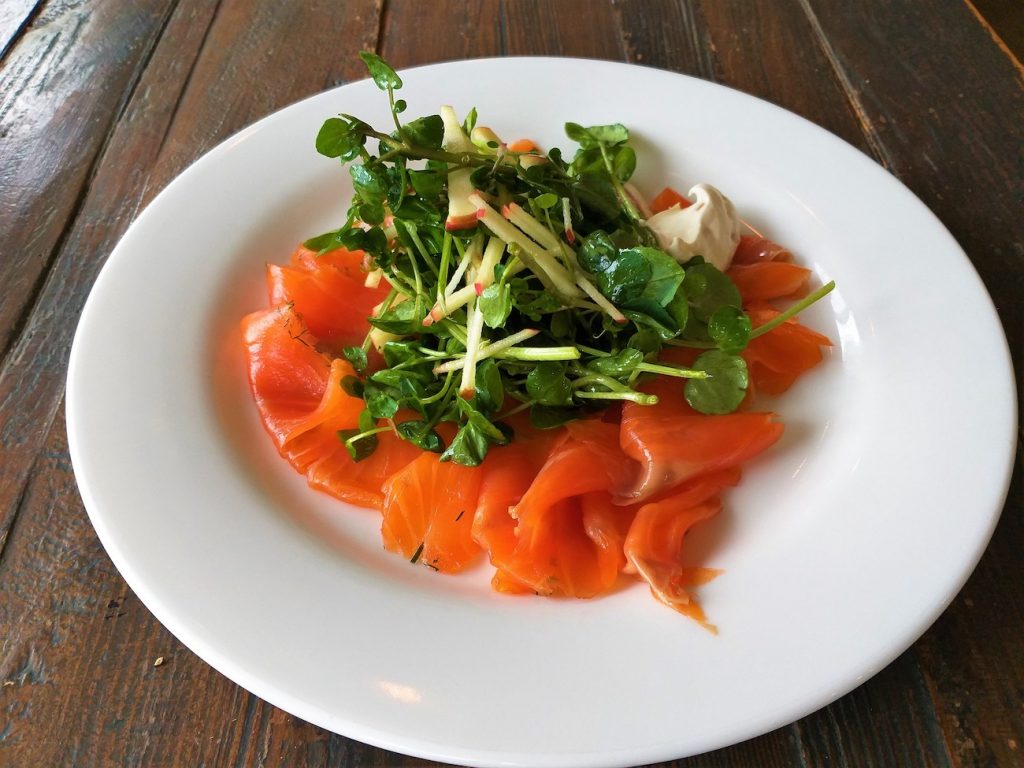
The trout is a fabulous dish. House-cured with horseradish cream, watercress and a beautiful apple salad propped on top. It looks like a lot of fish, and it is, but it is so moreish the plate is gone before you realise.

The onion bhaji are delicious. Indian spiced fritters served with a cooling raita dip. Again, it’s a big serve – you are never going to leave hungry – but once you get started you don’t stop.
Mussels are my “go-to” and while you can make them at home, you can’t do it as well as The Boathouse. They are steamed and served in an aromatic sauce of tomato, chilli, garlic and coriander – with three huge pieces of crusty bread dripping with butter. OMG. Either soak up the sauce with the bread or use your spoon and just drink it up.

(Be prepared and take a few tissues. That chilli will get your nose dripping – just be discreet. Wiping your nose is not the done thing anymore. Like coughing. My brother told me that blokes used to cough to cover a fart, now they have to fart to cover a cough. Who knew!)

Kyle’s “go-to” is the seafood linguine. He has tried a number of times to recreate it over the past few months but now he realises his is a pale imitation. It’s a wonderful dish filled to overflowing with big prawns, plump mussels and fish with a garlic, lemon, fresh tomato and white wine sauce. Such a good meal.
We didn’t have room for dessert but my favourite is the saffron panna cotta with a mango puree and toasted coconut ($14). Next time.
Oh, drinks. There are plenty on offer with a really good wine list and most by the glass. But maybe splurge out on a bottle. I had the 2017 Xanadu Chardonnay from Margaret River which is $10 for a glass or just $46 for the bottle. Kyle, ever the driver, opted for ginger beer.
The Boathouse Restaurant is a wonderful choice for lunch or dinner and we found ourselves feeling actually refreshed with a bit of a reprieve from a busy life and stressful times. The service is immaculate, the staff friendly and the food is wonderful – then there are those views of lovely Lake Daylesford.
Words: Donna Kelly | Images: Kyle Barnes