


June 23rd, 2023Artists of the Central Highlands

with Eve Lamb
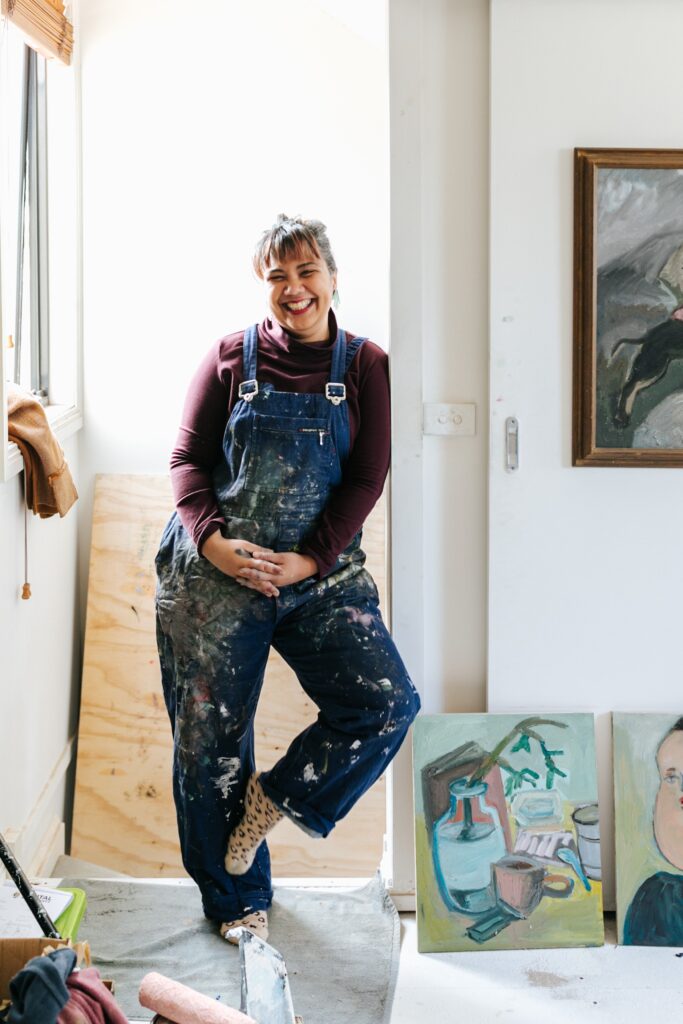
Armed with a personal attitude that “life is too short” Karima Baadilla (pictured above) ditched professional accounting to pursue her passion for art, and swapped life in the inner city for a tree-change at Clunes on the old central Victorian goldfields. She is now a multi-media artist whose prints create a narrative of everyday life, migrant identity and community that is fresh, vibrant and tends to bring instant cheer.
Eve: Hi Karima. It’s great to have artists like you enriching the community of Clunes with your work. How long have you resided in Clunes now and where did you shift here from?
Karima: Hello, thanks for reaching out. We came from the inner west suburb of Footscray and this past April it’s been two years now. Time sure does flies.
Eve: What attracted you to Clunes?
Karima: We got to know Clunes because of (local real estate agent) Angela Flowers actually. She was such a personable lady and speaks highly of our town of Clunes. When we actually saw it, we knew exactly what she meant.
Eve: How do you describe your artistic style? And how did you come to art?
Karima: I guess I would call my artistic style fun and a little weird. Haha!
I didn’t come to art the traditional way. I was a certified practicing accountant for about eight years before abandoning that. Long story, but basically life is too short not to do what you want.
Eve: I hear you are currently pursuing further studies at Bendigo. Can you tell us a little about that? What are you studying?
Karima: I have always loved studying; it’s an ongoing obsession of mine. Currently, I am pursuing my honours year in Fine Art, studying is a great way to enrich your art practice and learning the context in which my work sits in a wider realm of visual art.
Eve:What goals do you hope to achieve through your art at this stage?
Karima: The honours year is a research based degree, and I am working towards a mini thesis that scares the pants off me!
Eve:Which artists, current or past, influence your own work?
Karima: I love works by our First Nations artists such as Emily Kame Kngwarreye and the works of Rosalie Gascoigne (AM), the New Zealand-born Australian sculptor and assemblage artist.
Eve:What is your media of choice?
Karima: I am trained as a ceramic artist through RMIT, but my love is painting.
Eve:What do you find inspirational? Your subject matter of choice? … Why so?
Karima: Persistence and generosity are what I find to be inspirational, and people around me give me that all the time. People like (Clunes Neighbourhood House manager) Lana de Kort the way she gives to the community tirelessly, Marguerite Clancy who is a new(ish) friend of mine, who just finished her fourth(?) book and Christine Lethlean another Clunes resident who curates amazing exhibitions through Textile Palette.
Eve:Do you work in any other area besides your arts practice?
Karima: I am a bit of a bowerbird (LOL) I jump around. I was working for Renew Australia as an arts administrator and curator for about four years before I move to Clunes. Since then, I have dabbled with casual gigs – floristry, mural assistant, and teaching kids’ workshops.
Eve:Do you have any exhibitions or special arts events coming up that you would like to let others know about?
Karima: I am working to put more works through Boom Clunes with other community artists. Keep an eye out for ‘Dogs of Clunes’ merchandise!


June 22nd, 2023Leeanne socks it to us

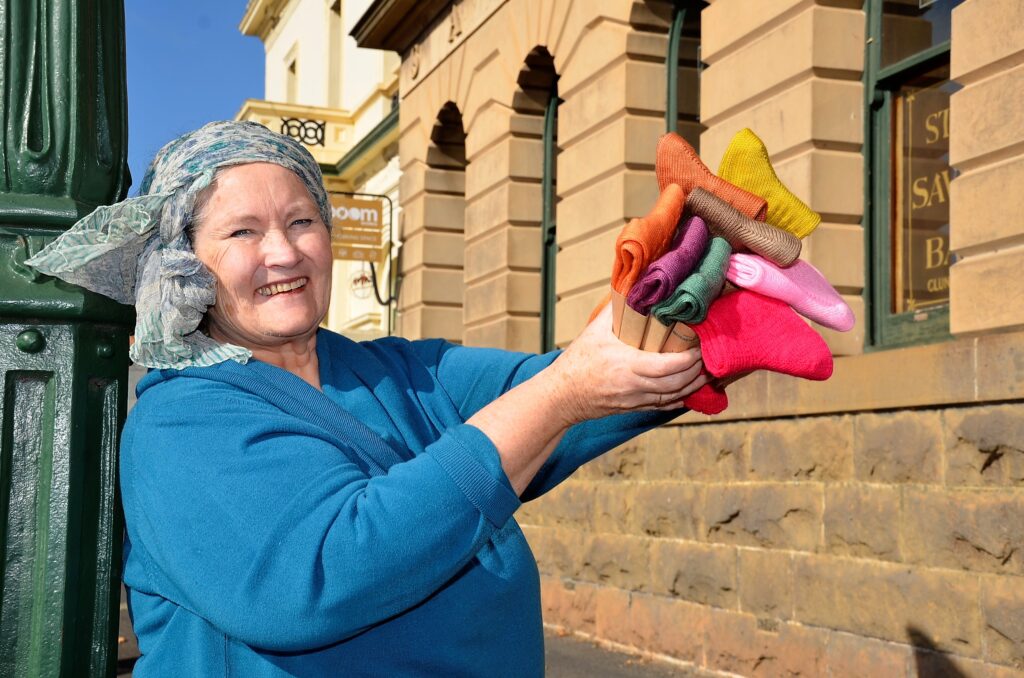
Finding an enterprise that makes beautiful handmade socks in every colour of the rainbow in Clunes is really not so odd.
The Odd Sockery’s slogan is ‘Bringing Sock Making Back to Clunes one Pair at a Time” and, as owner and sock maker Leanne Wills (pictured above) says, that’s because commercial sock making actually happened here way back.
“The history does fascinate me,” she says.
“Historically Clunes did have a sock manufacturer here and that history really struck a chord with me, the fact that it ties in with the history of Clunes.”
The Odd Sockery has now been bringing sock making back to Clunes since 2018, and to do so Leanne brought her own considerable background in textiles – and a vintage Gearheart Circular Sock Knitting Machine circa 1904.
“This is a circular sock knitting machine that I found on eBay. It had been in a museum home in America. It was in parts and when we brought it out we didn’t know if it was all there and we didn’t know if it was working. We took a punt,” she laughs.
Fortunately, it was a punt that paid off and now, from this machine and other restored and newly built machines, Leanne designs and creates a wide range of socks – all hand cranked and dyed.
They forge a link to the town’s rich history of sock manufacturing going back to 1939 when the Interknit Hosiery Company produced its first pair of socks in Clunes.
“I’ve been able to go on from there and develop into a whole array of experimentation. I’ve discovered the whole world of colour and my confidence has just burst through and I’m loving working with dyes,” Leanne says.
Visiting this rare little enterprise that has its main shopfront at BOOM Clunes in the town’s Fraser Street, is a sock fanciers’ dream come true as the colours come in just about every hue imaginable, striped and solid, and the yarns used are a tactile treat.
To reel off a few options in The Odd Sockery range, there’s merino hand-dyed numbers, there’s the striped sock, the ribbed top shortie, the possum merino, the custom sock designed to meet individuals’ health, circulation and colour palette wants and needs.
There’s the art gallery collection, designed originally by Leanne in collaboration with the Ballarat Art Gallery shop where they’re also stocked.
“They feature a loose rib top boot sock with contrasting cuff, heel and toes made using Nundle woollen mills Australian merino yarn – which I just love – and Danish self striping yarns that are processed in Italy,” Leanne says.
She says The Odd Sockery socks are all finished using the famed “Kitchener stitch” so named after the British Secretary of State during World War One.
“Commercial socks today have a ridge at the toe but the socks I make on this machine are the same as a hand knitted sock,” says Leanne who knows her sock history.
“The Kitchener stitch is hand stitching when the sock is being finished and it was developed to help prevent trench foot in the war because a big threat to the army was trench foot which was exacerbated by ridging on socks causing irritation and infection.”
She says the ultra warm merino possum range is a recent addition and has “a lovely story” behind it.
“I’d been asked a few times about possum but I wasn’t sure about it. Then unsolicited, I had a local Aboriginal elder approach me and she took me aside and said I give you permission to bring back possum.
“The possum wool we use comes from New Zealand where the possum is an environmental pest. We don’t get any of it from here where it’s protected. They’ve set it up in New Zealand as a way of controlling its numbers.
“I’m just delighted with the whole story of these. I feel very privileged to have had the Aboriginal elder’s blessing on that.”
Another new development is the very recent introduction of The Odd Sockery’s Donegal tweed range which Leanne makes using tweed yarn imported especially from Donegal, Ireland.
“It is the warmest sock – apart from the merino possum – that I’ve ever worn,” she says.
“These are a sock for those who are truly dedicated to warm feet. They’re more suited to being a dress sock and they also make wonderful bed socks.”
Leanne says having BOOM Clunes as a main shopfront has been great for her unique little enterprise.
BOOM also operates as a co-working space and also stocks a wide range of other creations made by local craftspeople, artisans, writers and producers. The money that comes in stays in the local community.
At this time of year Leanne is at full stretch meeting demand as many sock fanciers can’t wait to slip on a warming pair of The Odd Sockery’s lovingly hand cranked and hand dyed foot apparel.
“I do have trouble keeping up because everyone wants them at the same time,” she laughs.
“It is slow fashion. Yes I am using technology, but it’s industrial revolution technology.”
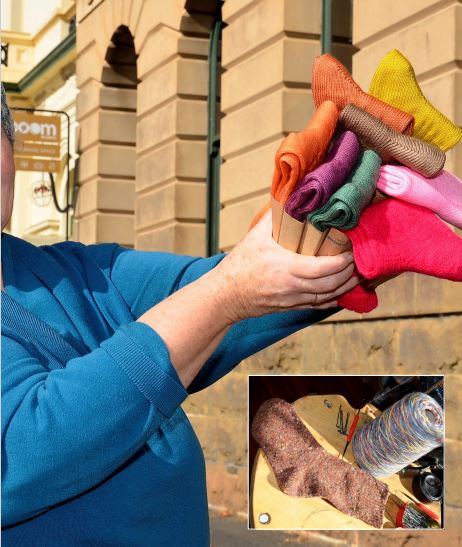
While the manufacturing process may be retro, the Odd Sockery’s sales mechanisms are more up to the minute, and the Clunes-made socks are now finding their way all around Australia via The Odd Sockery’s online shop.
Leanne has even started a Facebook group – Circular Sock Knitting Machines and Knitters of AUS – for those keen to learn more about the rare old trade. It has over 500 members and quite a few of them also regularly get together in person in Bendigo.
Words and Images: Eve Lamb

June 6th, 2023Gold in them there world heritage bids: UNESCO bid boosted

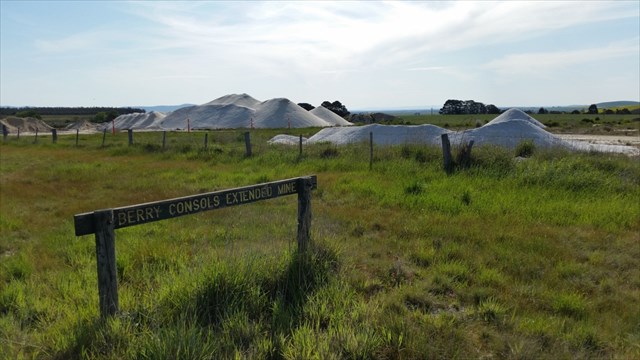
The Victorian Goldfields UNESCO World Heritage bid has been given a hefty boost thanks to $3.8 million announced in the Victorian budget for championing Victoria’s outstanding heritage.
World Heritage listing of a limited number of globally significant sites is forecast to deliver real
and long-lasting benefits that will be shared by communities and people right across the Goldfields region, including in little local towns like Clunes and Creswick which have a significant part in the area’s golden past.
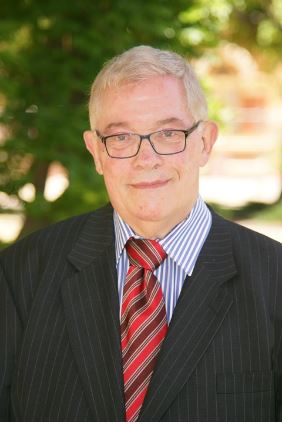
World Heritage status is expected to bring world-wide recognition and attention and is a proven, powerful catalyst for unlocking transformative opportunities for local communities. It’s estimated to be worth $1 billion to the region over 10 years. Connecting the world with the Victorian Goldfields is forecast to grow the area’s global visitor market, driving sustainable tourism and jobs.
Meanwhile, a targeted tourism investment strategy is expected to start delivering benefits in the short-term.
The bid is the initiative of a regional partnership made up of the Victorian Goldfields Tourism Executive and 13 local councils led the City of Ballarat and the City of Greater Bendigo.
Chair of the Victorian Goldfields Tourism Executive Cr Chris Meddows-Taylor says a tourism masterplan currently being developed features exciting World Heritage Journeys which will disperse the increased visitors – and visitor dollars – throughout the region.
“It will take in our smaller regional and rural communities meaning there are no winners and losers, only winners.”
Macedon Ranges Shire Council Mayor, Cr Annette Death, said it was pleasing to see more funding provided for the bid to join about 20 other Australian sites currently showcased on UNESCO’s World Heritage List.
“This worldwide recognition would complement our own tourism initiatives here in the Macedon Ranges and our own unique heritage, which we’re currently inviting submissions on to help inform a revised Heritage Strategy.”
City of Ballarat Mayor Cr Des Hudson OAM says that leveraging and strengthening community pride is a vital part of the work.“Locals have told us they are proud of what we have. Our unique heritage is a key reason they want to live and work here.
City of Greater Bendigo Mayor Cr Andrea Metcalf says that unlocking the benefits needs strong collaboration between local communities, businesses and industry.
“It will take everyone working together. The bid merely opens up the opportunities. Importantly, Traditional Owners will be able to tell their own stories about the impact of the gold rush and share those with visitors in the ways they choose.
“We urge everyone to get involved in shaping an exciting, sustainable and prosperous future.”
Locals keen to get involved in co-designing an exciting future for the Goldfields region and to learn more about the bid are being invited to visit www.goldfieldsworldheritage.com.au
May 25th, 2023Neighbourhood house begins new chapter for historic library building

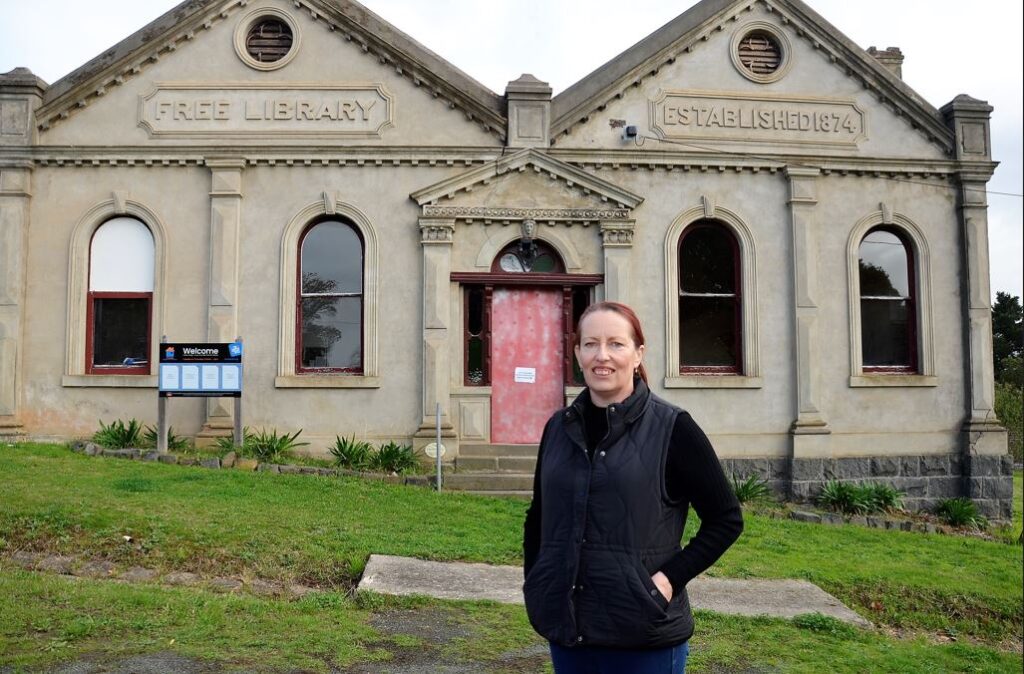
Words and image Eve Lamb
The permanent relocation of Clunes Neighbourhood House to the town’s former Free Lending Library Building is poised to breathe new life into one of the town’s historically significant sites, invigorating the CBD as well.
For the previous 20 years or so Clunes’ historic former free lending library in Templeton Street, has sat largely unused, save for some assorted community meetings and a brief stint involving youth activity.
But plenty of groundwork by dedicated community volunteer committee of management members has paved the way for the beautiful old building’s reinvention – for essentially the very same use its founding mothers intended way back in 1852.
Stage one works inside the building, are now in full swing and are scheduled for completion in June, says Clunes Neighbourhood House manger, Lana de Kort.
When the new flooring and other internal works are done come the end of June the Neighbourhood House will then base itself there permanently, having previously been housed in the town’s Lee Medlyn Bottle Museum complex for the past 10 years or so.
In the meantime, while key works are under way, the Neighbourhood House HQ is temporarily working out of the town’s BOOM co-working space in Fraser Street.
Lana says the move to the former free lending library building has been informed every step of the way by what the community wants, guided by the ethos “focus on the Neighbourhood and the House can follow”.
“The Committee of Management and Department of Energy, Environment and Climate Action (DEECA) approached us to use the building at a time that was perfect for us,” she says.
“We’re still continuing to take responsibility for the Lee Medlyn space and we will work out how the community wants to use that into the future.
“Most of the works here (in the free lending library building) will be finished by the end of June, and that will enable us to get into the building. The current work is the first stage of a series of stages and we expect there will be four stages,” Lana says.
She says funding for this work was “just the latest in a series of smart decisions made by people protecting this building” and was secured by Graeme Johnstone, Phil Taig and Denise Fordham (the then committee for the building) through the Hugh D.T Williamson Foundation.
“The volunteers that went before us did engineering and structural reports and historical reports, and stabilising works so now we’re at the stage where we can preserve and restore.
“With these reports, as well as engineering reports completed over the last decade, we have been well placed to work with DEECA to begin the safety works to restore the entrance and meeting rooms.
“The volunteer committee stabilised the building and we had an event in February where people could look through the building and share their ideas for it.
“The real magic is that the ideas that the community has come forward with are essentially exactly the same ideas that brought the building into being in 1852,” Lana says.
“Back in 1852 a group of women from Clunes identified a need for a space where people could come together and read and learn together.
“They worked with the community to raise the funds for the building. They lobbied landowners and the mining industry to support the development of the building as a place to develop literacy skills.
“I think it started off as the mechanics institute but it was always a place of informal learning. It’s always been a space where the community can come together and grow and that’s what we intend it will continue to be as we go forward.
“It is a community space where people can connect, learn and gain support.”
The Clunes Neighbourhood House itself has existed for four decades, operating from various venues, and is a vital community hub delivering social connection activities including group exercise, training courses, general support including digital literacy, and help navigating things like applying for the state government’s power saving bonus.
“We also provide emergency relief support,” Lana says.
The newly reinvigorated former free lending library building will provide contemporary meeting, office, kitchen and training spaces, all set off beautifully by the historic high timber ceilings, fine old arched windows and stained glass.
Lana says staged work planned ahead will also include shower and laundry facilities that will be made available for use by those who need them through a partnership with Anglicare Victoria.
There are also plans to accommodate the re-introduction of a regular children’s playgroup for the town.
“We are certainly looking at having a playgroup here, after the playgroup in Clunes ceased operating as of the middle of last year,” Lana says.
There are also plans to use one of the beautiful old high-ceilinged rooms within as a parlour to host music events among other activities.
“For us it means we have a permanent home,” Lana says.
“We will be operating from here three days a week from Tuesday to Thursday, and this location is much more visible and accessible to people.”
Lana notes that with CNH temporarily based in BOOM Clunes, that shopfront will be open until the June long-weekend, seven days a week from 10am – 3pm with staff available on Wednesday and Thursday to assist with the power saving bonus.
In the meantime concept boards are being used to highlight the different ways the community has imagined spaces might be used at Clunes Neighbourhood House once the Clunes Former Free Lending Library building is fully restored.
“All of the activities that the Neighbourhood House does in Clunes are community–led so people can continue to come forward with ideas.”
May 13th, 2023Bee-sotted! How a backyard hobby became a business
The Local is running a producers’ series over the next few editions. Here Eve Lamb talks with Graeme Grigson from G’s Bees Honey – Down to Earth.
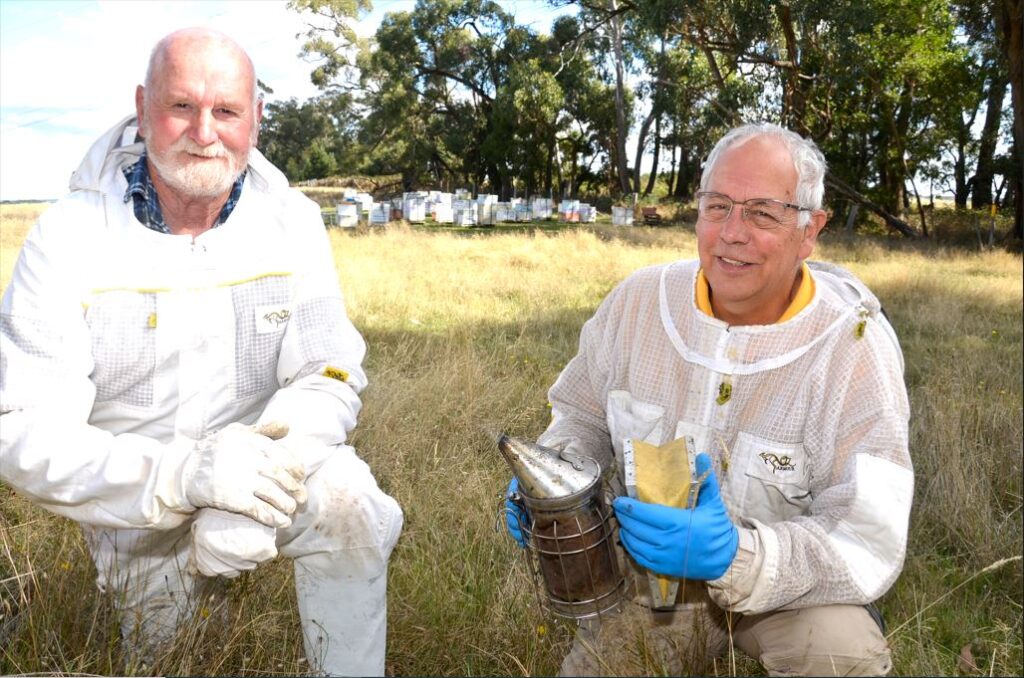
How does someone go from having just two bee hives to having 80? Don’t ask Clunes’ Graeme Grigson because he doesn’t know how it happened.
Suffice to say it did and now he’s a fulltime beekeeper. Bee-sotted you might say.
So is his buddy in all things apiary, Ian Macfarlane a former Clunes resident who now lives in Ballarat.
Ian keeps his four hives alongside Graeme’s, and, just between you and me, confides that it’s all part of a cunning plan to find out more about the pastime for which the two share a never-ending fascination.
“Graeme’s a great mentor. He likes to pass on all his knowledge,” Ian says.
Graeme says he started out as a hobbiest beekeeper with just a couple of boxes about two decades ago..
“I’ve been in beekeeping now for about 20 years,” he says.
“It started out as a hobby with two hives. Then I started helping others and my two hives became 10 and now it’s about 80 all up. I don’t know how that happened.
“It’s become full-time over the last two to three years.”
While his beekeeping enterprise that’s called G’s Bees Honey – Down to Earth, is a boutique business compared to the bigger commercial operations, it nevertheless sees him producing some 3000 kilograms of honey annually, “in a good year”.
“Normally in a good year we’d get about 3000 kilograms,” Graeme says.
As a result Graeme now supplies multiple local retail outlets from Melton and Bacchus Marsh to Creswick and Clunes, and he also regularly attends local farmers markets, selling his bees’ delicious produce.
But honey is far from the only product that flows from this pursuit of choice.
G’s Bees – Down to Earth has now also helped to create part-time employment for a neighbour of Graeme’s, in Clunes, who uses some of the honey to produce a range of tempting confectionery including chocolate-dipped honeycomb, lolly-pops and ginger honey.
“The ginger honey has really taken off,” Graeme says.
As well as this, G’s Bees – Down to Earth provides wax to other enterprising locals who convert the raw product into beautiful candles including natural tealights, and moisturizing lip balms, which also sell at local markets and select retail outlets.
“There’s nothing in a bee hive that can’t be used,” Graeme says.
“The wax, the honey, the pollen, the propolis…”
Then there’s the almond pollination. Graeme’s 80 or so hives – plus Ian’s four – get to travel quite a bit including up north to pollinate commercial almond crops.
“We migrate our bees throughout the year to different sites from Clunes to the Little Dessert,” the Clunes beekeeper says.
We go north to Piangle on the border in August for almond pollination then down to Kerang, and Sheparton and the canola which helps build the bees up after the almonds.”
Depending on where the hives are stopped, they collect from tree species including “long leaf box, yellow box, brown stringy bark, yellow gum, red gum, grey box, orange blossom, messmate.” Grame reels off some of the species from which his bees typically collect.
When possible, this list may also include the type of tea tree from which the precious medicinal manuka honey is produced.
When The Local caught up with Graeme and Ian, it was at a magnificent Buninyong site where about 60 of the hives had been sited but were soon to be collected and shifted to another site near Mount Beckworth just out of Clunes.
“My first honey extraction is normally around October and if it’s a good season we can extract every four to five weeks after that through to May,” Graeme said.
He explained what drew him to beekeeping in the first place.
“I just love honey really. And what better way to enjoy honey? I never use sugar any more as a sweetener. Just honey. It’s medicinal as well and, I believe, the darker the better.”
Both Ian and Graeme take the occasional sting as par for the course, but are also careful about donning the correct protective beekeeping kit before getting up close and personal with their buzzzy charges.
The challenges of bee keeping include “keeping on top of pests”- something Ian mentions – to the sometimes prohibitive costs associated with travel and transport which Graeme mentions.
“And if we get a bad season that’s a big challenge,” Graeme adds
The wetter weather of last year was challenging and impacted yields for many of the state’s beekeepers, for example
But Graeme and Ian agree it’s one of the most addictive enterprises you can get into.
“Really I got into it when I started learning how wonderful those little insects are,” Ian said.
Graeme names the lifestyle and the practice of getting out and about into some glorious parts of the state among the sweet aspects of becoming a beekeeper.
“It’s a fantastic interest to enjoy,” he says.
But he has some parting advice for those who think beekeeping may be for them.
“If you’re going to start out as a beekeeper, do your researcher and go out with a mentor. Also there’s beekeeping clubs like the Ballarat club and the Melbourne Beekeepers Club. Join a club.”
Words and Images: Eve Lamb
(Next edition, Red Hare Estate Vineyard)
March 21st, 2023No excuses: Clunes gets new outdoor fitness equipment
Clunes locals and visitors will soon have less excuse to delay exercise.
The town is getting some new public excercise equipment and it’s being installed alongside the creek, connecting in with the scenic creek walk that’s already pretty popular with walkers and joggers.
The Hepburn Shire Council is installing the new Creek Walk Outdoor Fitness Space and reports that the equipment is being installed creekside at the bottom of Clunes’ Scenic Drive over the next few weeks, with some pieces already in place.
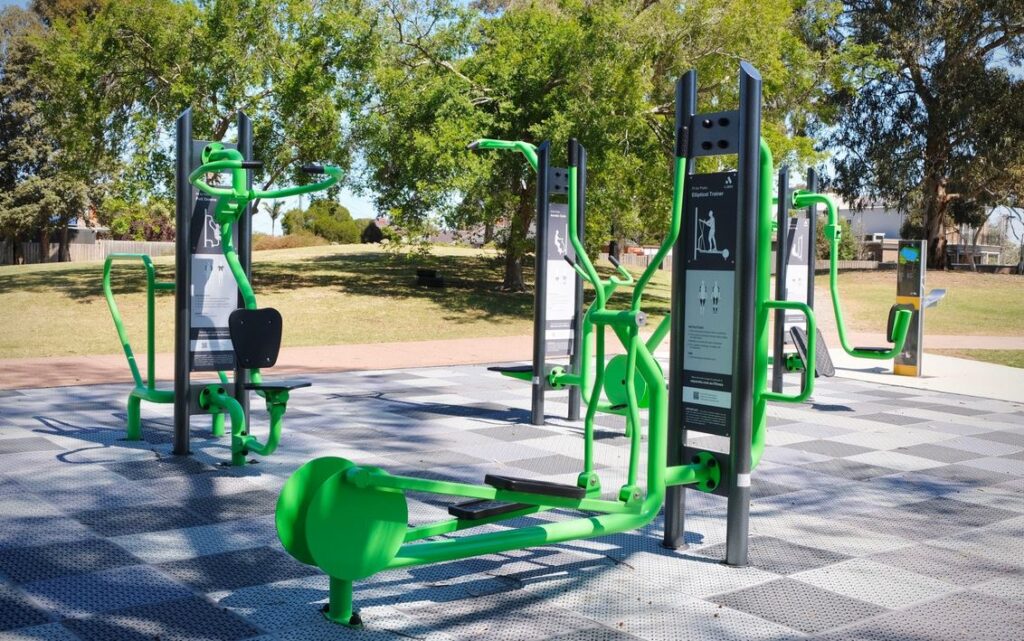
Pieces include an aerobic walker, dexterity bar, hand cycle, push up bar, step up, and chin up bar.
It’s all expected to be up and running – and to get locals up and running as well – by the end of March.
March 19th, 2023Clues about Russia revealed at Clunes
AS AN adolescent, Sheila Fitzpatrick challenged her father, including questioning his view on the Soviet Union. Being a socialist, he was hopeful that it was achieving something like socialism.
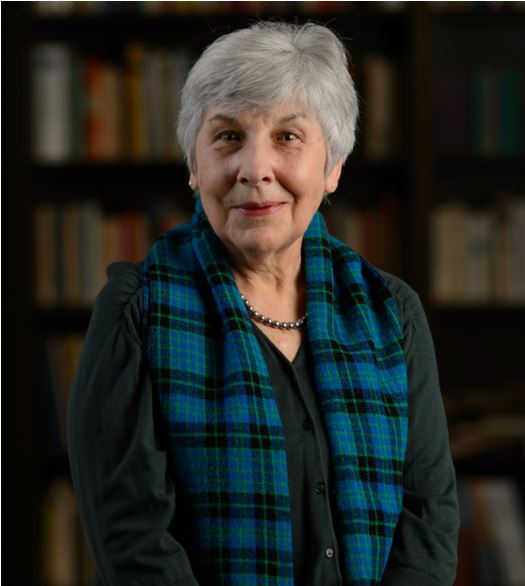
Later, she went to see for herself, emerging as the most prolific and influential
historian of the Soviet Union now at work. Her 11 books and many articles guided
two generations of scholars eager to crack open the mysteries of what is now again
Russia. An engaging and warm personality, she has been studying Russia since going
from Melbourne to Oxford University as a graduate student in 1964.
The winner of many awards, she is still hard at it at 81, although she retired from
the University of Chicago (home to “the nerdiest of the nerds”) after about 20 years
and is now at the Australian Catholic University in Melbourne. She will be at Clunes
for Booktown.
We discussed the famous Winston Churchill quotation from 1939 that Russia is
a riddle, wrapped in a mystery inside an enigma. It is possibly less so now, she says.
“But when I first went into the field I felt very strongly that it is a total mystery.
Some people would say everything over there is terrible and other people say that
everything over there is great and nobody actually seemed to know very much
because, of course, the Iron Curtain was a real obstacle to the passage of people and
information.”
That changed, but she says we still don’t collectively have a very clear sense
of what Russia is all about. We do know that Russia has been worried about the
expansion of NATO towards its border, and it felt that it had been assured that this
would not happen. At the time of the break-up of the Soviet Union, its President,
Gorbachev, did get such assurances.
“I don’t see a sign of any quick ending of this terrible war,” she says. “At the
moment neither side seems to be achieving a clear military victory, therefore there’s
got to be a negotiated settlement, at some point, one assumes, but I don’t see it soon.”
An indication of her following is that her latest work, the 256-page Shortest
History of the Soviet Union has had four English editions and 10 translations,
including Ukrainian. Surprisingly, she says, there is a Russian edition. The contract
was signed just before the invasion.
As an historian she used journalistic methods to track changes in Russian power,
looking up the Moscow and St Petersburg phone directories to see what people and
organisations had been dropped. Her father, Brian Fitzpatrick, had been a journalist,
as well as helping set up the civil liberties movement in Australia, and she says she has
some of the journalist in her.
“I loved doing that. I was very happy to find that source and to work away…”
Amazingly enough, while researching a new book on displaced persons from the
Soviet Union and the Baltic, she found that a secret agent was sent to Australia by
the Soviet to try to persuade former Soviet citizens who became “displaced persons”
because of the World War II to return. This was in 1951-52 and, she says, he had a
lot of difficulty because the migrants did not want to go back. She says the agent had
many psychiatric cases on his doorstep and was kind to them.
Almost as fascinating as her work was how she came to marry. She was on a
flight from New York to Austin, Texas, in 1989, which stopped in Houston. She
had an aisle seat and invited the man next to her to stretch his legs. They fell into
conversation. His name was Mischka Danos, a Latvian who, astonishingly survived
the World War II by moving to Germany, and then to the US with his mother, who
was sponsored by one of the Jewish people she saved.
He and Professor Fitzpatrick talked on that flight. They spoke in Russian. “He
suddenly stopped, explaining later that this was because he had a conflict about which
version of ‘you’ to use: the familiar, which felt natural but impolite given our very
recent acquaintance, or the polite one, which felt wrong because of his feeling that he
was talking to someone he knew well.” They were together until his death 10 years
later.
Away from academia, Professor Fitzpatrick played violin in chamber music groups.
And then there are her three passports. On entering or leaving this country
she uses her Australian one. Earlier, she automatically lost this by getting a British
passport so she could enter the Soviet Union. This was in her newly-acquired married
name, but she published under her maiden name, which helped because her first
scholarly article as S. Fitzpatrick (presumably male) was denounced as anti-Soviet
propaganda by a Moscow daily paper but nothing happened to her. Then she got an
American passport and now has an Australian one as well, so she can certainly travel…
Professor Fitzpatrick will appear with fellow historian Professor Joy Damousi
talking about Russia’s Soviet past at a sold-out event at Clunes Courthouse at
1.30pm on Saturday, March 25.
Words: Kevin Childs | Image: Contributed
February 4th, 2023A stitch in time: the Textile Palette Exhibition’s back
Words & image: Eve Lamb
If you’re a nifty needleworker with a talent for textiles then the Clunes organisers of this year’s Textile Palette Exhibition want to hear from you.
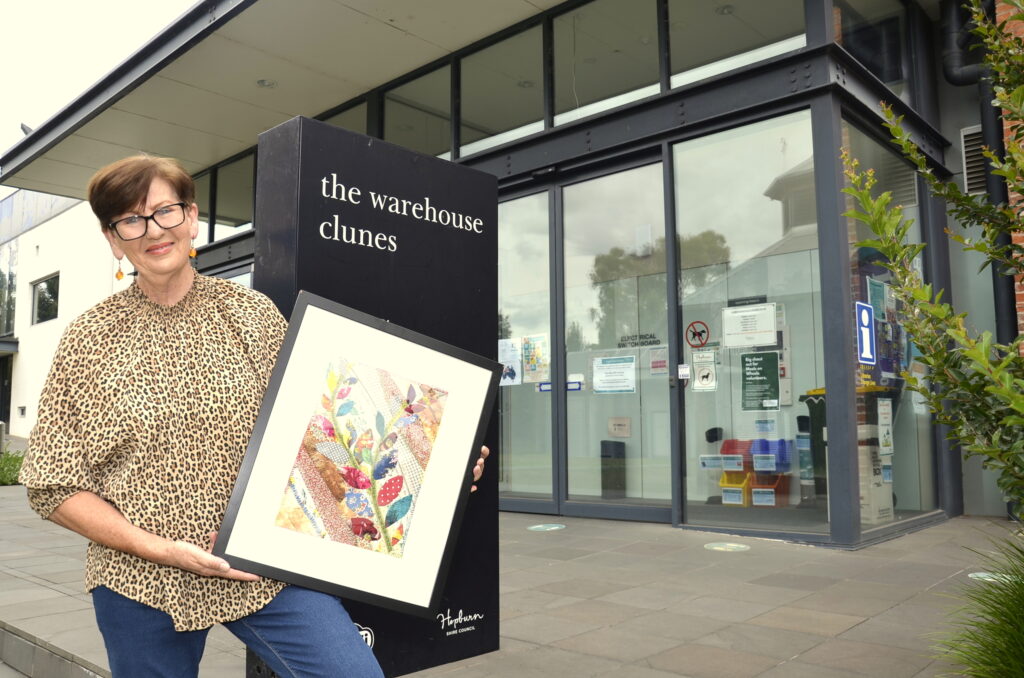
After a Covid-enforced break, the Textile Palette Exhibition is back, being staged in Clunes over April 1-29, in the Clunes Warehouse for the first time.
And the date for submission of work for inclusion has now been extended from January 27 to February 10, says the exhibition’s regional coordinator, Christine Lethlean (pictured above).
Christine, a talented textile artist who moved to Victoria from WA a decade ago, has called Clunes home for the past eight years, and runs regular workshops from her Clunes studio. She also teaches textile art Australia-wide.
“I’ve always loved stitching,” says Christine who is also a former health professional with a background that includes nursing, mental health nursing and art therapy.
Christine says submissions for this year’s Textile Palette Exhibition are being accepted from interstate as well as closer to home.
“We’re really talking about textile art as a visual art-form,” she says.
“The theme for this year’s exhibition is Time for Stitch. After the past few years
navigating the changes to our lifestyle and restrictions placed on us by the pandemic,
having endured long periods of isolation and separation, what’s spoken of now is how
the quiet time for creativity helped many of us cope.
“Sitting and stitching was a lifeline to maintaining a sense of normality, and keeping a focus and our creative motivation alive.”
With this theme in mind, textile artists intending to submit work for inclusion in the exhibition are being invited to work on ideas connected to their experience during pandemic restrictions – or simply a project highlighting a love of all things connected to textiles and stitching.
Submissions considered for this year’s exhibition may include framed and unframed works, sculptural pieces, wall hangings, costumery or surface design, with artistic soft furnishings and unique upholstered furniture also considered.
As regional coordinator of the upcoming exhibition Christine makes no secret of the fact that she’s aiming to lift the profile of the annual event, and will be applying for a Hepburn Shire grant for promotion, marketing and signage.
“When we held the first exhibition in 2016 – it was a roaring success,” she says.
“We started as a group of about 15 stitching enthusiasts and we’ve had about four
or five shows since the first.
“Now it’s going to be in April every year and I’m anticipating making it a bit
more formally recognised as part of the Hepburn Shire’s events calendar, bringing
visitation from curators, collectors, artisans and anyone interested in stitching as an
art-form. I’m aiming to put it on the calendar as a must-do event.”
Those keen to know more can go to www.textilepaletteexhibition.org and there’s also an Instagram page @textilepalette.

December 23rd, 2022Ageing … with a healthy dose of attitude
Words and Image: Eve Lamb
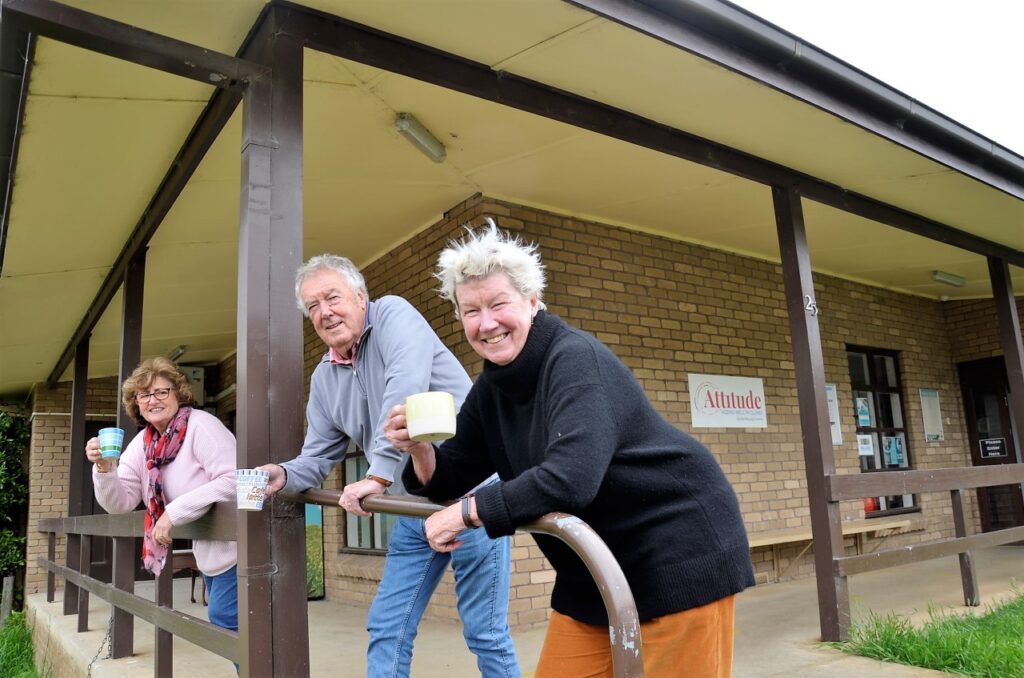
THEIR parents may have been okay with becoming senior citizens, but as they move beyond a certain age, today’s baby boomers and the first of Gen X behind them – not so much.
It’s an observation evidenced in the fact that the building that two years back used to house Clunes’ Senior Citizens is now HQ for Attitude: Ageing Well.
Attitude by name – as solidly stated on their wooden signage – and Attitude by nature. It’s clear there’s no shortage of the stuff going down here.
Attitude is “a grass roots model of ageing well in community”, explains a flier. It’s a home-grown model that sits under the Clunes Neighbourhood House umbrella, and is starting to grab attention from further afield.
As I pull up a seat inside Attitude HQ, I’m here to hear first-hand from the regulars whether they believe there’s a need for more retirement living options in Hepburn Shire.
There is general agreement there is but it doesn’t take long to discover the Attitude focus is far more wide-ranging.
Gareth Sharp, a retired engineer who used to project manage for government, and Lois Nichols, a former city-based magazine sales professional, are quick to point out that social connectivity underscores much of what Attitude is all about.
“We run along the same lines as the Mens’ Shed movement,” Lois says.
Those who get along are invited to introduce any particular interest area and then oversee it becoming part of the program. Since Attitude started in November 2020 it’s conducted more than 600 activities involving more than 2500 participants.
Regular free film nights, weekly pétanque sessions, bi-weekly boot camp, easy indoor exercise class, ukulele, philosophy, art, and outdoors walking are all just a bit of what’s on their seasonally renewed program – as are social outings.
“When you look at the population of Clunes there are so many people who are retirees or wanting to retire here, but we’re very inclusive and we welcome anyone coming along including those who would not previously have been considered senior citizens.
“It (adequate retirement living) will be an issue. There will be people from our baby boomer cohort with health issues.”
Access to transport, particularly for those who may not have a licence or a private vehicle is also an issue that comes up. Ready access to a community bus would help Attitude run its ongoing outings to locations that include wineries. Funding is also needed to enable programs to be subsidised.
The issue of ensuring provisions are in place to age well surrounded by friends is a perennial one, and it’s quite a pressing one for Hepburn Shire, the director of Belle Property Regional Victoria, Will Walton, observes.
Being in real estate gives Will a unique vantage point from which to regard the wider issue. “I think the council needs to take a proactive approach to planning for growth that includes attracting operators of retirement villages,” he says.
“We’re one of the older local government areas in Victoria as far as population goes and hopefully both the state and local governments will look at options to enable people to stay in their community and remain connected.
“In the Daylesford area there’s a big problem, absolutely. The two issues are the availability of land to house an independent retirement village. The problem we have here is the land is very expensive.”
The other problem that Will mentions is the dearth of smaller private accommodation options – units and the like, built to house just one or two people and enable older locals to downsize yet remain happily living in their own community.
The lack of independent retirement living opportunities only entrenches the shortage of rental accommodation for younger, larger households with older singles or couples forced to remain in abodes that have become too big for them to maintain, Will says. “I think it’s a problem the entire width of the shire.”
“But I also think that independent living retirement options that come with all the bells and whistles, like cinemas and indoor pools, usually have a minimum requirement of 50 units – so I’m not sure if the smaller towns could sustain that.”
Hepburn Shire Mayor Cr Brian Hood also rates the availability of retirement living options for the Hepburn Shire as an issue demanding attention.
“My immediate reaction is that it does need attention. We do have an ageing population. We know that the median age for people living in Hepburn is 52 and that’s older than the state average, and it’s a significant proportion of our community.
“And we’re painfully aware that housing availability is a general issue for our community including appropriate housing for older residents.”
Cr Hood was among those who, a few months ago, attended the launch in Creswick of Hepburn Shire’s No Barrier Positive Ageing Strategy 2022-30.
He says provision of housing to meet the specific needs of more mature locals into the future is one of the main focus areas prioritised within that strategy. Others include transport, health and social connectivity and participation.

December 8th, 2022Functional pieces with an earthy aesthetic
Words and Images: Eve Lamb
IF YOU’VE ever encountered the term wabi-sabi while exploring Japanese spiritual or aesthetic philosophy you will have a bit of an insight into the style of Clunes ceramicist Chandra Paul.
Originally a city girl, Chandra escaped the clutches of the state’s main metropolis six years ago to set up a home and ceramics studio in Clunes – complete with kiln.
She has not looked back since.
“I do hand building. My work is slab and coil built,” Chandra says.
Her own website describes her work as: “Hand built, small batch stoneware pottery. Minimal, rustic, contemporary, earthy and tactile”.
“Hand building is slow and laborious so in effect each piece you make is a one-off piece. I like to see the maker’s marks embedded in the clay,” she says.
Chandra’s focus is on creating original functional pieces with a beautiful earthy aesthetic to sell at artists’ markets as well as online.
Exquisite little tableware pieces, unique display vases and indoor plant display pots are all part of what she does. Very recently she has also made a suite of bespoke pieces for higher end local restaurateurs looking for something very special to set off
attractions on their menu.
“I want to work closely with other small businesses and their vision and help make it come alive through my craft. The design process is where a lot of the work is.”
Wabi-sabi is all about the beauty inherent in the perfectly imperfect, and the pieces Chandra creates beautifully showcase the raw aesthetic of the materials from which they are made.
To hold one of these organic little creations in the palm of your hand is to instantly conjure something precious and essential, a homage to the landscapes from which they’re derived.
But before making her move to Clunes, Chandra had never enjoyed the creative convenience of possessing her own kiln.
“This kiln and I are friends,” she says of the kiln that she ordered from Germany and waited for six months for it to arrive. “This is a good kiln.”
“I built here in Clunes in 2016. When I was in Melbourne I was a tenant and couldn’t have my own studio. I chose Clunes partly for financial reasons. It was affordable.
“But I was also thinking that 10 years down the track Clunes is going to be a bit like Daylesford and Hepburn were in the day. I thought this might be a bit of a hub for creative people.
“I grew up in inner Melbourne and before I moved here I was living in Seaford and not feeling particularly safe. Every time I came up here I felt I could breathe again. I like space.
“I had been renting some space in a ceramics co-op out in the suburbs and someone teaching art in the adjoining room had a holiday house here in Clunes and told me about it. It just sparked my interest.”
Right now Chandra has various artists’ markets lined up to attend in the metro area as she loves being present to chat to those who are drawn to her work.
“It’s a niche, ceramics, but the people who love it come back because they have a yen for the things of the earth,” she says.
“The idea at the moment is online shopping with activations – that is going out into the world and engaging with people whether it’s at markets or exhibitions, or pop-up shops,” she says.
“I have also recently started a blog – I’ve never done one before – for anyone who wants to hear about some pottery minutia.
“It’s about my journey and processes with pottery.”
December 8th, 2022Defibrillator signage for Clunes, a state first
Words and Image: Eve Lamb
CLUNES has achieved a state first, getting public signposts installed to highlight the location of every public defibrillator in the town.
The woman behind the heart-warming, and potentially
life-saving, achievement is Deb Bright, coordinator of the
town’s neighbourhood house and also a GoodSAM.
Ambulance Victoria’s GoodSAM (Smartphone Activated
Medic) program connects local volunteer responders to
patients in the first critical minutes of cardiac arrest while
paramedics are on the way.
Deb says GoodSAM is a free global smartphone app that
alerts several volunteer GoodSAM responders to someone
nearby in cardiac arrest.
It can – and in Clunes it has already – make the critical
difference as it’s known that for every minute a patient
doesn’t get CPR/defibrillation, their chances of survival fall
by 10 per cent.
Deb is one of several GoodSAMs in Clunes and after
recently learning of a South Australian initiative where
physical signposts have been installed to point out AED
locations, she approached Hepburn Shire Council to see if
something similar could be done in her own town.
To her delight, the shire came through, and as a result in
recent weeks multiple signposts have been installed helpfully
pointing the way to each of the town’s five public AEDs
(Automated External Defibrillators).
“We’re lucky in Clunes that we have five AEDs that are
available for members of the public to access 24/7,” Deb says.
“They are at the town’s supermarket, here at the
neighbourhood house, at the bowling club, the golf club and the medical centre.
“The signs have now gone in outside all of the locations of the publicly available AEDs and they point in the direction of the nearest defibrillator. They just went in in recent weeks and I can tell you that they’re already being noticed.”
Deb said the town would love to have some more GoodSAMs.
“The only thing you need to become a GoodSAM is a willingness to respond when you are alerted to a cardiac incident, and knowledge of basic CPR.”
Deb says there had been multiple cardiac arrest incidents in Clunes over the past few years, some of which she has personally attended in her capacity as a GoodSAM.
“Statistically we know that use of a defibrillator in those first critical moments can increase your chance of surviving by 72 percent,” she says.
Deb says seeing the new signposts go in has been very rewarding and she is now keen to see them extended to other towns throughout the shire – and beyond.
“I’d really like to see the program extended and I’ll be contacting Hepburn Shire to suggest that it is extended throughout the shire,” she says.
Local residents who think they may be able to help out and become a GoodSAM responder are encouraged to check out Ambulance Victoria’s GoodSAM website, with some local training in defibrillator use also coming up fairly soon.
“I run regular defibrillator training sessions here at the Neighbourhood House and we advertise them on our socials,” Deb says.
“We will probably start running them again in January.”