


June 23rd, 2024Bushwalks of the Central Highlands

with Eve Lamb
Creswick Regional Park Walk II: St Georges Lake to Gosgrave Reservoir via the Old Koala Park,
Chinese Plum Orchard, and Eaton’s Dam. 9km return.
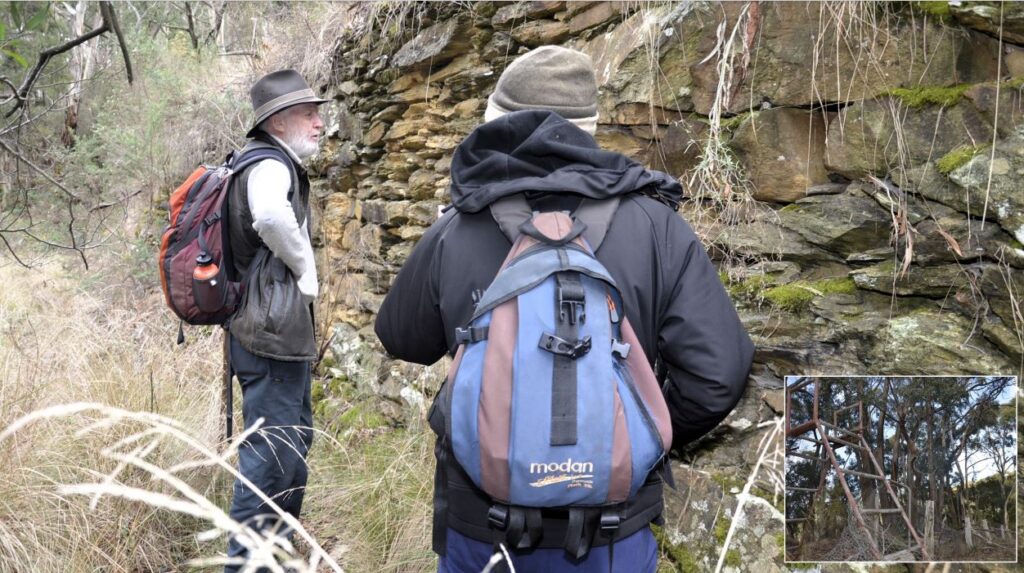
Paddy H and I are in luck as Creswick artist and keen bushwalker, Craig Barrett has kindly offered to guide us on one of his favourite local walks.
It will, Craig says, take in the old Creswick Koala Park, relics of the 1860s gold rush era, an old Chinese plum orchard and the notable stone walls of Eaton’s Dam.
“Sounds good,” I say as we plan the walk for Sunday when, the BOM forecasts, a lower chance of rain.
Craig explains that the walk starts from the St Georges Lake smaller, lesser-used south eastern car park, just out of Creswick, off the Melbourne Road. I’m particularly keen to see this Koala Park site that I’ve heard a fair bit about but never actually seen.
Off we set, carrying camera gear, lunches, a proper bushwalking kit including maps, compass, walk guide and first aid kit (in Craig’s case) and plenty of dark chocolate (in mine).
We are in the Creswick Regional Park, part of the traditional lands of the Dja Dja Wurrung People. In part, our walk ahead will follow a small snippet of the Goldfields Walking Trail (Buninyong to Bendigo) and in small part it also overlaps with where Creswick’s new mountain bike track is being built.
In fact there have been reports recently of some overly keen types ripping down protective temporary barriers to get at the new bike trail before it’s deemed ready to go.
Fortunately our prudent guide, Craig, has checked with the relevant authorities to gain approval for our walk today. Later, when I read authoritative warnings on this front, I am pleased he has.
But as we set off and morning sunlight splashes down through tall eucalypts lining our path, my mind is unfettered by officialdom. As soon as we set foot on the walking track headed south straight out of the car park, Paddy H and I can see this is a fantastic little hike.
“You should see it in spring,” Craig says. “Superb wild flowers.”
Gaining gentle elevation, striding through aromatic bushland for just under a kilometre, we soon arrive at the remnant boundary fence of the old koala park. In 1942, forestry students built the koala park by constructing a fence in a section of the forest to be used as a breeding area for koalas.
However, just a tad comically, they failed to adequately acknowledge koala climbing know-how and the furry little fellas swiftly decamped into the surrounding forest.
These days, the literature states, “there is just as much chance to see a koala in the surrounding Creswick State Forest as the old koala park. I look up a fair bit but do not see a koala.
Having finally visited, though, I can now say that the paucity of the much-loved marsupial does nothing to diminish the site’s value as a top walking spot, with a short 2km loop walk around the
entire former koala park another nice option.
Today, we stop here briefly to check out an old metal stile for helping humans, back in the day, to get into and out of the park, then we move on, following the Goldfields Walking Trail to the north of the koala park, running roughly alongside Creswick Creek. The creek used to be called Back Creek on old maps, Craig says.
Further on we pass alongside remains of an old gold mining water race running through the bushland, scars of 1800s picks still fairly evident in places.
Roughly two or so kilometres further along the Goldfields Walking Trail, Craig stops and points out the site of the old Chinese plum orchard, today a grouping of ghostly moss-encrusted fruit trees whose limbs stretch bare against the early winter light.
We take a little detour through this ghostly orchard and historic market garden site. “Black plums,” says Craig, and then recounts the vision of spring blossom that still blooms here all these decades on. It must be a sight.
And slipping back into the past, to a time long before any of us existed, Craig now points toward nearby sites where hotels once stood nearby – “the Springmount Hotel was there,” he says… “and the Munsters Arms Hotel … in that direction.”
We leave the old plum orchard and its ghosts and regain the Goldfields Track, continuing on until we reach the intersection with Jackass Road. Instead of turning left onto the road and continuing to follow the Goldfields Trail north here, we instead simply cross the road and rejoin the walking pad that heads on, eastward toward the historic site of Eaton’s Dam about half a k further on.
Our resourceful guide provides some literature which instructs that Eaton’s Dam is: “a well preserved example of a mining dam built in 1862 on Creswick Creek”.
The site was leased by American brothers Benjamin and Charles Eaton. While the dam was breached in 1933, and after that fell into disuse, there’s still plenty to see here including some pretty remarkable, high stone walls.
“It’s also one of my favourite places for forest bathing,” Craig muses.
In the cold summer sunlight, a mossy outcrop has something of the bushland shrine about it, complete with tiny exquisite wren attendants.
We stop and admire for a while and then Craig suggests we finish up by continuing on for a few hundred metres more to reach the Cosgrave Reservoir.
It proves to be an excellent place for lunch with two wedge tailed eagles circling above. As we sit there munching away, a man rolls up in a vehicle (the reservoir is accessible by car) and hops out brandishing swish Nordic walking poles.
“Where are you off to mate?” Paddy H enquires.
“Just walking around the reservoir,” says the bloke, bidding us all a cheery farewell and setting off.
Once we’re all fully fortified we head back, basically retracing our steps and listening to Craig recount tales of times well spent in France.
“And what do you like most about this walk?” I ask.
Craig pauses for only the briefest moment before replying.
“That there are great wildflowers. And there aren’t many people. I’m definitely a path less travelled type,” our guide says.
We continue on, all up covering roughly 9kms the round trip, and returning to a path more travelled to reflect on all we have seen and learned, over a warming red by the fire. It was a good day.
Words & Images: Eve Lamb


January 19th, 2023Craig Barrett: A love of art and pared back simplicity

Creswick’s Craig Barrett is one of the region’s accomplished artists whose love of landscape and the natural world and the way human endeavour has interacted with it, resonates through his creative output. He has works held in the National Gallery of Victoria, the State Library of Victoria and the Shrine of Remembrance in addition to private and corporate collections. He chatted with journalist Eve Lamb about his love of art and his personal arts practice.
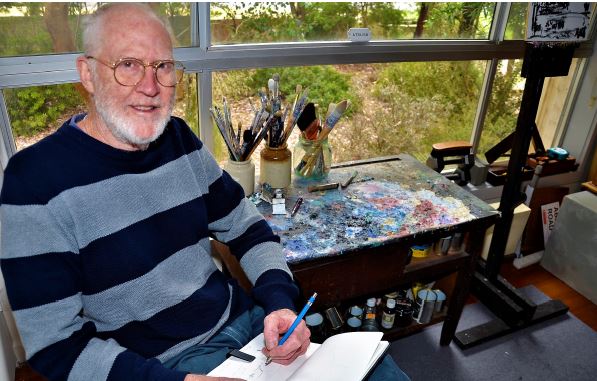
Eve: Does your arts practice conform to any particular genre and if so which?
Craig: None at all. All over the place, it depends on what interests me at the time. Over the past 45 years I have ventured through impressionism, abstraction, symbolism – wherever seems to be my sweet spot at the time.
Eve: How do you prefer to describe your artistic style?
Craig: For the past 20 years, since living in the south of France with my then wife Kendry, I have been heavily influenced by Romanesque art of the 10th-12th centuries. I like its pared back simplicity. Things are implied rather than spelt out. A stripping back of detail. Detail is a distraction from the essential, the important.
Eve: How did you come to art?
Craig: Art came to me – by magic. Nobody in my family had any interest in art. As a child, there were no original artworks on the walls, only those classic flying ducks – and ceramics. A friend of my mother’s gave me a small box of oil pastels. The glory of that rainbow of colours and the smell of those pastels remain with me. My eldest brother gave me a small set of oil paints when I was about 13 or 14. New smells of paint and turps. Hooked from thereon.
Eve: Which artists, current or historic, have influenced your own work?
Craig: Wow! As teenagers, I think we all fell in love with the French Impressionists. As I grew older, learnt more and travelled the world, I became more influenced by artists that looked inward rather than outward. Someone like Pierre Bonnard, the way he could paint a bowl of fruit as a spiritual journey, as with a Chardin still life study. Perhaps the master of all, Giorgio Morandi who found endless possibilities in a few bottles, vases and tins. When in Spain, I discovered Arshile Gorky. I was moved to tears by his intensely personal abstract paintings and drawings. Gorky himself used to say he was “with” Cezanne, or Picasso or whoever was his influence at the time. I feel like that also. Since my time in France, my main influence has been that of the great unknown and nameless artists of antiquity. Extraordinary sculptures, paintings, stained glass windows and architecture. Not the current “celebrity artists” of our time.
Eve: What is your medium/media of choice?
Craig: I pick up whatever seems to suit the idea. Painting, drawing, etching, sculpture. They all have a particular response.
Eve: What is/are your subject matter of choice? Why so?
Craig: Crikey. What takes my interest at the time. I do seem to come back again and again to some subjects. I have great empathy for people working the land. The hardships and the rewards of that. So, there are a lot of rural themes returning. Also, I am a sucker for heavy industry as well.
Eve: What are you working on at the moment in your current arts practice?
Craig: In September 2022 I had a small retrospective exhibition at Stephen McLaughlan Gallery in Melbourne to celebrate the 25 years that I have been showing with him. The Berry Consols works that were on loan to the Eureka Centre in Ballarat in 2021 will be touring to the Central Goldfields Gallery (Maryborough) in 2023. Currently, I am about to start a new series – still secret.
Eve: When you work do you like to play music?
Craig: Always have music when I am working. Always Baroque. Cello, viola. Sublime. Music never got any better in my book.
Eve: To date, what have been your career highlights as an artist?
Craig: Buggered if I know. It is always one foot in front of the other and don’t look back. I have works in the collections of the National Gallery of Victoria, the State Library of Victoria, the Shrine of Remembrance in addition to private and corporate collections. I did get a thrill though when I saw a drawing of mine at the NGV hanging between two heroes – Max Ernst and Paul Signac.
Eve: Do you have any unrealised artistic goals towards which you are striving?
Craig: In 2001 I had three exhibitions in Melbourne – at Stephen McLaughlan Gallery, at the Shrine of Remembrance, and at McClelland Gallery. At the time, I thought this was the launch of a great career. By the time my wife Kendry and I returned from France, all I could think about were the truly great anonymous archaic and medieval art works that I had encountered. There was no ego in those works. They were simply great. Now, I am just happy to make what I make. If someone else enjoys that, that is enough for me. However, it would be nice to see in print the children’s book Bonne Chasse! that Kendry wrote and I illustrated while we lived in France. There’s a dream still to come.
Eve: What do you think are the main challenges for practicing artists today?
Craig: The absolute terror of online ‘art’ markets. Picture framing, I see so much digital crap that is just wallpaper. Why would any person of sound mind buy something they have never seen in the flesh? Also, the generations that used to actually collect real art are now disappearing. They are downsizing their homes and their collections. The young ones have no art literacy and are buying digital garbage – very sad.
Eve: And the main rewards?
Craig: For the true believers, art-making is its own reward. What else would we do?