


March 7th, 2025Passions and possibilities for the Wombat: exhibition to open in Daylesford
An audio-visual exhibition exploring passions and possibilities for the Wombat Forest begins at Daylesford Museum this Saturday.
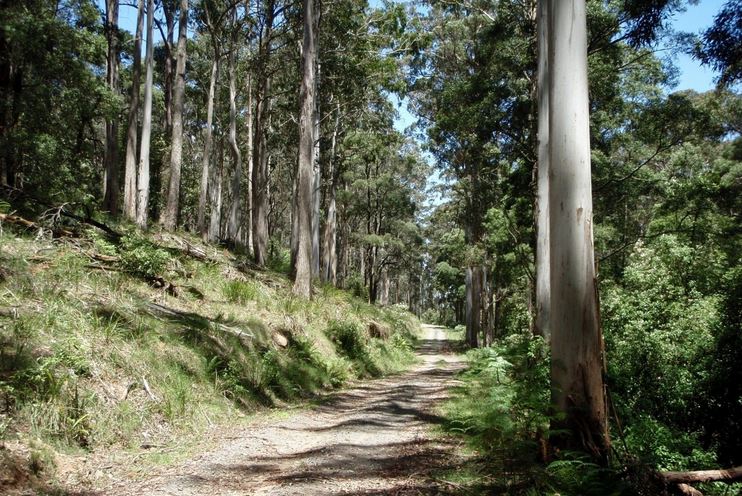
Framings of Wombat Forest is an audio-visual exhibition that also explores visions and tensions associated with the local and much-loved tract of forest.
From skink ecologists to bike riders, activists to cultural fire practitioners, the exhibition presents 11 photographic and audio “portraits”, each offering a unique frame through which to consider the Wombat.
Creators of this exhibition say they are “seeking to present different perspectives in proximity without attempting to draw conclusions as to the right way forward”.
“Rather, we invite you to spend time with the intimacy of each person’s framing of the forest, honouring the diversity of community and leaning into the exquisite messiness of what it means to feel connection to place in a changing world.”
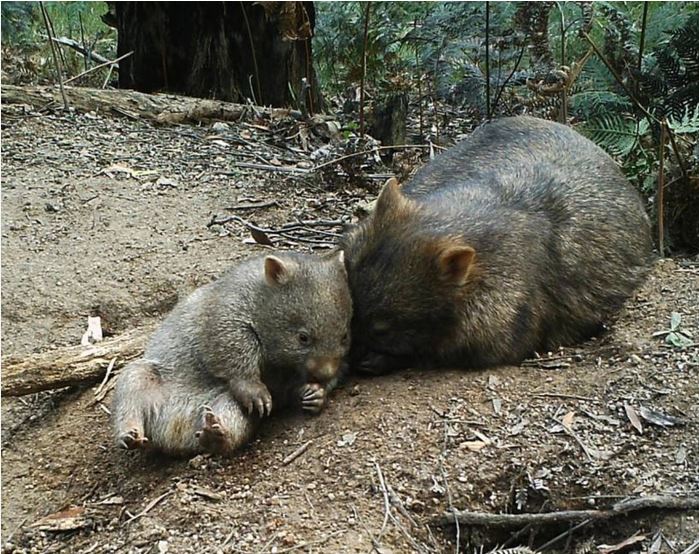
Those planning to check it our are advised to bring along a device and headphones to make the most of the exhibition which is being supported by the Hepburn Shire Council.
On 24 June 2021, the Victorian state government, following an extensive review and recommendation process, declerated that the Wombat State Forest would be added to the National Park register, providing it with additional protections.
Located between Woodend and Daylesford and covering approximately 70,000 hectares, the Wombat State Forest extends along both sides of the Dividing Range.
The Forest contains a diverse range of native plants and animals, including a number that are listed as rare or threatened, such as the Powerful Owl and the Wombat Bush Pea.
As well as these natural values, the Forest is a significant water catchment area, and contains the headwaters of the Lerderderg, Moorabool, Coliban, Campaspe and Loddon rivers.
A notable feature of Wombat State Forest is the extent of mineral springs which account for over 80% of Australia’s mineral springs. The mineral waters are rich in calcium, silica, magnesium, iron and sulphur.
- Exhibition: March 8-21 daily 10 am – 2 pm
- Opening event: Saturday March 15, 11 am
- Daylesford Museum, 100 Vincent Street, Daylesford.
May 23rd, 2024Bringing a 19th century wedding day beauty back to life

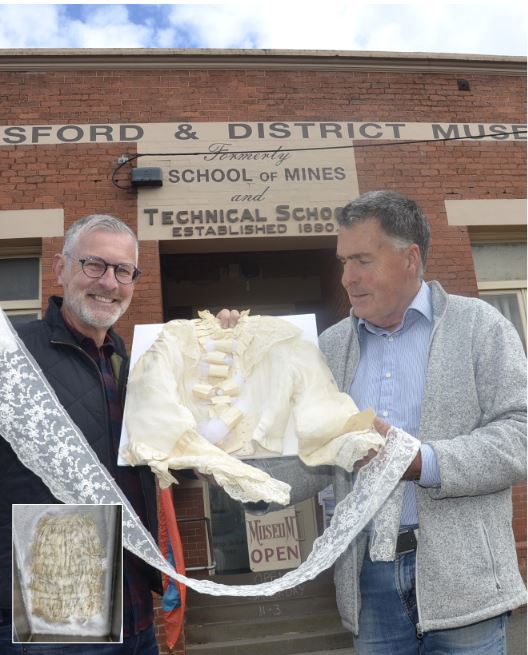
Qualified textile conservator Larry Edwards knows how to bring beautiful but time-worn vintage garments back to life and make them “talk”.
But when you’re talking a wedding dress made in the 1800s and stored for many decades, this is no easy process. One must really know their stuff as one false step could set the whole process back
– potentially irretrievably.
Right now this local expert in restoring and conserving valuable vintage textiles is midway through resurrecting a significant historic wedding dress held in the Daylesford & District Museum collection, ahead of its public exhibition later this year.
Museum curator Gary Lawrence says the beautiful historic dress was offered to the museum by the region’s Trewhella family.
The linen, cotton and silk tulle lace number was worn by Sarah Trewhella (nee Hosking) upon her marriage to Ben Trewhella on January 7, 1885 at her parent’s home in Simmons Reef.
For so many decades it had sat in a box, its considerable beauty fading with each passing year, but now, assisted by some funding through the Rosalind Pyers Memorial conservation support fund, the museum has been able to draw on Larry’s expertise to bring the glorious garment back to be publicly admired.
Larry has an extensive background in costume construction and had been working in the costume department with the Cirque du Soleil when Covid hit shutting down the circus’ big touring plans.
But Larry made good use of lockdown, using the disruption to the circus’ touring plans to take on masters studies in conservation of cultural materials, specialising in textiles, through Grimwade Conservation Services at University of Melbourne.
“As part of this I needed to complete a thesis so I asked to do one based around a significant assessment of the textile collection held with the Daylesford Museum,” says Larry who is also a volunteer with the local museum.
“(Fellow museum volunteer) Judy Files and myself both worked for over a year. We went through every box and categorized, catalogued and photographed every item… 1011 textile items. It was a wonderful project, an incredible collection.”
Items in the museum’s textile collection chart the decades and fashion eras from early European settlement of the area and the 1800s. They range from miners’ boots, which still had dirt from the gold rush era embedded in them, to beautiful silk wedding shoes, and from rare yesteryear men’s uniforms to a notable assemblage of Victorian ladies’ parasols.
All have a tale to tell, says Gary who is keen to see many of those stories shared
and made known.
Now Larry has not only completed his masters degree but the museum has a beautifully catalogued textile collection of remarkable historic clothing and textile accessories that can now be readily sourced for any exhibition they may relate to in the future, Gary says.
As the museum eagerly anticipates this June for the conclusion of a protracted major upgrade works project, it is planning three exhibitions beginning with a Daylesford Ceramics Collection exhibition over the June long weekend, Gary says.
Beyond that, the museum is looking to stage an exhibition celebrating winter in the gardens with Friends of The Wombat Hill Botanic Gardens.
Finally, an exhibition focussing on the collection of special occasion garments is envisioned for September with the painstakingly restored Trewhella wedding dress a highlight.
Larry says that already at least 50 hours have gone into the restoration of the vintage garment with the process to date focussed on assessment and cleaning, an arduous process involving pH analysis and washing separate parts of the garment with different treatments according to the fabric they’re made from.
The treatments that Larry has used to bring the gorgeous garment back to life are now set to be among those detailed at the Textile Conservation symposium at the National Gallery of Victoria on June 27.
“This dress was very thirsty. It had been in a box and folded into three. It had to be humidified first just to get it sitting straight,” Larry says.
The dress’ skirt is linen, its bows and accessories silk, its top cotton, and it features silk tulle lacework.
The garment also features a bustle which required specific analysis to restore to its former glory, while missing lace from elsewhere in the garment had to be carefully matched and replaced using lace imported from a company in the UK that still produces lace and trim made using original machines of the 1800s.
“My challenge now are the sleeves,” says Larry who’s anticipating “at least” a further 50 hours of very detailed work ahead to bring the dress up to a point where it’s ready to go on public display.
The fact that Larry is a man who loves what he does is revealed in the way he refers to the item he is working on.
“She has had five baths,” he says, admitting that the dress has revealed “herself” to have a character all her own and a story to match.
“This is a Victorian era dress, Queen Victoria’s era. I can tell she has been made by someone on a very early treadle machine. She was not made in a couture fashion house. The lace would have been imported.”
As the restoration progresses, Gary and the Daylesford and District Historic Society’s dedicated team of volunteers that run the not-for-profit museum are keen to share the story right through to “the big reveal”. So watch this space…
Words: Eve Lamb

April 25th, 2024Heritage listing for Daylesford’s old school of mines building

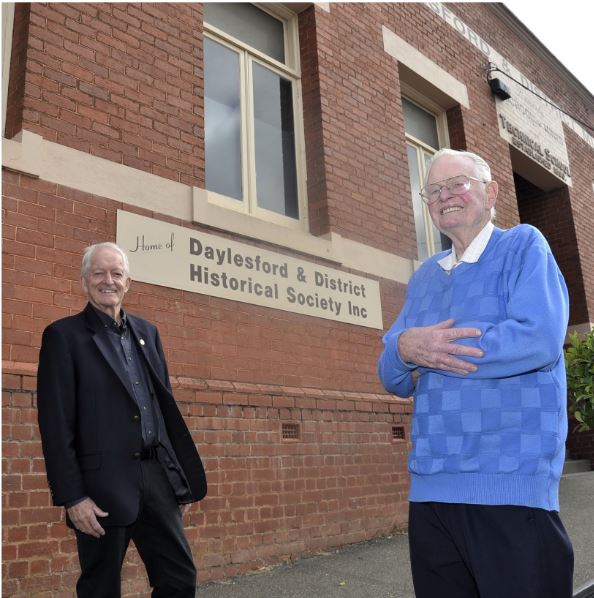
The recent inclusion of the Old Daylesford School of Mines building on the Victorian Heritage Register has significant positive implications for the future of the building.
It means that the building that now houses the town’s museum will be able to attract crucial funding through Heritage Victoria for maintenance works into the future.
It also recognises the significant place that the 1890s brick building at 100 Vincent Street occupies as part of the state’s mining and education history.
The nomination was lodged by the former Daylesford Museum Reserve Committee of Management back in 2019.
Its successful listing on the register was confirmed in February this year providing much cause for celebration particularly among locals who played a key role in lodging the nomination.
Former Daylesford Museum Reserve Committee of Management chair Ken Warren is among them and delighted with the result. He notes how rare and difficult it is to have such a nomination succeed.
“We’re very, very fortunate to get this up on the register,” Mr Warren said.
“Everybody worked so hard to get there.”
Mr Warren says the listing has major implications for the ability of the current and future committees of management to attract ongoing funding required for upkeep of the building.
“It also preserves well into the future the building as significant for the shire and the state so it doesn’t disappear,” he said.
“Lots of places disappear because people don’t appreciate their sense of significance.
“This listing mean there is a sense of permanence and a line of funding into the future and it makes it even better as a site for the museum.”
Current repair and upgrade works are continuing on the building that today houses two much loved cultural institutions, the Daylesford and District Historical Society and the Daylesford Community Brass Band.
The museum building dates back to the early 1890s when it was used by the School of Mines to teach classes on science and art.
The building retains many of its original features including one of the earliest and most intact School of Mines laboratories and metallurgical laboratory interiors in Victoria.
The Victorian Heritage Database Report associated with the new listing notes that the School of Mines is historically significant as a forerunner of the technical schools that were a key part of the state’s education system for many decades.
The database records that: “The Daylesford School of Mines is architecturally significant as it retains a combination of fine features that are characteristic of an early technical school – roof lanterns for daylighting, distinctive brick assay chimney, furnaces, fume cupboards, and 1890s joinery”.
The old Daylesford School of Mines comprises the laboratory building with chimney and the art department building dating from 1890, and the technical school addition of 1914.
Local resident Graeme Orr was a student at the technical school in the late 1940s and the 1950s and said he was delighted to see the building gain heritage listing.
“I think it’s wonderful,” said Graeme who attended school there from 1949 to 1951, starting at the tender age of 12.
“This is really exciting as there are not many Daylesford buildings on the State Register,” says Heather Mutimer who was secretary with the committee of management that lodged the successful application for listing.
“A lot of work went into the nomination and was underpinned by the completion of a detailed Conservation Management Plan,” Heather said.
Words & Image: Eve Lamb