


October 29th, 2023Glen, about the house
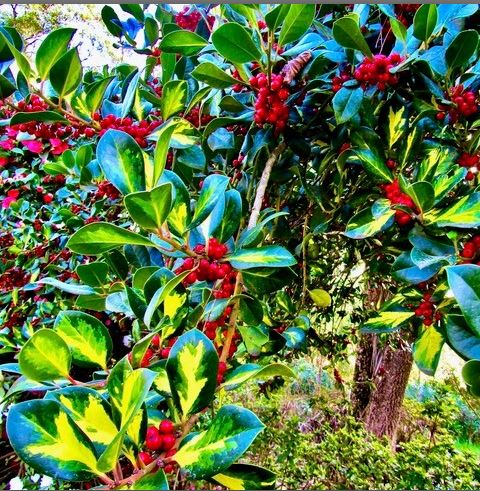
the variegated ilex altaclerensis family, thriving at the Wombat Hill Botanic
Life with El Niño
In normal years we usually expect days of rough and windy November weather. So who can tell what this year will bring? Apart from broken branches caused by the sheer force of the wind, many plants suffer splits and abrasions from being battered against buildings and fences.
Fractured, split and weakened branches should be completely removed or cut back to a point of healthy wood. Dead wood should be removed completely.
You will probably notice that the twine or string used to secure fragile branches to
stakes or other supports has caused rubbing or chafing during strong wind. It may be
necessary to remove any badly affected branches.
Less damaged ones will benefit from a dressing of pruning mastic – sterilising paint or petroleum jelly over their scrapes and cuts, to seal the wounds and aid the healing process.
Old pantyhose are one of the best materials for tying up plants as they do not
cause chafing and their resilience allows some natural movement in the plant.
Young trees, particularly in heavy, sodden soils, may have been blown about so
that their roots have been damaged and the tree now rocks. Look carefully to see if
your young plants need staking, or perhaps, even restaking.
It’s far better to use three evenly spaced stakes around plants, than just one. With a loop that passes from each stake and around the main stem, allowing about 5cm of movement each loop, the tree is able to move minimally and will be almost self-supporting.
Usually trees completely supported by a single stake placed right up to them become totally reliant on that stake and likely fall over if the stake is removed. That’s if the stake itself hasn’t become loose and floppy.
Water the key to success
Gardens can be damaged as much by incorrect watering as they can by lack of it. Fresh green lawns and lush, healthy flower beds can be maintained year long, even through times of drought, by regular feeding and maintenance. It is the way the garden has been watered that holds the key.
Prolonged hot weather can place plants under great stress if the moisture supply
isn’t kept up to their feeder roots, but the problem isn’t necessarily lessened in the
cooler months if the plants aren’t being watered correctly. The first point to remember
is that it is the root system that takes in the water supply for the plant, so there is little
point in supplying water anywhere else but on the ground.
Drip watering systems are most successful because they supply all of the plant’s
needs directly to the roots, and use less than half of the amount of water needed for a
sprinkler or hand-held hose to do the same job.
Thorough watering is best as it encourages deep, strong and self-sufficient roots. A heavy watering once or twice a week – depending on the weather – is far better than frequent surface waterings that encourage developing root systems to grow close to the surface in anticipation of the next supply.
It is best to water early in the morning so the moisture can soak in before the sun’s drying rays can take effect. This is even more important in the heat of summer. If you are using sprinklers, much of the water will have evaporated before it reaches the ground.
Even more importantly, If you are using sprinklers, watering in the evening or
night builds up humidity in the lawn and garden beds and aids in the spread of
fungal disease. Gardens Got a gardening query? Email glenzgarden@gmail.com
October 16th, 2023Glen, about the house…
El Niño
The pundits were right, El Niño is back, along with ‘his’ increased risk of drought, heatwaves, bushfires and coral bleaching.
Recent past events have resulted in warmer than average temperatures across most of the south of the country and in eastern Australia, where nine of the 10 driest winter/spring periods on record were during El Niño years.
And most of the major droughts, including in 1982, 1994, 2002, 2006 and 2015, coincided with El Niños.
Because of reduced rainfall and those temperatures, the risk of a significant fire danger season is much higher after an El Niño year, according to the BOM. Previous examples of this occurred during the summers of 2002-03 and 2006-7. So it’s only reasonable to expect 2024 will be no different.
El Niño has a profound influence on our climate – lower rainfall and higher daytime heat – boosting the chance of risky bushfire seasons.
This one is expected to last until late summer or early autumn. At a press conference to announce the likelihood of El Niño, the Bureau of Meteorology’s Dr Karl Braganza said it would be up to individuals and communities, particularly in the nation’s south-east, to prepare for a summer of fire and heat hazards, but he added that the landscape was not as dry as it had been leading into the catastrophic fires of 2019 and 2020.
Days are hotter on average during El Niño years, especially in southern Australia, due to decreased cloud. In Australia’s south, high-pressure systems move around more during an El Niño, which actually reduces the chances of prolonged warm periods even though overall average temperatures remain high.
But the decrease in insulating cloud cover during El Niño can mean colder nights, increasing the risk of frost damage to crops and gardens already weakened by lessened rainfall.
Drought proof your garden
Start with the ground up as it all begins with a healthy, happy root system. After all they are the plant’s engine room and not just to keep the plants upright but ingenious pumping systems distributing moisture and nourishment throughout the whole plant.
Drought proofing your garden starts with the soil. So improve its structure by adding plenty of organic matter in the form of compost and aged manures, and working it in to the topsoil by forking or digging it over to improve air and water penetration.
Make sure every drop reaches the plants by watering directly onto the soil around their root systems – and the most efficient is by slow, inexpensive and evaporatio-free
trickle hose.
You can hide the hose under a good, thick layer of compost or gravel. Every single drop goes directly to the plants and there’s no wastage. We now have our whole garden covered by a network of inbuilt dripper, plastic hose. Reduce moisture loss from the soil (evaporation), by adding a thick, insulating layer of mulch.
Watering the foliage may cool the plants down briefly after a hot day but it could also encourage fungal problems to develop. Besides, water droplets on some soft leaves may cause burn spots if the heat of the sun is amplified, resulting in the leaves being scorched or burned.
Any of your likely to be heat-affected, pot-grown plants that might suffer from a spell of sunstroke should be moved to a cooler, shady spot at the first sight of wilting. To sum it up, water the roots, not the leaves. Got a gardening query? Email glenzgarden@gmail.com