


June 8th, 2024Woman of vision: meet videographer Nadine Jade

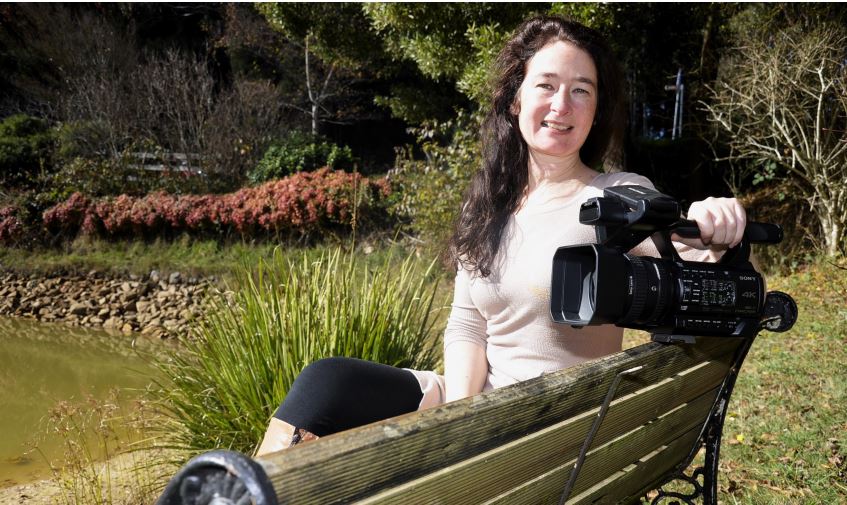
After many years of paying her dues in the competitive world of professional video production, Bullarto’s Nadine Jade has reached the stage where she can finally choose which projects to accept.
It’s a position many in this hard-to-crack field would envy – but it’s been hard-earnt.
Nadine’s chosen path emerged early, while still at high school in Ballarat when she started studying photography and then video production.
“When I was in year 10 I discovered the dark room. It was the mid-90s so it was still film and analogue VHS editing,” she says.
“I found I loved capturing people. Then I discovered video and the Mount Clear High School at Ballarat was very well equipped with a TV studio and editing suite so I learnt how to properly produce videos from about the age of 16.
“Then I started to do pro shoots in crews and make music videos. When it went to digital I was in my early 20s and I taught myself digital editing… I love editing. Turning beautiful shots into a coherent story.
“When I was 22 I started working in the industry as a video editor in Prahran.”
Creating video is a passion as well as a profession for Nadine who has just produced a video telling the story of artist and musician Monty Osewald, a colourful Daylesford character with an eventful life story.
Nadine’s new Monty Osewald, Artist video began to take shape after Monty himself checked out her work and, duly impressed, commissioned her.
The resultant production has been enjoying a public audience at The Convent gallery in Daylesford, complementing Monty’s own most recent art exhibition that’s been staged there.
“It covers his whole life and Monty gave me a lot of background photos and artwork and the soundtrack also features his own music and also music by other local musicians,” Nadine says.
“Monty is just one of those people who is always evolving, producing new art and music. He is more modern than I am in a lot of ways even though he’s been on the earth for longer.”
Nadine says being asked to make Monty’s biographical video-doco was an honour, and after some 300 hours of work on it, she says it’s still not quite done.
“It’s about 98 percent finished.”
Nadine says she just wants to add a little more historic detail before declaring the video 100 percent done and ready for online release.
It’s just one in a suite of current projects for Nadine Jade Productions, Nadine’s business that specialises in video production including biographical documentary, music video and corporate work.
But Nadine has also worked on feature and short films including a notable film short that’s soon to screen as part of the St Kilda Film Festival.
This is The Job by award-winning director Tatiana Doroshenko. Nadine worked as assistant director for The Job that will feature as part of the opening of the St Kilda Film Festival on June 6.
Nadine also worked on a feature film, a thriller, shot at Glenlyon in 2021 and expected to be released later this year.
But next on the immediate horizon is a music video being made with a local band in Daylesford. This project is a little hush-hush just now but sounds pretty exciting while Nadine’s prior music videos can be checked out on YouTube.
As the mother of two teenagers, the local videographer says she generally complements her creative professional income by also working in hospitality , currently at popular local watering hole, the Radio Springs Hotel.
But despite the imperatives of parenthood, as a mature-age student Nadine made the time to also complete studies in screen and media study though RMIT.
“At the moment I’m the busiest I’ve ever been with video work,” she says.
“People want me to do the work and I’m finally at the stage where I am able to choose which projects I take on … and which I don’t . I want my video work to feel enjoyable.”
A fan of Danish film director and screenwriter, Lars von Trier, with a particular liking for psychological drama, Nadine says one personal goal remains to write and direct a short to target the St Kilda Film Festival.
“I have a couple of screen plays that I’ve written and I’d love to have something I’ve directed to enter into the St Kilda Film Festival. I feel like that’s the next step,” she says.
“Everything I create I write, shoot, direct, do the sound, edit. That’s what I love to do. You never know what job comes next … and I kind of like that.”
Words: Eve Lamb

June 7th, 2024A solid day’s work: the dry stone waller’s art

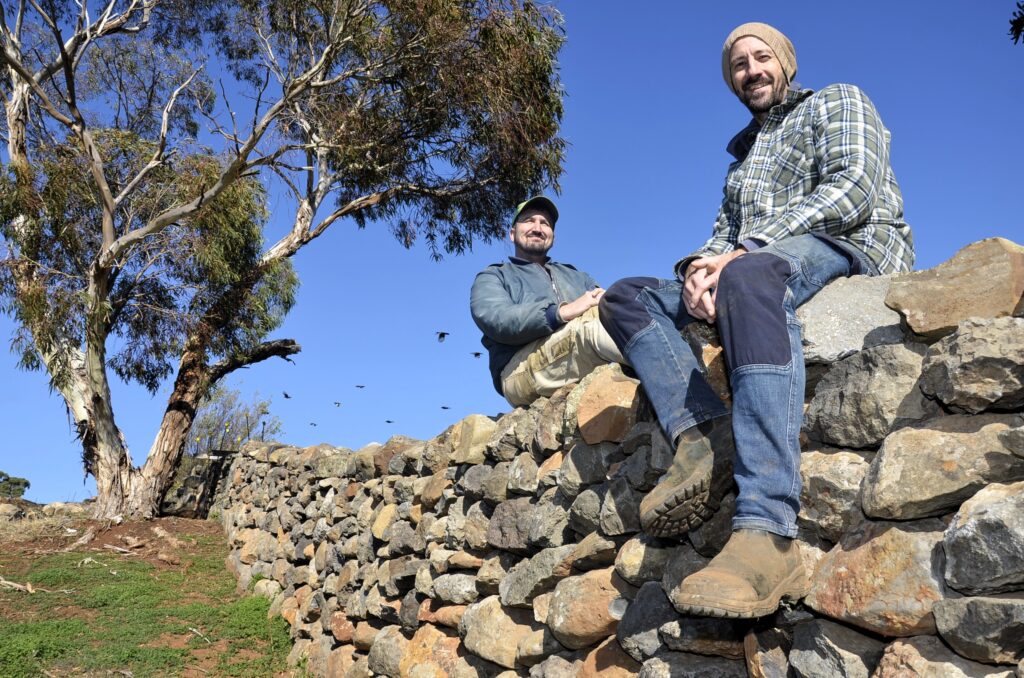
Hepburn Springs local Jim Milesi reckons he may well be Australia’s only professional speech therapist who also works as a dry stone wall builder.
It’s a part-time occupation that lately his brother, Vince, is also enjoying.
The Milesi brothers are currently working to restore a 30-metre stretch of an extensive historic dry stone wall on the private property of Trefor John and Tina Winzar at Elevated Plains just out of Hepburn Springs.
Running alongside the Hepburn Springs-Newstead Road, the wall is understood to be about 130-140 years old and one of many built by the area’s early Swiss-Italian immigrants who include the Milesi’s own forbearers.
“This is a dream job,” says Jim whose love of the time-honoured art of dry stone walling started way back in childhood on the family’s Hepburn Springs property.
“We had some dry stone walling on the family property and I always liked it and started mucking around with it then,” he says.
Much later in life, while working as a speech therapist in Kyneton about six years ago Jim noticed a man building a “beautiful dry stone retaining wall”.
This observation would lead to him furthering his own dry stone walling skills by working alongside Evan Pierce, a renowned dry stone wall builder with Kyneton Dry Stone Walling.
“Every day was a master class with Evan,” says Jim who recently launched out independently as a part-time dry stone waller.
“I’ve been doing it for a long time but up until the last few years years I didn’t think I’d ever get paid to do it,” says Jim who’s also travelled to northern Italy and furthered his dry stone walling skills there as well.
For the current project Jim has been joined by brother Vince who has an equally surprising professional background for a dry stone waller – voice acting.
Many will have caught the television series Kitty Is Not A Cat for which Vince provided various cartoon cat voices, among his myriad other projects in the arts sector.
Currently taking a break from city life Vince is clearly enjoying working as a part-time dry stone waller as well.
“At the moment I’m enjoying a different pace of life and taking on new skills,” Vince says.
Jim says the stretch of wall that they’re working on at Elevated Plains continues the restoration of the wall started several years ago by accomplished dry stone waller, Josh Bowes.
“Dry stone walls are amazing,” Jim says.
“They provide a microclimate for lizards, birds, even bats. There is no mortar. They’re free-draining and, as a retaining wall, if they’re built property, they’re the best.”
To restore the historic wall on the Elevated Plains property they’re sourcing the material – natural stone – from the site itself.
It’s physical work – pretty much a “full-body work out” – but it’s also good for the mind as well says Jim who has now built walls in locations including Yandoit, Daylesford, Buninyong and Rockbank, with local councils increasingly keen to conserve their unique heritage value.
“The concepts are simple. There’s not a lot of technical things to remember,” he says.
“I love them. In a sense this is a building form that hasn’t changed in thousands of years.”
With a fair bit more of the current wall to be restored beyond the 30-or-so metres that they’ve been engaged to work on, Jim says that if the property owners are happy for them to keep going he’d jump at the chance to take on more of this age-honoured art form that he loves.
“It will teach you patience. It will teach you humility,” Jim says.
“I appreciate that it’s almost thrusting mindfulness upon you. You can’t really be worrying about other things when you are thinking about what you’re doing on the wall.”
Property owner Trefor John says there’s probably about a kilometre of walls on the block, “some very dilapidated and some almost intact”.
“We’d love to restore it all but, realistically, time and funds are the limiting factors,” Trefor says.
“We’ll do what we can with what we’ve got. A drystone wall is a thing of beauty. A dilapidated or damaged wall is a sad thing.”
Jim says he could talk about the art of dry stone walling all day, and is often in luck on this front as quite a few appreciative and observant passers-by have stopped for a chat.
“I’d encourage anyone who sees us to come and say G’day,” he says.
Words: Eve Lamb
June 6th, 2024Islands in a stream of public opinion

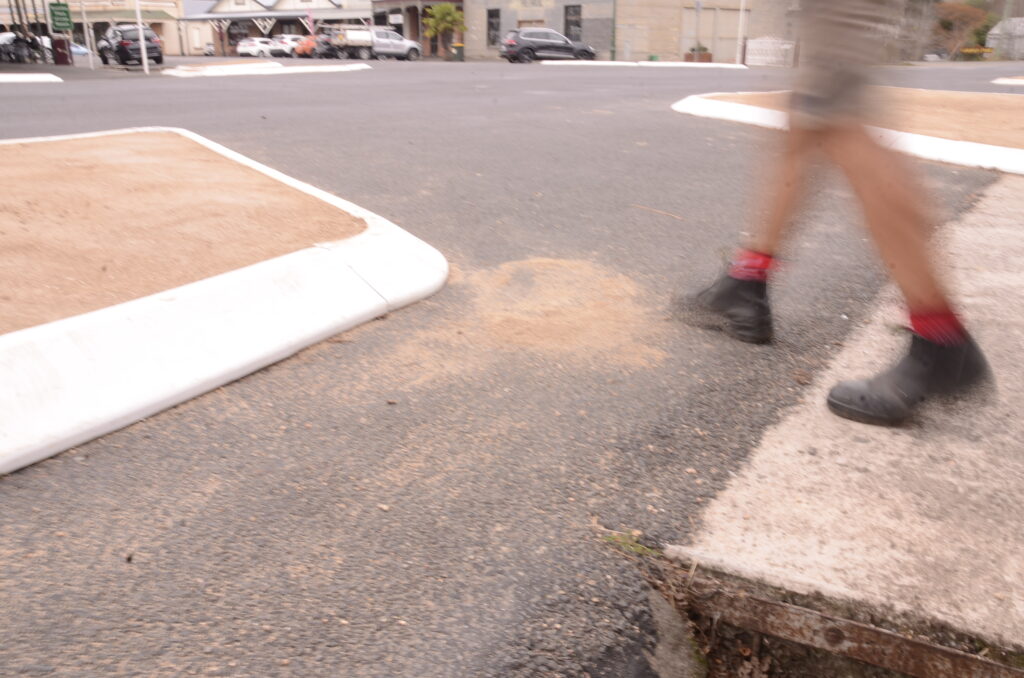
Prompting plenty of public opinion, the current trial of pedestrian islands at the intersection of Fraser and Service Streets in Clunes will continue through to August 4 the Hepburn Shire Council says.
The trial has been inspiring plenty of conversation and mixed responses from the community which will have the opportunity to formally provide input, with the council planning to call for feedback in response to the trial in July.
The council says that if there is strong support from the community for the pedestrian islands, it will look at options for upgrading to a permanent solution in future budgets.
If there is little support for the pedestrian crossing, the area will return to its previous layout with no affect to the area, the council says.
Installed last month, the “pin down” islands form refuge points for pedestrians attempting to cross the road and follow calls for a safer pedestrian crossing in the township, the council says.
The trial is part of the council’s wider Clunes Streetscape project with new streetlights at the pedestrian crossing, on the supermarket and creek side of the intersection also planned to improve safety there.
The pedestrian island trial has drawn criticism from some like local resident Kate Edwards who, in a letter to The Local pointed out that there had been no recorded fatalities to date, and rating the traffic islands as a blight on the town’s wide historic streetscape
“Despite no reports of people being run over in town they (the council) have to act on the perceived danger spot and … Clunes (has) received some very ugly, brightly painted traffic islands at the main entrance to our famous, historic, widely photographed streetscape,” Ms Edwards said.
“The council says they are only there for a trial period. I assume that if there are no pedestrian fatalities in the next six months, they will be deemed successful and stay, regardless of the fact there were no fatalities before they arrived.
“There is also now the added pressure of a catch22 situation where if they are removed due to public outcry, some silly human will decide to get hit by a car and sue the council for removing them.
“Our town’s lovely deep death-trap gutters and all those unmaintained shop verandas will be the next to go and don’t forget to chop down all the trees that might fall on us. Be careful what you wish for!”
But others believe the trial is warranted with pedestrians often left confused as to the safest crossing point at the intersection, and reports of occasionally erratic and unpredictable driving at the site, one of the busiest in Clunes.
Local councillor Tessa Halliday was among many to delve into the issue in social media posts stating: “if the community finds this helpful in achieving better pedestrian safety then they will replace these with permanent outstands that suit the heritage streetscape. Likely the concrete would be bluestone edging or the like.”
“I think it is worth seeing what is possible and what we can live with in order to keep our most vulnerable community safe,” Cr Halliday said.
Words & Image: Eve Lamb
More information was available at https://participate.hepburn.vic.gov.au/clunes-crossing

May 27th, 2024Walks of the Central Highlands

with Eve Lamb
Tipperary Track, Daylesford – Tipperary Springs to the Blowhole via Bryces Flat and return (8.6km)
‘One day,’ I’d always thought, while driving past the Twin Bridges picnic area on the Midland Highway just out of Daylesford.
Well today was the day. Sort of…
A preliminary reconnoitre visit revealed an officious little sign, instructing that The Tipperary Track between Twin Bridges and Tipperary Springs was currently closed. Although I could see folk – and their dogs – enjoying this “closed” section of the track that I had in mind to explore, I decided discretion was needed.
Afterall, the beauty of Daylesford’s Tipperary Track (total distance 16km from Lake Daylesford to Hepburn Springs) is that you can divide it neatly into sections.
So, with Paddy H along for company on a recent sunny Sunday, we set out to sample the section of the Tipperary that follows Sailors Creek, starting at Tipperary Springs and continuing on to Bryces Flat (3.3km) … then a further 1km to The Blowhole, making a leisurely 8.6km the round trip.
Driving first to the Tipperary Springs picnic ground, (via the Midland Highway and then Tipperary Road) we first spent some time appreciating this beautiful little spot and Paddy H struck up a conversation with a man filling multiple bottles at the spring.
“Been drinking it all my life,” the man said, exuding good health.
Paddy H sampled some of the water. “Try it,” he suggested. “This one tastes good.”
Promising I would, later, we set off following the footpad that runs along the western side of Sailors Creek, and quickly affords very pretty views, from surprising elevation, down over the creek.
Stone relics from the 1800s mining days are visible along the way, and after 3.3 km Bryces Flat made a great stop for a creek-side lunch.
Paddy H struck up a conversation with a young man who was busy fossicking for gold in the creek.
“Found anything mate? Paddy H enquired.
The dude had. Some tiny, weenie little flecks of gold and also some garnets which he said he planned to “facet”.
Later, following this exchange, I thought it prudent to do a bit of research to determine the legalities around fossicking for gold in the Sailors Creek, and was relieved to find that: “Fossicking for gold is permitted along Sailors Creek – all adults must hold a current Miners Right to engage in fossicking”.
Fully caffeinated after our lunch stop, we continued on, crossing over the Bald Hill Road creek ford and resuming the walking track on the eastern side of the creek, after following the road uphill, and to the left, for a very short way, passing a house in the process.
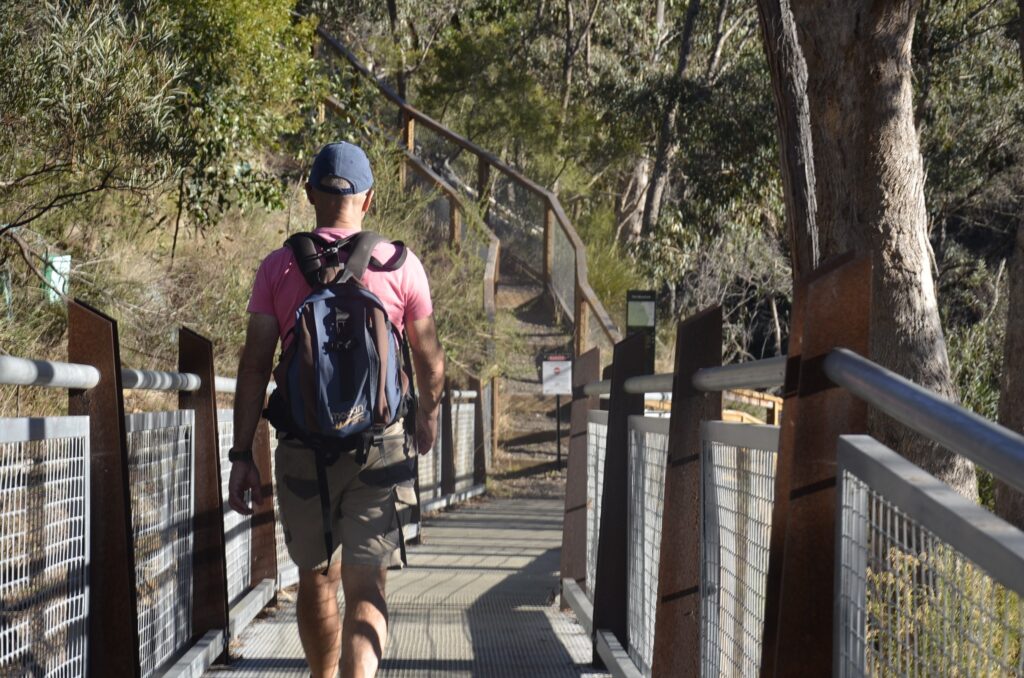
A really lovely bushland kilometre further on we arrived at the Blowhole which features a newish boardwalk and lookout from which a beautiful view down over a tranquil pool below well rewarded the effort made to get here.
But to appreciate said Blowhole it was necessary to walk down to the bottom of the steps here, and then look up from which point this man-made diversion tunnel was suddenly evident.
At the top of the boardwalk section signage had offered a potted history of The Blowhole Gold Diversion Tunnel which is listed on the Victorian Heritage register for being both historically and scientifically important.
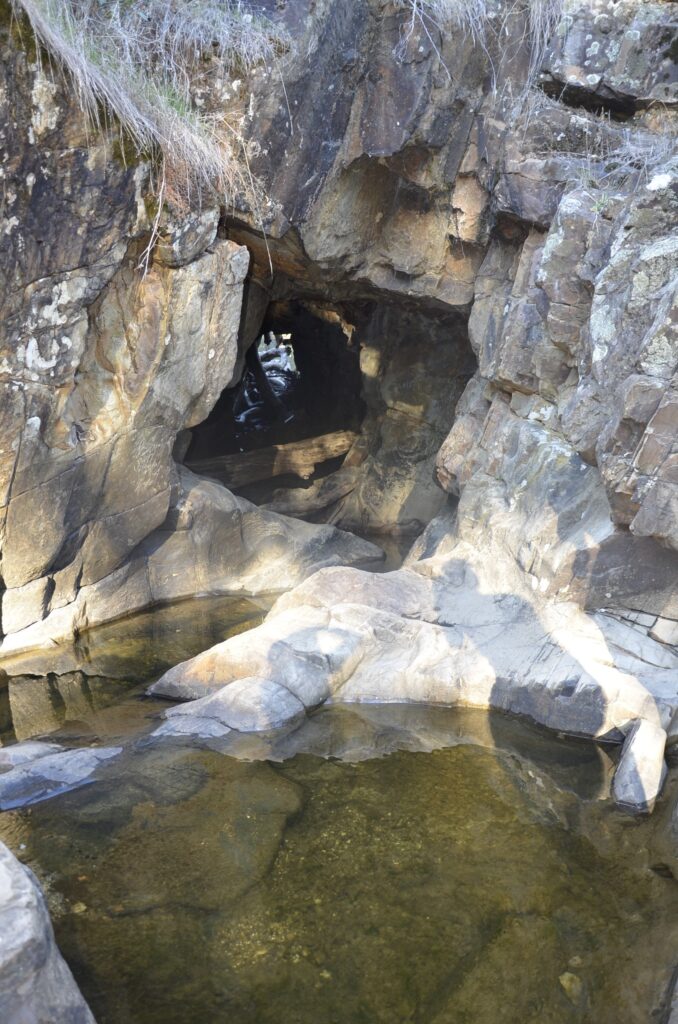
The tunnel was created by the diversion of the creek and estimated to have been built in the early 1860s when the area was being extensively worked by European and Chinese miners.
It was used to divert the creek waters, cutting off a section of the original creek alignment and enabling the resultant dry creek bed to be extensively worked by the gold-smitten.
A 2005 photo included as part of the signage shows the tunnel after heavy rain, and it is an impressive sight.
After lingering at this beautiful and history-rich landmark for about half an hour, we then retraced our steps, well pleased to have finally explored some of this great local walk and already looking forward to sampling some more of it into the future.
One word of warning, though: take care to watch your step on the Bryces Flat-Tipperary Springs path as the drop-off is both steep and very close to the edge in places.
Words: Eve Lamb
May 26th, 2024 The untold story of William Shum: biography of an early influencer
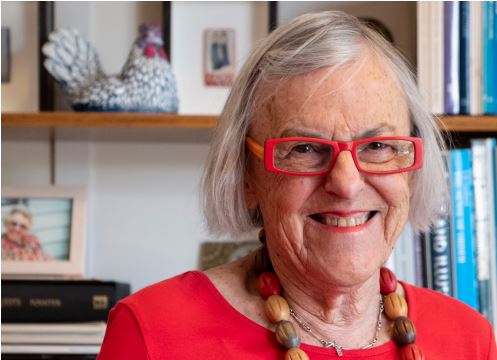
Way before social media influencers were a thing, the way we lived was subtly shaped by talented individuals like colourful yesteryear influencer William Shum.
Shum was founding editor of The New Idea and Australian Home Beautiful magazines and his progressive approach played a significant role in shaping and colouring the way Australians of the day lived their lives.
Now, former Daylesford local, arts doyen Sue Walker, who happens to be Shum’s grand-daughter, has released her second major book, The Untold Story of William Shum, a biography of her talented grand-dad.
William Arthur Somerset Shum (1875-1961) was a pioneer in Australian magazines at a time when they were a powerful influence on the way people lived. At the helm of these exciting publications, he came into people’s homes every month for 43 years, from 1902 to 1945.
Shum led his readers through a time of great change and encouraged people to break with traditional thinking about their homes and gardens and be open to ideas, particularly the modernist movement.
Australia, as we know it today, was taking shape, and Australian Home Beautiful and New Idea were leading the way.
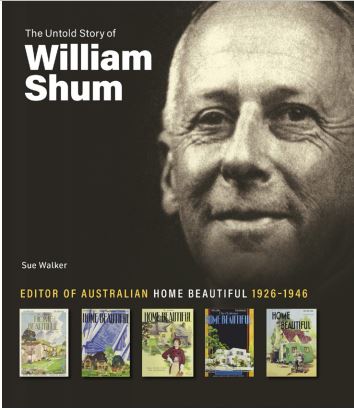
However, not one to seek personal acclaim, Shum was happiest writing stories as a journalist, capturing people’s daily lives in photographs and working in the editorial role where he loved the creative challenges it presented.
“He was editor but he was very happy being behind the scenes. He brought it all together,” Sue said.
“He was was also great believer in women having many opportunities. He was a great fun character. He was a larger-than-life character in my life. He was a fantastic photographer with a very impressive informal approach.”
Fascinated by new ideas he was ahead of his time in many ways, frequenting the clubs and societies of bohemian Melbourne where his friends included important artists and literary figures of the day.
Sue said that writing her grandfather’s biography has taken her “a good ten years” and included working with the support of a creative fellowship with the State Library of Victoria.
“I also wrote quite a lot of the book also while living in Ballarat,” she said.
With a significant background in the arts sector, Sue is well known in Daylesford from the time when she previously lived and worked here.
While Sue now resides in Fitzroy, many Hepburn Shire residents will remember her from her time she worked with the Visitor Information Centre, and from her time chairing the Hepburn Shire’s public art committee.
Sue is the oldest of William and Edith Shum’s eight grandchildren and obviously inherited quite a lot of her grandfather’s creative tendencies.
She is the founding director of the Australian Tapestry Workshop, a collaborative studio involving artists, weavers, architects and clients working together to create major works of public art.
Sue was responsible for the production of more than 350 tapestry projects including monumental commissions such as Arthur Boyd’s Reception Hall tapestry for Australia’s Parliament House, the Federation Tapestry at Melbourne Museum, and a number of tapestries now hanging overseas.
Clearly not one to rest on her laurels, Sue hinted that she is already fairly well entrenched in research toward another book, this time focussing on the other side of the family.
The Untold Story of William Shum Editor of Australian Home Beautiful 1926-1946 is now available in major bookstores including Collins Bookstore in Lydiard St, Ballarat.
Words: Eve Lamb. Images: Supplied
May 23rd, 2024Bringing a 19th century wedding day beauty back to life
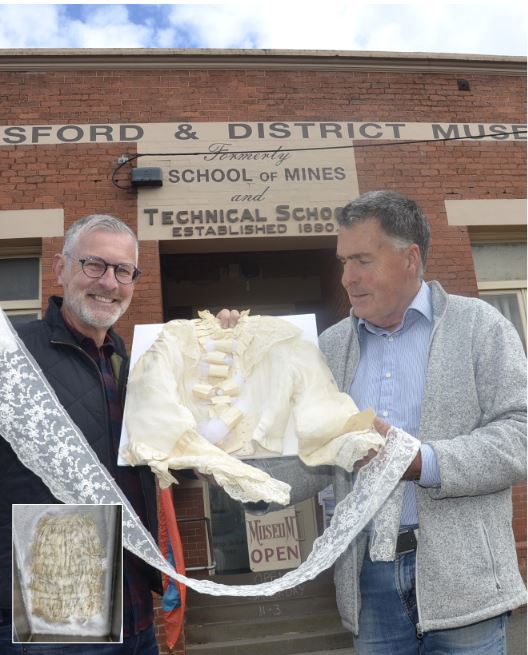
Qualified textile conservator Larry Edwards knows how to bring beautiful but time-worn vintage garments back to life and make them “talk”.
But when you’re talking a wedding dress made in the 1800s and stored for many decades, this is no easy process. One must really know their stuff as one false step could set the whole process back
– potentially irretrievably.
Right now this local expert in restoring and conserving valuable vintage textiles is midway through resurrecting a significant historic wedding dress held in the Daylesford & District Museum collection, ahead of its public exhibition later this year.
Museum curator Gary Lawrence says the beautiful historic dress was offered to the museum by the region’s Trewhella family.
The linen, cotton and silk tulle lace number was worn by Sarah Trewhella (nee Hosking) upon her marriage to Ben Trewhella on January 7, 1885 at her parent’s home in Simmons Reef.
For so many decades it had sat in a box, its considerable beauty fading with each passing year, but now, assisted by some funding through the Rosalind Pyers Memorial conservation support fund, the museum has been able to draw on Larry’s expertise to bring the glorious garment back to be publicly admired.
Larry has an extensive background in costume construction and had been working in the costume department with the Cirque du Soleil when Covid hit shutting down the circus’ big touring plans.
But Larry made good use of lockdown, using the disruption to the circus’ touring plans to take on masters studies in conservation of cultural materials, specialising in textiles, through Grimwade Conservation Services at University of Melbourne.
“As part of this I needed to complete a thesis so I asked to do one based around a significant assessment of the textile collection held with the Daylesford Museum,” says Larry who is also a volunteer with the local museum.
“(Fellow museum volunteer) Judy Files and myself both worked for over a year. We went through every box and categorized, catalogued and photographed every item… 1011 textile items. It was a wonderful project, an incredible collection.”
Items in the museum’s textile collection chart the decades and fashion eras from early European settlement of the area and the 1800s. They range from miners’ boots, which still had dirt from the gold rush era embedded in them, to beautiful silk wedding shoes, and from rare yesteryear men’s uniforms to a notable assemblage of Victorian ladies’ parasols.
All have a tale to tell, says Gary who is keen to see many of those stories shared
and made known.
Now Larry has not only completed his masters degree but the museum has a beautifully catalogued textile collection of remarkable historic clothing and textile accessories that can now be readily sourced for any exhibition they may relate to in the future, Gary says.
As the museum eagerly anticipates this June for the conclusion of a protracted major upgrade works project, it is planning three exhibitions beginning with a Daylesford Ceramics Collection exhibition over the June long weekend, Gary says.
Beyond that, the museum is looking to stage an exhibition celebrating winter in the gardens with Friends of The Wombat Hill Botanic Gardens.
Finally, an exhibition focussing on the collection of special occasion garments is envisioned for September with the painstakingly restored Trewhella wedding dress a highlight.
Larry says that already at least 50 hours have gone into the restoration of the vintage garment with the process to date focussed on assessment and cleaning, an arduous process involving pH analysis and washing separate parts of the garment with different treatments according to the fabric they’re made from.
The treatments that Larry has used to bring the gorgeous garment back to life are now set to be among those detailed at the Textile Conservation symposium at the National Gallery of Victoria on June 27.
“This dress was very thirsty. It had been in a box and folded into three. It had to be humidified first just to get it sitting straight,” Larry says.
The dress’ skirt is linen, its bows and accessories silk, its top cotton, and it features silk tulle lacework.
The garment also features a bustle which required specific analysis to restore to its former glory, while missing lace from elsewhere in the garment had to be carefully matched and replaced using lace imported from a company in the UK that still produces lace and trim made using original machines of the 1800s.
“My challenge now are the sleeves,” says Larry who’s anticipating “at least” a further 50 hours of very detailed work ahead to bring the dress up to a point where it’s ready to go on public display.
The fact that Larry is a man who loves what he does is revealed in the way he refers to the item he is working on.
“She has had five baths,” he says, admitting that the dress has revealed “herself” to have a character all her own and a story to match.
“This is a Victorian era dress, Queen Victoria’s era. I can tell she has been made by someone on a very early treadle machine. She was not made in a couture fashion house. The lace would have been imported.”
As the restoration progresses, Gary and the Daylesford and District Historic Society’s dedicated team of volunteers that run the not-for-profit museum are keen to share the story right through to “the big reveal”. So watch this space…
Words: Eve Lamb

May 21st, 2024Get set for open mic night at the Palais

All skill levels and styles will be welcome as The Palais, Hepburn brings back Musicians’ Corner Open Mic Night on the last Thursday of every month, hosted by Ben & Dan.
Starting next Thursday, May 30, the regular open mic nights will be prime opportunities for music-loving patrons to get along to the Palais and enjoy catching the local musos as they showcase their talent in a cosy, community atmosphere with everyone welcome.
Musician’s Corner is an Open Mic night, run by musicians, and is focussed on creating a fun, respectful and welcoming outlet for local musicians to share their music in an intimate live setting.
It’s a chance to meet and mingle with like- minded musos and get involved in the local scene.
Performers of all levels will be welcome and can bring along their friends and family or just meet some friendly people on the night.
The night is held in the cosy salon and runs from 7pm till 10pm, with sign up from 6:30pm, or registrations via the link on the venue’s website.
Much of the audience will be fellow performers and The Palais management says it will be encouraging everyone to stay the whole night and share the love with more details on the venue’s website.
Words: Eve Lamb
May 11th, 2024Artists of the Central Highlands

Words & Images: Eve Lamb
When bodily stresses intervened, artist and designer David Dawson went from making a living as a builder to creating Blampied’s unique Overwrought Garden Art workshop, gallery and display garden. In so doing he and his partner Karen McAloon have created a thriving enterprise that now employs nine staff and has become a much-loved attraction for the region. It’s a prime example of marrying art and functionality to create enterprise and bring joy into the lives of many.
Eve: Hi David. How long have you been here now?
David: We’ve been here (Overwrought Garden Art at Blampied) for about eight years but we’ve been in the area, living at Mount Franklin for 20 years, from Melbourne originally.
Eve: How did you get into this line of creative work?
David: Well even when I was a kid I always loved working with my hands – Lego and plasticine. I used to work with wood and I ended up working as a builder. But it got too hard on my body so I had to look at another means of making an income.
I started out making some wrought iron gates. I took them to the Seymour farmers’ expo and they sold. I got orders and I thought … ‘that worked!’ But I didn’t just want to make wrought iron though. I wanted to make really unique organic designs with trees and leaves and birds, and so I looked into different ways of making different shapes and came up with laser cutting.
Initially I got this done in Ballarat and had it couriered back here, and I then shaped and welded it here. I did that for a couple of years. But then I realised I could do my own cutting and I started out with a CNC plasma cutter before I bought my first laser cutter about seven years ago. Then we got a second one during Covid. I’ve come up with all my own manufacturing techniques and I make all my own jigs.
Eve: What items do you make?
David: (laughs) If it’s metal we make it. Garden art, sculpture, wall art, garden furniture, gates, privacy screens, bird baths, fire pits… But we don’t do structural engineering jobs. I’m not a structural engineer.
Eve: How do you come up with the designs?
David: People always ask me that and I don’t really know how to answer… I see things in nature and I imagine how they’d be in steel. Sometimes I start with a photo and I edit and adapt the design.
I love a challenge and some of the best designs come from people saying ‘can you make this?’ For example a tawny frogmouth project.
Eve: Can you tell me a bit more about your journey of establishing this site here at Blampied? It’s transformed a fair bit since you started out here.
David: Yes. This (gallery and retail space) was a fallen-down hayshed with a dirt floor when we started out here about eight years ago. The workshop was an open shed with no floor. I and another guy rebuilt the entire place and I landscaped the garden. I designed and built the garden here from scratch and I am really happy with the way the garden has come together.
Eve: How many people do you employ here now?
David: We’ve got nine employees, not counting myself. We are very proud to be able to support local people and we try to buy all of our materials locally.
Eve: What would you rate among your more memorable projects to date David?
David: Probably the biggest one was a set of gates for Burnley Gardens. They were a 150th anniversary for Burnley Gardens and the design featured espaliered fruit trees.
Eve: I hear that you and Karen are just back from a pretty interesting trip to Vietnam. What came out of that trip?
David: We’ve always tried through this business to support local and other artists and while we were in Vietnam we did some arts workshops, and we met some artists making interesting pieces and we have now brought some of those pieces back to exhibit and sell here.
We went to a place called The Hope Centre in Hue. It works with people who have disabilities and gives them vocational training. We have brought back some of these pieces to sell here and we want to continue to support them.
I want to go back and spend more time there, meet more artists and build more contacts.
Eve: With your own work, what materials do you work with?
David: Mild steel and we use hydrochloric acid to rust the surface. I also use stainless steel for backing, or acrylic sheet, and also galvanised iron for backing. I can also work in coreten which is designed to rust and then stop rusting.
Eve: What do you find most fulfilling about your work David?
David: I love seeing the joy it brings to people. Some of the work I try to make is a bit quirky. It makes people smile and I love that. Everything I make I get a kick out of making.

May 9th, 2024Sweet sound of success: Hepburn couple crack global games market
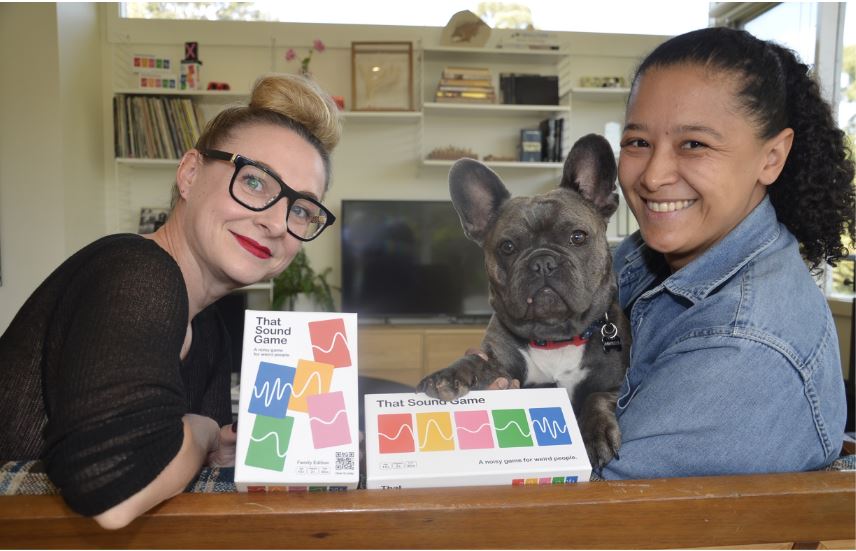
World-wide, some truly remarkable things have come out of the global Covid pandemic and one of them is the meteoric rise to international success of a new part game developed by a Hepburn Springs couple during lockdown.
One aspect that makes the success of That Sound Game so remarkable is that the two women behind it, Nat Delaney-John and Cam Jasson have backgrounds that could hardly be any further from the games scene.
Cam is a construction sector project management consultant whose professional dedication saw her awarded the Property Council of Australia’s Future Leader of the Year Award ’23, while Nat, who dreamt up That Sound Game, is a taxidermist.
The two had been living in a Melbourne apartment getting on with their work. But when the pandemic struck, Nat’s life and livelihood was badly impacted and she was left struggling to find a reason to get out of bed in the morning.
“I was so used to feeling like my world was large,” Nat recalls the impact of the pandemic on her personal existence. “Because of taxidermy I was used to working with palaeontologists and digging up dinosaurs.”
“When Covid happened it really, really hurt my company. I felt the walls closing in.”
But as Victorians – and millions of others world-wide – cocooned in their houses and turned to things like food, wine and board games during enforced lockdown, Nat had an interesting realisation.
“I needed to feel like you could still have dreams. And the more I thought about it, the more I realised someone should have done this before us,” Nat says.
“It is so rare to see a big gap in an already established market.”
Locked-down Nat had noticed that while the world had no shortage of charades-based games, word games galore, and myriad vision-based evergreen board game favs, there seemed very little, if anything, based around the medium of sound.
A dream was borne with Nat and Cam pouring their time, energy and money into developing
an entertaining fun-filled, family-friendly game to fill that gap. The result is That Sound Game.
That Sound Game is a fast-paced, interactive and very noisy party game, with the goal to get your team to guess as many answers on the category card as they can in a minute. Players can use any combination of sounds and movements, but their hands must be behind their back.
On its release in February 2023, That Sound Game became a social media sensation, “going viral” on TikTok.
“Nat came up with the idea in 2021 at the start of the second lockdown,” Cam says.
“We worked on the game for the whole of the lockdown and it’s been in production for about two years.
“We launched the game at the start of February ‘23 and when we launched it went viral on TikTok. We sold out in the US in four hours and we sold out world-wide in four days.
“Within our first year of launching we sold 100,000 units.”
Nat says social media has been a big part of their success.
“Our total reach on social media now is 190 million views. That’s how many eyeballs have seen us,” she says.
That Sound Game has since gained distribution in the US and the UK with major international retailers like Barnes & Noble, Walmart Canada, and Waterstones and John Lewis in the UK stocking it, while their own website and a partnership with Amazon enables them to fulfil supply obligations for online sales globally.
“We can fulfil (online sales orders) pretty much anywhere in the world,” Nat says.
But getting to that stage was far from easy.
“I was working three jobs and Cam was working two jobs to make it happen,” says Nat who took on additional work at Reptile Encounters, teaching young adults with autism to become zoo keepers in order to raise an extra $50,000-$60,000 needed to get them over the line.
“Thank goodness it paid off,” she says.
It not only paid off but enabled them to purchase their own home in Hepburn Springs in December after an initial shift to Daylesford mid-2023 as the game was taking off.
“I think both of us have been motivated by the fact that we are supporting our families as well,” says Cam who is financially assisting family in South Africa.
As for Nat, she is providing support for her mother who is contending with terminal illness.
To cater for market demand, they have further developed That Sound Game by creating some add-on x-tension packs including a ribald adults only pack, and another one aimed at more junior players in development, while the main game itself (that retails for $49) is family– friendly and suited for players young and mature alike.
The game has now been translated into Italian, French, Portuguese, Spanish and German, and as The Local caught up with Nat and Cam at their home in Hepburn Springs in very recent days, pre-sales were poised to go live in each of those countries.
As if that weren’t sufficient success, That Sound Game has just taken out Game of The Year at the Australian Toy Association Awards, and is also a finalist in the running to win Gift of The Year in the UK with Nat flying to London to attend a gala awards event and find out if they’ve scooped it.
Ellen DeGenre’s (online subscription) Game Night got in touch last year and as a result, That Sound Game is set to feature on that platform mid-year in what represents a fairly invaluable promotional opportunity.
It’s a heady take-off from November 2022 when, Nat laughs recalling, “we started selling to family and friends as sheer harassment to buy the thing we’d been working on.”
Nat and Cam now represent one of the very few entirely female-owned board game enterprises in the world.
“It’s amazing. Life-changing,” Nat says when asked what the journey has been like so far.
“We thought we had a million dollar idea, but to actually become a million dollar idea… These things don’t happen by chance. We were working up to 20 hours a day and now it’s probably down to 16 hours a day.”
Asked whether there’s any advice she could give aspiring entrepreneurs, Cam draws on her sporting background and says: “I was always taught to be the hardest worker in the room. I feel lucky it’s paid off. You have to visualise that the thing has happened or is going to happen. You have to win that battle in your head first.”
And then she adds: “I’d say invest in yourself as well. Take a gamble on yourself.”
Words: Eve Lamb
April 27th, 2024Walks of the Central Highlands
with Eve Lamb
Andersons Tramway Walk … plus. Mollongghip
Today we’re tackling the Andersons Tramway Walk at Mollongghip just east of Newlyn. This 8km (16km return) bushwalk is a bit of a surprise packet. Who could have guessed there would be a “tramway” running through the bush here?
When I say “tramway” what we’re talking about is the remnants of a cleared pathway through the bush where work horses, and later steam engines, once used to cart out heavy felled timber that was destined for the crazy ol’ gold fields of the day.
This walk basically follows that cleared haulage route that remains, over-grown yes, but still clearly visible as it makes its way to where the township of Wombat once existed back in those roaring days.
Now there’s nothing left to indicate the fact that a township ever existed here other than a cleared flat section that used to be the town’s railway siding. Adjoining this is the clear remains of where the old Ballarat to Daylesford railway line once ran.
The railway tracks have long since been taken up but the rail-line today forms part of what, for bushwalkers, has become the Wombat Station Walk – a 19km long hike from the old Wombat town site to Daylesford via Sailors Falls.
My walking accomplice Paddy H and I decide we will also do just a little bit of this walk as well as our main focus, the Andersons Tramline Walk, so as to check out the significant rail cutting that remains with walls that reach up to 20 metres high according to the literature.
This section, with the impressively high walls, immediately joins the end of our Andersons Tramway walk. It will add about two kilometres (four km the round trip) but is well worth it. Fortunately, when we set out we are fueled with the recent spoils of Easter and could use a good trek.
So to the start : The eight km Andersons Tramway Walk starts off from the Slater Road, Mollongghip, and follows the route of the old tramway through the Wombat State Forest along the top of the divide at 700metres.
According to my pre-walk research*, the Anderson brothers arrived from Scotland to try their luck on the goldfields in 1851. Instead of digging they cut and supplied timber to the ever-hungry mining industry.
Having cut their way through most of the timber at Dean they then built a horse-drawn (and later steam) tramway into the Wombat Forest. This tramway was no temporary construction as cuttings were dug, bridges and embankments built and iron rails laid for over 23 km of track. However, before long they cut themselves out of a job.
Starting again in another venture the unstoppable Andersons concentrated their attention on flour milling by constructing the massive bluestone mill in Smeaton in 1862. The imposing multi-story mill at Smeaton remains today as a monument to Victoria’s pioneers.
Reflecting on the spirit of those driven yesteryear sorts, Paddy H and I navigate our way successfully to the start of the tramway walk, parking near the intersection of McPhans, Gleesons and Slaters roads. We set out carrying maps and lunch. And it quickly turns out to be a beautiful bushland walk, the remnants of the old tramway, readily identifiable along the way.
About three kilometres in we meet a small walking party of three women, heading in the opposite direction to us, and all equipped with walking poles and determined expressions. We stop for a track-
side chat and they tell us they are Melbournians and are on a bigger, ongoing mission to complete the entire Goldfields Track, of which this walk is but a section.
“We’re doing it over multiple visits, one section at a time, all the way through from Bendigo to Mount Buninyong,” one of them tells us.
“And we always make sure that when we come back to do a new section we park the car at the exact spot where we ended the previous section so we don’t cheat,” another adds.
They obviously got started a fair bit earlier than we did today as they also tell us that they set out from Sailors Falls near Daylesford today.
“Did you see any other points of interest along the way?” I ask them.
“There’s the dam,” enthuses one of the three trekkers.
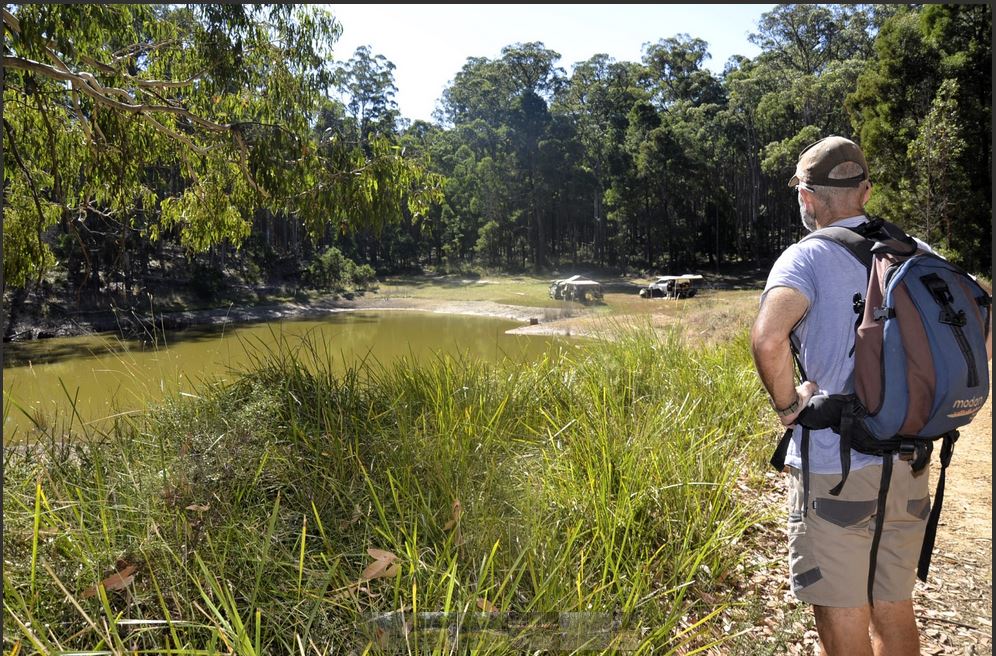
We bid them farewell and a bit further on stop track-side for lunch, accompanied by the mysterious musical calls of choughs, before making our way on to the dam. Mullens Dam which, my research informs, was built to supply water for the old gold sluicing works.
Today the Easter holiday break is still in full swing and Mullens Dam turns out to be hosting a couple of campers, very snugly set up with all the comforts. One man dozes in the afternoon sunshine. Anther looks very like he’s about to do the same. A wine glass rests languidly on the arm of a comfortable camp chair.
“Happy Easter,” says Paddy H who appears slightly affected by the season.
“Thanks,” says the man with one of the elaborate camp setups.
The late flush of Indian summer sun beats down. The bush-land all around hums with unseen life. The dam water is still and green, framed by eucalyptus leaves.
“Your Easter eggs might melt,” Paddy H helpfully advises the man.
“Nah Mate. They’ll be right. I’ve got a fridge,” he says.
“Camping aint what it used to be,” observes my walking accomplice as we move out of earshot.
From here we gain a little more elevation as we head on toward where the township of Wombat apparently once existed. Today there’s no trace, but the spot where this little gold town once stood may still be identified by a picnic rotunda that’s also accessible by vehicle off the Rocklyn Road at this point.
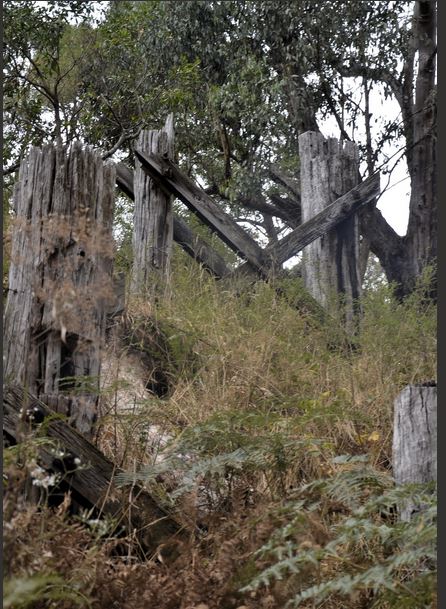
Reaching it now means we have now covered eight kilometres and completed the Andersons Tramway Walk. We stop for a coffee refuel, and then take a short 2.5km ramble along the Rocklyn Roadway toward where a yoga ashram now operates. We do this in order to photograph the skeletal remains of a timber railway bridge that formed part of the old Ballarat to Daylesford railway line which, the literature informs, opened in 1887 and closed in 1953.
Achieving this goal successfully we then return to the Wombat station site again and rally our energies to tackle a further couple of ks on the adjoining Wombat-Daylesford walk section, just so as to check out the railway cutting section with the high walls.
Almost immediately after embarking on this section of track, headed toward Daylesford, the anticipated cutting walls appear, rising up on either side of the trail, creating a small microclimate in which Paddy H and I notice three different types of thriving ferns including tree ferns.
The walls, are cut through clays and bedrock, and peering up at them we reckon the literature is not exaggerating when it says they reach up to 20 metres. We briefly wonder at what it is that motivates humanity through times past and present to tackle such undertakings.
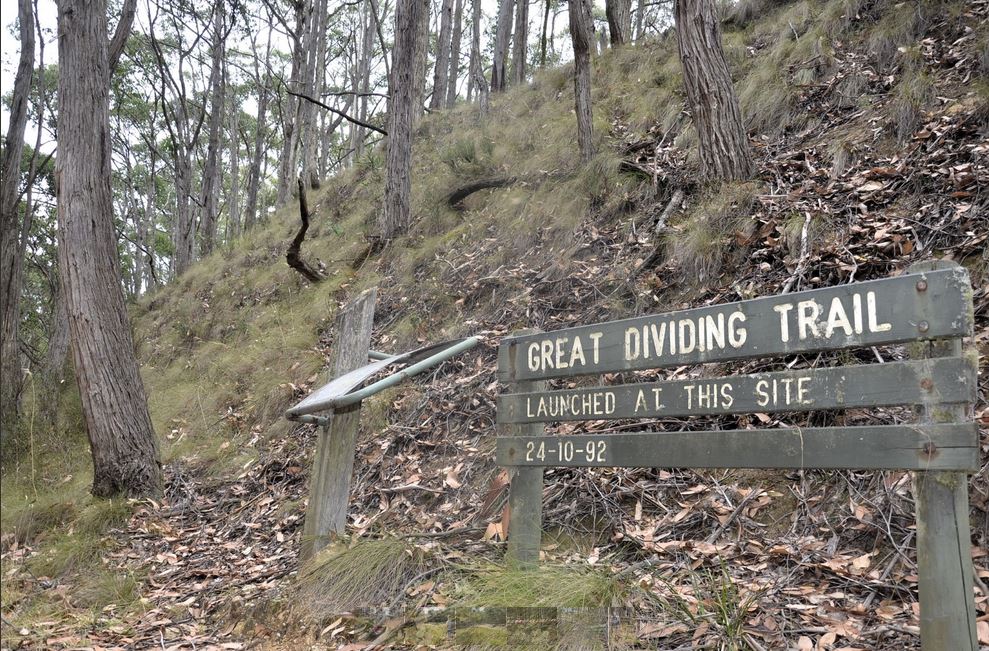
After about two kilometres we reach the point where the Great Dividing Trail (GDT) was officially launched in October 1992. Signage marks the spot.
The GDT here also follows the remnants of the dismantled Ballarat-Daylesford Railway. At this point Paddy H and I have now covered a bit over 12 kms all up when you count our small addendum ramblings, and it’s well time to head on back.
Promises of a hearty dinner and a glass of wine provide useful motivation to help combat our increasing bone weariness as we retrace our steps through the bushland’s lengthening shadows.
As we once again pass Mullens Dam, headed back, the man with the fridge is flat out, blissfully asleep in his commodious camp chair.#
Words and Images: Eve Lamb
*Walks, Tracks & Trails of Victoria. Derrick Stone. CSIRO Publishing 2009
April 25th, 2024Heritage listing for Daylesford’s old school of mines building
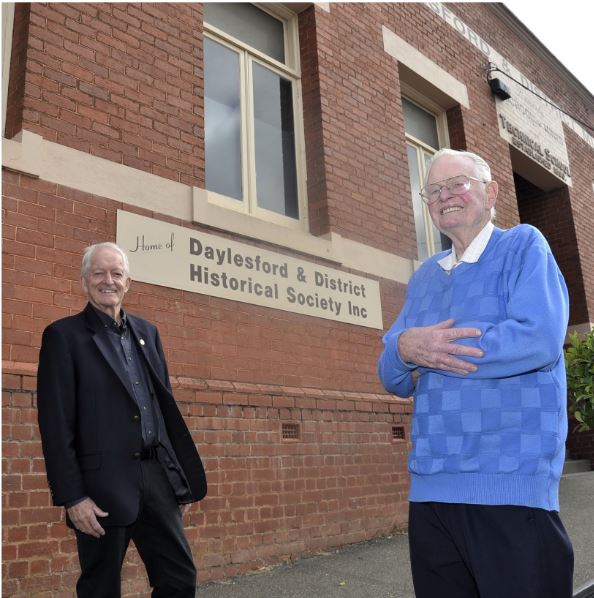
The recent inclusion of the Old Daylesford School of Mines building on the Victorian Heritage Register has significant positive implications for the future of the building.
It means that the building that now houses the town’s museum will be able to attract crucial funding through Heritage Victoria for maintenance works into the future.
It also recognises the significant place that the 1890s brick building at 100 Vincent Street occupies as part of the state’s mining and education history.
The nomination was lodged by the former Daylesford Museum Reserve Committee of Management back in 2019.
Its successful listing on the register was confirmed in February this year providing much cause for celebration particularly among locals who played a key role in lodging the nomination.
Former Daylesford Museum Reserve Committee of Management chair Ken Warren is among them and delighted with the result. He notes how rare and difficult it is to have such a nomination succeed.
“We’re very, very fortunate to get this up on the register,” Mr Warren said.
“Everybody worked so hard to get there.”
Mr Warren says the listing has major implications for the ability of the current and future committees of management to attract ongoing funding required for upkeep of the building.
“It also preserves well into the future the building as significant for the shire and the state so it doesn’t disappear,” he said.
“Lots of places disappear because people don’t appreciate their sense of significance.
“This listing mean there is a sense of permanence and a line of funding into the future and it makes it even better as a site for the museum.”
Current repair and upgrade works are continuing on the building that today houses two much loved cultural institutions, the Daylesford and District Historical Society and the Daylesford Community Brass Band.
The museum building dates back to the early 1890s when it was used by the School of Mines to teach classes on science and art.
The building retains many of its original features including one of the earliest and most intact School of Mines laboratories and metallurgical laboratory interiors in Victoria.
The Victorian Heritage Database Report associated with the new listing notes that the School of Mines is historically significant as a forerunner of the technical schools that were a key part of the state’s education system for many decades.
The database records that: “The Daylesford School of Mines is architecturally significant as it retains a combination of fine features that are characteristic of an early technical school – roof lanterns for daylighting, distinctive brick assay chimney, furnaces, fume cupboards, and 1890s joinery”.
The old Daylesford School of Mines comprises the laboratory building with chimney and the art department building dating from 1890, and the technical school addition of 1914.
Local resident Graeme Orr was a student at the technical school in the late 1940s and the 1950s and said he was delighted to see the building gain heritage listing.
“I think it’s wonderful,” said Graeme who attended school there from 1949 to 1951, starting at the tender age of 12.
“This is really exciting as there are not many Daylesford buildings on the State Register,” says Heather Mutimer who was secretary with the committee of management that lodged the successful application for listing.
“A lot of work went into the nomination and was underpinned by the completion of a detailed Conservation Management Plan,” Heather said.
Words & Image: Eve Lamb

April 12th, 2024Artists of the Central Highlands
with Eve Lamb
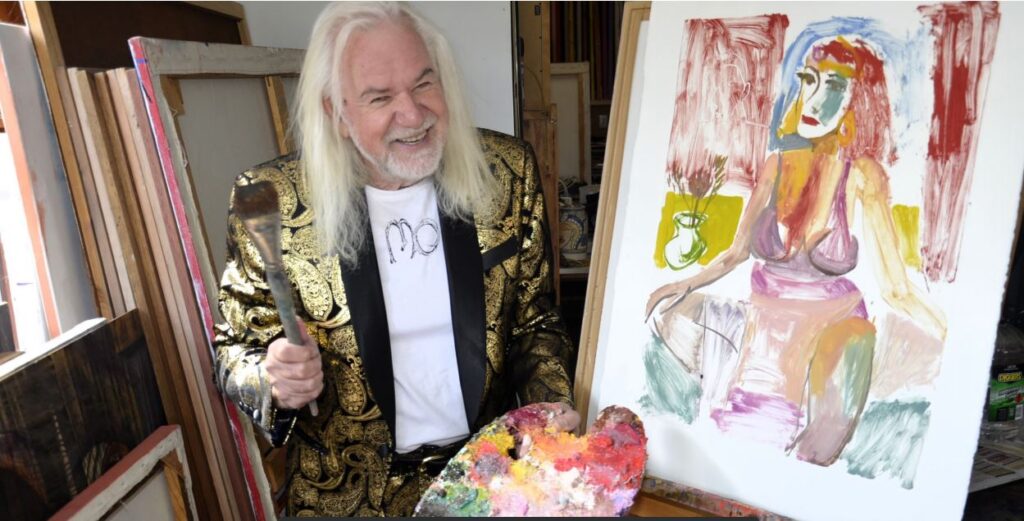
From his earlier days as a rock musician and his years at the prestigious Academy of Art in Dresden, Germany – to his new upcoming exhibition at the Convent Gallery, Daylesford’s Monty Osewald is the sort of vivacious talent whose creative work gets noticed wherever he goes. His personal story could be described as fiery, even phoenix-like. Ahead of his new show that opens later this month, he shared a little of that story.
Eve: Now I know you have an exhibition coming up at the Convent Gallery here in Daylesford,
later this month Monty. When is the launch?
Monty: It opens on Sunday April 28. I’ve been doing a burlesque series of prints of a stunning model, Mini Mayhem who is a burlesque performer. She is going to open the exhibition at 2pm with a burlesque act and that will be followed with me doing a painting of her in her outfit for the day. Of course the show’s up as well.
Eve: Yes. Please tell me a little more about the show. What does it feature?
Monty: It’s forty years of work. It’s called Forty Years of Painting, Drawing and Prints. There are about 50 works and it will run for a month. In one section there is the latest burlesque series done in 2023 and 2024, featuring Mini Mayhem. There’s a section for the Dresden paintings, the Samoan series, a Daylesford series and also a surreal series that I did following the death of my mother.
Eve: Monty can you tell me about your story as an artist? I believe it’s quite eventful.
Monty: I finished my rock n roll career in 1984. I wasn’t getting paid enough in that so I thought, oh I’ll do some painting. I did arts school years before that. I was at the Gordon in Geelong, VCA in Melbourne. But after I finished my qualifications I just went out and played rock n roll for years. I started doing artwork with a group show at the Works Gallery in Geelong and then a solo show at an artist-run space called Artery in Geelong.
I hadn’t painted for years and all of a sudden it just burst out. That went pretty well and I got a show at the Geelong Gallery and was bought up by a Sydney Group called the Sydney Art Bank. In Sydney I bumped into a really famous guy called Kym Bonython, an art dealer and entrepreneur who brought bands like The Beatles out to Australia. He said ‘show me what you’ve got’ . He said ‘bring all of it to my place in Kew’…
I pulled it all out and threw it down on the lawn outside his mansion in Kew. He said ‘I’ll take the lot’ – and we showed it in Adelaide and in Sydney and I ended up in group shows with people like John Coburn, Fred Cress, Charles Blackman. That gave me a lot of impetus to keep going.
I was in Geelong at that time. I ended up making fibreglass paintings and spent more than 12 months making this massive exhibition of paintings, each a couple of meters long and a meter-and-a-half high. They were all finished and ready, and I had booked the Qdos Gallery in Lorne and we had a show to do the next day.
All the paintings were in the factory down at Fyansford. That night I went to bed probably 3am. I lived at Lara. The next morning I woke up to go to school – because I was a school teacher as well – and I got a phone call in the morning. Somebody had set fire to the factory. All of the 17 huge paintings that I’d done were incinerated in this massive fire.
The guy that did it was an arsonist. He had problems. We saw him in the court. He got five years jail. He
had destroyed plenty of people’s businesses and caused millions of dollars worth of damage.
Eve: That’s terrible. Monty, how did you cope?
Monty: It wasn’t aimed at me but I lost out on a fabulous fibreglass show. Who knows what might have happened. I just sort of slumped. I didn’t know what to do next. I hung around for about a year and then decided ‘right I’m out of here’.
I went and lived in Dresden in East Germany for five years. I was actually born in Kiel in Germany so I can speak German. I’d sent a video clip of myself working at my studio in Lara to all of the major cities in Germany. I arrived in Dresden and went up to the front door of Akademie Fur Bildende Kunste, a massive academy. Beautiful.
I said ‘I’m looking for the video tape that I sent’. They said ‘we can’t find it’. I said ‘I’ve come a long way. I’ll wait until you find it’. And while I was sitting there, waiting, one of the professors came over and said ‘can I have a look in your art folder’.
He looked through it and said ‘come with me’ and he gave me a studio which I worked in for four years after that at the Academy in Dresden – for nothing.
Eve: That’s wonderful.
Monty: Out of the despair of the fire comes this.
Eve: And you’re still a practicing artist today. What is your genre of preference now?
Monty: I think that it’s expressionist.
Eve: And what is your preferred medium?
Monty: It’s oil paint. I use other materials but a lot of my collection are monoprints – oil
paintings on aluminium plates and those images are transferred to paper through an etching
press.
Eve: What is your subject matter of choice?
Monty: I’m really interested in people. But I also love doing landscape. Now I just love the fact that I am just painting for myself and just accepting the marks that come out. It’s a very spontaneous sort of mark-making ritual that I do. I’m living the life that I’ve always wanted to live.
April 12th, 2024Writers launch new Chequerboard anthology
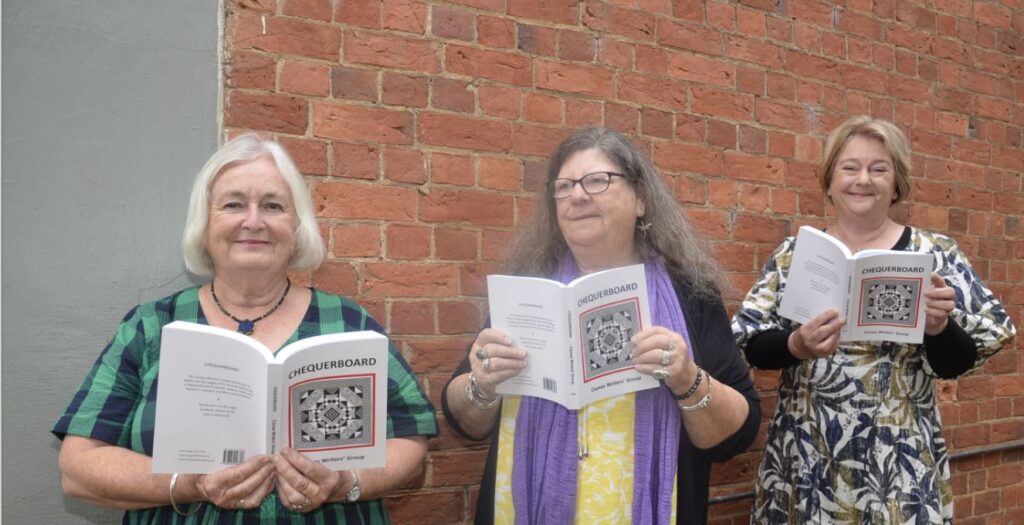
The Clunes writers group is a diverse lot so it’s little wonder that their new anthology has something in it to appeal to just about every kind of reader.
There is short story, fiction, autobiography and memoir, poetry, haiku – even song lyric.
The group, which has been running for well over fifteen years, launched the new 310 page volume called Chequerboard at the recent Clunes Booktown festival.
It’s the group’s second published anthology featuring the work of members, and it’s being snapped up fairly fast with half of the copies published in the first print run already sold.
The new anthology showcases the talent, diverse interests and considerable background life experience of the group’s membership – and it’s an impressively consistent membership.
“We generally have about 14 to 18 members turn up each month so it’s fairly consistent,” says group convenor and keen local writer Sandra Nichols.
When members gather, as they do on the second Monday of the month, they get the chance to read their latest work out aloud, taking to the mic to test out their creative output on others who appreciate the written and spoken word.
But members like Newlyn’s Julie Moran are quick to let you know that you don’t have to take to the mic with your work if you don’t wish to.
However, the fact that it doesn’t seem to take long before most are fairly itching to grab the mic speaks volumes of the fact that this is a welcoming and non-intimidating group.
“During our monthly meetings we encourage our members to read pieces aloud with a microphone,” Julie says.
“We have a monthly theme and more often than not we all write to that theme.
“We don’t critique each other’s work. We don’t pull the pieces apart. It’s a very welcoming environment.”
Fellow member, Clunes musician and writer Judi Palmer who, like both Julie and Sandra has a background in academic research and writing, agrees on this point.
“It’s very laid-back,” says Judi who contributed several original song lyric works to Chequerboard.
The new anthology was also published by Judi who runs her own local publishing enterprise, Harmony for Books, while the cover design features a quilt design by talented local textile artist, Mel Drummond.
Sandra says that for those group members who, like herself, do occasionally want a bit of constructive feedback, they can simply request and readily obtain it during the group’s monthly sessions.
“Quite a few of our members have been writing stories or poetry for a very long time,” says Sandra, reflecting on the benefits to be derived from being able to read your work aloud to others who share an appreciation for good writing.
“It provides an opportunity to have an audience of people who appreciate what you do.”
Among the 20 different writers whose work is represented in the new anthology, Julie contributed three fictional short stories to Chequerboard, while Sandra contributed works of poetry.
Copies of the new book are available for purchase ($27 for those keen to secure one) from BOOM Clunes at 28 Fraser Street, and group members say they’ll also be selling copies at this month’s Clunes Farmers and Makers Market that happens in the town’s main street on Sunday April 14.
Sandra says new members are very welcome to join this longstanding local writers’ group whose current members travel from locations throughout the wider region including Talbot, Creswick, Newlyn, Newstead, Ballarat and Scarsdale, to attend the monthly sessions that happen from 1-3pm in the town’s main street Attitude building.
“I’m not sure exactly how long the group has been going for now but it would be 16 to 20 years,” muses Judi.
Members say that those who think the Clunes Writers’ Group may be for them, are welcome to simply sit in on a monthly session and listen to how it all works before taking the next step and becoming a member for the very nominal $10 annual membership fee.
More information about the group is available from Sandra on 0438-415-715.
Words: Eve Lamb
April 11th, 2024Ancestory detective connecting generations
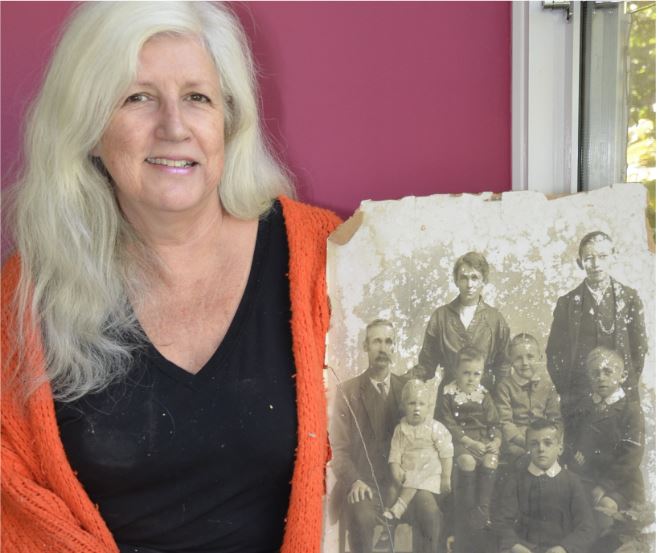
It’s the thrill of the chase in large part that makes family history research such an addictive pursuit
for professional genealogist, Lynda Collier.
“My cousin is an actual detective and he said to me ‘you are a detective too really’, muses the
specialist researcher who lives at Wheatsheaf just out of Daylesford.
Because this niche area of historic research is all about identifying and confirming the links between
one human being to so many others back through the annals of time, it also means “bringing to life”
characters of the past, one’s own relatives. And this too especially appeals to Lynda.
“I spend a lot of time on DNA analysis,” she says.
“Even in my own family we’ve got an unknown ancestor, my mum’s great, great grandfather. I’ve
been lucky enough to test both of my parents with DNA.
“Every generation loses basically fifty percent of your parents’ DNA, because you only get half-ish
from each. And it’s not even. So from your grandparents you might have got 20 percent and 30
percent respectively. It can vary quite a lot.
“We’ve also got lots of cousins that we’ve been able to test and that helps with working out things
with DNA, and I’ve done that for quite a few people with an unknown parent, or those who know a
parent but where the name they’ve gone by their whole life wasn’t their real name. So the family
always knew there was something unknown there, and through DNA they’ve been able to find the
family.”
As a professional genealogist with a special interest in DNA, Lynda dedicates much of her own
current life to researching family histories for others and also to delving more deeply into her own
ancestry.
It’s a field of research that these days has gained a respectability in academia that it didn’t always
enjoy, and that has been popularised by television programs like ‘Who Do You Think You Are?’
Lynda says public interest in genealogy or family history has increased in recent times, augmented
by significant advances in technology, particularly including DNA research techniques. She also
believes developments in AI hold plenty of positive potential for unearthing historic family linkages
and shedding light on familial ancestry in a manner not previously possible.
“Yes I think interest has increased,” she says of the uptick in people eager to uncover their own
family connections going back through the generations. You just never know who you might be
related to.
But, there’s a cautionary note, here when it comes to DNA. Those delving back into their past may
be in for some surprises, this experienced genealogist says.
“Many don’t realise that what they find may completely change what they thought about their
family, like finding out your father is not your biological father for example. All sorts of stories can
come out.”
Of course, while the “surprises” that DNA analysis may uncover might be disconcerting in some
cases, they may also be exciting, even flattering. Lynda says that when it comes to DNA research, the
revelation of “surprises” in family trees is quite common.
Lynda’s own journey with genealogy dates back to the late 1980s when she tried (unsuccessfully) to
encourage her own mother to get enthused about genealogical research. Lynda studied photography initially as a university student, going on to do honours in creative media incorporating
a focus on family history.
She then went on to complete masters post graduate studies in history through Monash University,
completing a thesis on the early female immigrants – the “needle women” who were assisted to
immigrate gratis to Australia from England on a ship called the Culloden.
From there, her research tracing her own family history has taken her to the US and to the UK where
she has unearthed here own Quaker antecedents while, in London, she uncovered a famed 1800s
actor in the family tree.
Lynda also uncovered quite a few church ministers in her own family background, and she says the
discovery of intriguing forebearers is all part of the attraction.
“I love it. Obviously. I feel like I get to know my ancestors,” she says.
As a fulltime professional genealogist, Lynda is a member of the global Association of Professional
Genealogists, the Society of Australian Genealogists and of the Genealogy Society of Victoria.
When somebody approaches her with a request to research their own family history, the sorts of sources she typically turns to may includes parish records, land titles, national archives, local archives, professional and academic organisations, old military records, census data, the registry of Births, Deaths and Marriages and even old land maps revealing the names of farms and former family properties from days long lost to the mists of time.
She says that it’s really only been over the last eight years that advances in DNA research have come
to the fore in the field of family history – “before that it was very expensive. The cost has come
down a lot,” she says.
“There’s a lot online but it would be less than 10 percent of the records that are out there,” she says.
“Artificial Intelligence is already making a big impact.”
Lynda says the reasons people will turn to a genealogist to assist them in their quest to find out
more about their lineage are varied.
“Sometimes it’s because they don’t know how to go about it and sometimes it’s because they are
too busy,” says Lynda whose work in the field has resulted in the publication of quite a few books
both for herself and for others, including in coffee table style and magazine style publications.
Her earlier background in photography has proven to be very complementary to her work in
genealogy and in the work of preserving family knowledge for posterity.
“I think a lot of older people are wanting to leave something for their children. They are concerned
that it isn’t all just thrown out.”
Words & Image: Eve Lamb
March 31st, 2024Artists of the Central Highlands
With Eve Lamb
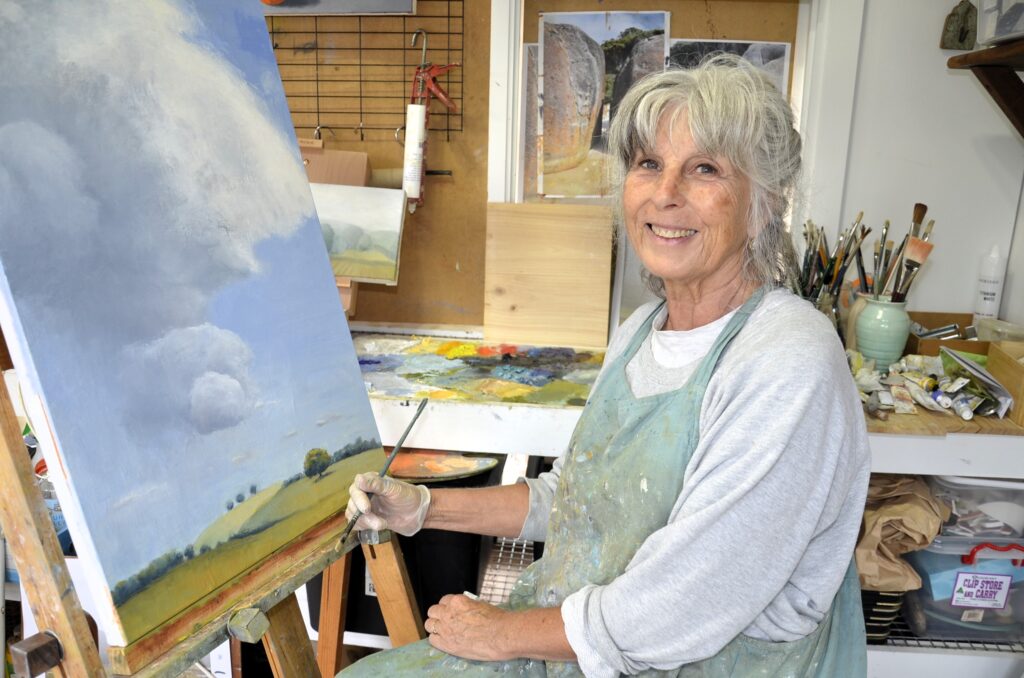
Lyonville artist Suzi Donovan is not sure how to describe her artistic style. She is still experimenting with landscapes, clouds and still life but also trying seascapes, rocks and forests. Also extending into abstract work, this local creative is busy right now preparing for her first public exhibition, together with fellow artist Gayle Cykner, at Trentham’s Cosmpolitan Hotel.
Eve: How did you come to art?
Suzi: From an early age I always wanted to be a fine artist. My parents steered me into graphic design.
Eve: How did you nurture your innate arts talent? Studies?
Suzi: As a teenager I went to the Maryland Institute College of Arts (in the US) where I did a three-month course in drawing the human form from skeleton to skin. I learned to “see” as an artist. It was amazing. As a graphic designer before computers, I was trained in all disciplines – illustration, photography, drawing, typography and design. In my 30s I took up watercolours and botanical art for many years.
Eve: Where do you do most of your art work Suzi? Where is your home studio?
Suzi: I now work in what was the potting shed at my home in Lyonville. There is lots of natural light and I’m nestled right in the garden which is lovely. There are sparrows nesting in the roof who chatter away constantly.
Eve: That sounds like a suitable ambience for creative endeavour. Can I ask you which artists have influenced your work?
Suzi: I love the work of John Olsen, Fred Williams, Margaret Olley, Manet, Monet, Chagall, Matisse and Brett Whiteley.
Eve: Are there any other factors that have influenced your creative practice?
Suzi: I have always been an observer. I am very influenced by the beautiful landscapes and skyscapes surrounding us here in the Macedon Ranges. I love colour – colour is important to me.
Eve: Yes we are so lucky here with our landscapes and skyscapes. What is your media of choice?
Suzi: I now paint in oils. On holiday I take my drawing journal, pencils and watercolours.
Eve: What is your subject matter of choice?
Suzi: I paint landscapes because everywhere I look around me is a beautiful painting. I paint the clouds because the sky is so big here. The clouds are so big. I paint a still life of something important to me – my nana’s vase, my grandmother’s teapot or homegrown veggies on a kitchen bench.
Eve: The beautiful things in life! Have you ever worked in any other areas besides working as an artist?
Suzi: I am a yoga teacher. I have taught yoga asana, pranayama, meditation and yoga Nidra to children, teenagers and adults for about 20 years. The practice of yoga has taught me to observe on a deeper level. After graphic design I worked as a colour consultant for a few years. This work enhanced my awareness of subtleties in colour.
Eve: What are you working on at the moment?
Suzi: I am currently working on a large abstract landscape.
Eve: Any particular projects in mind for the future?
Suzi: In the future I hope to work on larger canvases. I would like to try mixing media – maybe try creating more texture, going more abstract. Having more fun.
Eve: Sounds like you’re having a fair bit of fun already. When you work in the studio do you like to play music and if so what is your music of choice?
Suzi: Yes, I do play music – depends on my mood – usually I like music that is peaceful. I often play yoga music.
Eve: To date, what have been your career highlights as an artist?
Suzi: I am very new to oil painting. I had my first private exhibition last year when we opened our garden for the Real Gardens of Lyonville event. It was so exciting to sell my work for the first time and people loved it. One couple drove all the way from Melbourne to buy one.
Eve: Do you have any exhibitions or special arts events coming up that you would like to let others know about?
Suzi: My first public exhibition is coming up in April. The opening is on Sunday, April 14, at the Cosmopolitan Hotel in Trentham from 3pm to 5pm. I am exhibiting with my friend Gayle Cykner. The paintings will be on display until mid-May.
Eve: That sounds like an event to attend. Suzi, what would you rate as the greatest rewards derived from your personal artistic practice?
Suzi: The greatest reward for me is to create a painting that celebrates the beauty around us – a painting that I love and that brings joy to others.