


March 28th, 2024To feel the need, the need for sidecar speed…
When you’re doing well over 200 km an hour, just centimetres from the ground with no seat belt and no air bag you don’t think about much other than remaining upright.
The niche sport of sidecar racing would have to be one of the most photographic, daring, arguably lunatic and heroic motor sports going.
“It’s exciting,” says Daylesford’s Noel Beare, one of the fairly exclusive bunch of folk that belong to Australia’s competitive sidecar racing fraternity.
“You don’t think about your house loan or that bill you have to pay,” he laughs.
When he’s racing sidecar Noel, also known around town in his more sedate guise as a postie, also thinks (or perhaps it’s something more instinctive than thought) about how he’s using his own body weight to counterbalance the ferocious forces happening at those speeds to keep the sidecar upright and hopefully in a winning position.
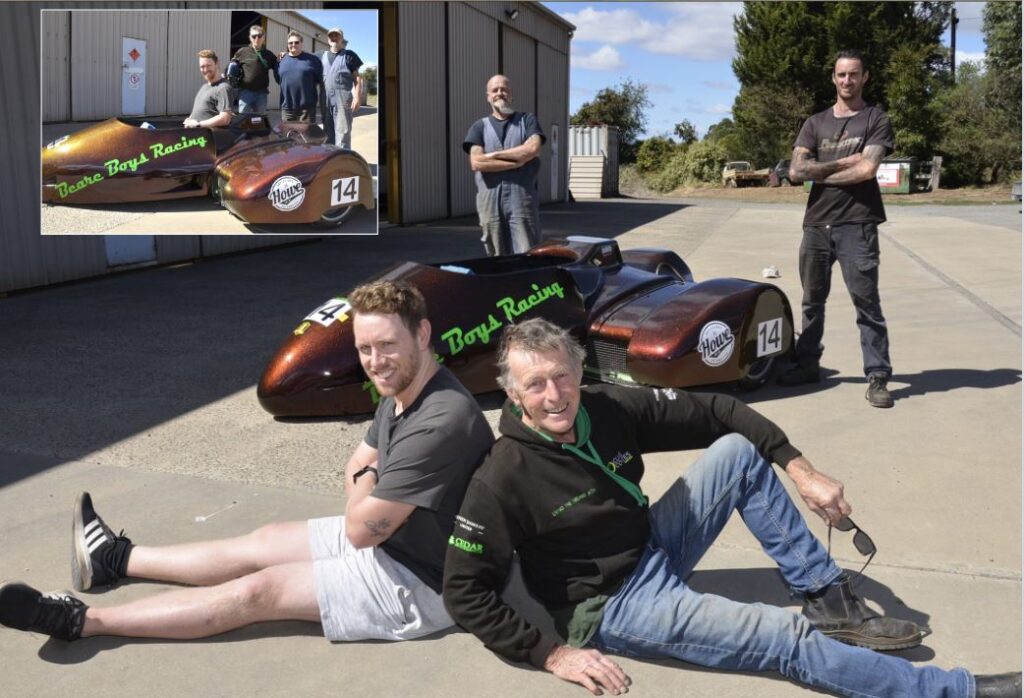
These days when they race, it’s Noel on back doing the “passengering” (read balancing) and son Declan in the driver’s seat
They’re just back from Tailem Bend, SA where, totally self-funded, they put their F1 1000 CC sidecar through its paces at the Australian National Sidecar Championships.
They were doing very well up until a chain snapped setting them back somewhat.
But chat to father and son and it’s pretty clear neither are too worried about the chain-snapping set-back.
They both rate the experience as resoundingly positive, and as a good “shake down” for what lies ahead.

“It was bit tricky learning a new track,” said Declan of the Tailem Bend outing.
“We did the Friday practice day and by the end of that day we knew which corner was coming up next and so we were able to go a bit faster and have a bit of fun.
“On the last race before our chain snapped we started at 12th and got up to sixth and our times had kept dropping.
“We were starting to get a bit of a feel for the bike again because it’s been about four months since we’ve been out. It’s good to be back out on the bike, and all the changes that have been made have been really positive – a lot to do with the seating for myself, for more support and just so I can get a bit more of a feel for what the bike is doing.”
And, Noel adds, any safe outing is a good outing.
Many Daylesfordians will recall that the Beare family lost keen sidecar racer Dwight Beare, Declan’s brother, back in 2016. He’d been racing at the Isle of Man TT (Tourist Trophy) at the time and following his untimely and tragic loss, the entire Daylesford Town Hall was packed out by mourners.
So, today Noel says that heading back to the Isle of Man this May will be “bitter-sweet”.
Bitter because of the loss of Dwight, 27, there. Sweet because it’s here on this island that sits in the Irish Sea and is particularly famed for its F2 600 CC sidecar racing that Noel feels especially close to the son he lost to this addictive sport.
The Isle of Man event will be happening over May 27- June 12 and Noel will once again be making the trek, not to compete but rather to spectate and to mark also the tenth anniversary since the first time he and Dwight ever attended the Isle to compete.
“It is a little bit bitter-sweet for us but I feel like we are close to Dwight there,” says Noel.
“I’ve been every year just to spectate. It’s fantastic. This year I am just going to spectate and it will be 10 years this year since I first raced there with Dwight.
“In 2014 there were 64 sidecars. We started in 61st position and we came 12th and won a bronze replica trophy.”
In his career as sidecar passenger – which simply couldn’t be any further from the passive role usually associated with being a passenger as it entails literally using your body to shift and counter-balance the immense forces at play, frequently hanging over the side of the vehicle like a living rudder, Noel is current holder of two lap records at the Sydney Motor Sports (Eastern Creek) raceway where a lap is about 4.3km. One of those records was set with Dwight ten years ago, an F2 class race (1.44.84).He also retains a current lap record at Philip Island.
Before Noel heads off to The Isle of Man this year he and Declan are next up headed to Broadford in about a month’s time to compete in the Victorian Titles.
“All the changes that Hamish and the team have made (to the F1 1000 CC long chassis sidecar) are positive and you just hope for a safe and a fast time,” Noel says ahead of Broadford.
“Under a minute, five would be good.”
As they look ahead to take on the competition at Broadford there is a whole team of locals who they want to thank for helping them get their gleaming machine in order.
Noel writes the names down. The list (below) includes people like Hamish Millar who has spent many months working on their F1 Road Race sidecar’s body, steering, and even its remarkable paintwork.
“The paint is called aurora chameleon interference mica pearl,” says Hamish who is noted as being the first person in Australia to have built an F2 sidecar, as raced at the Isle of Man.
Noel and Declan are also looking to compete at Philip Island in September, a track where they regularly top 220km an hour.
“You know you’re alive I tell you,” Noel says when asked what travelling at that sort of speed with part of your anatomy leveraging balance, just five or so centimetres from the ground, is like.
Noel says the number of people in the sport of sidecar racing is dwindling and he is keen to attract more to this niche motor racing fraternity that he loves.
“It’s an unusual sport. People often say ‘where are the safety belt and the air bag?’ And there is none! You just hang on.”#
Words and Images (Top and Inset): Eve Lamb
The local team that Noel and Declan wish to thank for getting Beare Boys Racing up and racing includes:
Howe Auto – Albert and Will Lamb, Kerry Lamb, Deb and Peter; Daylesford Tyre Service – Jamie Adams, Jason Liversidge and Aaron; Dan O’Toole Signs, Hamish Millar (for nearly everything); Mal Reid.
March 17th, 2024Walks of the Central Highlands: Jacksons Lookout Loop Walk, Hepburn Springs

Words & Images: Eve Lamb
Wildcat Gully and taking the waters
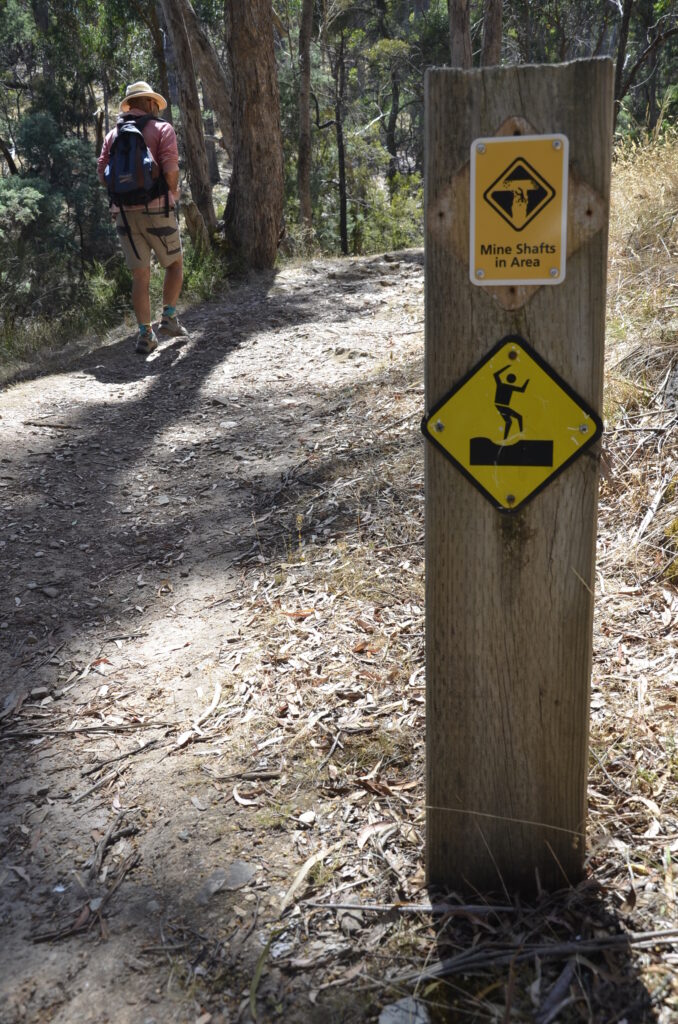
The Jackson’s Lookout walk taking in Wyuna, Argyle and Golden Springs is a great option for going just that little bushland bit beyond the more heavily traversed tourist saunters out of Hepburn Springs Reserve – even if you’re strapped for time.
The way we did it was anti-clockwise starting out in that time-honoured place of much frequented classic charm that is the Hepburn Mineral Springs Reserve grounds. Lunch first.
Admired a squeaky flock of black cockies, and myriad little blue wrens bobbing about, above. Checked the map, then set off on this breezy little 6km trek heading first to Wyuna Spring where my trusty walking companion, Paddy H, took the waters.
“Very fizzy. Reminds me of bicarbonate of soda,” he surmised.
Anyway onwards, following the Argyle Creek, breathing in the bushland beauty redolent of so many happy wanderings over so many sunny Sundays, and exchanging various far-fetched and fanciful accounts of BBC (Big Black Cat) sightings across the wider region.
These were inspired by the evocatively named Wild Cat Gully that we would soon traverse.
But first we headed directly on to Argyle Spring where Paddy, more extrovert than I, struck up
a conversation with a couple sitting beside the spring, who shared that they were visiting from
“Brizzy” and had to catch a flight back later that day and be back at work tomorrow.
Feeling their pain, we munched on a bit of dark chocolate and then set off again, retracing our steps for a short way until we reached a sharp V-shaped (roughly 45 degree) diversion off to the right (as you’re heading back in the direction of the Hepburn Springs Reserve picnic grounds).
This is the path that leads onwards and gradually upwards, and traverses the Wild Cat Gully on the way to Jackson’s Lookout. Our destination.
Jackson’s Lookout
“Hepburn and Daylesford are still very much locales for romantic weekend escapades,”
Paddy H observed, reflecting on the various happy and less happy twosomes we’d passed
along the way to this point, some delightfully preoccupied with each other’s company, others
not quite hiding the fact that they were mid-tiff.
But from here our couple sightings petered out … at least for a while. In fact the beauty of this handy walk is the fact that just for a brief while the time-strapped walker does leave behind the tourist trails more trodden to obtain a more lingering and much less populated taste of the lovely sclerophyll forest.
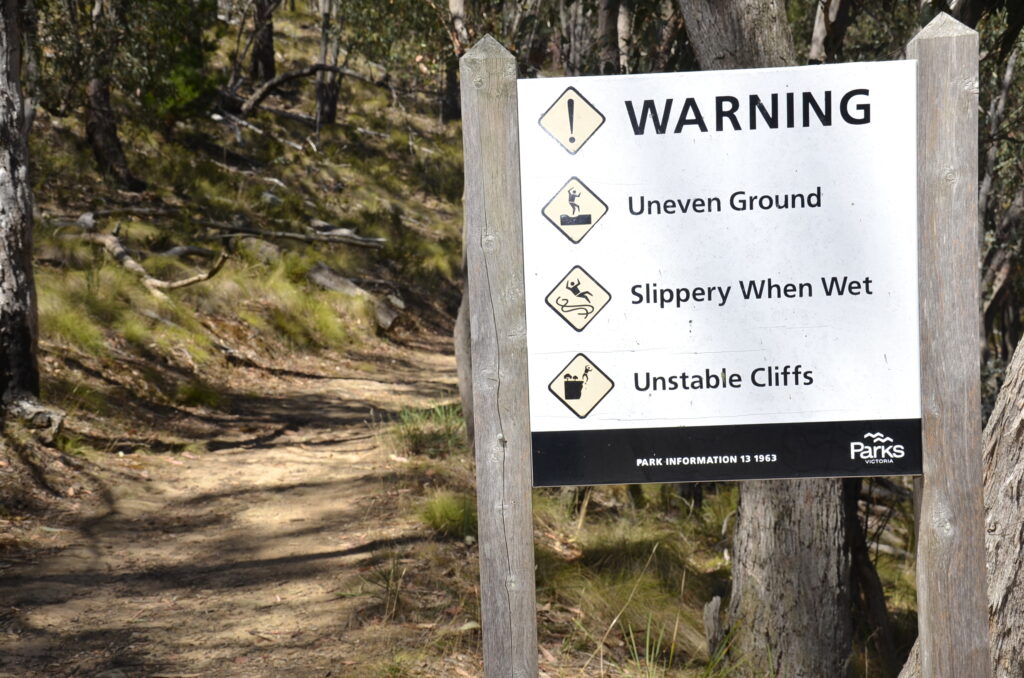
The path ahead rises gently as it climbs to the lookout which opens up a good view to Mount Kooroocheang to the north. Here we whisked out the thermos while admiring two wedge tailed eagles gliding smugly in widening leisurely arcs across the wide blue above.
Then Paddy nudged me and pointed to where a couple, oblivious to our silent presence, had momentarily stopped their own walk to engage in a furtive snog in the forest. Ah true love. Ah
Hepburn.
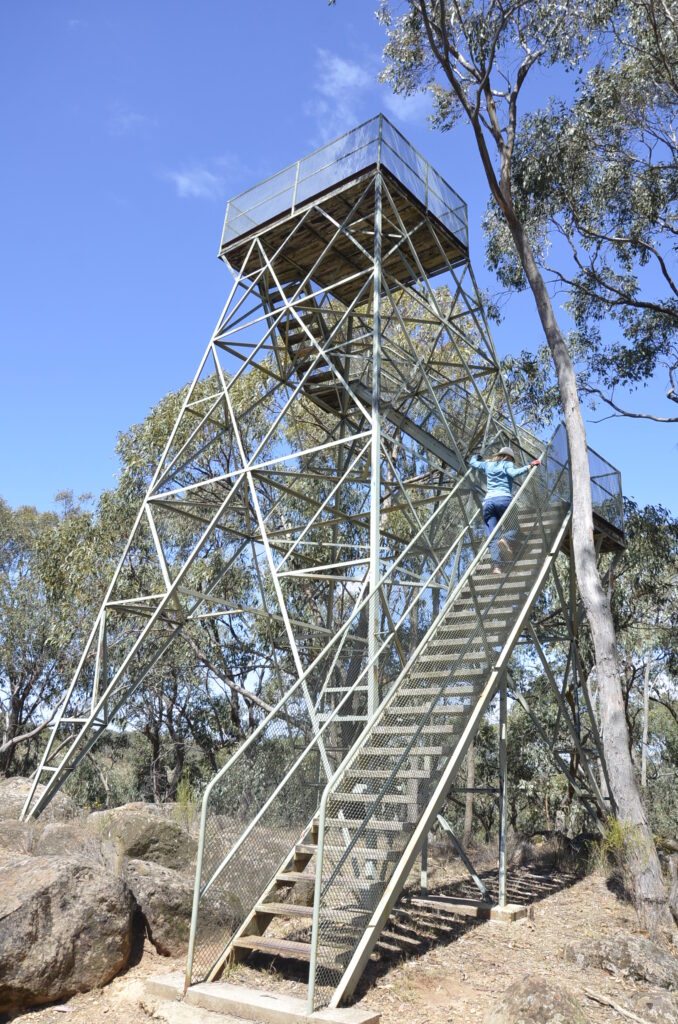
So then it was time to sample the view from the tower atop Jackson’s Lookout. Jackson’s Lookout, so our research informs, was designed in the 1940s and restored in 2017. The tower provides excellent views of Hepburn Regional Park.
“Don’t say wobbly,” said Paddy H who by this time had obtained the top viewing platform while I stood below, staring up and taking a few snaps.
The tower offers a fairly fine view across to the Wombat Hill Botanic Gardens in Daylesford, and while we took it all in there was an accompanying soundtrack of currawong cries. From here we followed the well-marked trail towards Golden Spring, joining a section of The Great Dividing Trail in the process.
Sulphur and holiday homes
The trail passes through a little grove of whispering pines just before reaching Golden Spring, and when we reached the spring, Paddy gave it a whirl too.
“Smells pretty sulphuric,” he observed, astutely. But it didn’t stop him sampling.
“This one tastes quite fresh and clean. It hasn’t got a deeply sulphuric flavour,” he concluded. I gave it a miss having had a prior bad experience – in another location entirely – on the sulphuric front.
We stayed and soaked in the atmosphere, spring-side, for a while or three before retracing the path back and up fairly sharply to where it meets the first old weatherboards of Hepburn Springs weekender land, then followed the sealed road back to our starting point.
“There should be an acronym for these – RUHH – Rarely Used Holiday Homes,” muttered my walking companion politically as we concluded this very pleasant little walking adventure that could just as well be done in reverse.
Much later that night I remembered the “Brizzy” couple at Argyle Springs and, again, felt their pain as I recalled her asking plaintively: “can you suggest any other good walks here?

March 16th, 2024Good news for Daylesford’s historic guide hall
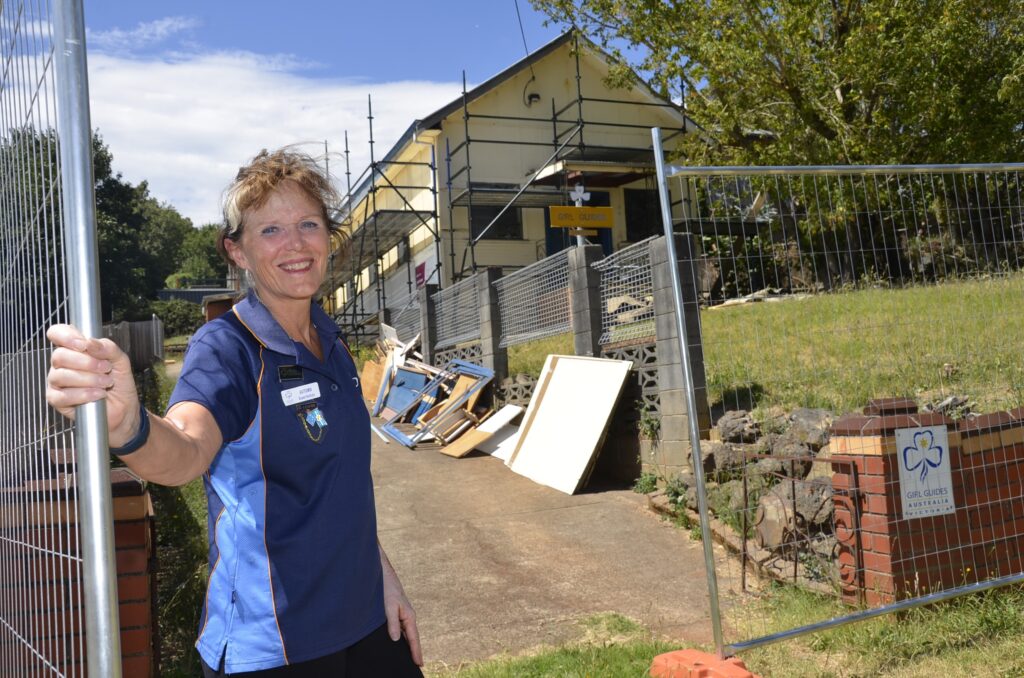
It’s been a long wait for the Daylesford Girl Guides but after two years the good news finally came through.
They have a builder.
Back in 2022 the local guide group secured government funding of $47,000 through Regional Development Victoria’s Living Local Regional Grants Program, for a long awaited revamp of their historic hall – including removal of asbestos.
But guide leader Susan Verbyla says the widespread shortage of tradies meant they had been unable to proceed with the work … until now.
Recently the guides secured the services of local builder Alan Ware of Ware Carpentr, meaning they can also go ahead and bring in the asbestos removal experts to rid the vintage hall of the unwelcome material.
The asbestos is – thankfully – not in the main body of the hall that guides have used all the way back to 1958, Susan says.
“It’s on the outside eaves, and in part of the kitchen and there’s a piece behind the electrical switchboard,” she says.
“The grant will cover removal of all of the asbestos, replacement and repair of walls, ceiling, front steps, electrical work, plumbing, painting, carpet and curtains and some exterior work. It was an exciting grant to receive as the hall is in dire straits. The builder is just starting now.”
Susan was not making any secret of her excitement over the fact that after the long wait work can finally get going which is not just good news for the guides.
It’s also great news for many other local community groups who, once work is complete, will be able to use the hall for their gatherings as well.
Susan says a main aim is ensuring some ongoing income with rent coming in, and a couple of local playgroups already lined up as regular hirers of the beautifully positioned old hall in Duke Street, neighbouring Daylesford’s civic offices.
“It’s just in the ideal spot. This is the original hall in the original spot,” Susan says.
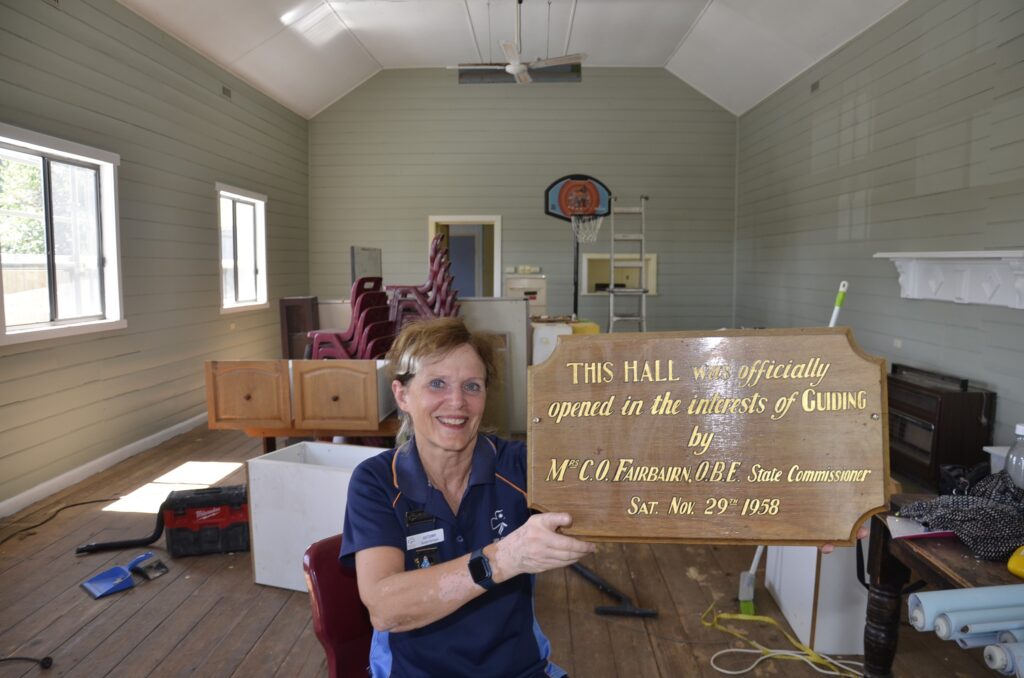
The guides are hopeful the work will be competed by Easter, at which point Susan hopes to hold a public open hall week so current and former users of the hall can get along and admire the upgrades.
“I’d like to have it done by Easter and I think we will,” she says.
“I would love to have an open hall week for the community. I reckon there are women here in the community who were probably part of that original group.”
It would also be a chance for any community groups who are interested to take a peek and see if the hall may just suit their own ongoing meeting needs as well.
“Quite often other groups in the community contact me and ask if they can hire the hall,” Susan says.
The hall’s presence in Daylesford dates back to the late 1950s with a plaque naming the date of 1958, and Susan says it was moved to its current site in Duke Street especially for the guides of the day.
Former guide leader with the group, Glenda Fleischer started with the guides back in the late 60s as an assistant for the rangers (older guides) and remained with them for three decades including a stint as assistant regional leader.
“The hall came from near Glenlyon. It was donated by the Ogden family,” says Glenda who lives at Glenlyon.
“Before the hall, I think they used to meet at the church behind the guide hall. Daylesford was a very early unit.”
The guiding movement in Daylesford has been going for well over 100 years – right back to the early 1900s – and Daylesford’s Marj Green is among those who remembers back to the days before the current hall arrived.
“The hall came from Spring Hill and I’m fairly sure it used to be a church,” Marj says.
Marj started as a brownie (which have since been replaced by junior guides) back in the 1940s when the Daylesford brownies and guides of the day used to gather in the town’s Baptist Hall.
“Back then we belonged to the Clunes District and we used to have lots of fun,” recalls Marj who went on to become a brownie leader (or Brown Owl) in 1977 and stayed on with the movement in Daylesford until 1996.
Back in the day, Marj says the young brownies would learn about many things including how to do the dishes properly, clean their shoes correctly, and set the table properly including correct placement of soup spoon.
Today, the Daylesford unit has about 18 guides whose ages range from six to 14 and they enjoy a wide range of activities. Things like skateboarding, swimming, camping – and yes, a bit of knot-tying. A few of the more traditional things remain, like cookery, craft and community service.
But the movement has changed quite a bit since the 1950s, says Susan who has been with them for at least a decade with her own daughter, Lucinda, having grown up a keen guide.
“Girl guides is very different these days. It’s got to be girl-led,” she says.
Words: Eve Lamb
March 14th, 2024Those fascinating folk, now at rest…

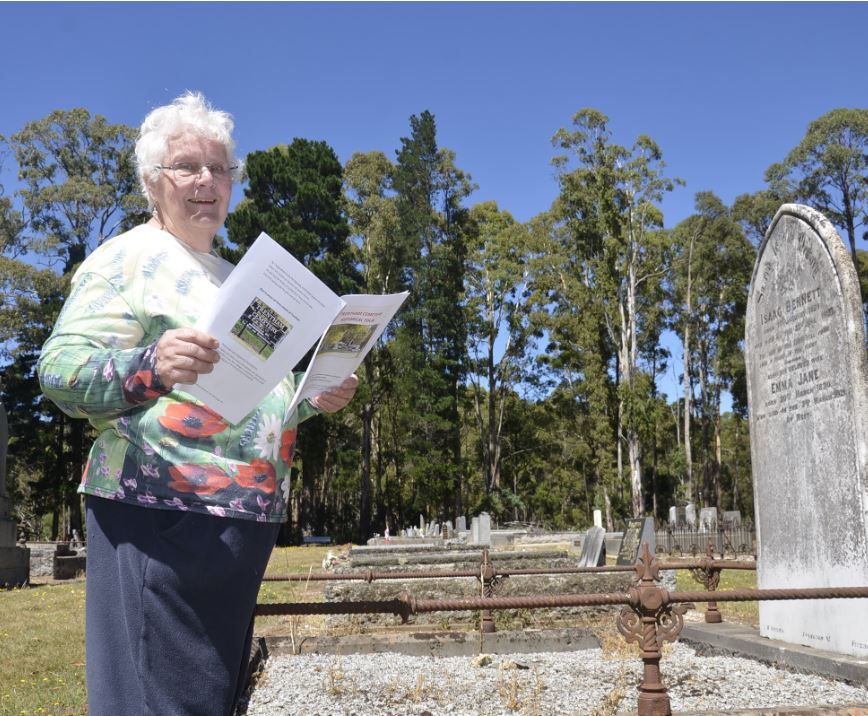
Retired Anglican priest, Trentham’s Peta Sherlock admits she’s more than a tad addicted to fossicking out fascinating stories of the past.
“It’s a nice addiction,” chuckles the dedicated amateur historian who simply loves to share her keen
interest in the lives of those who have gone before with those living today.
Right now Peta, a member of Trentham Historical Society, is preparing to indulge that passion a little
when she leads a historical tour of the Trentham Cemetery on Saturday, March 23.
Everyone is welcome to join Peta as she leads the 75 minute tour being presented by the Trentham Historical Society in conjunction with Trentham Neighbourhood Centre, for the very nominal cost of $8.
Tour participants will not only be taken on a rollicking journey through the past, “meeting” some of the intriguing characters who lie at rest in this local cemetery, they’ll also receive the benefit of Peta’s extensive research – and an informative printed pamphlet she has prepared as well.
“I love the cemetery. It’s the people, and this is full of people,” says Peta whose prior tours of this local cemetery, including one earlier this month, tend to be very well received. They’ve all got stories,” she says.
They certainly have. The Trentham Cemetery was established in 1870 and even one quick tour looking into the former lives of those who lie at rest here provides a rich dip into Trentham’s post European past.
There are the early settlers, the captains of industry, the visionary, the wealthy, the mysterious, the
heroic and the tragic. There are love stories buried here and tales that could make you weep.
A look into the lives of those who now lie at rest here provides a potted history of the development of the township and lively insights into how the movers and shakers of the 1800s and early 1900s got things done.
Peta says that as the town’s built environment changes, the cemetery increasingly becomes the only
physical connection left to many significant threads of its past.
“It’s not a scary place. To me they are still ‘alive’,” she says.
“Some have had horrible lives. Some have lost all their babies. There are people who made a mess of their lives and people who made a great success of their lives. But they are all God’s creatures.”
Peta’s research into the lives of those interred in the Trentham cemetery dates back to 2014 when
she started researching the history of the town’s Anglican Church to mark the 150th anniversary of
the denomination’s presence at Trentham… “Then you start to get interested in everybody,” she says, recalling how the history bug bit.
Peta has her own personal favourite grave sites, the memorial resting places for characters like 1800s businessman about town J.W.S. Wolff, local humanitarian Catherine (Kit) Trewhella, and much-loved yesteryear medic Dr Gwen Wisewould. She loves to share their stories and the way their legacies have shaped the community that Trentham is today.
“I want to know who talked to whom when they spotted them in town, and who walked on the other side of the street,” she says.
In carrying out her research, Peta has noticed certain patterns emerge. Patterns that she has come
to realise can point to significant demographic trends. She mentions early sanitation problems, the disposal of night soil, by the “dunny men” of the day, down old mine shafts, the subsequent pollution of local waterways, the potentially lethal link to typhoid.
There are the tragic trends whose ghostly fingerprints have left their traces in the early burial records… The yesteryear deaths of an unusually high number of men of a certain age, the potentiality of syphilis playing its part. People lived and partied hard in those days, apparently. But speculation is speculation, and Peta strives always to find the facts.
“Only God is perfect and history is an ongoing thing,” she muses as she hands me with a copy of the
pamphlet she has produced to accompany her tour.
“This is pretty accurate and nobody has pulled me up on anything quite yet,” she says.
One of the elements Peta relishes about leading a cemetery tour is the input from those who take the tour.
“Often people will tell me stuff,” she says.
“A cemetery can be a confronting place, partly because here we realise our own mortality.”
Peta is no stranger to the presence of human mortality, having conducted funeral services during her
many years spent working as a priest.
“Even though some of the stories today are about the full and fruitful lives of past Trenthamites, some are also sad, the death of children especially so,” she says.
“It’s a lovely cemetery. It’s been really well looked after and it’s run by a local trust of volunteers.”
Those keen to take the upcoming tour and “meet” many of those colourful, now at rest, characters who once peopled Trentham and surrounds can contact the Trentham Neighbourhood Centre to book into Peta’s next tour taking place on Saturday March 23.
Words: Eve Lamb
March 13th, 2024Keep you posted: Mick makes our postal heritage sing

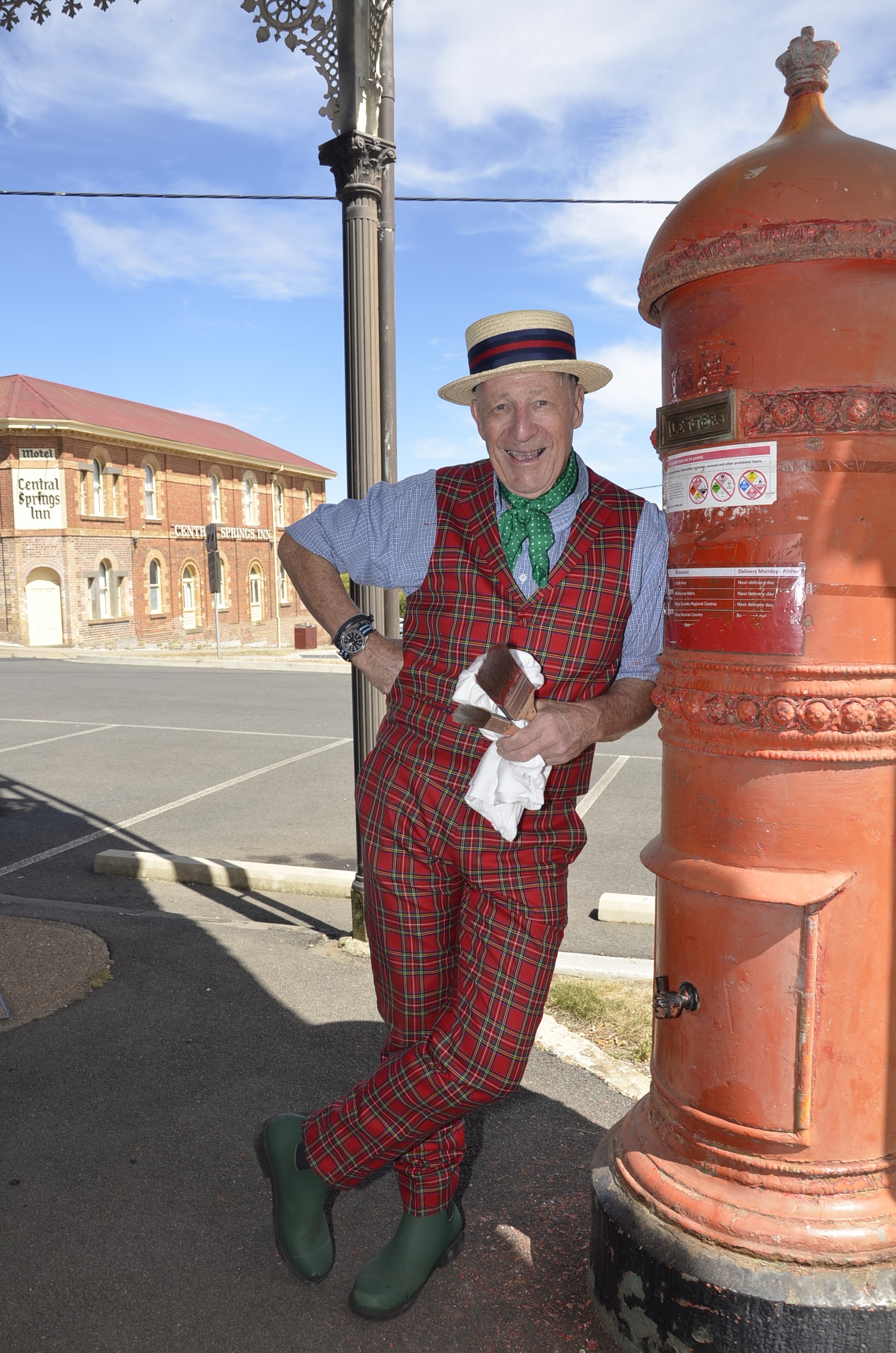
Former Bushwhacker Mick Slocum has been in Daylesford in recent days to do something he absolutely loves besides making music – working to make the town’s heritage post box sing.
Restoring the state’s 120 or so red heritage pillar post boxes has become a self imposed labour of love for Mick, well known to many through his former role as a muso with Aussie band the Bushwhackers.
It all started with his own local heritage post box in suburban Ascot Vale in April last year, when Mick became aware that it had been besmirched with graffiti.
First he cleaned up the graffiti, but then could not resist going a little further to restore the vintage postal piece properly back to its former glory.
“I came home, bought some cleaning material, cleaned off the graffiti, and stood back and looked at it and thought, I’ll just keep going,” he says.
“So I went down to the hardware store, bought a can of red, a can of gold, and a can of black and went back and rubbed it all down and sanded it and resprayed it.”
From there the bug bit and, gaining the full-hearted support of Australia Post, Mick has since restored more than 20 heritage post boxes on streets in various Melbourne suburbs and in regional centres including Kyneton and Castlemaine, before most recently turning his attention to Daylesford’s own historic number on the corner of Camp and Raglan Streets in Willis Square.
“This is the 26th one I’ve restored so far and there are about 120 statewide, all in varying states of disrepair and all seriously deteriorating,” Mick said as he got to work on the Daylesford box, painstakingly bringing out its intricate heritage details.
Mick is more than keen to lovingly restore each and every one of the remaining boxes in Victoria, with Australia Post not only remunerating him for his troubles, but also paying him a bit for his contribution to the nation’s postal heritage as well.
“But I never set out to get paid,” said Mick who is also a professional pharmacist and remains a working musician as well.
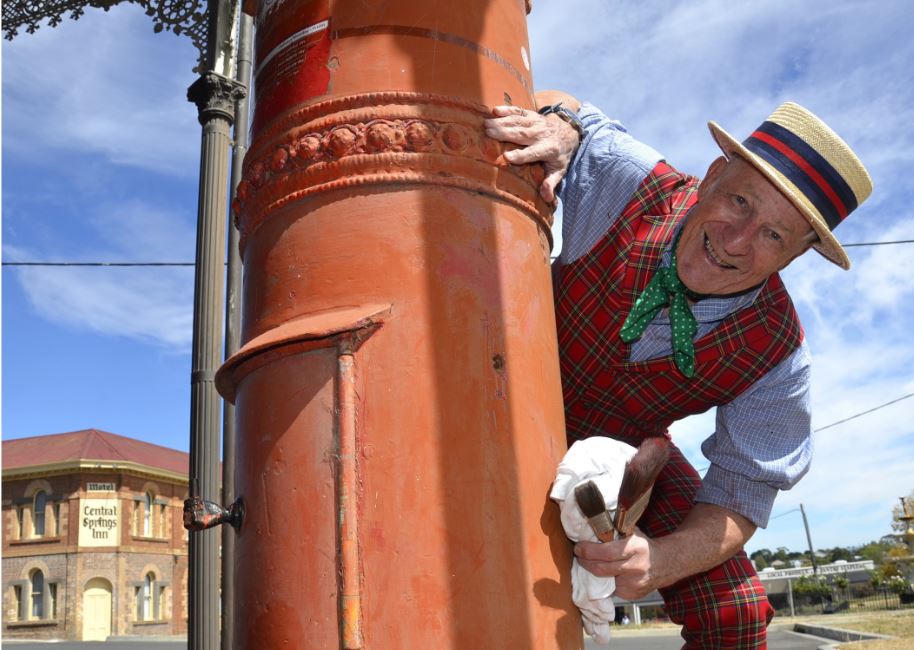
But, being a showman at heart, he dresses especially for his heritage restoration activities, sporting a tartan vest suit that emphasises the sense of occasion and reinforces the heritage significance of what he is doing.
“This one’s got about 10 coats of paint on it and the original features are covered,” he said in Daylesford.
“There isn’t a single person alive now who was here when this was installed. The oldest of them dates back well over 140 years and every third one is still useable.”
Daylesford’s is one of these. In fact someone popped over and posted a letter in it while Mick chatted about the restoration process that typically takes him a couple of days depending on the state of the box.
“I’ve sort of invented myself a job for life,” he said.
“It’s a bit like painting the Sydney Harbour Bridge because once you’ve finished it will be time to start all over again.
“It’s extremely meditative and I particularly enjoy it when I put the red paint on it and you can see it coming to life.”
Next up, following the restoration of Daylesford’s, Mick is turning his attention to Ballarat where, he says there are eight of the vintage post boxes and he plans to start with the one near the regional city’s train station, and then move on to the one in the CBD.
“They are priceless examples of our Victorian heritage,” he says.
When not bringing vintage postal boxes back to their yesteryear glory, Mick is also a professional pharmacist and an active muso who, together with his current band The Exciting McGillicuddies, has a regular Sunday evening gig at an Irish pub in inner city Kensington.
“We’re lifting the veil on Australia’s heritage. There aren’t many things on the streets these days that are 130 years old. They’re so beautiful,” he said. Words: Eve Lamb

February 29th, 2024Artists of the Central Highlands

With Eve Lamb
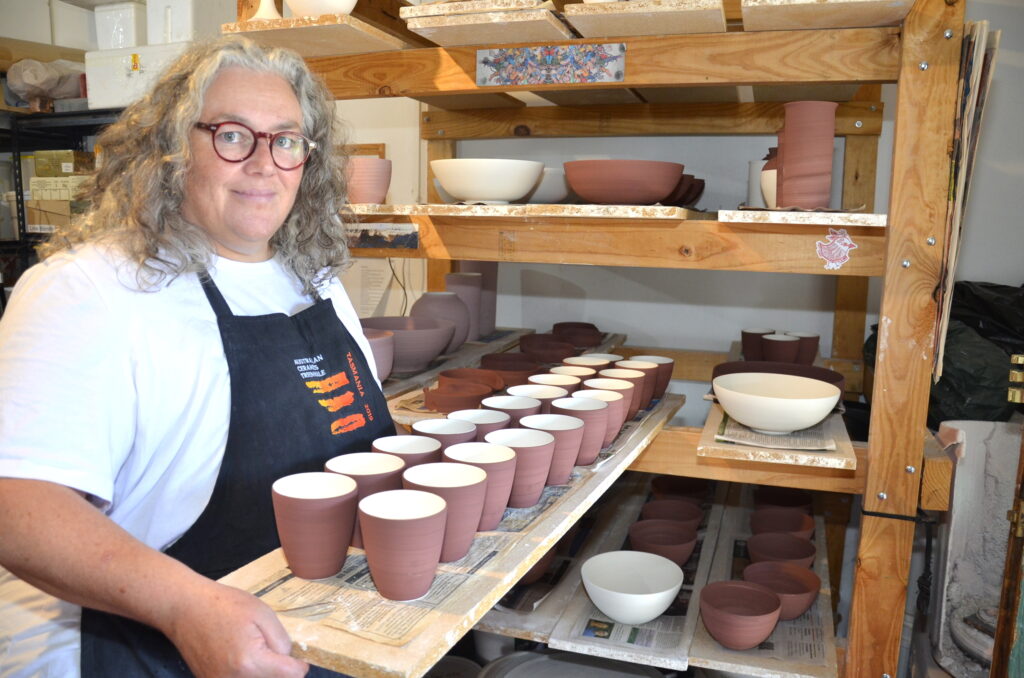
Sarah Koschak’s fascination with pottery began as a small child and never really left. For several decades, though, it was a passion that lay dormant as, in adulthood Koschak travelled the world, working as a photographer in some amazing places. These days the childhood fascination is made manifest as this talented local devotes herself to creating objects of beauty and functionality at her studio/gallery at Newstead.
Eve: Hi Sarah. Can you tell us a bit about your ceramics journey?
Sarah: I’ve had a connection with pottery since I was seven years old. I remember being at a craft fair and watching a potter throw pots on an old kick wheel. I was mesmerised. I can remember everything really clearly about that day. It’s just one of those pivotal moments that switches on a light.
I took classes in my early 20s, but as I was traveling and working as a photographer, it was hard to find the space and time to devote to pottery. It was only in my mid 40’s that I decided to dive in and learn the craft. In 2015 I began learning with potter Phil Elson in Castlemaine.
Eve: Sarah, I know that your prior working life as a photographer, working alongside your partner, nature sound recordist Andrew Skeoch, took you into some remarkable parts of the world. Do you think those experiences have now influenced your work as a ceramicist at all?
Sarah: I haven’t set out for it to do so consciously. I don’t think I aim to do that. We’d do these long field trips in Australia or around the world. Andrew would go off sound recording and I’d spend my time photographing. Photographing was more like a meditation. You just have to open up to where you are so you can really see.
Obviously nature was a big part of it because we were doing nature sound recordings in jungles, forests, ancient historical sites. I’m a fairly quiet, meditative person and my approach just follows through. Now I love creating beautiful shapes and glazes.
Eve: Yes, the glazes you achieve are very beautiful. Sophisticated colours. What are you aiming for with your glazes?
Sarah: I think elegance and timelessness are both in there. I’m not aiming for something that’s popping with bright colour or is in-your-face. I make all my own glazes, and the work is fired in the shed attached to my studio. I have a two burner gas kiln.
Eve: Are there any particular ceramicists whose work you admire?
Sarah: I think the Japanese and Korean work. I really resonate with a lot of their glazes. A lot of the glazes I choose come from those traditions. But I try not to copy.
Eve: I know you work using porcelain clay but do you also use any other types of clay as well?
Sarah: I only (wheel) throw in porcelain as my clay, but I do use other clay that I brush on to get another effects. Working with porcelain … it’s a bit of a diva!
Eve: Are you introducing anything new or making any changes to the way you work at the moment?
Sarah: I’m trying to work with bigger pieces.
Eve: This is a great little studio that you have here in Newstead. How long have you been here now?
Sarah: Coming up ten years here this year.
Eve: Are you currently preparing for any special events or exhibitions at the moment?
Sarah: Yes. I will be part of the Newstead Open Studios Art trail event that is taking place over two consecutive weekends in March. March 9, 10 and 11 and over the next weekend, March 16 and 17 as well. I love it. I love working consistently towards a big event like this. The shelves will be just heaving with work. I might have 500 people come through the studio over the weekend. It’s a really nice social time for me because I usually spend most of my time here working away on my own.
Eve: What do you find most rewarding about your work and creative practice Sarah?
Sarah: The most rewarding is to have a form in mind that I want to make and then being able to execute it. It’s just very satisfying. I think there is timelessness in certain forms that just endure and I love the fact that people will buy my work and it will get handed down. It takes a long time for a ball of clay to end up as a bowl or a cup. There’s a lot of heart and soul that goes into making ceramics.
February 29th, 2024No time to relax… brigade remains ready
It may have been a comparatively mild summer fire season out Hepburn-Daylesford way so far … but it’s not over yet.
That’s the informed opinion of long-serving local volunteer CFA firey Barry Yanner, captain of the Hepburn Fire Brigade.
Barry for one certainly isn’t relaxing just yet. He reckons things are looking pretty dry out Hepburn way and surrounds and says February and March are not times to become complacent.
“February and March are always our worst months,” he said, chatting presciently to The Local about a week before the major fire incident broke out in the wider Beaufort area last Thursday.
“The forest (in the Hepburn area) has dried out now and the grass is drying out. On Mount Franklin it’s as dry as a chip.”
Admittedly this season to date has been fairly low key, but the local brigade that will celebrate its 80th anniversary later this year, has been called upon on multiple occasions nevertheless.
These have included two recent callouts to lightening strike events earlier this month, and a concerning number of callouts also to assist at the scene of motor vehicle accidents.
“We’re not a rescue brigade like Daylesford is, but we do attend motor vehicle accidents and do assist with things like traffic control and first aid if required,” Barry says.
“The thing I’m noticing is that we’re getting called out to a lot more motor vehicle accidents these days. We’ve been to six already just in the first month for 2024, and out of those six, three of them were reasonably serious and one was a fatal (at Denver).
“There’s just so much traffic on the roads these days and the state of the roads doesn’t help.”
Across at Daylesford, brigade captain there, Glenn Webster also believes current road conditions are a factor in the recent uptick in motor vehicle accidents that the local brigades have attended. He also says having a rescue unit adds a lot of pressure, and a lot of training takes place.
“Last month the brigade turned out to six serious car accidents, far more than usual,” he said.
“We have had a particularly busy year due to potholes in the road that have caused some driver distraction.”
Members from both the Hepburn and Daylesford brigades recently met with CFA Chief Officer Jason Heffernan to highlight the importance of road crash rescue brigades and the vital work they do in the community.The CFA has 21 road crash rescue brigades state-wide, Daylesford among them.
“Unfortunately, we’ve seen a dramatic increase in the number of road crashes and fatalities in Victoria,” CO Heffernan said.
He said he wanted to meet up with the two local brigades to share his gratitude for the hard work and dedication they perform for the community.
“I also wanted to recognise the horrific accident that happened in the town (on November 5) that touched so many in the community,” he said.
“The members have been doing it tough. It’s an opportunity for me to come along and say thank you on behalf of the community and also listen to them and continue to support them in their recovery.”
As the Hepburn Brigade now looks forward to celebrating its 80th year of serving the community later this year, Barry says members of the public are always welcome to simply roll up to any of the brigade’s regular training sessions that take place on the first Sunday of each month from 10am to 12 noon.
“Anyone can join in with our training sessions every Sunday and we meet here (at the Hepburn Fire Station),” he says.
“This time of year we’re mainly focused on suppression of bushfire and grassfires. In winter we focus more on structure fires.”
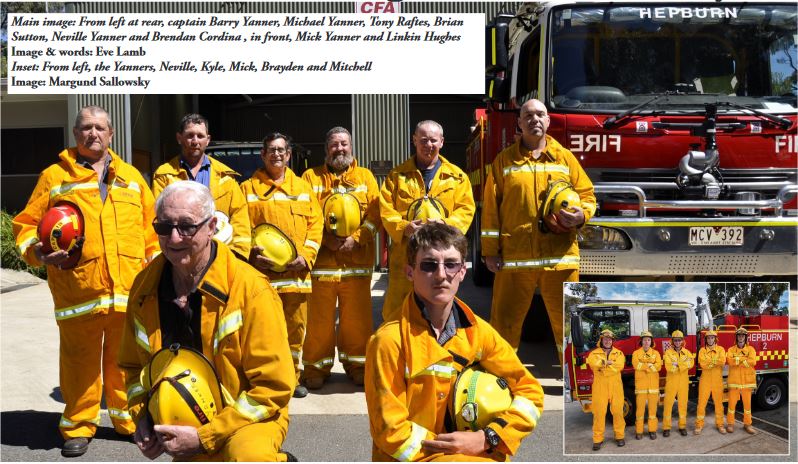
The Hepburn brigade has about 30 members who range in age from 16 to 78. The eldest is Barry’s uncle, Mick Yanner who’s been with the brigade for an impressive 65 years, while the youngest is Daylesford Secondary College year 11 student Linkin Hughes, 16, who’s hoping to eventually become a career firey.
“I joined the CFA as a volunteer at Glenlyon in 2019 when I was 11,” says Linkin who has recently qualified to turnout on the tanker to incidents.
“It’s probably the community commitment,” Linkin says when asked what it is that keeps him motivated to be a volunteer CFA firey.
“I like the hands-on tasks,” he adds. “You learn a lot from it, including from the online challenges.”Acquiring first aid skills including CPR training is part of the training, along with learning how to use appliances like the new tanker that the brigade received last year.
For the eldest member of the brigade, Mick, having notched up 65 years of CFA service for his community is a source of pride, as is seeing three generations of the Yanner family be part of the brigade.
Today, Mick’s grandsons Mitchell, 17, Brayden, 19 and Kyle, 21 are also volunteer members of the local brigade, as is their father Neville (Mick’s son).
Looking back over his own considerable time with the CFA, Mick – who’s received life membership and a 60 year service medal for his decades of dedication – chuckles as he recalls some of the changes he’s witnessed over those 60-plus years.
Today both of the Hepburn brigade’s tankers are equipped with defibrillators. But it wasn’t always the way.
“Years ago the trucks didn’t even have a first aid kit,” Mick says. “You were lucky to find a bandaid.”
Reflecting on the big changes that have occurred since those early days, Barry says something special is being planned to celebrate the big 80th anniversary that ticks over on December 9 this year.
“We’re going to do something. It’s quite a milestone,” he says.
In the meantime he’s encouraging anyone interested in joining up as a volunteer member to get along to one of the brigade’s regular training days.
February 17th, 2024Walks of the Central Highlands
With Eve Lamb
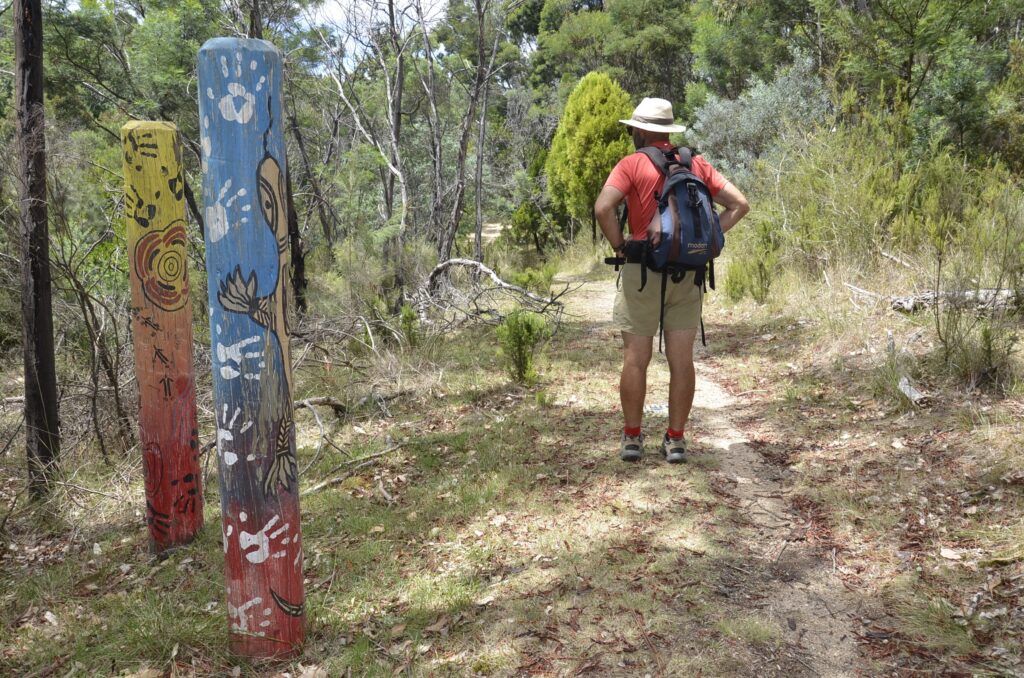
Creswick Heritage Walk
If there’s just one walk to take visitors on while in the Creswick area, this would have to be it.
The Creswick Heritage Walk is a little beauty, chock full with points of interest and diversity despite its comparative brevity at just 8.5ks. It’s supposed to take three hours to complete but, lingering indulgently along the way, it took us about five.
It takes in the University of Melbourne’s historic Creswick Campus grounds, and the rich history of pioneering forester, arbourist and conservationist John La Gerche, incorporating the leafy La Gerche Trail with its established trees, including oaks and conifers, that were among the many species La Gerche trialled here in the late 1800s.
We set off one fine Saturday, late summer. A cracker of a day to hit the trail, equipped with the Creswick Heritage Walk map (easily obtained online courtesy of the Great Dividing Trail Network) a picnic lunch, and a sense of adventure.
The walk sets off from the town’s central Visitor Information Centre, crosses the main drag, Albert Street, and follows Victoria Street past the Creswick Water Splash Park on your left and the IGA supermarket on your right, across the Creswick Creek footbridge.
Then there’s a short stroll, to the right along Moore Street, to reach the starting point – the wrought iron gates of the University of Melbourne’s Creswick campus, formerly the School of Forestry, established 1910.
We enter the gates, admiring the park-like setting, and follow yellow-topped Goldfields Track posts heading diagonally through the campus, past the heritage- listed Victorian splendour of Tremearne House near the entrance, and past the imposing white historic façade of the former Creswick hospital, a fetching habitat for ghosts. If they existed.
The campus grounds here host some splendid old significant trees, established as part of an arboretum (grab a pamphlet from the Visitor Centre). Following the markers, we reach a sealed roadway and turn to the left to pick up the trail markers on the opposite side of the road and link with the Landcare trail, now on Parks Victoria land.
For a short stint now the trail features colourful tiles with environmental messages made by school students, and takes us to the start of the 2km long La Gerche trail winding through a diversity of conifers and the extensive Oak Gully, established more than 135yrs ago as a state nursery for rehabilitating the mined moonscape of the era.
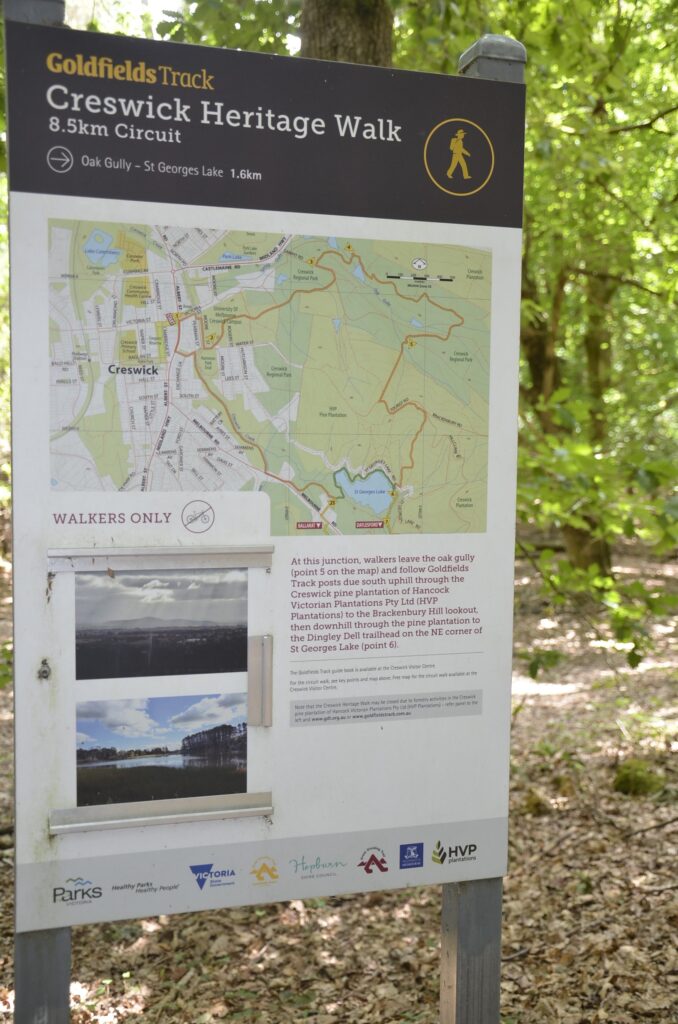
This is a superb slice of arboreal heritage, and the great significance of La Gerche and Creswick’s role in the state’s forestry and conservation heritage is detailed on plaques, markers and monuments along the way.
As it’s getting on lunch time we take a good moment here to soak in the cool ambience and appreciate this special place, its history and its living presence.
The sandwiches and home-baked black forest cake that Paddy H thoughtfully packed go down a treat in the depths of the Oak Gully, but eventually it’s time to move on as we’ve got a walk to finish.
It’s easy to find the right place to turn off and leave the forested La Gerche trail, as the correct point to do so is well marked with signage boards. Look out for them in the Oak Gully and you can’t miss ‘em.
Leaving the leafy La Gerche legacy, we diverge from the Oak Gully (point 5 on the map) forging due south uphill through a re-establishing young radiata pine plantation to the lookout on Brackenbury Hill.
Appreciating the sense of isolation here, we gain elevation following the sandy track uphill, brushing through tall native grasses. Views behind us open up to Spring Hill a few kilometres to the north, north east. Dramatic against the season’s blue sky.
Gaining elevation further, we reach the lookout point (1757 foot) where a stone cairn marker, a historic gift from the yesteryear Creswick Old Boys, helpfully provides a 360 degree pointer to various landmarks unfolded before us in a sun splashed geographic pastiche.
After pausing to admire it all, we wend our way downhill and onwards toward St Georges Lake. I’m fairly glad, around about here, that my ever-watchful walking accomplice is tuned in so we don’t actually miss the (unobtrusively marked) right hand veer that comes up quicker than expected, as you begin descending, diverting you quite abruptly to St Georges Lake. Its watery expanse makes for a lush reward on a hot day. Note to self: Pack swimmers for next time!
Arriving at its glistening edge, we first take a quick little turn to the left simply to join the lakeside track that then leads Creswick Heritage Walkers to the right, hugging the pine-fringed northern shoreline.
We follow the green Parks Victoria posts leading to the concrete spillway and then to the inviting lawned bbq area that’s alluringly visible across the water towards the south side of the lake.
Today, there are plenty of kayaks, picnickers and swimmers and it’s all pretty scenic. So we opt for a lakeside chocolate and coffee reviver with a good view to the spillway just beyond the craggy remains of a disused jetty where kayakers now frolic.
Moving on, we next traverse the spillway, reaching that lawned picnic area which today is offering a concise demonstration in what fruit salad days are made of.
We’re now back in civilisation and at the car park’s west end, locate a yellow- topped marker and from here follow the Goldfields Track posts of the Eureka Track back into town with Creswick Creek a stealthy companion on our right.
We finish this fairly excellent day with a brew at one of the town’s two pubs and a sense of satisfaction at having completed this top little hike. It delivers an insight- rich crash course on the area’s unique historic significance, with captivating features around pretty much every turn.
February 16th, 2024
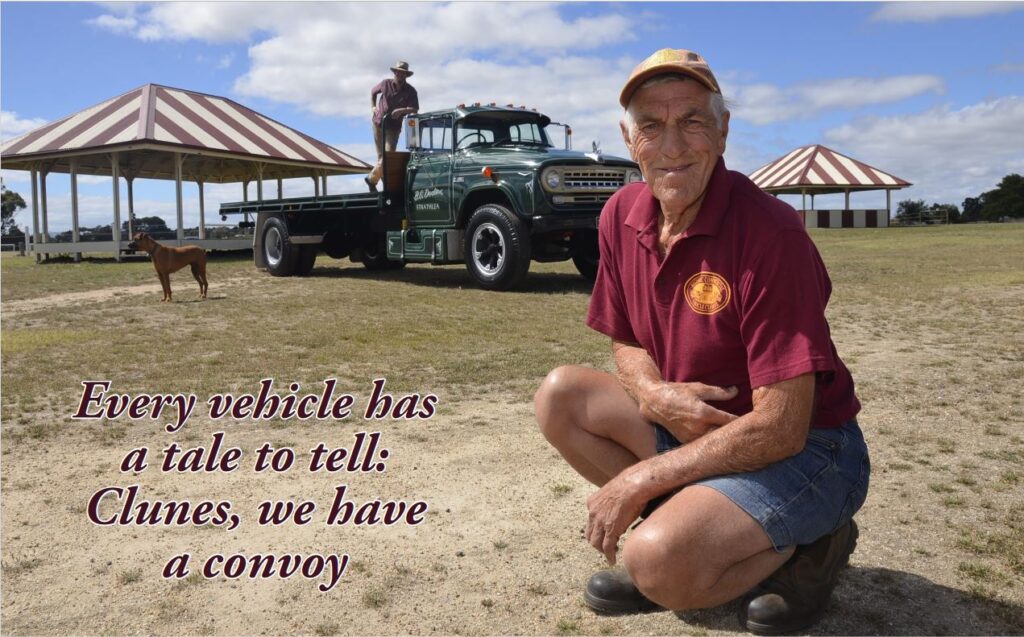
When the Historic Vehicle Show happens at Clunes showground next month look out for the
retired truckies as they catch up with tales tall and true.
Starting the day before, the town’s attractive little showground gradually transforms as it fills to the
hilt with retro vehicles, many of them historic commercial trucks as this annual fixture is staged by the Historic Commercial Vehicle Club of Australia, Ballarat branch.
For Strathlea retired career truck driver, Barry Dodson, for example, it’s a time to show off a historic vehicle or two from his own collection, and also for some serious chin-wagging as he catches up with
others in the scene that has its own staunch following.
“This show is on the circuit,” says Barry who clocked up seven million kilometres (but who’s counting!) during his 52-year pro trucking career that started when he was a mere youngster of 20. Imagine the stories to come out of clocking up that many ks.
Yes, Barry says, there are a few. But some of them involve witnessing some things on the road that
you’d probably rather not recount.
“I’m a worn out, retired truck driver,” he laughs.
“I drove for seven years interstate, Adelaide and Brisbane, and then local, bulk grain and fertiliser.”
By “local” he means the state of Victoria and pushing a bit over the NSW border as well.
“I drove Internationals and Western Stars. The first semi I ever drove was an International. It was a C
Line Butterbox. I’ve always had Internationals and loved ‘em.”
These days Barry loves few things better than to spot some old neglected vintage vehicle and then
lovingly restore it to full gleaming glory.
He currently has a collection that features three vintage International trucks including a 1970 International C Line with V8 engine, Tasmanian oak tray and chrome features, that he loves to take
along to shows like Clunes’ as a conversation starter.
Suffice to say he’ll be heading along to the upcoming show here on Sunday March 10 to add the
beautifully restored 1970s workhorse (named Greenie) to the impressive number on display.
“This is the 13th show here and I came to the first and then joined the club,” Barry says.
Many who get along to the Clunes show also link in with other similar vehicle shows on the state’s
calendar.
“Besides this show at Clunes there’s another one at Lancefield before it and one at Kyabram after it
and people will go from one to the other over the three weeks,” Barry says.
“You do get a lot of retired truck drivers.”
Camping is encouraged at Clunes and many make a weekend of it, says the club’s Jon Paine, a Clunes
local who helps make it all happen.
“It’s a get-together for people to chat about old times and who used to work with who,” he says.
And it’s not just trucks. There’s also all sorts of collectible cars, small engines, caravans and tractors
that roll up as well, Jon says.
Vehicles that go on show must be at least 25 years old and Jon says they never quite know what’s
going to roll through the showground gates until the day arrives.
In the past, the surprise packets that have shown up have ranged from a vintage agricultural crop
header to the musician “Chooka” Parker.
“Last year there were roughly 80 trucks here on the Saturday night before the show and over the
Sunday of the show we had 180 trucks and 200 plus cars,” Barry says.
The admission fee is $10 for adults with kids under 16 free and the HVCA Ballarat branch donates
proceeds raised to good local causes and organisations, having given away $200,000 over the past
decade, Jon says.
The event is also a significant fundraiser for other local entities as well, including the Clunes and
District Agricultural Society and the local primary school which provides on-site food, alongside various food stalls that get along as well.
“It’s a time for everybody to come and enjoy themselves and relax,” Jon says.
The Historic Vehicle Show, presented by HCVCA, Ballarat branch, takes place Sunday March 10 at
Clunes Showgrounds with gates open 9am-4pm
February 15th, 2024Staying social with Scottish Country Dances

It was in Germany, of all places, that they eyes of Creswick’s Susan Greenbank were first opened to Scottish Country Dancing.
Eight years on it’s clear it was to be an enduring passion as Susan is among the region’s legion of Scottish Country Dancing devotees now keenly anticipating the resumption of the Daylesford Dancers’ Scottish Country Dance Group sessions from March 5.
From that date the Daylesford group will be dancing on the first and third Tuesday of each month at the Masonic Hall in Vincent Street.
The group’s Heather Ross says it’s a very sociable session and Scottish Country Dance is itself a very social activity.
“It’s not Highland Dancing,” Heather says.
“It’s more like square dancing and it’s purely for fun.”
Like many of the Daylesford group members both Heather and Susan also dance regularly with the Ballarat Scottish Country Dance Group as well.
Members from both groups recently joined forces to give a demonstration of the time-honoured dance form as part of a multicultural event at Ballarat’s Lake Wendouree.
Chatting with them after catching their engaging kilt-swirling performance it quickly became clear that members of both groups jump at just about any opportunity to dance with others who share their passion for the dance form.
“People come to our Daylesford group from as far as Werribee, Melbourne, Castlemaine, Ballarat,” Heather says.
“The Daylesford group was actually started by (the late) Les Morrow from Castlemaine, for people who love the dance form to come together from across regional areas.
“The group’s been going for at least nine or ten years now. It’s just kept going and it’s very casual but we’d love new dancers to come along. We’d love to have more Daylesford area people coming to the group.
“When we get new dancers beginning we take it very slowly. We introduce them to it slowly.
“You don’t have to wear tartan. No special clothes are needed. The main thing is just to have soft shoes and a sense of rhythm, and you’ve got to be reasonably fit.”
There must be something fairly addictive about Scottish Country Dancing as many of the region’s members become so engrossed in it that they travel to Melbourne on a weekly basis to participate in social dance sessions there as well.
“I’ve been going (to the Daylesford dances) now since 2016,” Creswick’s Susan Greenbank says.
“It’s not competitive. It’s all social. The thing I enjoy most about it is the fun and the laughter, especially when you mess up. You laugh your head off.”
Many of the Ballarat group members regularly travel to Daylesford to participate in the sessions at the Masonic Hall in Vincent Street as well as attending their group’s regular dance sessions on offer in Ballarat.
One of their members, Graham Gooding, says the dance form seems to particularly appeal to people with a maths or science background. Perhaps because of the repeating patterns, sequences and symmetry involved.
For these reasons it’s also recognised as being pretty good for the brain as well as the body, dancers say.
Graham is pretty clear about what the main attraction is for him – “the music and the fitness and the fun,” he says.
No partner is necessary to participate and the upcoming Daylesford dance sessions take place between 10am and 2pm with those who attend invited to bring lunch along with them, and drinks provided as part of the $10 session cost.
Heather says all newbies are more than welcome and should give her a call first on 0418-313-060.
Words & Image: Eve Lamb
February 2nd, 2024Quick go the shears at Clunes – for a cause
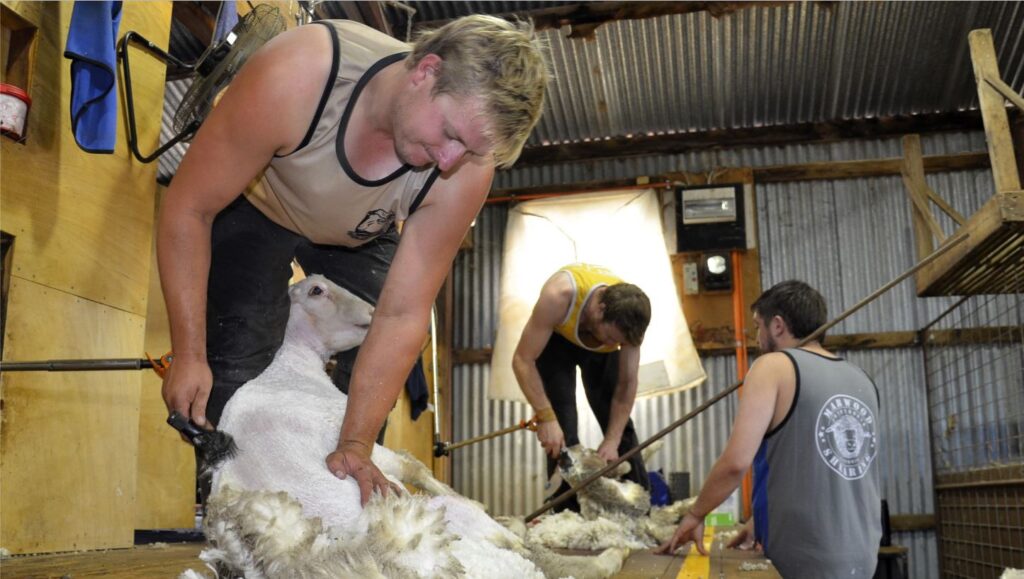
Showcasing the athleticism of one of the toughest jobs in modern agriculture, Clunes Quick Shear has become a favourite competitive fixture on the calender of pro shearers both local and from across the ditch.
It may not be included as a competitive Olympic sport just yet, but the Clunes & District Young Farmers are once again staging the niche competitive event at the town’s showgrounds with the date set for Saturday February 24.
“This is our our eighth annual Quick Shear, after a couple of prior test runs,’ Clunes & District Young Farmers’ treasurer Jenny Redpath says.
The main showcase spectacle of the day is the Quick Shear competition featuring three different categories – novice, intermediate and open.
The competition has a reputation for being pretty robust, attracting gun shearers and plenty of top athletic talent from among the Aussie shearing and Kiwi shearing pro circuits.
There are some good cash prizes up for grabs and with various Quick Shear comps out there besides Clunes’, Jenny says top shearers have a tendency to follow the Quick Shear competitive circuit, supplementing their income when they make off with the spoils.
A main highlight of the day at Clunes is the Aussie versus Kiwi relay event, a crowd-pleaser, with the Aussies likely to be out to settle the score this year and to avoid coming away feeling sheepish this time round.
There’s also a lively dash for cash competition, creating a second chance for those who missed out in the earlier main event to take another tilt at securing some prize-winnings.
It’s a family-friendly day and apart from anything else, offers an entertaining spectacle. Jenny says a barbecue will be among the on-site food options with drinks at bar prices and camping available at the showgrounds.
“The shearers are just amazing to watch, the way they move and position the sheep to make sure they’re safe and comfortable,” Jenny says.
“It is a skill we need to continue. We want to encourage the younger generations to get into shearing and build their skills.”
Every year that it’s been held, Clunes Quick Shear has raised money to support a worthy cause or charity, carefully selected by the Young Farmers, and this year’s cause is the Royal Flying Doctor Service.
Jenny says the event has built up a strong following attracting 54 shearers last year including a notable contingent of New Zealanders and even a couple of visiting English shearers as well.
“Yes, we definitely get a lot. Last year we were ten shearers up on the year before and we even had a couple from England – a boyfriend and girlfriend who were both shearers. There is usually a good amount of women who enter as well.
“We also have an auction and raffles with lots of good prizes.”
There’ll also be a commentated blade shearing demo, children’s activities and live music featuring pub rock outfit, Cut Lunch.
Entry is by gold coin donation with the day set to get started at the showgrounds from 2pm.
Words & Image: Eve Lamb
February 2nd, 2024Sunny side up: a new crop for Clunes
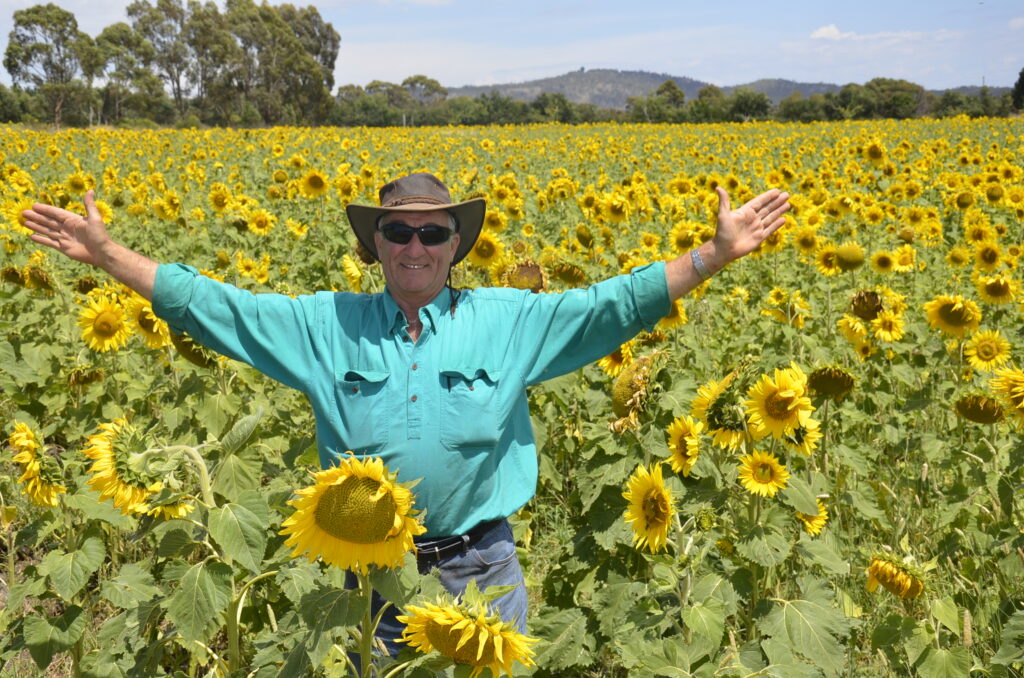
The field full of sunflowers on the outskirts of Clunes has been attracting its fair share of attention.
Growing these golden glories is a bit different here but all going well with the crop, that’s been planted by Miners Rest’s Andrew Fraser in a shares arrangement with Clunes’ Malcolm Hull, they may just become a more common sight into the future.
Long time Clunes local Malcolm Hull, who owns the paddock, says they’re growing the 12 hectare crop after Andrew approached him back in September with the slightly different farming proposal.
“We own the land and he’s got the skills and machines,” says Malcolm.
Andrew Fraser runs Frakel Farming Produce, a stock-feed business selling hay and a wide range of livestock-feed grains that he also grows.
The anticipated sunflower seeds are destined for use as quality animal feed ranging from birdseed to a component in horse feed mixes, Andrew says.
It’s the first time he has diversified into growing sunflowers and it’s all a bit experimental, but so far – fingers crossed – the weather has actually been on side.
“It’s been quite a damp summer which has been a bit of a Godsend for this crop,” Malcolm says.
It’s not believed to be the very first sunflower crop ever planted in Clunes as a commercial venture but, that said, it’s been a very long time since the immediate area saw its last field full of sunflowers grown on such a scale.
“I’d say it’s the first crop grown here for a very long time. I’d say we’d probably have to go back to the early ‘90s when one was grown in the Mount Beckworth area,” says Malcolm whose family goes way back at Clunes.
“My father always used to call this paddock (that the sunflowers are growing in) Kelly’s paddock after the family that once owned it.”
There are currently just a handful of other commercial sunflower crops in across the wider district including one at Ascot further down the road toward Ballarat.
Andrew Fraser is also growing that crop in a partnership arrangement with another local there.
“It’s a summer crop and it’s my first crop of sunflowers, says Andrew. “I put the Clunes crop in about a week before the one at Ascot.
“The reason I decided to grow it is just because it’s so hard to find sunflower seed. Normally it’s grown in the top part of New South Wales or in Queensland, and around Shepparton too, a lot further north.
“I‘ve seen a crop in Smeaton a few years ago.”
They’re also known to be grown at Dunnstown near Ballarat.
Andrew and Malcolm say the 12 hectare crop at Clunes was sown back in October and it’s been pretty straightforward since then, with a late application of fertiliser administered a little while back, and harvest now anticipated toward the end of March.
It may possibly be necessary to rig up some gas scare guns to operate during daylight hours just to keep the potential interest from cockies and corellas at bay as the seeds ripen, Andrew anticipates.
“It’s something a bit different here but in Europe there’s tens of thousands of acres grown for oil production,” Malcolm says.
“We were in France back in 2019 and there was just paddock upon paddock of them.
“They’re certainly eye-catching and there’s been plenty of inquiries and people interested in it,”
“We’ll just see how it goes this year and if it’s a good-yielding crop maybe we could look at growing them for oil.”
Words: Eve Lamb
January 20th, 2024Walks of the Central Highlands
with Eve Lamb
Lalgambook (Mount Franklin) crater rim walk
If you haven’t yet done the Lalgambook (Mount Franklin) crater rim walk, now’s a great time to get cracking.
I first sampled this little must-do hike several years ago as part of a longer guided walk led by Professor Barry Goanna Golding AM. The guided Golding trek had focussed on the significant Dja Dja Wurrung Aboriginal history of the wider landscape here, particularly including the Franklinford area, known to the Dja Dja Wurrung people as Larne-ne-barramul or the home of the emu.
Ever since then, I’ve always wanted to return to take a little longer to focus on the ancient extinct volcanic feature itself. This prominent local landmark, Lalgambook (648 metre elevation) is part of the Hepburn State Regional Park jointly managed by Djaara (Dja Dja Wurrung Clans Aboriginal Corporation) and Parks Victoria.
The crater circuit stroll is just 1.7 km in length, so there’s few excuses for not doing it. But despite its very leisurely post-lunch length, that won’t do much to enhance your reputation as a serious bushwalker or rid you of that extra padding acquired over the festive season, this is a great little short walk.
To properly appreciate it, it’s best to understand something of both the geomorpholology of this ancient area and the Aboriginal mythology and significance of Lalgambook (Mount Franklin).
Situated about 10 km north of Daylesford and accessed off the Midland Highway via a road that traces an ancient breach path of lava exuded from the crater, Lalgambook was created by a fiery volcanic eruption about 470,000 years ago. Today it’s classed as a prominent, breached conical scoria cone with a deep crater.
The resultant caldera (large crater, formed by the eruption leading to the collapse of the volcano mouth) is one of the deepest in the Central Highlands.
Lava flow from Mount Franklin and other volcanoes that preside over the surrounding rolling ancient plains had buried gold-bearing creeks that would become the ‘deep leads’ sought out and excavated by gold miners during the subsequent rush era.
The volcanic eruptions of Mount Franklin are believed to have been witnessed by members of the Dja Dja Wurrung Aboriginal tribe who referred to this ancient country as the ‘smoking grounds’ and to the mountain itself as Lalgambook.
The literature records that “Mount Franklin and the surrounding area appears to have been a place of considerable significance to the Aboriginal people. Both ethnographical and archaeological evidence indicates that frequent large ceremonial gatherings took place in the area.”.
Research had also led me to the following traditional creation story, as previously told by Justice B Nelson – Dja Dja Wurrung, Jaara – and published by Culture Victoria, telling the tale of two feuding volcanoes named Tarrengower (overlooking today’s township of Maldon off to the north) and Lalgambook:
“A long, long time ago, long before anyone but the Traditional People walked our Country, our lands, rivers, mountains and animals alike, all had magical life. They had personalities, purpose, speech and they could think for themselves.
Tarrengower in the Dja Dja Wurrung means to be big and heavy and indeed he was just that; big, bold, wise and a very proud old volcano who had become very tired throwing out rocks and lava and preferred to sit humbly watching over the plains.
Another volcano called Lalgambook was a young, loud and cheeky volcano that started to challenge old Tarrengower’s wisdom and authority, and began grumbling and building up anger towards the old volcano. But Tarrengower, being the wise old volcano that he was, decided he should just try to ignore this cheeky little volcano.
Lalgambook grew even angrier that Tarrengower wasn’t acknowledging his threats and started to put on a display of smoke, ash and brimstone to impress the land and animals who were also watching, but this didn’t intimidate the wise old Tarrengower. Instead he just laughed at Lalgambook.
Lalgambook became so frustrated that he began to throw large rocks at Tarrengower who grumbled with annoyance at this cheeky volcano and Tarrengower now began to taunt young Lalgambook by telling him he wasn’t very strong at all because the rocks couldn’t reach him.
Lalgambook exploded with great fury, spurting out lava and smoke high into the sky and hurled gart gart in Tarrengower’s direction, but still could not reach him. This caused Lalgambook to completely blow his core!
Tarrengower’s anger eased and he just grumbled at this cheeky little volcano who was now just coughing and spluttering with no energy left at all.
All the rocks thrown by Lalgambook at Tarrengower can still be seen today and have formed what is known in the present day as the Guilford Plateau where the Jaara people would perform ceremonies on the Bora grounds also known as Yapene.”
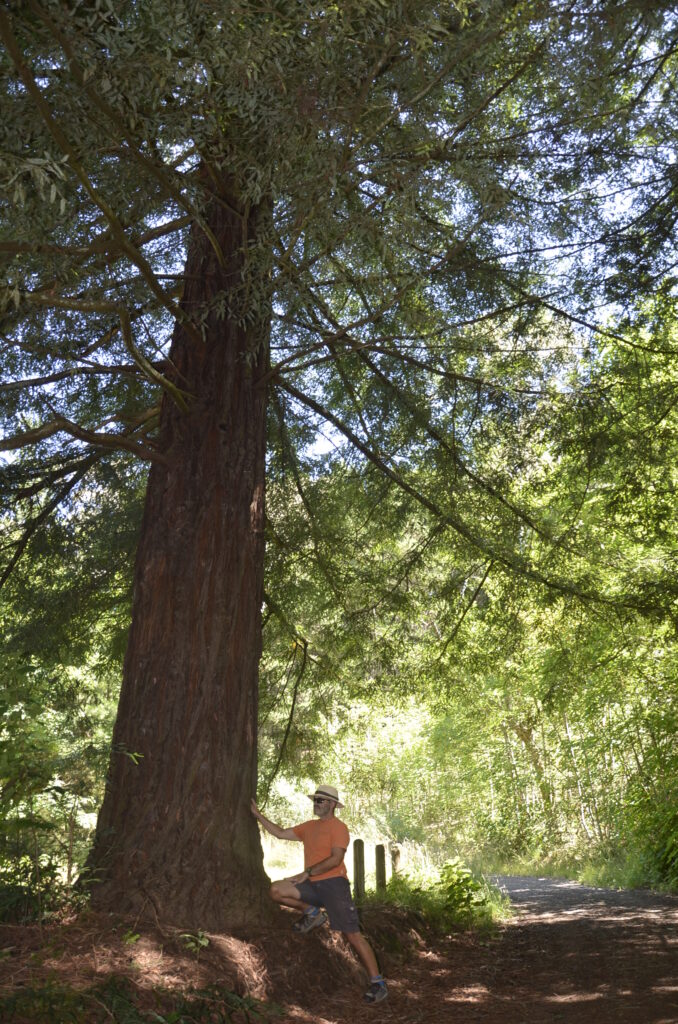
Reflecting on this lively heritage, my tireless walking companion Paddy H and I elect to start with a picnic inside the Lalgambook caldera which these days is an arboretum featuring established leafy exotics including silver birch, white poplar, sycamore and Sequoia sempervirens (Californian Redwoods).
It’s an attractive spot offering free camping complete with composting loos, and following our lazy picnic here, we start out on the signposted crater rim walk from the western side of the caldera.
It’s a very gentle climb through pine trees and other exotics, gaining some expansive views to the west to gradually reach the summit.
All the while I’m keeping an eagle eye out for rumoured semi-precious gemstones as I remember Prof Golding saying something about their being here. I’ve since read that, as a consequence of the now extinct volcano erupting all of those thousands of years ago: “the coarse ejecta exposed around the summit includes red and green olivine and megacrysts of high-temperature (some of the largest known Victorian examples) and orthoclase (to 7 cm long) and augite (over 9 cm long).”
Megacrysts? The potential research associated with this place is probably endless…
By about the half-way mark I still haven’t located any megacrysts, but we’ve reach the summit telecommunications tower and don’t spend too much time here before we begin the descent, sunlight filtered and flickering through the pines.
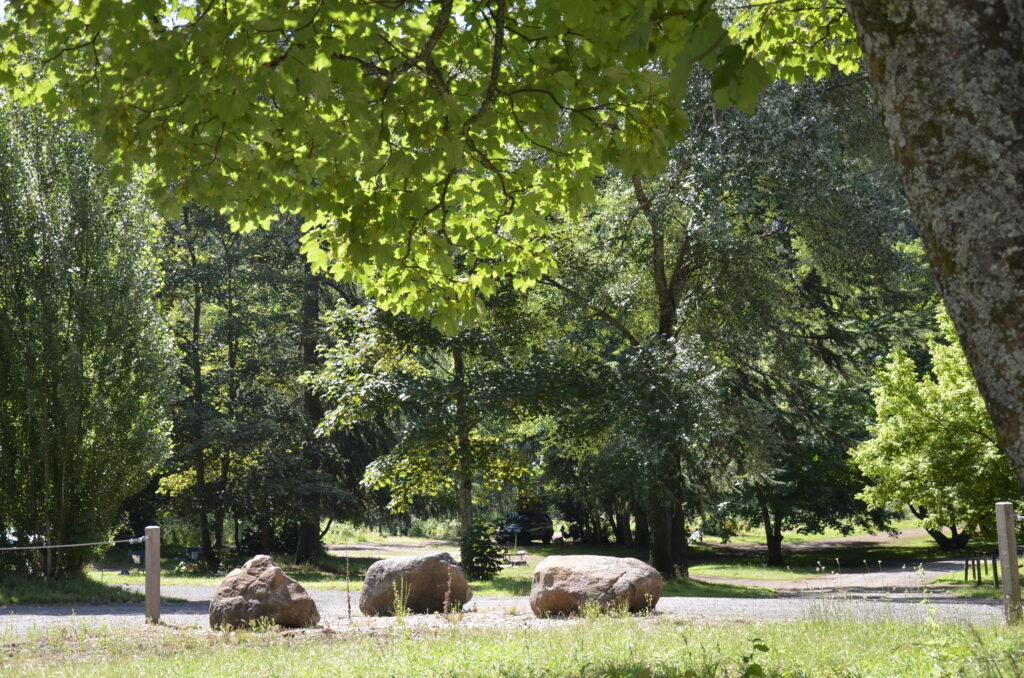
It need be noted here that the country around Mount Franklin was described in 1855 as “thickly timbered with box and stringbark”. Unfortunately, in 1944, a devastating bushfire destroyed most of the native vegetation on the mount.
As a result, the inner and outer slopes of the crater were planted with the exotic species we see today, mainly conifers. The caldera was planted with the leafy ornamentals I mentioned earlier, and whose shade we soon reach again to find that during our walk, more campers have rolled up to forest bathe in its charms.
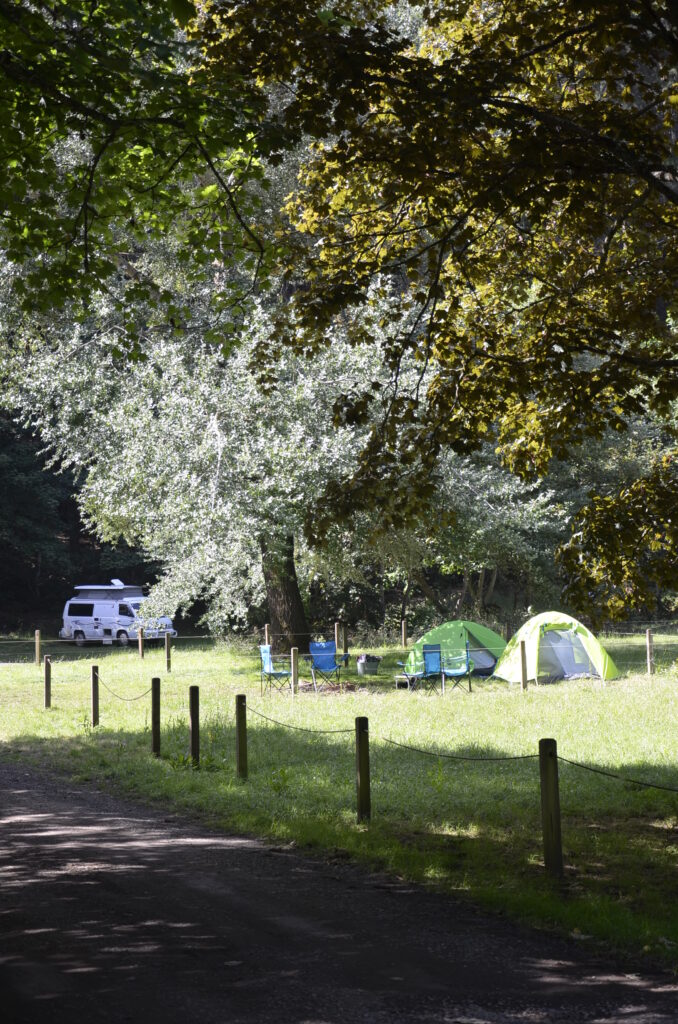
At this time of the year, summer school holidays, the short but heritage-rich Lalgambook crater rim walk is a choice option for young families to sample, while this beautiful leafy free camping and picnic area is well worth a visit in its own right.
Words and Images: Eve Lamb
January 18th, 2024The secret lives of a writerly town
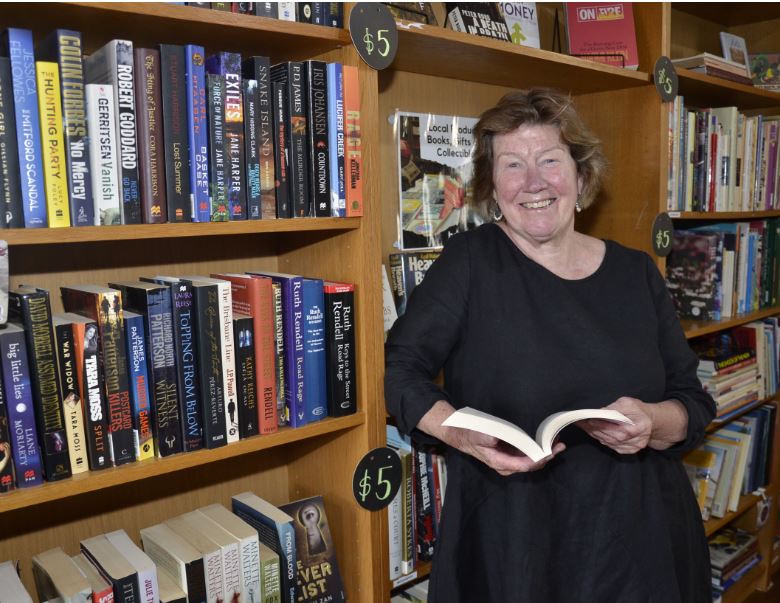
A significant number of secret lives have been uncovered in Clunes.
There was once a man, let’s call him Toddy, and he stumbled quite unawares into one of them.
It all happened one Saturday when Toddy, visiting Clunes from inner Melbourne sauntered into Boom Clunes, the main street community retail hub representing local makers and selling books new and pre-loved.
Inside the handsome double-storey 1800s building, Toddy had wandered past a diverse array of handmade products created by local artisans, craftspeople and cooks, and took himself straight to the pre-loved books room. He wanted some good holiday reading.
Toddy selected a biography penned by a reputable writer and took it to the counter, delighted with his find and pleased to see that all of the pre-loved books cost only $5 each.
“A bargain,” he thought, as the biography he’d found on the life of a former notorious sporting personality was in top-shelf condition and, he knew, that if acquired brand new would have cost him that asking price many times over.
The friendly woman at the desk flipped the book over and told Toddy “Ah! That book has a secret life”.
“Sorry?” replied Toddy, unclear as to what she meant.
“Yes,” said the woman. “It has a secret life which means it comes with this…”
She reached beneath the counter, pulled out a cardboard box and from it extracted a neatly filed white envelope which she handed to Toddy. “That’s yours to keep,” she told him.
And that’s how Toddy ended up immensely enjoying a secret life.
He’d just discovered the Secret Lives of Books project happening at Clunes. It’s a unique project, where anyone who may be feeling writerly (and there are reputed to be quite a few in Clunes who regularly do) can volunteer to pen anywhere up to a page-long “secret life” for any of Boom’s pre-loved books that they choose.
When a customer then purchases a book that has had a secret life written for it (and is especially demarcated with an ‘S’ on its back cover as such), they receive not only the book but also it’s written secret life in an envelope to take away and delve into as well.
It’s a bit like getting a surprise gift, or participating in an exclusive book club where you get to receive a personal original response to the book in hand.
A creative initiative between Boom Clunes, the Clunes Neighbourhood House (that manages Boom) and the Western Victorian Primary Health Network, it all started during Covid in 2021 and since then has produced all kinds of “secret lives” to go with numerous selected books.
“It’s taking the interaction with the book to another level,” says Lois Nichols, project manager at Boom Clunes. Lois is a keen amateur short story writer with a background in magazine publishing who has so far penned 15 secret lives for selected books through the project, and counting…
Locals feeling inclined to pen a secret life for one of Boom’s pre-loved books get to read the book themselves for free first, before handing it back along with the secret life they’ve written for it.
These secret lives range from imagined fantastical globe-trotting pasts people by characters whose hands and lives the book previously graced, to interesting factual aspects of its narrative teased-out for special focus, to genuine heartfelt personal responses to the book’s content.
“Everyone’s got a different take on it,” says Lois. “Some write about how they related to the book as they were reading it or, if they were struggling with something, how the book helped them.
“It’s a bit of fun. It gets people writing and encourages people to read and it’s a way of connecting people.”
“We sell pre-loved books donated to us by local people and we have two book rescuers here, Rhonda and Patsy, one is a book lover and one is a professional librarian, and they clean, sort and beautifully file the books on the shelves so we have a fabulous range and just about every known genre.
“The idea was inspired by a book called The Secret Life of Dresses which is about a pre-loved dress shop owner who made up stories for her dresses.
“At the moment we have about 60 books in stock that have secret lives. The books with secret lives are marked with an ‘S’ on the back and each secret life is very different.
“The customers who pick up a secret life book are fascinated, thrilled, and want to know more. What started as a retail promotion has become a community activity.”
The Secret Lives of Books project fits snugly with Clunes’ reputation as a Book Town.
“We get a lot of visitors here on weekends,” says Lois.
Clunes Neighbourhood House manager Lana de Kort says the Secret Lives project is reaching and appealing to a wider range of people than the usual suspects who put their hands up to get involved in community activities.
“It’s a project that really appeals to people who are perhaps a little more introspective and who wouldn’t necessarily connect or volunteer in other ways,” she says.
“A good book really captures your imagination and this project takes that further. It’s brought a lot of people together and it’s drawn people in from Clunes and surrounding areas as well.”
Many have heard that Clunes has an annual Book Town event and they expect to be able find and purchase books in the town. Open on weekends, Thursdays to Mondays, Boom Clunes is helping to meet that expectation, Lois says.
“We also have a really strong writers’ group in town and two book clubs which isn’t bad for a little town of this size,” says Lois, herself a member of the Clunes Book Club that meets at Attitude Clunes on the third Monday of the month at 7.30pm. Meanwhile, the Book Lovers book group meets at Boom once each month as well, she says.
With the project now set to continue throughout 2024 anyone interested in writing a secret life for any of the Boom books can simply roll up at the Boom Clunes counter in person to learn more, or can call the Neighbourhood House.
Words: Eve Lamb
January 18th, 2024Berry fine way to spend a day
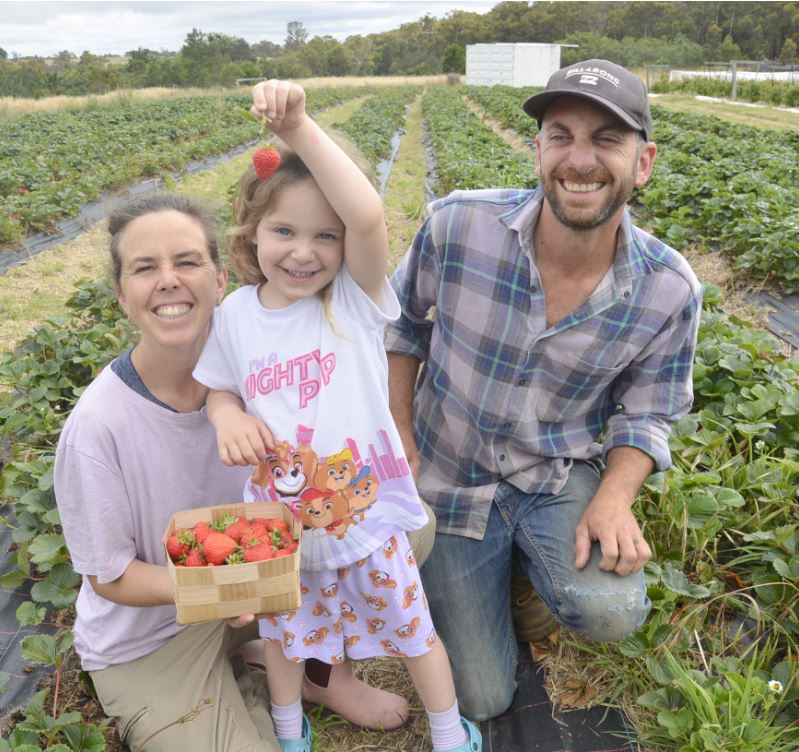
Going summer berry picking makes for an idyllic holiday activity whether you’ve got kids along for the fun or not.
At Eganstown just west of Daylesford, Claire Gunner and Peter Monea operate Morningswood Farm growing strawberries galore and plenty of different types of cane berries including raspberries, boysenberries, youngberries, loganberries and blackberries.
At any one time, they’ve got 20,000 strawberry plants growing on the property which, although not certified, is run as a spray-free organic operation.
Berry-growing season is in full swing right now with the season running right through to March and plenty of demand from locals and visitors to get out and pick the delicious ripe fruit, or snap some up pre-picked.
Claire and Peter say the recent deluge over the Christmas weekend didn’t cause as much damage as you might have guessed, because at that particular moment they’d just been temporarily picked out of strawberries, while the cane berries are growing under protective netting.
But since then there have been plenty of new berries ripening up to be picked, particularly strawberries, and a good range of different cane berries.
“It’s a big job,” says Peter, who has a background as an accountant.
“We do everything sustainably so we don’t use single-use plastics. We use heavy duty plastic for weed suppression so it can be re-used.”
Several years back, with a little creative input from a neighbour, the couple devised their own special compostable punnets for people who go fruit picking on their farm to use.
The neat little hand-made punnets are created using the sustainably sourced timber veneer discards of a Melbourne-based timber business, Peter says.
For the cost of entry to the farm to pick their own berries, visitors receive one of these nifty little punnets to place their haul in and take home.
As far as Claire and Peter are aware, they are the only people in Australia offering such punnets, although Peter says they are in pretty widespread use in Europe and Asia.
“Before we started sourcing it, the timber veneer was going straight into the rubbish bin. It’s taken us on a five year journey. No one else in Australia is using these timber punnets,” he says.
In an interesting twist, the little hand-woven punnets that they devised to help run their pick-your-own berries business, have since led to another additional enterprise and income stream, producing more elaborate natural packaging boxes using the same timber veneer industrial by-product.
“They’re used by a large online retailer and by Source Bulk Foods. It’s actually become as much of a business as the berries themselves,” Peter says.
“We also use the veneer under the mulch to help with weed suppression.
“We’ve had the berries in the ground here for the past seven years and the farm has been open for four years.”
During the summer berry season, picking your own berries at Morningswood Farm is available to the public on weekends (unless they’re picked out or they’ve been impacted by a destructive weather event) with updates going out on their Instagram and Facebook sites.
“This has been the earliest start we’ve ever had to our picking season,” says Claire who has an environmental science background and also works at local properties as a professional gardener.
“This year it went off with a bang in the second week in November.”
She says the berries they grow at Morningswood also go to supply local restaurants including some well known top end eateries.
Meanwhile, Peter is also on site “chief jam maker” cooking up a delicious range of berry jams, including triple berry options, which make for another source of income.
Peter says dehydrated berries have also proven to be a real winner for use in their own household.
He says rain in itself is not necessarily a problem at this time, providing it doesn’t hang around too long and is not accompanied by too much high humidity.
It’s been almost eight years since the couple have had the farm at Eganstown, and the berries they grow, and the pick-your-own activity they offer visitors during the warmer part of the year have won them a legion of fans and followers.
“We get a lot of locals and a lot of tourists who travel easily up to an hour from Bendigo, Ballarat and Melbourne, and a lot of regulars,” Claire says.
“Some of them will come and pick berries every second week.”
Words: Eve Lamb