


November 12th, 2023Walks of the Central Highlands…

with Eve Lamb
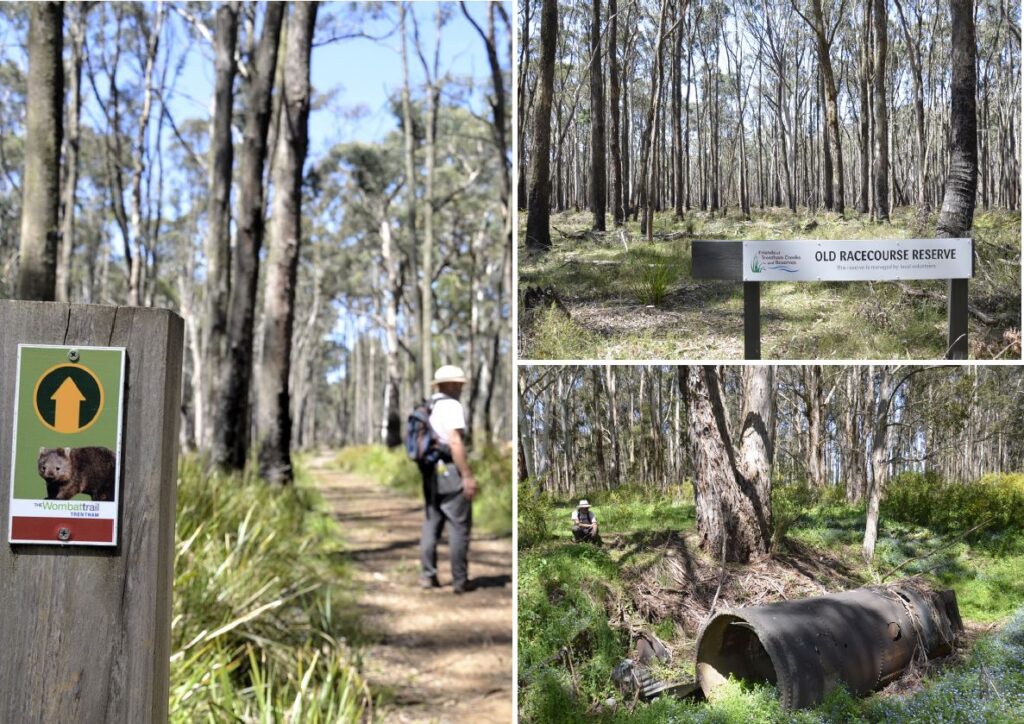
It’s a sterling Spring day, late October, as we set off to walk the nine kilometre Wombat Trail that sets out from Trentham’s pretty little Quarry Street Reserve.
While this little ripper of walk starts here in the township itself, crossing High Street and entering the Stony Creek Reserve, and then meandering through lifestyle-property-land, it doesn’t take too long before you’re in the forest with plenty of impressive eucalypts for company.
Today, I also have the company of my excellent walking companion, Paddy H, plus a packed lunch which is fairly quickly dealt with before we even leave the Stony Creek Reserve section.
So we’ve only covered about a kilometre by the time we hit the sandwiches and coffee, but we’ve already seen plenty of native birdlife and an unexpected sculptural monument entitled Inter-stelae.
Located at the edge of the Wombat Forest, this top little loop walk is both flat and well signposted and moseying along, we soon reach the historic Trentham Cemetery, alongside which the trail passes.
The cemetery itself is worth a quick stop to visit the grave of one of Trentham’s larger than life yesteryear characters, the former inimitable Dr Gweneth Wisewould. Signage shares a little of the good doctor’s eventful history (there’s her memoir ‘Outpost: A Doctor on the Divide’ to look up if you’re interested) and points out her final resting place here, facing the forest as she’d requested.
Leaving the cemetery behind, there’s a short section of trail ahead before we cross the Trentham-Blackwood Road, after which we enter the forest.
But just before we do, we encounter a couple of surprises: the first being the remnant chimney of a long-crumbled dwelling ensconced in a weedy but pretty swamp of forget-me-nots, and the second a large rusted historic boiler, a relic from the area’s past that features both gold mining and forestry. The latter helped to keep Dr Wisewould plenty busy.
At this point the canopy above us starts to become pretty impressive with some remarkable tall trees.
Crossing the Trentham-Blackwood Road, we enter the forested section of the walk and soon find fresh evidence of the trail’s namesake animal in residence. From here the trail offers a good bushland experience and further on ahead, the historic site of the former 1800s Trentham Racecourse – unused since 1907.
This is like no racecourse site you’ve ever seen before. In fact, were it not for the signage, you’d never pick this as having been a racecourse, let alone a 1.6km course that once boasted a grandstand.
Here, we’re surrounded by forest, an under-story featuring native grasses and a eucalyptus canopy through which the wind rushes in bursts like a restless inland sea. Myriad tiny white and purple native violets, sprinkled like micro fairy lights are abundant along this section of the trail.
We walk on, now navigating the forest-engulfed 1.6km racecourse loop that once hosted pounding hooves – anticlockwise as they would have raced – stopping where the grandstand once stood to imagine long-gone mug punters losing their pennies on punts and pints.
Having completed the racecourse circuit we stop for a well-earnt trail side tea break imagining ghost horses with flaring nostrils and thundering hooves… Perhaps it’s just the canopy zephyr?
From here it’s not far back to the township and the Quarry Street Reserve with its handy amenities, parking and proud new wood duck families enjoying the pond. Reflecting that we only encountered three other people along the entire trail, Paddy H and I celebrate the satisfactory completion of this little gem of a walk with a couple of bags of crisps. At 9kms, Trentham’s Wombat Trail is just the right length to tackle if you want a walk that gets you into the forest, with some unique points of interest in the mix, even if you’re strapped for time.

November 9th, 2023Going Ga Ga at Clunes

Words & images: Eve Lamb
For those of us who’d never heard of a “Ga Ga Pit”, the special ribbon-cutting occasion at Clunes Primary School last week provided a quick learning curve.
For the school’s students, though, it was the culmination of some fairly impressive lobbying to get a Ga Ga Pit of their own.
For local members of the Historical Commercial Vehicle Club of Australia (Ballarat Branch) cutting the ribbon on the brand new Ga Ga Pit was a particularly satisfying experience after they’d earlier donated $5000 for it to be built, courtesy of their annual truck show held over the March Labour Day weekend at Clunes Showgrounds. The Local’s Eve Lamb headed to the school to find out more and snap a few photos.
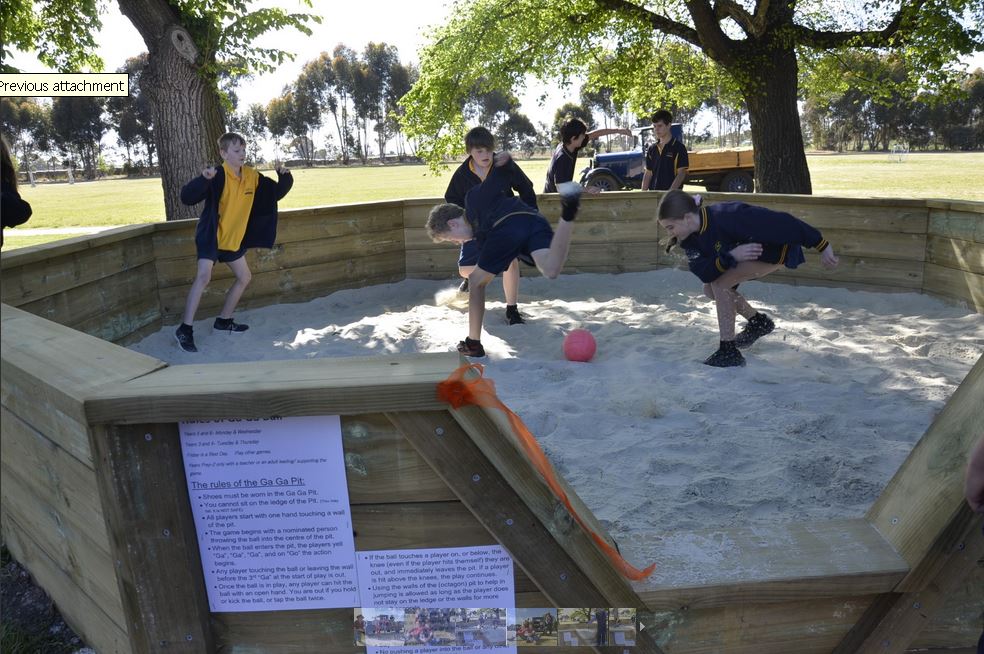
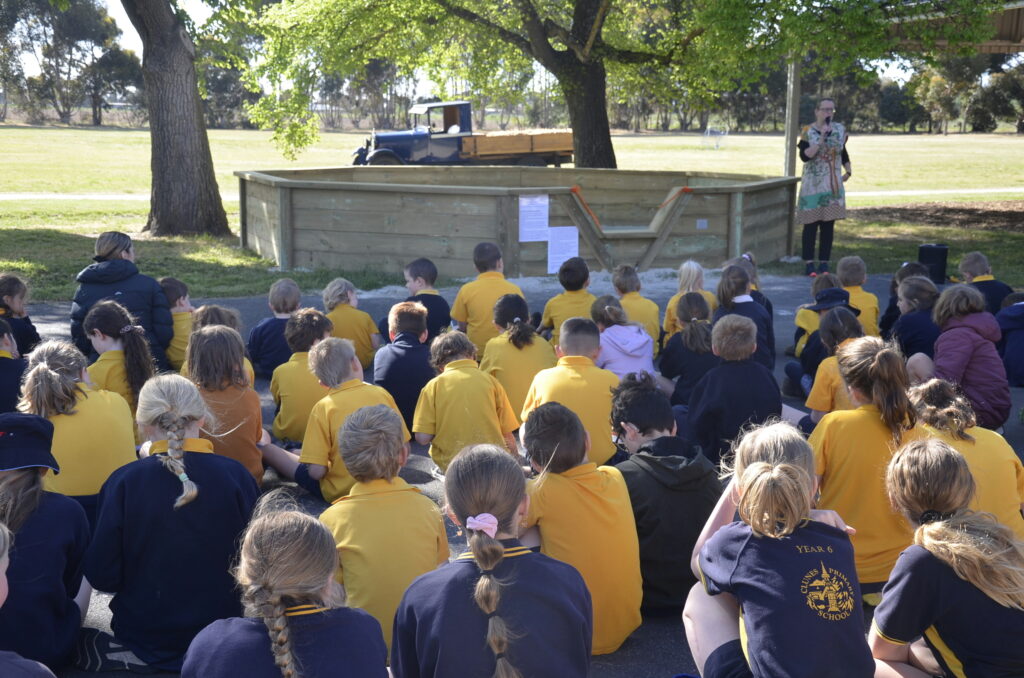
Above: Clunes Primary School students demonstrate how Ga Ga ball is played in the new pit that was purpose-built by school council members using the $5000 donation from the club. Turns out Ga Ga is a game played by children and big kids alike, a fast-paced form of handball or dodgeball played in a hexagonal or octagonal pit, with its own set of rules.
“Ga Ga is a Hebrew word that means Hit Hit and it’s been played all over the world,” school principal Sonia Jardine said, providing the uninitiated with a crash course on the finer points of the sport that’s recognised as especially valuable for building motor skills, fitness and social skills. “In Victoria they started through the YMCA camps.”
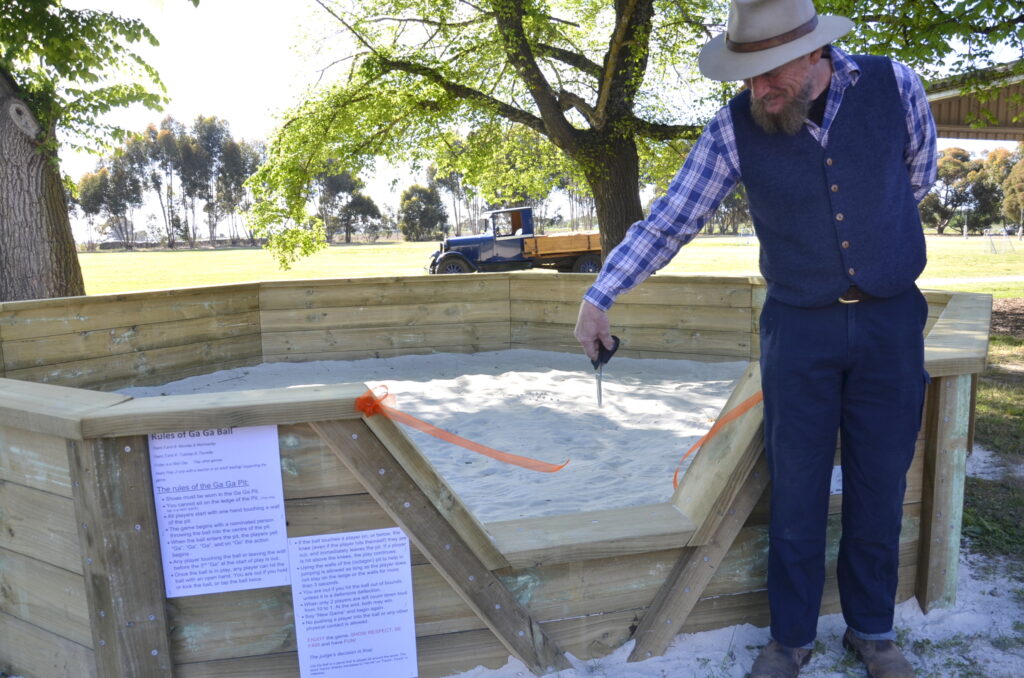
Below: Club committee member, Clunes’ Jon Paine cuts the ribbon on the Clunes Primary School’s new Ga Ga Pit. This year the club also donated $5000 to the Male Bag Foundation for prostate cancer, and another $5000 to help tackle motor neuron disease.
“Every year for the past 14 years the club has held its annual truck show at the Clunes showgrounds. We are a not-for-profit and all of the proceeds go to good causes.”
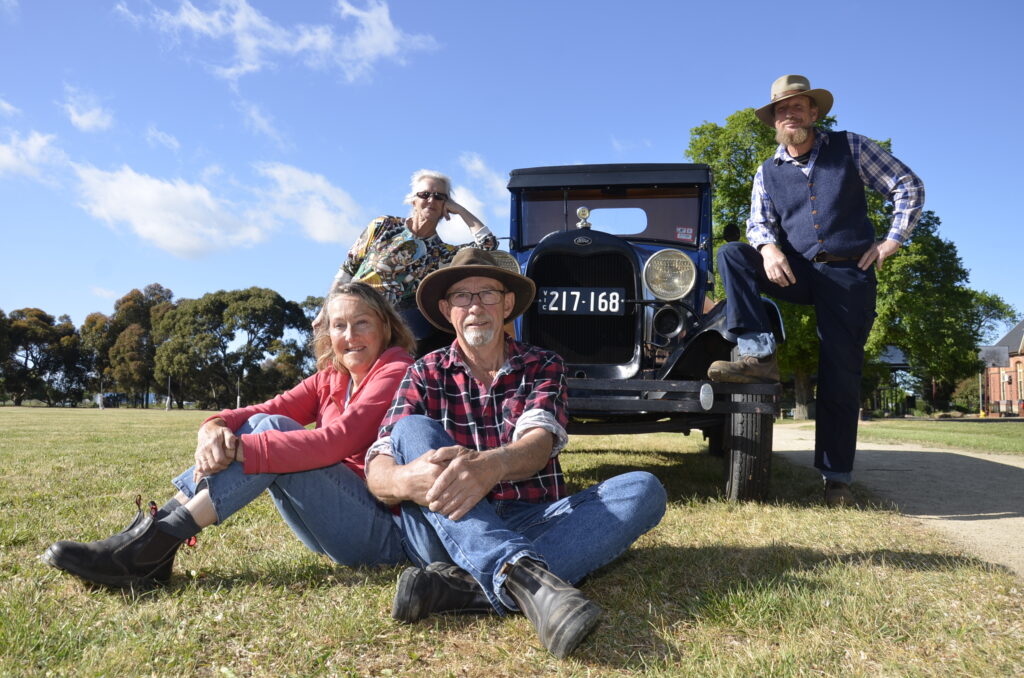
Below: From left, Clunes vintage truck enthusiasts Janet Braithwaite, Lorraine Hogan and Ken Corney (who rolled up in his 1929 AA Ford Truck) with club committee member Clunes’ Jon Paine.
Below: Clunes Primary School principal Sonia Jardine tells all assembled for the Ga Ga Pit launch that receiving the donation from the club was a wonderful surprise.
“When the club secretary presented me with the cheque I nearly cried,” she said. Ms Jardine said
students had earlier embarked on a persistent campaign to get a Ga Ga Pit for their school, after
sampling one while on camp at coastal Queenscliff.
“They’ve written me persuasive texts…it’s been a very compelling argument and the decision was
made that we would listen to the voice of the students.”
November 9th, 2023Show goes on: Clunes to stage 160th country classic

Words & Image: Eve Lamb
The 160th anniversary Clunes Show has been along time coming but it’s finally looking like all
systems go for Saturday, November 18.
“It’s not just that it’s our 160th anniversary show but that it’s also been more than three years in the
making,” Clunes and District Agricultural Society secretary Gayle Wrigley says.
“It’s been stop-start, stop-start for the last three years, first with Covid and then last year with the weather.”
Having contended with prolonged precipitation in the lead up to last year’s attempt, they’d just managed to get the centrepiece arena to thumbs-up stage when the heavens opened again.
“We got 30mm of rain and there was just no way we could run it,” Gayle recounts last year’s eleventh hour disappointment. “That was devastating. I can tell you there were tears.”
This time there’s an even steelier determination among the volunteer committee to ensure the big 160th anniversary show will go on.
“The phones are ringing and we’re getting a sense that people really want to see it back and want to get through the gates,” Gayle says.
The longstanding event packs an enviable reputation among the state’s remaining true classic country show experiences, particularly for staging crowd-rousing old fashioned entertainment.
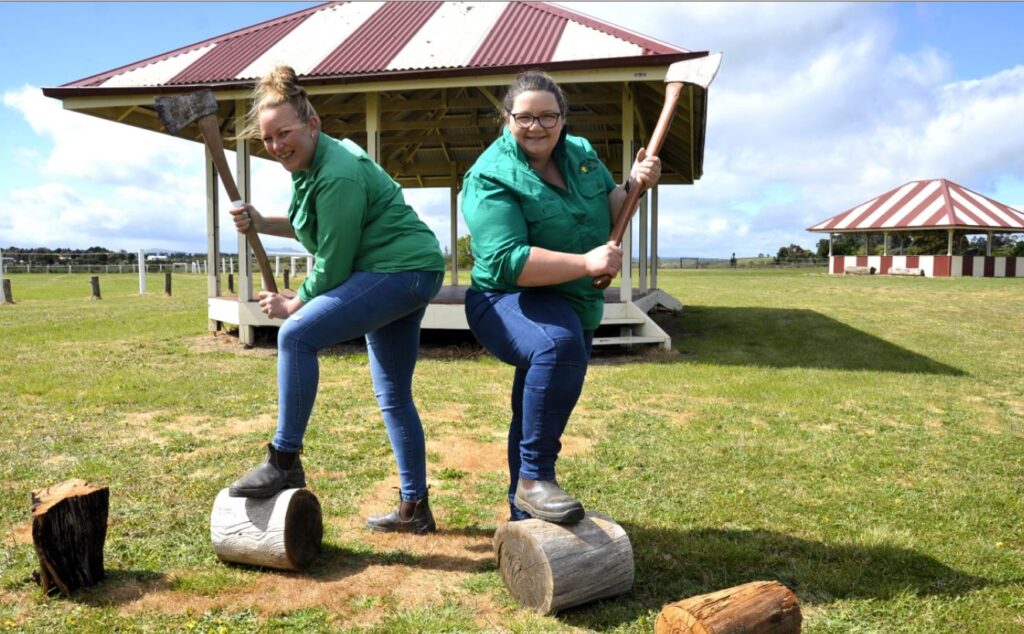
The gumboot throw, tug-o-war, keg throw and ladies’ wood splitting events are keenly contested by
locals and visiting ribbon raiders and just as keenlywatched from the sidelines.
“We’re now the only show in Australia that still runs the ladies’ wood splitting,” committee president
Jenny Redpath says. “We usually get anywhere from 12 to 20 women entering and there’s cash up for grabs.”
Among the local women with their sights set on taking home the wood splitting cash prize and ribbon
is Clunes’ Beth Campbell, a former winner. Jenny says all of the favourite show day attractions will be back, including time-honoured drawcards like the equestrian program, Midlands Axemen’s woodchop display, ferret racing, homecrafts pavilion, showbags, rides and grand parade.
There’ll be the full complement of agricultural competitions, shearing displays, the dog high jump, live acts including the Ballarat Pipe Band, a food and wine pavilion and the 25th anniversary running of the
Bute Ute Competition.
“We’ll also have some new attractions including the Strongman Competition, the Mediaeval Combat
Competition and the Header Simulator. That was a great attraction at the Melbourne show this year,”
Gayle says. “We’ve also got Sandy Creek Clydesdales coming. We haven’t had them before.”
Jenny says the majority of the community will be involved in some way or another.
“The CFA does the morning breakfast. The school does Devonshire tea and sandwiches throughout the
day, the cricket club runs a barbeque, the footy club does the bar and the school will also be running the cow poo lotto as well.
“We have also done a book which has a history and a timeline. One of our committee members and a past president have put that together and it will be available for purchase on show day.”

October 28th, 2023Artists of the Central Highlands…

with Eve Lamb
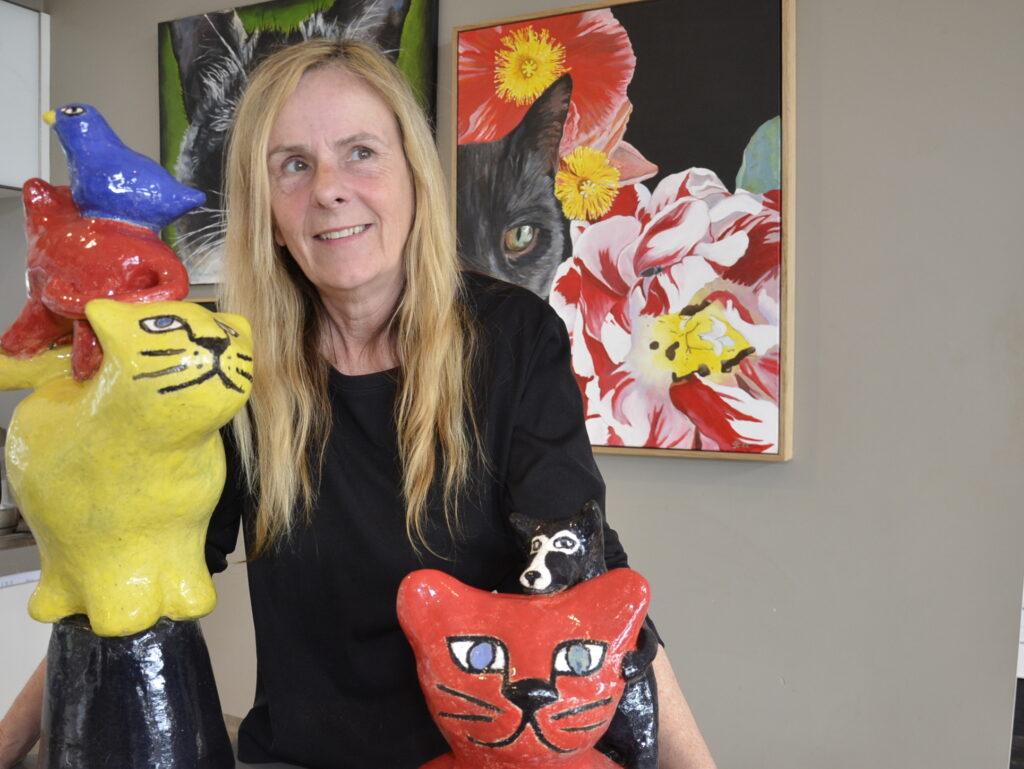
Clunes-based artist Kate Edwards is especially renowned for her personality-packed ceramic pieces. Her talents have seen her work selected multiple times among the finalists in the Clunes Ceramics Award. Kate shares her passion for art by teaching at a local secondary college and her work has won this talented local creative plenty of fans who love the joyful nature of her original creations.
Eve: Hi Kate, How should we best describe your artistic style? Does it fit into a particular arts genre?
Kate: I love the elemental process of ceramics but also bright colours and patterns. My ceramic sculptures and mosaics reflect this. Last year I returned to study to support my daughter and started painting as well.
Eve: How did you come to art?
Kate: As a child of the 1970s growing up in the outer east of Melbourne, handcrafting was very popular. My mother sometimes wove the fabric to make my clothes and I was a dab hand at macramé. Childhood mud pies developed into pottery and then into ceramic sculpture.
Eve: How did you nurture your innate arts talent?
Kate: I originally moved to the Central Highlands to complete my degree in visual art, but I keep the learning alive by attending master classes and workshops with visiting artists quite regularly.
Eve: Where do you do most of your art work?
Kate: I am presently between studio spaces completing work where and when I can. My dining table at my home in Clunes hasn’t seen many meals lately as it currently hosts all my latest artistic endeavours.
Eve: Which artists have influenced your work?
Kate: So many, from Etruscan and Aztec ceramics, through folk art and modern painters. I’m a bit of a magpie really, picking up shiny ideas from everywhere and weaving them into my art.
Eve: Are there any other factors that have influenced your practice?
Kate: I do love travel. Trying to stand in the same spot Van Gogh painted a scene in Arles helps me link in with artists through time. Collecting souvenirs that inspire me with exotic designs and colours; although I wouldn’t recommend loading up your suitcase with Moroccan plates and dragging it through the Paris Metro. Gardening is another major obsession of mine.
Eve: What is your media of choice?
Kate: Ceramics is my first love, and mosaics, but sometimes it is fun to just draw and paint.
Eve: What is your subject matter of choice?
Kate: Ask anyone and they will say “cats, birds and foliage”. I did try to delve into more deep and meaningful themes at university but I had to admit it wasn’t me. Why cats, birds and foliage? Because they give me joy.
Eve: Have you ever worked in any other areas?
Kate: My mother was a teacher and I was adamant that life wasn’t for me but after attempts at being a radiographer and several public service positions I found my calling as an arts educator.
Eve: What are you working on at the moment?
Kate: Just for fun, I am currently painting in gouache a series of angels in the style of gilded Byzantine icons, with cat’s faces, of course.
Eve: What work, goals or projects do you have in mind for the future?
Kate: In my ideal world I would build the perfect studio and spend half my time making and selling art and the other half travelling the world, but between work and my responsibilities caring for my mother and my children I have so little time and money. Hopefully I will get closer to my dream in retirement.
Eve: To date, what have been your career highlights as an artist?
Kate: I have had work selected in the Clunes Ceramics Award three times. It’s such a privilege to see my work displayed beside the work of famous ceramicists.
Eve: Do you have any exhibitions or special arts events coming up that you would like to let others know about?
Kate: I am hoping to attend the exhibition “Picture This” at the Possum Gully Art Gallery in Adelaide Lead on the Melbourne Cup weekend.
Eve: What would you rate as the biggest challenges in being a professional working artist today?
Kate: For me I would say “finding headspace”.
Eve: And, for you what are the greatest rewards?
Kate: Taking a piece of earth and creating something never seen before.
October 26th, 2023Get ready for the Gathering…

Words: Eve Lamb. Image: Supplied
Organisers of this year’s Daylesford Highland Gathering are urging locals to get out in force and enjoy the long- running annual event.
Happening December 2, the Gathering is now in its 72nd year making it one of the town’s most long-standing annual events.
“It’s very popular in the district and I think the only longer running annual event for the town would be the agricultural show,” muses Gathering committee member Keith Pyers who himself has been with the
Gathering organising committee for 40 years.
Established in 1952 by Dan McKinnon, the Gathering has a proud history of bringing together those interested in Scottish culture from throughout Australia and internationally.
Daylesford’s Highland Gathering last year made a strong comeback after Covid’s interruption and this year it’s back with a vengeance.
Run in conjunction with the Victorian Pipe Bands Association, it promises a great spectacle with numerous highland pipe and drum bands, and dancers from around the state and further afield performing and competing throughout the day.
“Our Daylesford Gathering is the first of the new season of Highland gatherings so it’s very popular with the Scottish community and with the competing bands,” Keith says.
The day fires up with the morning parade through Vincent Street, itself a competitive event for bands and judged by top judges with the Victorian Pipe bands Association.
After that the full day’s entertainment takes over the town’s Victoria Park transforming it into a tartan microcosm of traditional dance and band performance and competition.
“We’re hoping to see a big surge in local attendance at Victoria Park,” says Keith, who himself boasts a 25 percent dram of Scots genetic heritage.
“And at the end of the day, around 4pm or 4.30pm, all of the bands come out onto the arena for the massed bands performance and it is a really brilliant spectacle.
“It’s very moving actually. The power of those pipes is something to hear.”
Keith says accommodation venues in and around Daylesford are typically heavily booked for the weekend and he’s urging local accommodation operators and other businesses to promote the
Gathering and let visitors know about its significance.
“The Scottish community and the history of Scottish settlement is very strong around western Victoria,” he says.
“The Hepburn Shire is named for one of the early Scottish migrants, John Hepburn, who came into the district.”
For anyone with even a trace of Scots heritage coursing through their veins – and there are plenty of such folk in the wider district – the skirl of the pipes can be undeniably stirring. But you don’t need Celtic blood to appreciate the entertainment on offer at the Gathering.
There’ll also be food and merchandise vendors and it’s a great chance for those with the ancestry to pick up some Scottish souvenirs or find out a bit more about their lineage with Clans marquees also present on the day.
“In recent years we’ve encouraged the Clans to attend and they’ll be setting up a tent section,” Keith says.
Secretary with the organising committee, Anne Heriot, has strong Scottish heritage. She also has very fond memories of competing in theDaylesford Highland Gathering dance events as a child.
“I used to be a Highland dancer from the age of four to 16, when we used to live in Melbourne and we’d come here every year for the competition. They are very fond memories for me,” Anne says.
She says it was wonderful to see the Gathering return last year after Covid, and says this year promises an even bigger turnout of bands.
“We’re expecting more than last year – 16 or more,” Anne said“And this time we’ve also got Ballarat Scottish Country Dancing coming to do some demo dances – reels and jigs.”
In a side-note likely to please all with a dash of Scots, Keith says the cost of a day pass “has not significantly moved in 20 years”.
More information can be found on the Daylesford Highland Gathering’s dedicated website.
October 26th, 2023Daylesford hosts a visitor from Venice
Words and Image: Eve Lamb
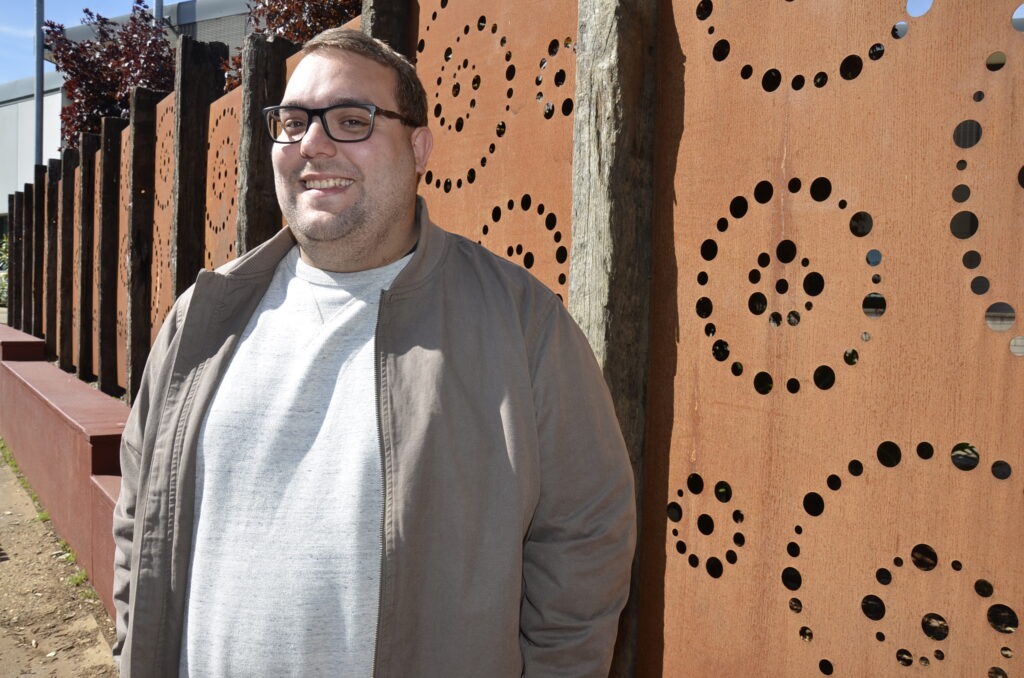
Daylesford is a long way from Venice, Italy but for 26 year old visiting Italian Christian Scaletta it’s an intriguing place to visit and work.
Christian arrived in Australia in April, along with about 29 other Italians,
all of them posted for a half-year stint to assist with teaching the Italian
language and culture at various schools, mostly in Melbourne.
Christian, who also speaks Russian, German, Spanish and Czech, was
assigned to assist with teaching Italian in Daylesford – at the local
primary school for one day of the week, and at the secondary college for the other four.
“I was born in Sicily and my family moved to near Bologna in the central
north of Italy when I was eight, but I have been living in Venice for the
past six to seven years,” Christian said.
The posting to Australia is for six months, a temporary arrangement
through the international organisation Co. As. It (Italian Assistance Association).
Christian says he became aware of the opportunity through his
university, Ca’foscari University of Venice, where he graduated in language studies before securing work there as an intern in the university’s international relations office.
“I thought it (assisting with teaching Italian in Australia) sounded very
interesting. I’ve always been interested in teaching,” Christian said
recounting how he jumped at the opportunity to experience life on the other side of the globe.
Coming to Australia for the very first time has been a bit of an eye- opener and Christian admits he is keeping an eye open for dangerous and potentially lethal Aussie critters – like snakes and spiders.
While in Daylesford he has been staying with local couple Leonie Keynes and Mark Bird.
Leonie says hosting Christian in their home has been a blast for all of
them and, just quietly, she has enjoyed having a bit of a chuckle at her visitor’s expense.
“He has been very wary of the ‘animals that can kill you in Australia!’ but
I think he is getting used to living in the country now,” she says.
“One of the first questions he asked when he moved into our place was
‘what type of animals can come into your backyard that may be dangerous?’.”
Conveniently, Leonie and Mark’s residence is opposite Cliffy’s cafe,
noted locally for its coffee, and Christian has been getting used to doing coffee the Aussie way.
This too has been a very different experience for the visiting Italian who,
when back home drinks espresso as a matter of course through the day.
While in Daylesford he has been getting used to the Aussie flat white.
“Coffee here is just a different experience. I don’t get espresso here,” he said.
“I would normally have three or four cups of coffee to go – espresso to
go, to get through the day, whereas here it’s more like a treat and my
order has been flat white which you just don’t get in Italy – maybe in Milan,” he says.
Christian has been making the most of his time in Australia, visiting as
many places as he can readily get to, and so far, during term breaks,
he’s managed to pack in trips to Tasmania, Adelaide, Sydney, Byron Bay and Brisbane.
As a self-confessed city boy he admits that he particularly enjoyed Sydney.
‘I’m not used to being in quiet places. I have always been in big cities so
I have really liked just taking my time while I’m here. Daylesford is lovely
and it’s very nice to just get the real Aussie experience,” he says.
“It’s been very interesting to see a lot of animals that I normally wouldn’t
see like kangaroos and wallabies and so many different birds. I did ask
for some help as to whether I should be worried about certain animals or not.”
Christian’s Daylesford visit is particularly timely as it coincides nicely with
the return of the area’s popular Swiss Italian Festa.
The local primary school children have been getting into Festa mode
with his assistance, by learning some traditional Italian folk dancing and
card games, and Christian plans to experience the festa vibe while he has the chance.
“I’ll probably be joining in the parade on Saturday,” he said.
Now, with only two months remaining of his time Down Under, Christian
says living in Daylesford and assisting both local teachers and students
with their Italian language and cultural know-how has been a wonderful and beneficial experience.
“They also correct me sometimes when I get a word in English wrong – which is fair,” he said.
“I love it. It’s extremely useful and I’ve created a bond with some classes. There’s this trust. I’m really enjoying my time here. It’s just a really enriching experience from both sides.
October 25th, 2023Secret is out as garden lovers weekend returns
Words and Image: Eve Lamb
Garden lovers are in for a treat over the weekend over November 11-12 as Creswick Garden Club again stages the Creswick Garden Lovers’ weekend featuring top gardens in Creswick and surrounds.
This year there’s a choice of seven diverse private gardens to visit and enjoy, including large and small town gardens, quirky and eclectic gardens, sustainable gardens, and real country gardens.
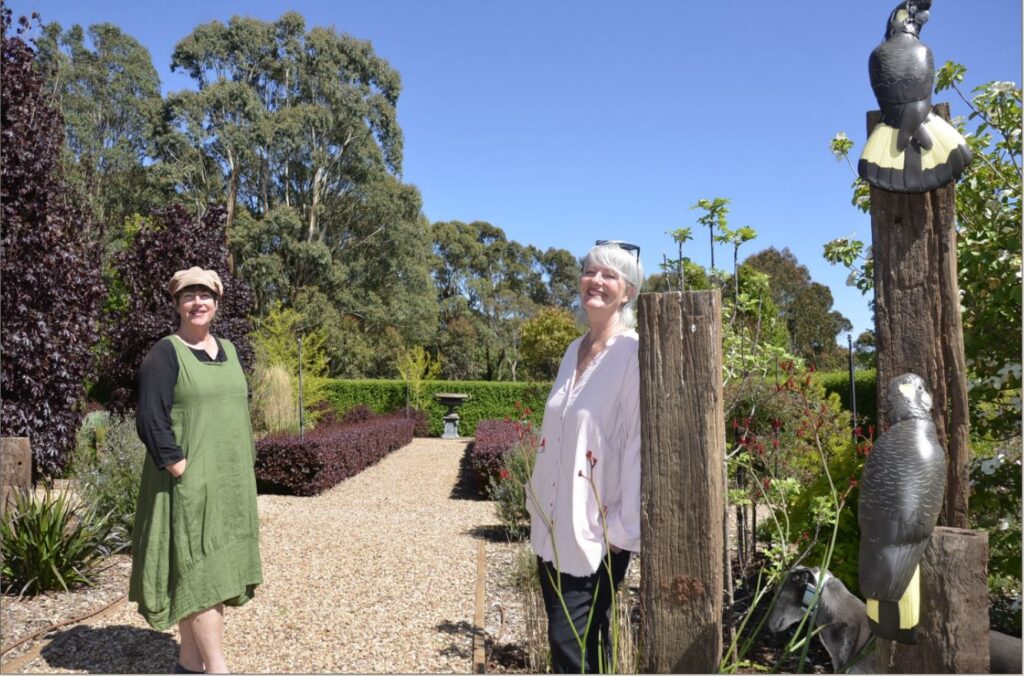
Among them, and opening its gates for others to visit for the first time, is the Secret Garden Home Garden at Mollongghip, not far out of Creswick.
It’s hard to believe that owner residents Lou McLachlan and Deb Clarke only started developing this impressive slice of paradise about nine years ago.
They brought in a large number of advanced trees, laid out paths and carefully designed using hedging to create a series of garden rooms to delight the eye and the senses.
“It all started with us wanting to cut down on lawn mowing,” recounts Lou, an experienced horticulturalist and well known in Daylesford as owner-operator of the town’s Secret Garden nursery.
“They call it the ‘slow creep’; once you start you can’t stop,” she laughs.
“As the hedges reach a mature height it’s been exciting to see the garden rooms develop.”
“We’re right on top of the great dividing range here so we sort of have our own weather here and it can turn on a dime,” adds Deb.
The garden now features plenty of herbaceous perennials that have proven they can withstand the area’s unique climatic challenges, and also plenty of garden sculpture particularly including beautiful native bird sculpture by renown local creative Miriam Porter.
“We’re privileged to have Miriam’s sculpture displayed in the garden and we will also have an array of garden art and ornaments available for sale on the weekend,” Lou says.
While Deb humbly praises Lou as chief on-site gardener, both Lou and Deb clearly love their patch of paradise and are looking forward very much to sharing it with the wider community for the first time.
“It’s the serenity, the insects and the bees, all of the insects,” says Deb when asked what she appreciates most about The Secret Home Garden which is situated at 490 Dean-Mollonghhip Road.
“And it’s great to see the results from all of our hard work. It just kind of sings to us.”
Coincidentally, when The Local dropped in to visit Lou and Deb in their Secret Home Garden last week, they were also getting ready for a visit from ABC’s Gardening Australia team that was going to be filming on site for a future episode of the popular TV gardening program.
“We’ve got Costa coming along with a film crew and a drone,” Lou said.
Further information about this garden and the other wonderful local gardens that will be opening over Creswick Garden Lovers’ weekend may be found at www.creswickgardenclub.com/glw.html.
All profits from the Creswick Garden Lovers’ weekend are used for local community projects while the event itself affords garden lovers a great chance to visit the historic Central Goldfields Region of Victoria and see an array of diverse private gardens, iconic commercial gardens and nurseries, and more.
October 15th, 2023Budburst Festival returns to Macedon Ranges
Words: Eve Lamb. Images: Supplied
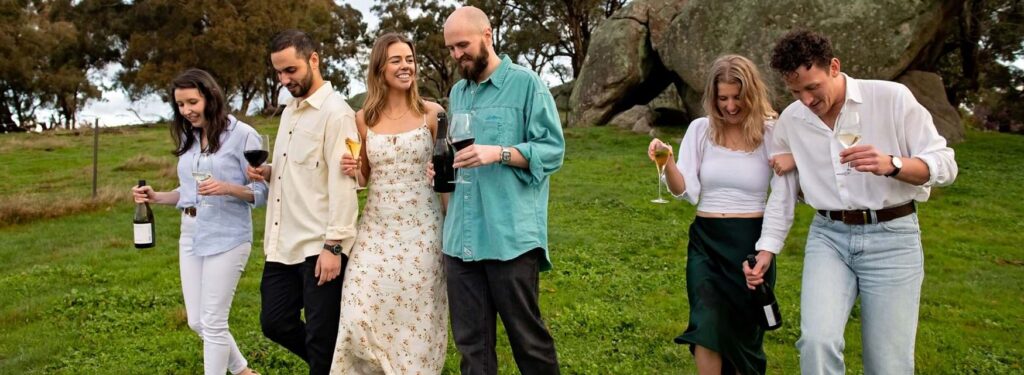
There could hardly be a better way to welcome the quickening pulse of the season. All who are partial to a good wine will be keen to note that the famed Macedon Ranges Bud Burst Festival is back and happening over the weekend of Friday 17-Sunday 19 November.
The quintessential Macedon Ranges wine-tasting experience, Budburst is a once-a-year chance to step behind the vines and meet the knowledgeable winemakers.
Over a glass of something good, and amidst a backdrop of lush vineyard rows, volcanic rock and ancient plateaus, festival-goers soak up a unique sense of how the region’s family-owned and small-batch makers shape mainland Australia’s coolest wine region.
Across the weekend more than 25 of the Macedon Ranges region’s winemakers across 18 budburst sites, will open their wineries and cellar doors offering tastings, curated food menus championing local produce, art shows, sculptor walks and live music.
Notably, last time it all happened was 2019, pre-COVID, and this time there’s additional good reason to mark the event up big on your personal wine appreciation calendar.
That’s because this time the vineyards on the western (Daylesford) side of the Calder Freeway will also be offering a special wine bus loop – in the same way that those on the eastern (Kyneton) side do.
Among the ‘Daylesford side’ wineries participating is Musk’s Passing Clouds Winery owned and run by Cameron and Marion Leith (pictured below).
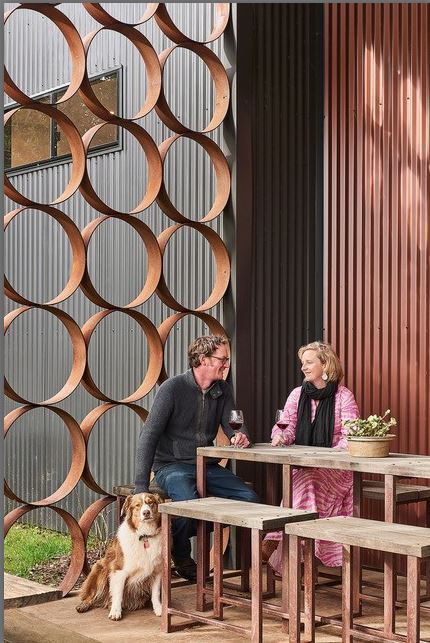
In recent days Marion chatted to The Local about preparations for the festival and explained that previously the wineries from this end of the region had participated by showcasing their wines at a central hub at Trentham’s Cosmo Hotel.
But Bud Burst really is all about getting out into the beautiful vineyards themselves – experiencing the terroir where it all happens.
“This time we have created a special bus loop for the Daylesford end as well,” Marion says.
“We have teamed up with Attwoods at Glenlyon and Zig Zag Road winery, and with Wombat Forest Winery and also Shadowfax Wines to offer a bus loop.
“To have a bus loop is a new thing for us and I think it’s a great way of bringing the wineries together.
“People can really make a weekend of it and stay for the weekend, so they could do the wineries on the Kyneton side on one day and then the wineries on the Daylesford side on the other day,” Marion suggests.
Festival goers can jump aboard any of the festival buses and visit up to five wineries on four different dedicated bus routes – including the new Daylesford Drive loop. There’s also the Lancefield Loop, the Kyneton Cruise or the Woodend Wander bus loop options.
Alternatively, wine appreciators may travel independently around the region’s winding country roads and scenic ranges to visit participating wineries and vineyards.
“The festival is really championing cool climate wine,” Marion says.
“Here (in Musk) we are one of the highest vineyards in the Macedon Ranges at 774 meters above sea level.
“Some of the wineries will be offering music and food and there will also be some special umbrella events on the Friday as well.
“We (at Passing Clouds) will be offering an exclusive tasting list highlighting our cool climate wines.
“The Macedon Ranges Vignerons’ Association, which we are part of, really wants to get people to the vineyards. It’s really nice for people to see the vineyards and experience where the wines come from.
“It’s a great weekend for locals to come out and support their local businesses and wineries.”
More detail about the festival, participating wineries, and different ticketing options available can be found on the festival website www.macedonrangeswineandfoodfest.com.au

October 15th, 2023Artists of the Central Highlands
With Eve Lamb
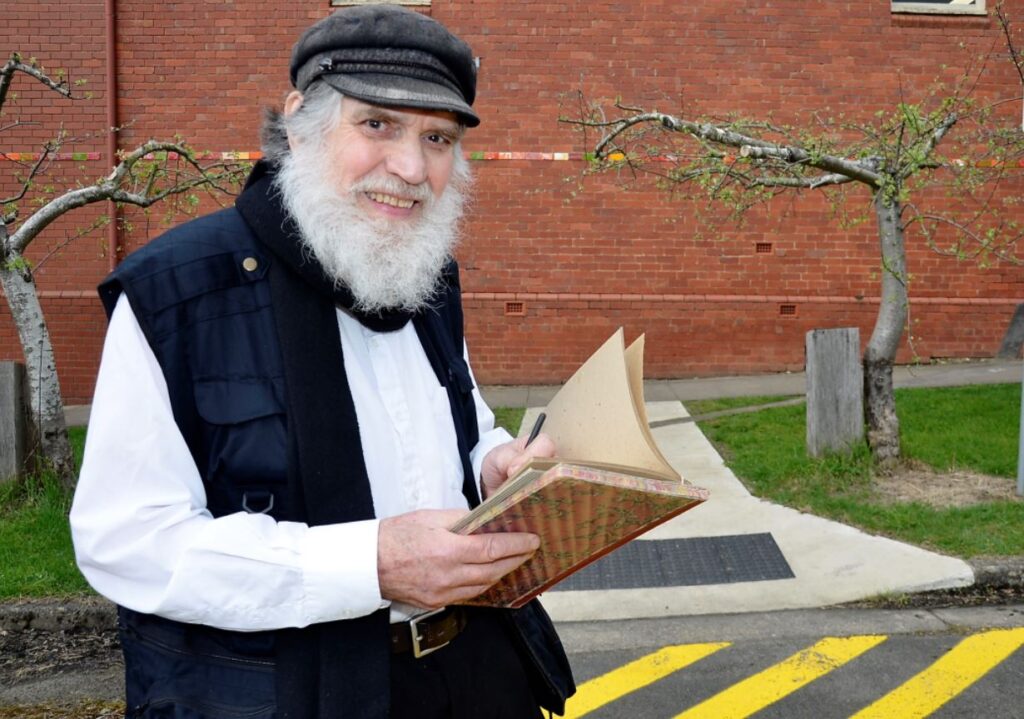
Long established artist and observing Jew, Daylesford’s Bill Meyer (pictured above) can name a multitude of diverse career highlights. They range from a painting commission for the Werdiger family, and their patronage over many years to having works included in the Hirsh collection and incorporated in multiple public collections. Further highlights include a touring exhibition of prints and drawings called Gapscape which, in the eighties, was showing in 26 state, regional and national galleries nation-wide. Today, while now in his 80s, this gifted local remains busy with digital arts and music.
Eve: How would you describe your style Bill? Does it fit a particular genre?
Bill: Art writers have described my work variously as related to German Expressionism, to lyrical abstract expressionism, to heavy metal girders rather than petit-point… I prefer to think of my visual work as landscape-in-metaphor.
Eve: How did you come to Art?
Bill: There was never any real alternative…I attended night classes in life drawing for several years until graduating from university when I was accepted as a full-time day student at the National Gallery Art School, which, by the time I graduated with a fine arts degree in painting and printmaking, had transformed into the VCA and nowadays is part of Melbourne University. Graduate studies in London followed and I spent the next decade in the Northern Hemisphere. Exhibitions lead to further development and encouragement from visiting artists to The Royal College and also curators and directors of the Institute of Contemporary Art where I exhibited, brashly, several times.
Eve: Where do you do most of your work? Where is your home?
Bill: I have lived and worked in Melbourne…also in London during the seventies. There have been multiple stays as a guest artist in Israel at the studios in Mishkenot Sha’ananim, Jerusalem, several years in America, again Australia as artist-in-residence at several university-attached art colleges and regional city galleries; rural accommodations for artist-in-schools projects, and now, for the past four decades mostly living and creating from my studio on the family property in the beautiful bushland of Hepburn Shire.
Eve: Which artists have influenced you?
Bill: The artist most valued by me would be Rembrandt for his philo-semitic intensity, his draftsmanship and composition, his use of light and shade, dramatically, aesthetically, and his tenaciousness towards creativity even under the worst of adverse times. My list of admired and influencing artists include the New York Greenbergian artists of the fifties through the seventies, including Morris Louis, Helen Frankenthaler, Rothko, Barnet Newman … also artists such as Modigliani, although I am not a figurative artist, I admire the poetry of his figuration, same for Klimt and the Viennese secessionists. Landscape influences include Turner, Caspar Friedrich David, and Hobbema.
In Australian influences I include Arthur Boyd, Fred Williams and my mentor with whom I learned so much about the philosophy and beauty of being an artist; Roger Kemp. The friendship extended to the entire Kemp family household. Victor Majzner, an artist friend to this day, has been part of both that world involving galleries, professional practice and education, and also the more spiritually focussed aspects of the Jewish art world. There are others…
Eve: Are there particular factors which have influenced your creative work?
Bill: Money was always an issue but somehow I have survived with the help of democratic governments, friends, family and patrons albeit that they complained often and frequently at length.. Networking and working on projects with other artists has been personally and creatively a great thing… In the past several decades, being located in the Central Highlands has given me a sense of much needed personal, spiritual and working space.The forests around Daylesford have contributed content and metaphor to my work.
Eve: What is your media of choice? Why so?
Bill: Printmaking as in fine art editions, initially as a conventionally analogue printmaker and more recently using digital technology. I also paint on canvas with either acrylic or oil, I draw, and have constructed multi-media installations with sound, light paper and natural organic materials. Recently, over the past decade, I have returned to musical composition, recording the finished works in digital formats.
Eve: What work, goals or projects do you have in mind for the future?
Bill: A large project on Trees in History, legend and Metaphor. Images, text and my dreadful poems. I’m also working on musical compositions which I had deferred for years whilst establishing as a professional visual artist. The music is very important to me.
Eve: What would you rate as the biggest challenge in being a professional artist today?
Bill: In some ways the challenges to professional artists today are similar to challenges to artists since the rise of mercantile civilisation from the Renaissance onwards. Money, creative head space and time, quiet creative time… The speed of life today however is destroying the creative head- space required for the truly competent and caring professional. We may ironically have to search out the scorned amateurs as in the C19th for a truly spiritual experience to be gleaned from the Fine Arts.
Eve: And for you, the greatest rewards?
Bill: The greatest rewards are that well- known ‘frisson,’ that delicious shivering when, in your soul, you know that something good has happened; a creation which has meaning…This is so rare but it is an affirmation that I am in the correct type of service and in the right place…
October 14th, 2023National human rights award for Creswick’s Tony Clark
Words and Image: Eve Lamb
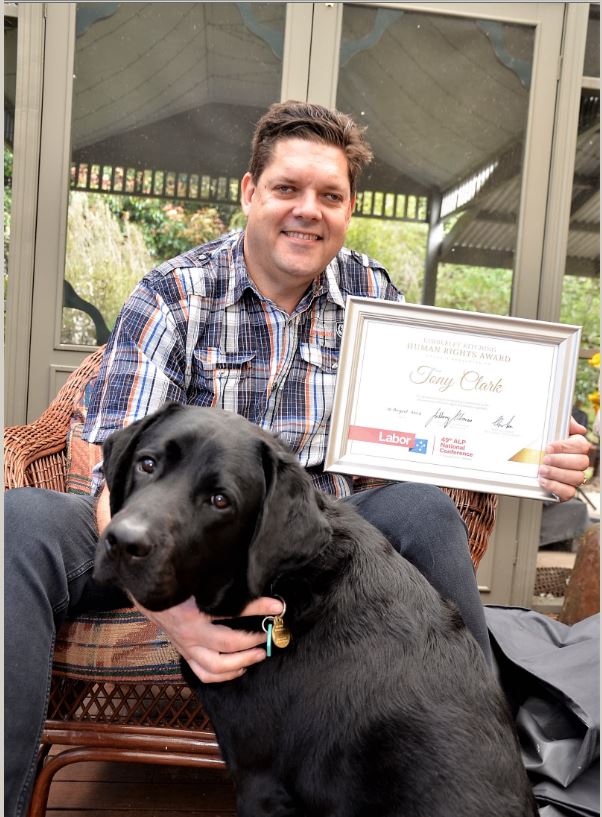
Creswick’s Tony Clark has received the inaugural Kimberley Kitching Human Rights Award at the recent ALP National Conference in Brisbane, using the opportunity to advocate strongly for a cause so dear to his heart.
A passionate advocate for inclusivity of people with disability, the Creswick-Clunes Labor branch member received the award from Prime Minister Anthony Albanese.
The citation on the award states: “For demonstrating an outstanding commitment to the advancement of human rights in Australia or globally”.
Deemed legally blind since the age of 20, the Creswick local was accompanied at the national conference podium by his guide dog Timmy and, in perfect timing, worked in a quick quip to assist the PM in ushering him to the lectern to accept the award.
“Take my elbow, Albo,” Clark tactfully advised without missing beat, before going on to deliver an impassioned speech to the 500 or so decision-makers in the room.
A member of the Victorian Labor Party since 2008, the Creswick local has spent much of his adult life challenging organisations, business and the Labor Party itself to be more inclusive and more accessible for people with disability.
“I took the view that I was going to use my blindness as a great strength,” Clark told delegates at the national conference that he attended with his partner Melanie Bellingham who is also a member of the local party branch.
“Those strengths are around tenacity, determination, thinking laterally, thinking outside that square, and persistence in the face of challenge,” he said.
These are all things Clark knows about first-hand.
“I was diagnosed with a degenerative eye condition when I was 19 and declared legally blind at 20. Tough thing for a young man of 19,” he said.
“I remember one of my greatest fears was ‘who the hell’s going to want to marry a blind guy?’
“And I did have a moment. It was with the Commonwealth Employment Service, the old CES. I’d just finished telling them I was looking for work. I had an honours degree in science in immunology.
“The response was ‘most people like you weave baskets’. I kid you not. And I have to be honest, people might not say it in those words anymore, but that’s still there. That’s absolutely still there.
“Attitude is the big thing and we all have some responsibility to think about how we can change,” said Clark who, besides his honours degree in science, also has a masters in communication, is a qualified company director, and chairs a board.
“I can tell you first hand of the passive discrimination and barriers that are out there that prevent good quality people getting jobs,” he said.
“We have higher unemployment. Higher poverty. These things have not moved for decades.”
Driven by his strong desire to see these things change, Clark has stood for Parliament three times including for the federal seat of Deakin in 2016 when he ran with the catchy slogan “No Sight, Great Vision.”
Believing that leaders should reflect the people they seek to represent, he ran for the seat, hoping to be a voice for the one in five Australians who are living with a disability. “When I got to 38, I thought: You know what? I don’t respect people who sit on the side and throw mud. I believe you’ve got to get in there… and government is what changes our community,” he said.
“It sets regulation, it sets job policies, it sets legislation. Everything comes from government and that’s where change can be made.” Although Clark didn’t win the seat of Deakin, the campaign trail nevertheless provided an opportunity for him to generously engage with the voters, the media, the ALP and the Parliament to get a fairer deal for people experiencing disability.
His decades of advocacy have resulted in the founding and formalisation of Labor Enabled Victoria, where, alongside Annie Payne, he has successfully argued the need for a Disability Action Plan for the party – a national first.
The Creswick local continues to advocate across the broader community to achieve greater access for people with disability to education, employment, economic opportunity, and healthcare.
Giving the example of the ALP’s quota system for gender equity, he is particularly keen to see quotas similarly introduced to ensure fair representation for people with disability in Parliament at state and national level.
“Twenty percent of people in Australia – one in five – experience some kind of disability. Yet we’ve only had eleven people with a disability in federal Parliament since Federation. Since 1901. It’s appalling,” he said.
Removing barriers to employment opportunities is also particularly high on his agenda for positive change.
“We are spending billions on billions of dollars supporting people with a disability and yet we are not taking advantage and grasping the value that they bring with their lived experience,” he told the recent national conference.
“I think the biggest barrier we face is perception and giving people an opportunity for a job.”
Clark said receiving the inaugural Kimberley Kitching award was “very humbling”.
“I’m incredibly humbled. It’s just Wow.”
Within his hometown the Creswick local is currently also advocating for a new scout hall.
“The current scout hall is in a flood zone and has been flooded several times,” he said.
“We want a new hall that’s fully accessible and can be used for the First Creswick Scout group and many other community groups as well. We want it to be built at a site near the train station and we’ve applied for $500,000 through the federal regional grant fund. We’re also seeking $400,000 through the state and working with our local member Martha Haylett.”
October 14th, 2023Keen to clog in Creswick
Words and images: Eve Lamb
Mention the word “clogging” and many will immediately visualise heavy Dutch clogs and maybe pitch in a mental windmill and a few tulips as well. Wrong.
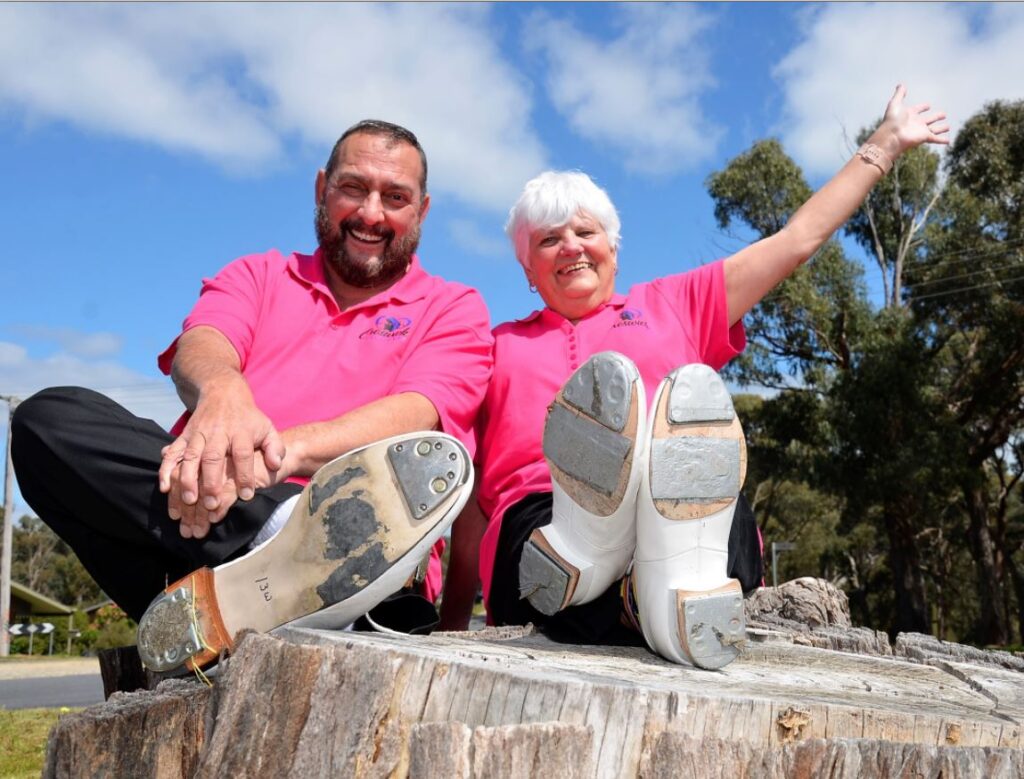
Turns out clogging is all about rhythm and not about wearing wooden clogs at all, as The Local discovered after catching up with experienced local clogging instructors Cheryl Holland and Nev Flegg (pictured above).
Cheryl, from Sulky just out of Creswick, and Creswickian Nev started the Creswick Cloggers just over two months ago. While they’d been quietly confident of a reasonable turnout, even they admit they’ve been surprised at the enthusiastic uptake among locals who are keen to clog.
The weekly sessions happen Tuesdays 6.30-8.30pm at the Creswick scout hall and have been been pretty well packed each time.
At this point Nev and Cheryl are considering starting a new beginners’ class either before Christmas or early in the new year depending on demand, and they’ve already registered the Creswick Cloggers to perform at next year’s CresFest.
“We’ve now got 22 cloggers – 14 beginners who have turned up and eight ex-cloggers,” Nev says.
Besides teaching clogging at Creswick Nev teaches the niche dance form in Footscray and also teaches line dancing as well, while Cheryl also runs weekly clogging classes in Cheltenham.
“Soon as you say clogging people think wooden Dutch shoes,” Nev laughs.
“We’ve actually got (moveable metallic) plates on our shoes and clogging taps rattle as opposed to tap dancer plates. Tap dancers have a solid piece of alloy bolted to their shoes.”
By way of demonstration, Cheryl and Nev pull on their nifty white dancing shoes, which look fairly flexible, and turn up the soles to display the metallic moveable plates attached beneath.
The plates mean the clogging steps they perform will make an infectious percussive sound that everyone within earshot will hear and find hard to resist, as Cheryl and Nev deftly demonstrate.
Coincidentally, both Cheryl and Nev took up clogging in 1988 while living in entirely different parts of Australia. Even more coincidentally, they both started teaching the dance form in 1992. Clogging has taken them both all over Australia and overseas to perform, often to high acclaim.
The new Creswick Cloggers group is affiliated with the Australian Clogging Association. In fact they’re just back from participating in the annual National Clogging Convention in Gosford, NSW, where they had a ball performing their chosen showcase dance, Cheryl says.
“The National Clogging Convention takes place in a different state each year. Next year it’s in Western Australia and we are hoping to hold it in Ballarat in 2025,” Nev says.
Beginners start out simply by learning to bend and straighten their legs in time with the music – “learning the down beat,” Cheryl says. They go on to master eight basic movements. “And the steps are cued so you don’t have to remember a whole routine,” Cheryl says. “You just remember the steps.”
Performed in time with other dancers and with those little moveable metallic plates attached to your soles, the steps create a very satisfying percussive impact. Cheryl and Nev say that while clogging used to be done pretty much entirely to country music, these days you can expect plenty of current contemporary pop in the mix.
“The actual word – ‘clogging’ means ‘time’ in Welsh so it’s actually a time dance,” Cheryl says.
I ask Cheryl and Nev what they love most about clogging, what drew them to it in the first place.
“The friendship and the fun,” Cheryl says. “And it takes us to a different state in Australia each year and to New Zealand.”
Nev – whose prior clogging fun traverses Seattle, San Francisco, Santiago, Los Angeles and Chicago, to name just a bit of where it’s taken him – says it’s tops for stress relief as well. Time out from life’s little, or not-so-little worries.
“I tried giving up once and I couldn’t do it. I really like teaching and so does Cheryl,” he says. The national association website informs that clogging – or “Appalachian Mountain Folk Dance” – is actually an American folk dance with origins in the Southern Appalachian Mountains of the US.
While it has strong ties to the step dances of the British Isles brought to the region by white settlers, clogging is also influenced by the traditional dance of Native Americans, and the traditional solo dances of African Americans.
Clogging is a misnomer, since it is not performed in clogs, although some of the original step dances from Europe were.
Nevertheless, the name persists, although in Appalachia, this form of percussive dance is often known as buck dancing or flatfooting. In recent times the dance form has spread to all parts of the world including Japan, England, Canada, New Zealand and Australia, as well as many European countries.
In Creswick, Cheryl and Nev say anyone interested can roll up and check out the class in action on a Tuesday evening, or you can email creswickcloggers@gmail.com if you’re interested in pulling on a pair of clogging shoes and joining in.
October 12th, 2023Classic ‘win-win’: the inside story of WomenCAN
Words: Eve Lamb. Image: Supplied
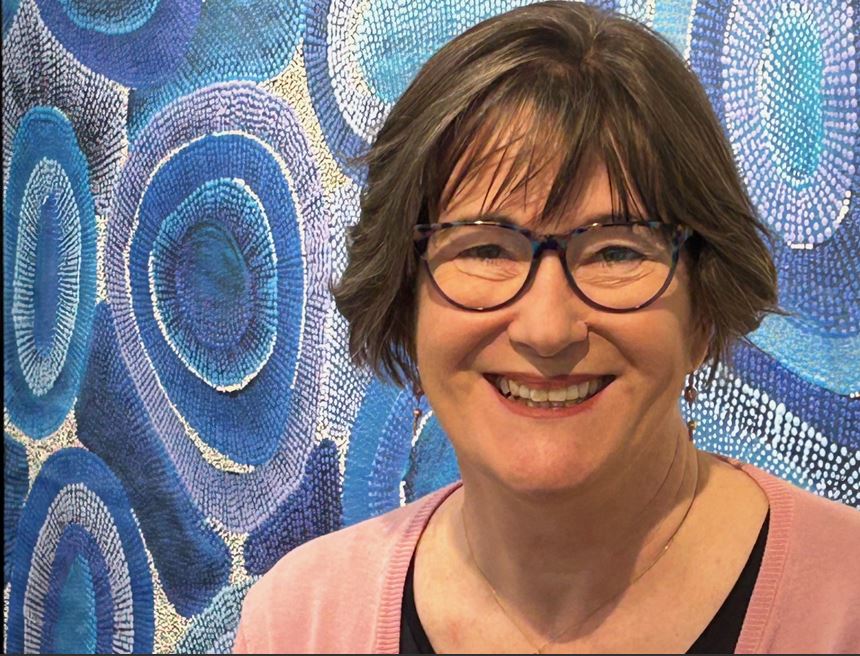
Former corporate lawyer, Mikaela Stafrace, (pronounced Staffarachi) is clearly passionate as she discusses her role as founder and CEO of WomenCAN Australia. The highly motivated change-maker will be guest speaker at the upcoming U3A AGM taking place in Daylesford on October 16.
Mikaela will share insights into why this not-for-profit, that helps disadvantaged women secure and retain good paid work, came into being, the work it’s doing now, and the difference it’s making.
Training and peer support are key aspects of what WomenCAN Australia does to help disadvantaged women secure good ongoing work.
It teams up with training institutions and employers to give free training and guaranteed jobs to women and girls who need them, but might otherwise miss out.
In the process, Mikaela says, it saves scarce taxpayers’ funds as the cost of its activities is “significantly less than Centrelink payments while the benefit is significantly more than that provided by Centrelink”.
In fact Mikaela says the numbers are currently being professionally crunched to work out just how much WomenCAN is saving the taxpayer.
Mikaela say women whom they particularly aim to help include refugees or asylum seekers who may need to retrain after fleeing oppressive and dangerous regimes. Sometimes simply learning to drive and gaining a licence is a key enabler for such women.
Other groups that may be assisted include women aged over 45, women who have fled domestic violence and those whose working lives have been disrupted by chronic illness.
In the four years since it started this organisation has changed lives and our wider society for the better.
“It’s now around 800 that we’ve helped and that includes 333 women who are now fully employed and 479 that have trained or are training towards securing work,” Mikaela says.
“A big sector of our cohort are women who have escaped domestic violence and are now getting back on their feet and coming into the healing process. We have some women who are exiting the justice
system.
“We only focus on five areas of high labour demand, providing peer support in five vocational areas, because we know there’s work there.
“That’s in aged care and child care, in transport, horticulture and commercial cookery, trades and, one for next year will be, cyber security. There’s a big need for data analysts and the like. Not the techies and the computer engineers, but data analysts.”
WomenCan Australia has a head office in South Melbourne but in the four years since it started it’s helped women in both metro areas and regional areas including the Castlemaine and Kyneton areas.
“I’d like to speak about the story of WomenCAN in terms of our journey and how we began and what we’ve achieved,” Mikaela says ahead of her upcoming Daylesford talk. “We’d rather that there was no inequality and that every woman had as much chance as the next person but that unfortunately is just not the case.
“None of us know each other’s stories and it can be incredible what a difference one offer of employment or one act of kindness can make.”
The AGM is at 10.30am with Mikaela’s guest speech set to start at 11am. Members of the public are welcome, but to help determine whether the venue is the town hall or the senior citizens building, those planning to attend should first email their RSVP to Hepburn U3A at info@u3ahepburnshire.com

September 28th, 2023Artists of the Central Highlands
With Eve Lamb
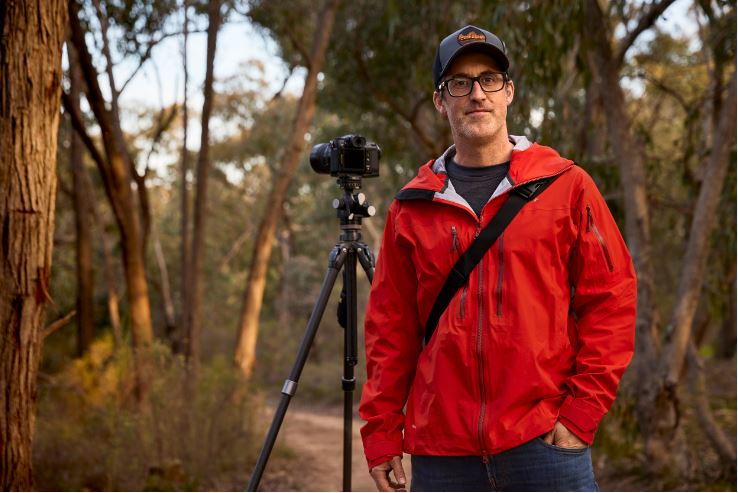
Renown for his photographic landscape studies and creation of gaze-grabbing images in the commercial realm, acclaimed Hepburn based photographer David Rosendale enjoys an ongoing love-affair with light and its transformative role in image-making. He currently has an exhibition taking place at Eastern Peake Winery Cellar Door, Coghills Creek as part of the wider Ballarat Foto Biennale happening now through to October 22.
Eve: Hi Dave. I’ll start by asking you how you initially found your way to becoming a pro photographer?
Dave: The first connection was in primary school in Melbourne. My parents had a bookshelf completely devoted to National Geographic magazines. I would sift through the photo essays and current affairs. I remember being amazed by the photography of the Volcano eruption of Mt St Helens and the Challenger Space shuttle in the early ‘80s. Capturing these epic moments in time. There were always incredible photographs and there were always these brilliant advertising campaigns by Canon, Nikon and Minolta in Nat Geo. I became fascinated by the potential of the camera and the medium itself. To be able to capture a moment. Fortuitously, opposite my primary school was a second-hand camera store, and in grade six I purchased my first camera, I think to take photos of all my mates as we were graduating and moving on. That summer holidays I photographed everything, and I think the first connection to the landscape was made there, spending time taking photos in Rye back beach on a family holiday. I chose art, studio art, and focused on photography in VCE at high school among the other core studies. I went straight to RMIT out of high school and did a BA in Commercial Photography and trained in film photography. It was three years for the BA. By the third I was already working as a photographer’s assistant. I worked for many great Australian photographers. This was film days… A different era. I was an assistant for five years, and it kind of simply occurred, when clients started asking if you can shoot certain jobs. You had the confidence to say yes.
Eve: Have you ever worked in any other areas besides photography?
Dave: No, I have worked in photography all my professional life, since my final years at RMIT as an assistant, then a professional. But before that I did the usual eclectic round of jobs to get by as a teen. I lied about my age and started working at about 12, first in a chemist, then a supermarket, then washed cars. Then a colour photo printer in a 60min photo lab, eventually dropping everything to be a photographic assistant. Then photographer.
Eve: How have you gone about developing your photographic abilities?
Dave: Learning doesn’t end. It is continuous. Every job I have, there is something random and unique I have to become proficient with, to adequately deliver a result. I constantly study lighting, how images in popular culture are made, and absorb visual media around me. I undertake workshops, on line webinars and the like. Attend talks.
Eve: What is your current camera, and other photographic go-to gear, of choice? The equipment you always have with you and wouldn’t be without?
Dave: I have had many camera systems over the years, Canon, Mamiya, Hasselblad, small, medium and large format film cameras. There is no one perfect tool. With the onset of digital I am currently using a Fujifilm camera… “Waiting for the light”, the one thing I can’t do without is my Gitzo Tripod. That, coffee and some kind of ski jacket and gloves cause its generally freezing where I shoot!
Eve: You are very well known for your superb landscape work. What is it about landscape that feeds your photographic soul so to speak?
Dave: Being in nature, hiking pre-sunrise in the dark and the freezing cold, and experiencing how the sun eventually rises and gives warmth, gives shape and dimension and life to everything. This is what I am connected to. I was always drawn to the light. The light is the mystery. It is responsible for all life in a literal sense, but gives meaning and purpose and context to all things. Trying to capture random events of light, the sun rising over a snow covered moonscape of Kosciuszko national park in winter (for example) are the fragments of time I seek to capture…
Eve: Are there any other focal subjects that particularly inspire you?
Dave: I love all aspects of photography, every situation requires something new. Though there are many sub contexts of photography, what I particularly love is light. Capturing light. Light in the landscape. Lighting an interior of a room, lighting a product for advertising. Lighting a face. Portraiture has always been a particular love as well… I also have a great love of still life and product photography. I specialised in beverage photography for years…
Eve: Where do you work? Travel? Although you live in Hepburn I understand you also have a Melbourne studio as well?
Dave: I still keep a studio in North Melbourne. This is perfect for all my commercial work, portraiture, products etc. Being on the west of the city, it is perfect to travel to from Hepburn. As most commercial work is now digital, I can work anywhere otherwise, on a lap top or at home. I constantly look for new locations locally in the goldfields, and travel to the alpine regions of Vic and NSW every year. I also have an on going project in Apollo Bay on the Great Ocean Rd.
Eve: What are the greatest rewards you derive through your work Dave?
Dave: Variety. Always learning something new. Opportunities to introduce you to interesting people and places. My career has connected me with notable Australians, athletes, actors, prime ministers,has taken me across Australia and the globe. Whilst all these opportunities have been incredibly rewarding, seeing your final artwork on a wall, or your work published, is an incredible reward. Having your work connected to a worthy cause is also most rewarding.
September 28th, 2023About to bloom: Musk gardens open day nears
Words and Image: Eve Lamb
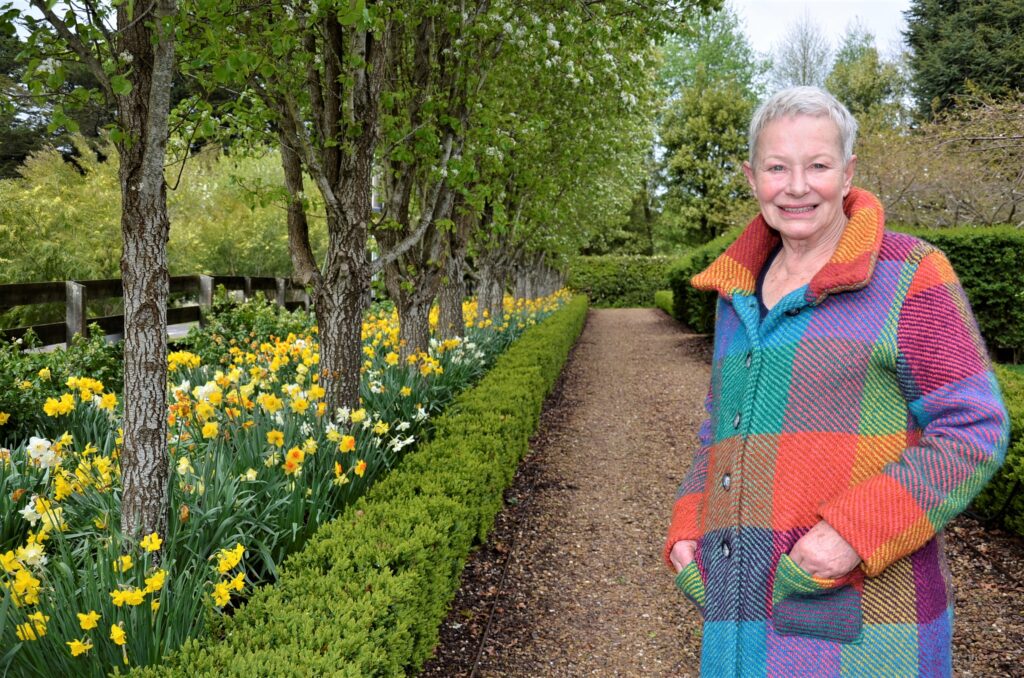
Two of the region’s premier gardens are preparing to open their gates to visitors for a fundraising picnic day on Saturday, November 18.
Famed Musk Farm garden and neighbouring Musk Manor garden, located within cooee of each other, are opening as a fundraiser to support the Musk CFA.
Famed Musk Farm is the iconic garden developed by the late Stuart Rattle and features 15 “garden rooms” inspired by the grand estates of France and England.
Across the road, Musk Manor garden is opening to the public for the second time and the garden’s creator and resident owner, Helen Hayes, will be on site for the event, as will her part-time gardener Clare Dynon.
It’s hard to believe, but true, that Helen and her husband Michael Lynn have only owned this impressive garden for the past six-and-a-bit years.
In that time resident green thumb Helen has set about cultivating the site into something to delight garden lovers and local birdlife alike.
“The whole bottom of the garden was just empty and weed infested and we pretty much started from scratch,” she says.
But it was the intrinsic garden potential of the site that clinched their purchasing the property from the outset, Helen says.
Now the continual evolution of the Musk Manor garden is an ongoing labour of love for this passionate gardener whose plant choices are often informed by her wish to cater to the needs of local bird and insect life.
“I definitely work in this garden six days a week now,” says Helen who is a former University of Melbourne librarian and also a former Australian Businesswoman of the Year, with a background in the corporate and government sectors.
Coordinator of the upcoming Musk Open Gardens, Duncan Evans says visitors are encouraged to pack a picnic rug and catch the tourist railway out from Daylesford to reach the gardens – for several good reasons.
One of these is to avoid potential parking issues that emerged when the Musk gardens opened last year and the event drew some 500 visitors.
While limited parking will be available, Duncan says another good reason to jump aboard the tourist train is simply to support this local tourist attraction and enjoy what it has to offer.
“Last year we had a lot of people from Melbourne who said they loved catching the train, and a lot of children who really loved it,” Helen says.
Duncan also says a good array of food and specialty beverage stalls will be on site on the day selling refreshments including coffee, gin and wine.
Visitors can even pre-order a gourmet lunch box via the event’s dedicated website at muskopengardens.com.au and are encouraged to purchase food on site, although you can also pack a picnic hamper.
There will also be a silent auction and some attractive raffle prizes up for grabs. A main aim, Duncan says, is to have visitors make a real day of it, stay and have lunch on site and really soak in the two gardens’ beauty.
“For garden lovers it’s a fantastic opportunity to see two of the region’s premier gardens,” he says.
Plant sales will be an added attraction and Helen says plants on offer at Musk Manor are likely to include hellebores, irises, hebes, Christmas lilies and “a lot of bulbs”.
“The irises will be looking brilliant at that time of the year,” she says.
“And last year people really loved the peonies and the oriental poppies.”
“I think it’s a garden for using. I love to see people just enjoying sitting on the lawn and having a picnic. It’s a beautiful time of year.”
September 27th, 2023Cats coming to Creswick
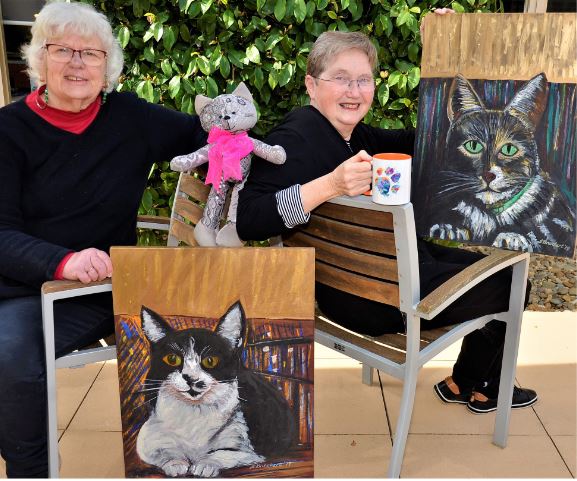
Cat and art lovers alike will be heading to the Creswick Town Hall this long weekend.
The Cats Come to Creswick Art Show is on from September 29 to October 1 and is the brainchild of Sandy Campbell, board member for the town’s John Curtin Aged Care Centre and event coordinator.
While musing on a good way to raise some money for the centre, Sandy realised that cats were perfect as a central theme for an art show for several reasons.
Firstly, they are ubiquitous creatures in our lives, she says, and secondly, artist Norman Lindsay, one of the town’s most famed historic figures, simply adored the feline species. Alongside human nudes, for which he is particularly known, he painted plenty of them, Sandy says.
“Creswick is very proud of Norman Lindsay and aside from painting nudes he also painted cats. He loved cats. There’s even a book dedicated to Norman Lindsay’s cats. To have them as the theme for an art show seemed like a logical thing to me.
“Wherever you travel in the world you will always find a cat. They are so ubiquitous.”
The art show will feature works by 51 artists, many of them professional, and many from throughout Central Victoria.
Well-known for her printmaking, Loris Button, who previously taught at the Ballarat Art School, says turning her hand to depicting the cat in art has been a bit of a different experience for her as well.
Portraiture, including self-portraiture, is usually more her thing, but Loris took this opportunity to create three prints honouring her own dearly departed, much- loved house moggie. “They depict our late cat sleeping. She was 23,” says Loris.
There’s also a couple of artists from interstate, and even some from very close to home including John Curtin Aged Care’s own CEO, Steve Bruechert, who usually paints entirely different subject matter.
However, Sandy was able to convince him to turn out some feline-themed works for the cause, which is to raise money for a new automatic minibus for the centre so staff can take residents on regular outings.
“We need to get a new bus to take the residents on outings and picnics and it needs to be equipped to take wheelchairs.”
Art will be for sale and is “first in, best dressed”, Sandy says.
“One of the works will be a compilation put together by a number of our residents with some help from a lifestyle team member.
“They’re being very secretive about it and it’s being unveiled at the preview event for artists, sponsors and board members on Thursday night.”
There will also be some attractive raffle prizes up for grabs as part of the show, and a cat-themed sales table including limited edition handmade toy cats and souvenir mugs.
The Ballarat Cat Lovers group, dedicated to finding good responsible homes for real cats, will be present during the show. Entry is $5 with children free.
Words & image: Eve Lamb