
November 8th, 2024Book launch of Naku Dharuk (message on bark)
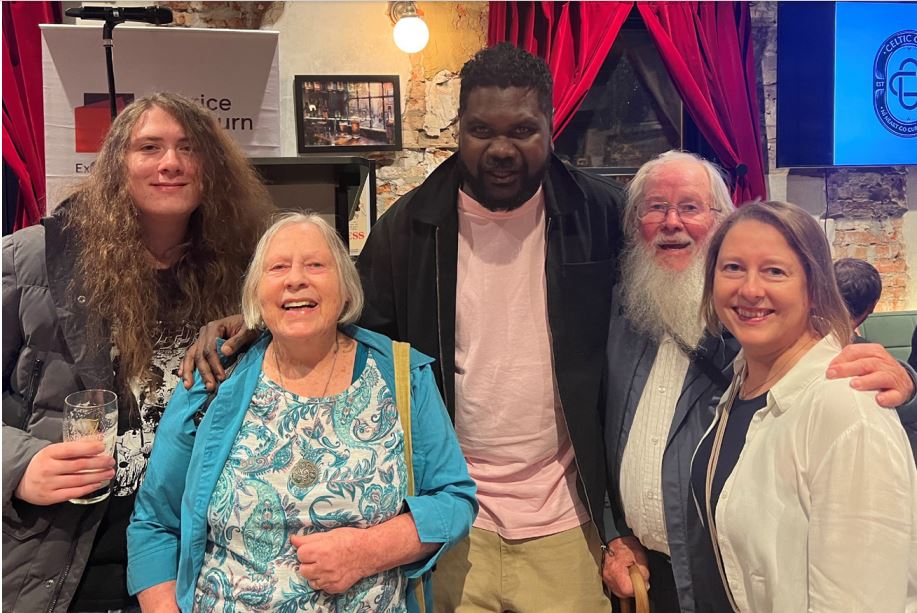
My husband Malcolm Bray and I, Ruth Bray, were recently fortunate to attend the launch of Professor Clare Wright’s book Naku Dharuk, The Bark Petitions. How the people of Yirrkala changed the course of Australian Democracy.
In the 1960s when the government permitted mining exploration and mining of bauxite on the Gove Peninsula in Arnhem Land, land which had been owned and occupied, for tens of thousands of years by the Yolnu people, their response came by presenting petitions to the Federal Parliament on bark paintings. This was many years before Mabo.
One petition is in the National Museum in Canberra, and the other two on display in Parliament House. My grandson Keaton and I travelled to Yirrkala last December when the fourth bark petition was returned to Yirrkala, where Malcolm and I lived and worked in the 1960s.
Clare Wright’s book, Naku Dharuk tells this story. At the launch at the Celtic Club in Brunswick, we introduced ourselves to Yirrkala man Yirrmal Marika, who is in Victoria to do a business studies course.
It was great that Malcolm and I retained some of the language we learnt so many years ago and we could converse and laugh with him in his own language.
He told us he felt he was with family. Then we discovered Beth Graham. Beth was a schoolteacher at Yirrkala in the 1960s with her husband Leigh, a carpenter. Beth later worked in the top end encouraging bilingual education in Aboriginal communities.
This was tremendous in helping Aboriginal children in their schoolwork. Unfortunately the government has disbanded the idea, although I understand the Catholic school system and the schools at Yirrkala still teach this way.
The noise of chatter over drinks and our conversation were interrupted by the sudden clapping of clapsticks and the sound of the familiar (to us) singing. Yirrmal, as he sang, was calling us together to listen. I don’t think I have heard a crowd silence itself so quickly.
The speakers at the book launch were the usual ones you would expect and included representatives from the Celtic Club, Clare thanked her supporters and those who contributed and helped her with her research including Beth Graham, whose letters in the 1960s home to her family provided a wealth of primary data.
In reading Naku Dharuk Malcolm and I were thrilled to see a line or two about our romance back in the 1960s. But it looks like you will have to read the book to find out more.
Naku Dharuk is the third in Clare’s Democracy Trilogy. The publishers, Text Publishing, must be pleased that Clare’s books are so readable and interesting.
The other two in this series are The Forgotten Rebels of Eureka – the story of the women and children who were in the Stockade, including a woman in labour while the attack happened, and You Daughters of Freedom on the 1902 suffrage campaign for white women.
All three books are a great read. They are the sort of books once you have started them, you cannot put them down. Any, or all would make a great Christmas present.
Clare said she would be happy to come to Daylesford and speak to any groups who are interested in her work.
Word: Ruth Bray | Image: Contributed
January 18th, 2024Teaching the next generation: Returning the Fourth Bark Petition to Country

Words: Ruth Bray
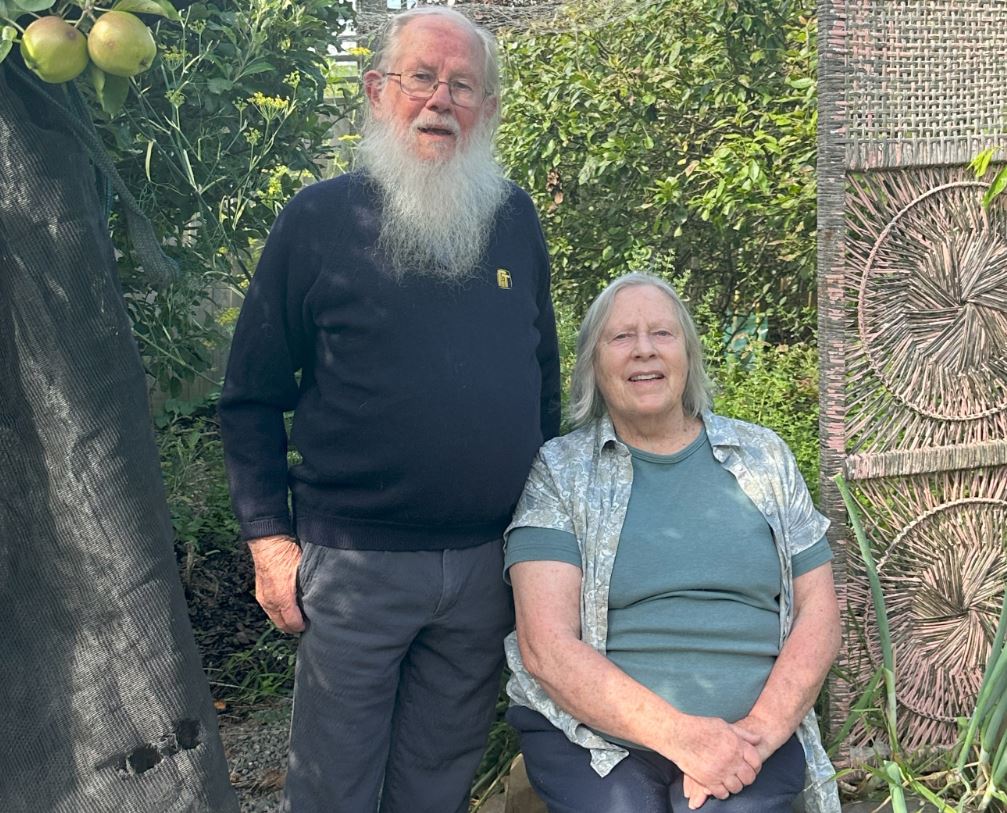
In 1962 my husband Malcolm Bray went to Yirrkala Mission in Northern Territory to work as a mechanic. I joined him three years later. We learnt the local Aboriginal language, and would often go to listen to the singing, the didgeridoo and the clapsticks in the evenings, and loved going out on Country with the Yolngu people.
We were thrilled when we received an invitation to a Bungul, or ceremony celebrating the return of the Fourth Bark Petition to Yirrkala in the first week of December. As Malcolm was unable to travel, our grandson Keaton from Hepburn, and I travelled to Yirrkala.
Yirrkala Bark Petition was the first formal petition presented to the Australian Parliament on Aboriginal Land Rights, and is considered a significant turning point in the recognition of Indigenous Rights in Australian history.
As a result a Select Committee on Grievances of the Yirrkala Aborigines, Arnhem Land Reserve, was
established. This was followed by the 1976 Land Rights Act, and eventually the Mabo ruling.
During this year, children from the local schools at Yirrkala, Nhulunbuy and Gunyangara attended workshops, learning the history of the Bark Petitions. They were told how when the government, without consultation with the Yolngu or the mission, permitted mining exploration at Yirrkala, Aboriginal Elders from the 13 clans sent a petition to the Australian Parliament concerning land rights, attached to bark paintings.
In 1963, there were four Bark Petitions. Two representing the different moieties of the Yirrkala clans are now on display in Parliament House and one is in the National Museum in Canberra. The fourth was recently discovered in Derby, Western Australia by Professor Clare Wright of La Trobe University and was returned home to the Buku-Larrnggay Mulka Centre at Yirrkala.
On the morning of the Bungul, Keaton and I accompanied Aboriginal Elder, Witiyana Marika and Professor Clare Wright, as the students were taken to each place of significance, in the preparation of the petitions.
In the church Clare told the students how in the 1960s, at the request of Rev Edgar Wells, local elders had painted two large significant bark paintings. These stood in the front of the church, and told their important traditional stories. I remember seeing them each time I was seated in church. These large bark paintings are now in the Buku-Larrngay Mulka Centre.
When MP Kim Beazley senior, was brought to Yirrkala by activist Stan Davey in response to the Elder’s concerns, and saw the magnificent bark paintings in the church, he suggested that the Elder’s petition should be attached to bark paintings.
Then we followed the schoolchildren up to a shady tree on the cliff top, beside what was the site of the old Mission House. The story of the night the Elders painted the barks under that tree was told. My husband Malcolm was there that night and recollects watching the elders as they painted the barks.
To celebrate the return of the petition, some weeks previously, each school collected ochre, cut a bark, and painted it. Like their elders before them, they wrote and fixed petitions to their bark paintings. Their petitions included modern problems with children not attending school and the need for better roads.
The children learnt how mission staff, mainly the wives, carefully translated the words of the Elders into English. Ann Wells, wife of the Superintendent Edgar Wells, typed 12 copies of the petition in both Yolngu language and English.
One key on her typewriter had been altered to type the tailed n, common in Yolgnu language. This
typewriter has been donated to the Buku-Larrngay Mulka Centre.
The students were then taken to the place where the Elders gathered to sign the petition. We heard how as the copies were passed around, each Elder made his thumb print, which was witnessed by younger literate members of the Yolngu community who then signed the petition.
After visiting these places and hearing these stories, the students then returned to the shade outside the Buku-Larrngay Mulka Centre and gathered around their own bark petitions, and added their thumb-prints.
Later that day, women in red, carrying long digging sticks, were seen singing and dancing towards the centre, accompanied by a replica of the fragile Fourth Bark Petition.
It seemed to me that the original Djankawa sisters from the old stories, who arrived with their digging sticks and occupied the land way back in history were bringing the claim for land rights.
After speeches from the different Yirrkala clans, the replica petition was slowly danced into the centre by the men, with the clapsticks echoing, and the sounds of the singing. It was powerful.
The replica disappeared and the petition, already hanging on the wall, was suddenly unveiled. The clapsticks went on and on and on, with the men standing there in front of the petition singing and singing and singing, louder and louder. When they eventually stopped, the Fourth Bark Petition was home.
Professor Wright has not only researched the Bark Petitions, discovered the lost petition, facilitating its safe return to country, but she and Elder Witiyana Marika have taught and encouraged the younger generation at Yirrkala to learn about the importance of the Yirrkala Bark Petition.
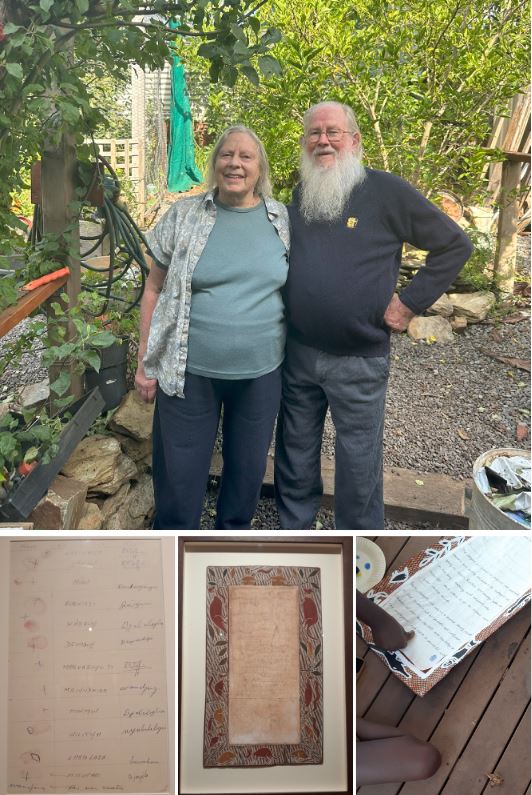
thumbprints and signatures on the Bark Petition, the Fourth Bark Petition, the Student Petition. Images: Ruth Bray..