


January 30th, 2025Clunes to form community advocacy group


Clunes locals are keen to form a new group to ensure the community gets good ongoing benefits from the 330 megawatt Nyaninyuk windfarm proposed for just west of the township.
Acciona is looking to establish the wind farm between Evansford, Clunes and Waubra, on the western side of Mount Beckworth with the proposal now in the planning and approvals phase.
The proposed development is valued at $700 million and projected to generate enough energy to power the equivalent of 210,000 households with the Western Renewables Link power conduit route proposed to pass just south of Clunes.
In recent days Clunes community members, farmers and council representatives were among those who met to discuss the proposed development and ways to ensure the community and landholders can broker the best impact compensation deals.
One of the meeting’s several co-convenors, Malcom Hull says general consensus emerging from the meeting is around the need to form and formalise a group to advocate on behalf of the community and to negotiate with the wind farm’s developers to ensure the community receives ongoing benefits.
“It’s coming and it was started back in John Howard’s day. This isn’t about being pro or anti wind farm. It’s about making sure the community doesn’t get dudded,” Mr Hull said.
He points to impact compensation deals that other communities have negotiated from the establishment of renewable energy projects in their area, as examples of what can be achieved.
“Waubra is getting $90,000 a year for the community,” Mr Hull said.
“Rokewood is getting $230,000 a year and every person who lives in Rokewood (and was living there before the windfarm was established) is getting their power bill paid for the next 25 years.
“We need to formalise an entity that can argue on behalf of the community and it’s up to the community to put thoughts forward as to how money could be spent – maybe a community battery, maybe electric vehicle charger points, maybe money for the CFA …”
David Lawrance of Farm Gate Renewables was among those who attended and spoke at this month’s community meeting.
Mr Lawrance says communities, including landholders, are doing “the heavy lifting” in the clean energy transition and need to be fairly compensated. But he says that if communities like Clunes don’t pro-actively stand together then they risk missing out on getting fair compensation.
“You have a voice in this. You shouldn’t be a silent victim,” Mr Lawrance says.
Farm Gate Renewables operates on a commercial basis, providing consultancy and advocacy to negotiate better ongoing deals for impacted farmers and landholders. But it also works on a pro bono basis to help communities that are impacted by developments to get the best outcomes they can in terms of fair compensation.
Mr Lawrance says providing legal advice on possible different structures that an effective community advocacy group may be able to adopt is one way that Farm Gate Renewables can assist communities like Clunes.
From here, Mr Hull and fellow co-convenors like Dr Tess Brady, say locals who are interested in being part of the proposed community advocacy group should attend the regular Sunday evening community drinks gatherings that take place at Attitude Clunes.
“If people have got skills, legal skills for example, or any other skills or ideas, we’d be more than happy to hear from them,” Mr Hull said.
Dr Brady says the ongoing Sunday evening community drinks gatherings at Attitude Clunes happen from 5pm (daylight saving hours) with all welcome to attend.
“We are looking closely at other cases, other communities and the kinds of compensation they’ve had,” Dr Brady says.
“It’s pro community and how can we turn this thing into something positive for us. The main aim is to avoid contention and find consensus.
“The big picture here is a redistribution of wealth into the regions. If you add up the amount of compensation around, it’s big dollars.” Words: Eve Lamb | Image: File

February 2nd, 2024Sunny side up: a new crop for Clunes

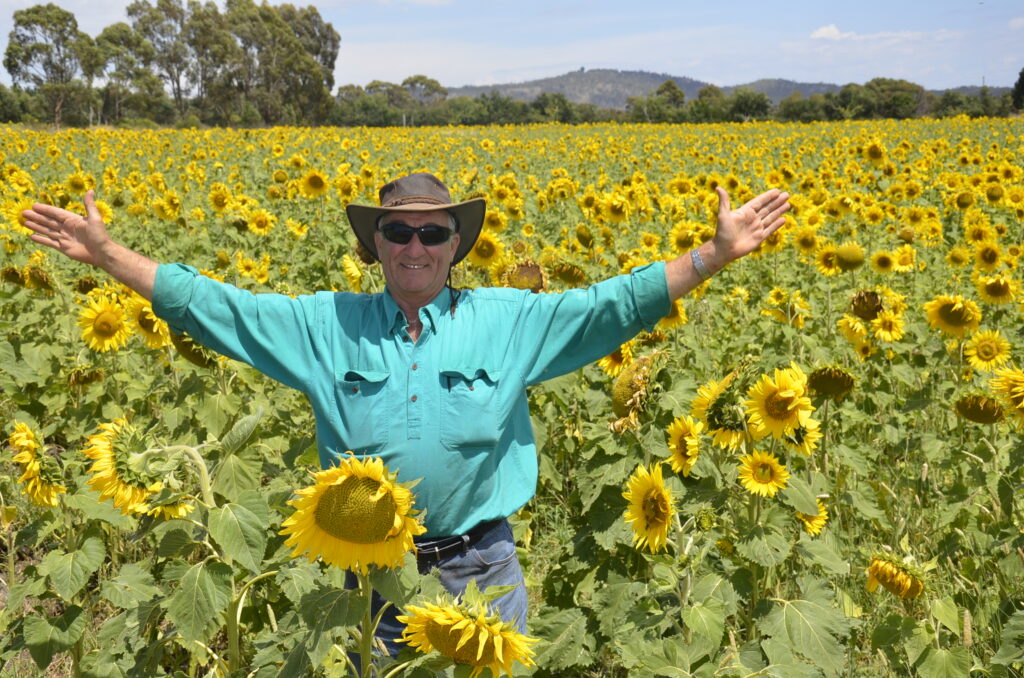
The field full of sunflowers on the outskirts of Clunes has been attracting its fair share of attention.
Growing these golden glories is a bit different here but all going well with the crop, that’s been planted by Miners Rest’s Andrew Fraser in a shares arrangement with Clunes’ Malcolm Hull, they may just become a more common sight into the future.
Long time Clunes local Malcolm Hull, who owns the paddock, says they’re growing the 12 hectare crop after Andrew approached him back in September with the slightly different farming proposal.
“We own the land and he’s got the skills and machines,” says Malcolm.
Andrew Fraser runs Frakel Farming Produce, a stock-feed business selling hay and a wide range of livestock-feed grains that he also grows.
The anticipated sunflower seeds are destined for use as quality animal feed ranging from birdseed to a component in horse feed mixes, Andrew says.
It’s the first time he has diversified into growing sunflowers and it’s all a bit experimental, but so far – fingers crossed – the weather has actually been on side.
“It’s been quite a damp summer which has been a bit of a Godsend for this crop,” Malcolm says.
It’s not believed to be the very first sunflower crop ever planted in Clunes as a commercial venture but, that said, it’s been a very long time since the immediate area saw its last field full of sunflowers grown on such a scale.
“I’d say it’s the first crop grown here for a very long time. I’d say we’d probably have to go back to the early ‘90s when one was grown in the Mount Beckworth area,” says Malcolm whose family goes way back at Clunes.
“My father always used to call this paddock (that the sunflowers are growing in) Kelly’s paddock after the family that once owned it.”
There are currently just a handful of other commercial sunflower crops in across the wider district including one at Ascot further down the road toward Ballarat.
Andrew Fraser is also growing that crop in a partnership arrangement with another local there.
“It’s a summer crop and it’s my first crop of sunflowers, says Andrew. “I put the Clunes crop in about a week before the one at Ascot.
“The reason I decided to grow it is just because it’s so hard to find sunflower seed. Normally it’s grown in the top part of New South Wales or in Queensland, and around Shepparton too, a lot further north.
“I‘ve seen a crop in Smeaton a few years ago.”
They’re also known to be grown at Dunnstown near Ballarat.
Andrew and Malcolm say the 12 hectare crop at Clunes was sown back in October and it’s been pretty straightforward since then, with a late application of fertiliser administered a little while back, and harvest now anticipated toward the end of March.
It may possibly be necessary to rig up some gas scare guns to operate during daylight hours just to keep the potential interest from cockies and corellas at bay as the seeds ripen, Andrew anticipates.
“It’s something a bit different here but in Europe there’s tens of thousands of acres grown for oil production,” Malcolm says.
“We were in France back in 2019 and there was just paddock upon paddock of them.
“They’re certainly eye-catching and there’s been plenty of inquiries and people interested in it,”
“We’ll just see how it goes this year and if it’s a good-yielding crop maybe we could look at growing them for oil.”
Words: Eve Lamb