


March 15th, 2025Walks of the Central Highlands

With Eve Lamb
Three Lost Children Walk, Daylesford, 15 km (total)
Part B
Today is the day we shoulder our packs once again to complete the final remaining half of Daylesford’s famed Three Lost Children Walk.

We start where we left off last time, in Hogans Lane at Musk Vale surrounded by comfortable homes on acreage, and it’s a couple of ks of hiking on gravel, across the Ballan-Daylesford Road blacktop, and onwards, following unsealed Hogans Lane right to its end. Then it’s right into Foxs Lane, then left into Manna Gum Track.
Here, finally, we begin to leave the lifestyle acres, goats and alpacas behind, and things start to get a bit bushy. For a start there’s a large male kangaroo eyeing us off and making me feel just a tad nervous, recalling tales of how these fellas, who have every right to feel miffed at people invading their ancestral home, have been known to eviscerate folk with a well placed claw hook.
Thankfully the big roo merely stares peaceably. And we walk on.
We’re equipped with a well thumbed copy of the Three Lost Children Walk brochure, readily available from the Daylesford Vistor Information Centre, and my copy of Walks, Tracks & Hikes of Victoria by Derrick Stone.
The bush is dry. The day is hot. We reach the point where the trail descriptions indicate we should swing left into Paddock Track. But a brief moment of confusion arises. There’s a marker post facing us but its face is bare, displaying no signage of any kind.
My walking accomplice, Paddy H, ever observant, takes a look and discovers that the about-facing side of the post does display the now familiar stylized Three Lost Children trail marker, confirming that this is, indeed, where we turn left. And we’re on the right track.
“That’s why I bring you along,” I tell Paddy H who accepts this as his due. As we gain a bit of elevation there are fallen eucalypts on the forest floor, relics of the famous June storm from a few years back. We’re on a rough-hewn dirt vehicle track, surrounded by the forest now. After a while, we hear the engine of a vehicle drawing closer.
A ute appears, trawling slowly behind us.
Glancing behind me, peering back at it, I see the occupants are a friendly-looking couple.
Paddy H stops to say G’day to the bloke behind the wheel, beside whom the female passenger grins back at me. Or is that a look of empathy?
I wait beside the track while Paddy H and the bloke behind the wheel converse. And wait. And then wait a bit more.
Finally they’re done.
“Nice bloke,” surmises Paddy H as we start moving again. “He’s concerned about climate change and the impact it’s having on the forest.”
Pretty soon it becomes apparent that our printed walk guide has failed to mention just how gnarly, and flinty this walk is. Let’s just say there are some undulations here that could bring delight to hard core theme-park enthusiasts if you ran a light rail over them.
And once again I find myself thinking of those poor three lost little tackers whose tragic 1867 meandering this walk memorializes. This is no leisurely pleasure promenade. I marvel especially, for the hundredth time or so, at how their small-child legs could ever have carried them so far.
Sweating as we tackle the dusty undulations beneath the blazing February sun we reach the almost-evaporated and rather sad-looking Specimen Hill Dam. More of a bog hole today really. History records that it was near this spot that a young man called John Quinn had encountered the lost children and (unsuccessfully) attempted to turn the three doomed smalls back for home.
“Good advice,” I reflect aloud.
“Reminds me of the bullock driver in Joseph Furphy’s ‘Such Is Life’,” muses my walking companion, cryptically.
“I’ll have to read it.” We still have a fair way to go and I need to conserve energy.
The walk description is proving fairly straightforward to follow, though, and the trail well-marked. We reach, and cross Specimen Hill Road that wends its lonely way on through the Wombat State Forest bushland as far as the eye can see from this juncture.
And from here we trudge on along the dusty and evocatively named Cockatoo Track for about 3km to finally reach the Wombat Creek Dam.
The walk officially ends here at the Wombat Creek Picnic Area. The “dam” water storage reservoir is a decent little body of water. On a hot day like today just reaching it is a very welcome reward.
Note: The first part of this walk review appeared in the January 13, 2025 edition of The Local.

January 19th, 2025Walks of the Central Highlands

with Eve Lamb
The Three Lost Children Walk. Daylesford-Musk Creek 15 km (Part A)

The first day of 2025 dawns sunny and mild, temperature in the mid-20s with a promise to reach no more than 28 degrees. Ideal bushwalking. Too good to pass up.
I check in with my trusty walking companion, Paddy H, and we decide it’s more than time to tackle the famed Three Lost Children Walk. This bushland walk covers 15 km starting in Daylesford, taking in part of Hepburn Regional Park and part of the Wombat State Forest. It ends at Wombat Creek Picnic Area near Musk.
It commemorates the tragic tale from Daylesford’s gold-rush era when three small boys (William Graham,6, his brother Thomas, 4, and Alfred Burman, 5) wandered away from their homes in Daylesford on June 30, 1867.
Sadly, despite a massive search after it became clear they were missing, they were not found alive. No trace was found until September 13, 1867 when a dog came home to Wheelers Hill, 10 km south-east of Daylesford, carrying a small boot that reportedly contained a small foot.
The following day the children’s little bodies were finally found. Two of them in a hollow tree and the other close by. The Three Lost Children Walk follows the approximate route the poor little fellas walked.
You can’t really write a bushwalking series centred in the Central Highlands and not include this walk, with its tragic tale tracing the doomed trek of these three intrepid little tackers.
You can pick up a good guide description of the walk, complete with map, from the Daylesford Visitor Info centre. I’ve been holding onto my copy for all of 2024. I’m also equipped with my good old copy of ‘Walks, Tracks & Trails of Victoria’ (by Derrick Stone) which includes this walk, while Paddy H has the relevant one of his many beloved topographical maps.
To get 2025 off and striding, we’re going to tackle roughly half the walk. We’ll come back again, another day, and complete the entire walk for this series. Today, first up we plant my car at our designated stop point of Hogans Lane, Musk Vale, and then drive Paddy H’s car to the walk start point.
The start point is the cairn in the Lost Children Reserve at the junction of Central Springs Road and the Midland Highway. We set out from the top corner of the Reserve, heading south along Table Hill Road then straight ahead down Forest View Lane.
The track becomes a sharp descent and we notice the dedicated Lost Children Walk trail markers. These feature a little stylized emblem representing the three small unfortunate adventurers.
We cross a footbridge over the Wombat Creek. A jogger, impatient in his bright tangerine running shoes, rushes past and tackles the rugged short flight of steps that we also must take, upwards, on the other side.
It’s pretty straightforward going now, just carefully following the walk guide description, maps, and dedicated trail markers. But just ahead, a point of potential confusion arises when, wending our way toward Sailors Creek, we reach a bush-land point where a medley of different dirt tracks interconnect and ping off in multiple different directions.
The trick is simply to keep calm and continue, basically following the path you’re already on as the gully naturally slopes down toward Sailors Creek. We reach the creek and turn sharp left as soon as we cross it, then remain on a very short little section of the trail for about 200 metres as it curves around to connect with Black Jack Track.
Here we turn left onto Black Jack Track which we will now follow for a couple of ks through Hepburn Regional Park.
The eucalypt bushland is tall and deliciously fragrant. I breathe in its spicy, inimitable aroma and then notice that someone has painted the word ‘Bees’ and an arrow pointing up, in yellow paint on a tree trunk to our left.
“Is it because we’re s’pose to be concerned we’re going to get stung … or to enjoy them?” wonders Paddy H who maintains a couple of backyard bee hives.
The bushland is beautiful but also fairly rugged going, and you’ve really got to admire – and wonder at – how those three small gold-rush era trekkers and their little legs ever managed to get such a distance.
Peering down at my own boots moving along on the track I see that two-legged pedestrians are not the only ones who’ve been navigating this path. There are horse hoof prints here too, etched in the sandy surface.
A bit further on, the source becomes evident when Paddy H spots, not a horse and rider, but …
“Look it’s a horse and sulky,” he says.
“What?”
Within seconds we’re meeting Glenn Conroy, a noted local harness racehorse trainer who trains in partnership with his sister, Anne-Maree Conroy.
“I use the bush lane every day,” Glenn says as the handsome bay horse in harness, takes a bushland breather.
“You must see some interesting things,” I venture.
“Yes. I see lots of people doing all sorts of things, walking, jogging, prospecting…” Glenn says, maintaining a steady grip on the harness reins as the powerful bay shifts about a bit.
“What’s your horse’s name?”
“When he’s in the stable he’s known as Smith, but he’s also more officially known as I’maboganboy,” chuckles Glenn.
The attractive bay seems fairly civilized for a bogan, I think. But we don’t want to delay them any further and in the whisk of a tail they’re off again heading further along the track.
Up ahead, the track climbs a gentle rise and here we encounter three bushwalkers, a middle-aged woman, older teenage boy and a teenage girl, whose serious-sized backpacks all lay heavily on the ground as their owners take a break.
Paddy H gets chatting and as a result we soon discover that they are: A. from Melbourne. B. plan to camp, and C. don’t know that the track we’re all on is part of the Three Lost Children Walk, or the story behind the name.
As Paddy H takes it upon himself to give them a brief tragic history lesson, I re-read the description for this section of the trail and see that up ahead we’ll soon, again, cross Sailors Creek.
By the time we’ve put a good bit more trail under our boot tread, crossed the creek and pushed hard up a gnarly little hill, admiring a gorgeous small pond on our left, to finally re-emerge from the bush in lifestyle-property-land at Hogans Lane, Musk Vale, we’re more than a tad happy to call it a day and sink into my awaiting car seats.
Is it the good life we’ve been living over the festive break catching up with us we wonder, as I simultaneously try not to get too upset thinking about those poor little lost chumpers. And I’m not even the clucky sort. Yet, later tonight when the lights go out, I will again find myself thinking of how terribly cold they would have been that frosty June long ago in the Central Highlands.
As we head for home we, by contrast, are sweating and looking forward to a summer salad dinner to round out our day on what has been a fairly ideal start to 2025.
Walk to be continued…

December 6th, 2024Local artists work featured in ‘Unfathomable’ exhibition

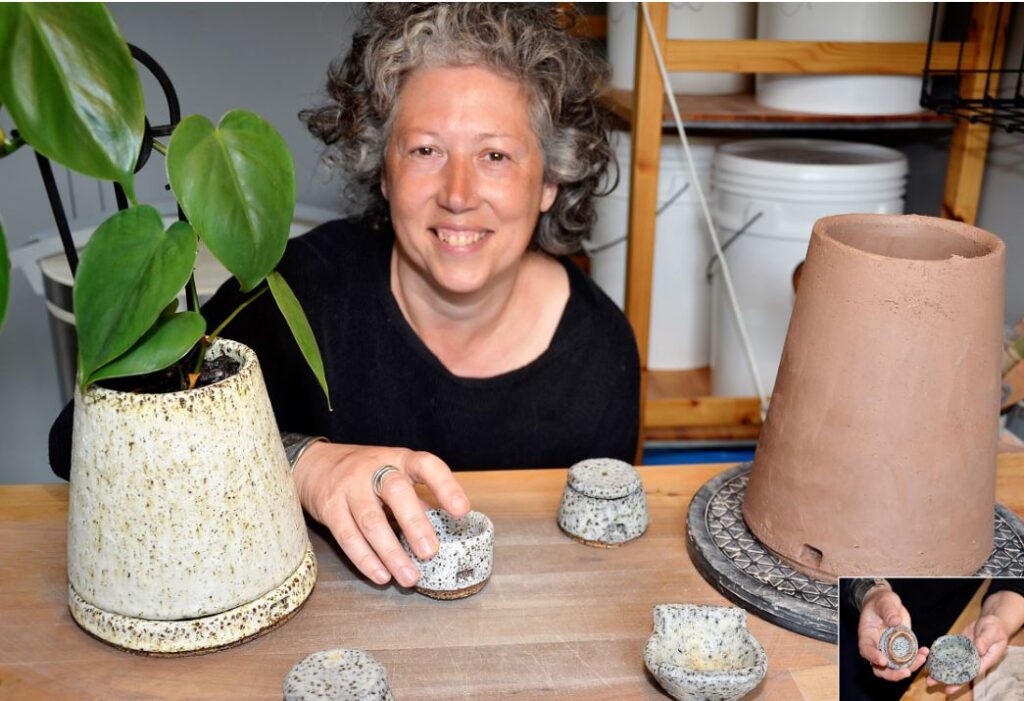
Ceramics by Musk Vale’s Minna Graham and Clunes’s Chandra Paul are part of a new group exhibition featuring new work by five Central Victorian artists.
The Unfathomable exhibition opening tomorrow at Lot 19 Art Gallery in Castlemaine aims to take that which is hard to explain and transform it into quality works of art.
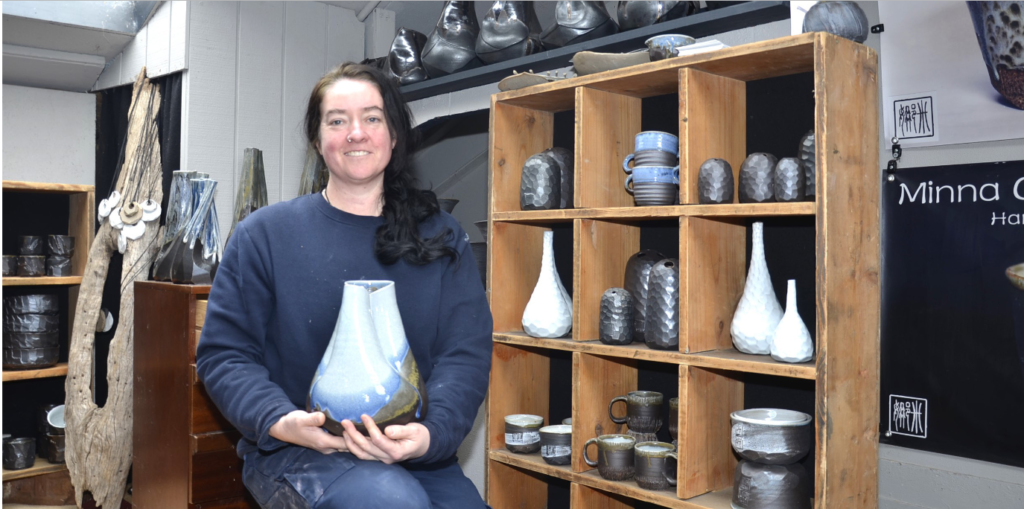
Represented artists include Minna Graham from Musk Vale, Jackie Gorring from Allendale, Ella Hughes from Guildford, Chandra Paul from Clunes and Dannielle Wilkinson from Castlemaine.
The exhibition opens tomorrow, Saturday, December 7 at 2pm then opens Saturdays and Sundays up to December 22 from 10am to 4pm.
October 27th, 2024Artists of the Central Highlands

with Eve Lamb
Creativity has always been central in the life of Musk Vale ceramicist Minna Graham. This exceptionally skilled ceramicist creates hand-made, functional tableware with a sculptural twist. Right now Minna is preparing to participate in a national open studio event and to exhibit her work at one of Australia’s foremost contemporary ceramics galleries, the Skepsi Gallery in Malvern.
Eve: What do you draw on for inspiration in creating your work Minna?
Minna: (gestures beyond her studio door) Out there! The bush. Landscape. I think I’ve come to terms recently with the fact that I’m a landscape artist. I’m really interested in mountains and volcanoes. Big inspiring landscapes. And we do travel a lot. I do chase different landscapes. Patagonia is a big one that’s stuck in my memory. Since 2016, when we travelled there, I’ve been having a love affair with the mountains and glaciers of Patagonia The Himalayas. The volcanoes of Indonesia. The Australian desert… And also the small things.
We live very close to the earth here. After a while you notice things in detail, The seasonal changes. There’s so many amazing micro-details that fascinate me like the gum leaves changing colour, tiny little micro orchids. These influence my glazing and colour and texture as well. I like to have a sculptural element to my work … The landscape kind of finds its way into every aspect of my work both physically and metaphorically.
Eve: What are some of your main ceramics career highlights?
Minna: Probably one of the best was that there was an Amazon Prime series that was filmed at Byron Bay called Nine Perfect Strangers, shot in 2020 and starring Nicole Kidman. Anyway when that was happening people who follow me on Instagram started sending me all these photos of Nicole going ‘Cheers’ with a drink in hand, in the series. I was wondering why are all these people sending me photos of Nicole Kidman going ‘Cheers’ and it took me a while to work out that she was going ‘Cheers’ with a piece that I had made. And there is also a breakfast scene in the series which has a lot of my work in it as well. It was especially satisfying because I’ve heard that Nicole Kidman is a bit of a stickler for being in control of the aesthetic.
Eve: That’s an excellent highlight.
Minna. Yes. There was also some artwork in that series by another Daylesford artist as well, Gav Barbey. Some other highlights for me over the past 10 years … I’ve enjoyed being selected for some major ceramics awards in Australia including the North Queensland Ceramic Awards. I’ve been shortlisted as a finalist this year. It’s opening in late November. And at the moment I’ve got three teapots in the Sydney Teapot Show.
Eve: Do you have any special events or exhibitions coming up?
Minna: Yes I will be participating in The Australian Ceramics Association’s national open studios event over November 23-24. My studio here in Musk Vale will be open and I will be doing demos though the day. I will also invite another local artist to be part of the open studio here as well. I will have the upstairs gallery open and work for sale there. I also set up sales items downstairs here in the studio and we have coffee and cake as well… I will also be part of a group exhibition in November at the Skepsi Gallery in Malvern which I’m very excited about. It’s a very well established gallery and attracts a lot of collectors. That opens on November 16 and runs for about a month.
Eve: Have you ever worked in any other sectors Minna?
Minna: I’ve done a lot of other things but I have always been in the creative arts. I have a background in music. I trained as a classical musician and I also used to make costumes for festivals and that sort of thing. Costume making and performing. But then in my late 20s I came back to ceramics and never looked back really. Both my parents were artists so I was never going to escape really.
Eve: Are there any changes that you’ve noticed in the wider realm of professional ceramics practice?
Minna: My God yes. The ceramics scene has enjoyed a real renaissance, probably since COVID. I think ‘ The Great Pottery Throw Down’ may have had something to do with it. Now people are becoming more educated. They have a bit more of an appreciation for handmade things. Ceramics is one of the toughest art forms to learn. There are so many elements to it.
Eve: What are some of the main professional challenges that you have to contend with?
Minna: It can take a good four plus months for me to get a piece from start to finish. It’s very time consuming. There’s zero instant gratification in ceramics (laughs). A friend once said to me when I was unloading the kiln: ‘it’s like some kind of horrible-wonderful anxiety Christmas’. And that’s true!