
November 8th, 2024Book launch of Naku Dharuk (message on bark)
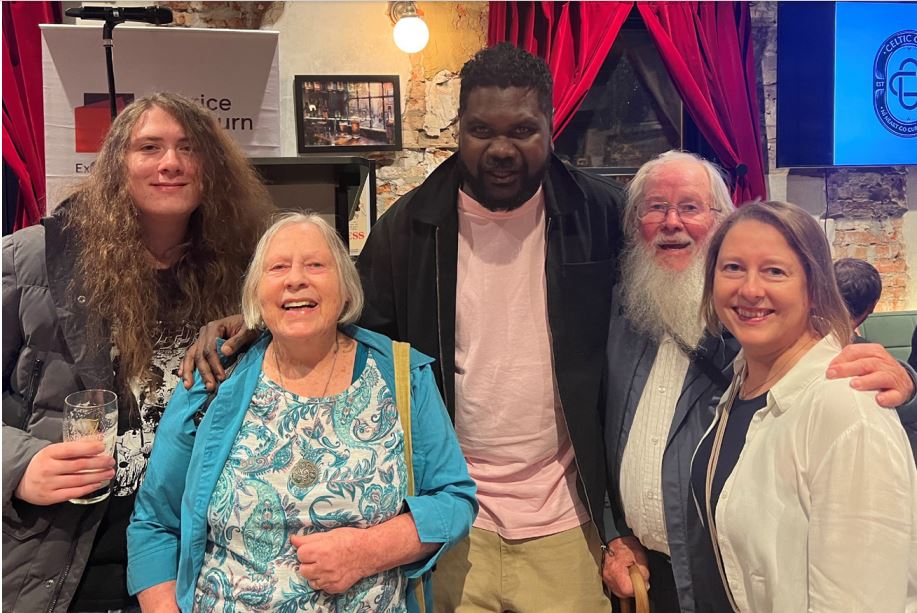
My husband Malcolm Bray and I, Ruth Bray, were recently fortunate to attend the launch of Professor Clare Wright’s book Naku Dharuk, The Bark Petitions. How the people of Yirrkala changed the course of Australian Democracy.
In the 1960s when the government permitted mining exploration and mining of bauxite on the Gove Peninsula in Arnhem Land, land which had been owned and occupied, for tens of thousands of years by the Yolnu people, their response came by presenting petitions to the Federal Parliament on bark paintings. This was many years before Mabo.
One petition is in the National Museum in Canberra, and the other two on display in Parliament House. My grandson Keaton and I travelled to Yirrkala last December when the fourth bark petition was returned to Yirrkala, where Malcolm and I lived and worked in the 1960s.
Clare Wright’s book, Naku Dharuk tells this story. At the launch at the Celtic Club in Brunswick, we introduced ourselves to Yirrkala man Yirrmal Marika, who is in Victoria to do a business studies course.
It was great that Malcolm and I retained some of the language we learnt so many years ago and we could converse and laugh with him in his own language.
He told us he felt he was with family. Then we discovered Beth Graham. Beth was a schoolteacher at Yirrkala in the 1960s with her husband Leigh, a carpenter. Beth later worked in the top end encouraging bilingual education in Aboriginal communities.
This was tremendous in helping Aboriginal children in their schoolwork. Unfortunately the government has disbanded the idea, although I understand the Catholic school system and the schools at Yirrkala still teach this way.
The noise of chatter over drinks and our conversation were interrupted by the sudden clapping of clapsticks and the sound of the familiar (to us) singing. Yirrmal, as he sang, was calling us together to listen. I don’t think I have heard a crowd silence itself so quickly.
The speakers at the book launch were the usual ones you would expect and included representatives from the Celtic Club, Clare thanked her supporters and those who contributed and helped her with her research including Beth Graham, whose letters in the 1960s home to her family provided a wealth of primary data.
In reading Naku Dharuk Malcolm and I were thrilled to see a line or two about our romance back in the 1960s. But it looks like you will have to read the book to find out more.
Naku Dharuk is the third in Clare’s Democracy Trilogy. The publishers, Text Publishing, must be pleased that Clare’s books are so readable and interesting.
The other two in this series are The Forgotten Rebels of Eureka – the story of the women and children who were in the Stockade, including a woman in labour while the attack happened, and You Daughters of Freedom on the 1902 suffrage campaign for white women.
All three books are a great read. They are the sort of books once you have started them, you cannot put them down. Any, or all would make a great Christmas present.
Clare said she would be happy to come to Daylesford and speak to any groups who are interested in her work.
Word: Ruth Bray | Image: Contributed
August 16th, 2024Little care for carers

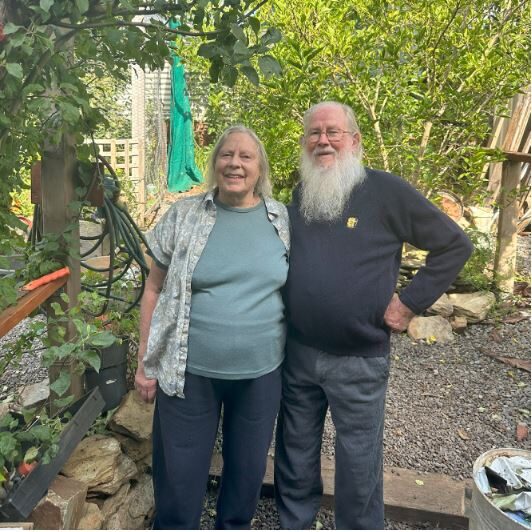
Daylesford’s Ruth Bray, pictured above with husband Malcolm, has taken part in the National Carer Roundtable in Brisbane.
Participants were asked to identify the major stresses and problems facing older carers and suggest solutions in response to the National Carer Strategy announced by the Minister for Social Services Amanda Rishworth in October last year.
But the trip for Ruth, who cares for her husband of 59 years, Malcolm, was not as simple as it could have been. Partly because she is a carer and also because she is an older Australian.
Ruth said after the initial stress of organising the household and support for Malcolm with just five and a half days’ notice, she also had to contact a number of older carers to talk about issues to raise and then ask her daughter and son-in-law to answer emails, organise digital wallets, virtual cab charge, plane tickets and an online photo.
Ruth then had to convince the organisers she needed to fly to Brisbane the day before the event.
“Getting up in the middle of the night in Daylesford (their suggestion) to catch a plane at 6.10am to advise the government at 10am and return that night, at 83 years of age, was not OK for me.
“I soon found myself clutching my luggage and walking stick, and in a wheelchair being pushed by a Virgin staff member, speeding through Tullamarine Airport to find a gate somewhere or other at the far end of the terminal.
“On the plane I met another delegate who did not have a young person in her house, so she had been unable to attend to all the online requirements.
“She decided our first problem was people not understanding that older carers may not be too computer literate.
“And perhaps some training, or maybe using snail mail with plenty of notice might be good. As I actually had my digital wallet by this time, even if I did not know how to use it, I suggested she share my taxi to the hotel.”
Ruth said the next morning about 50 carers, all aged over 65, from all over Australia, gathered for the roundtable.
Many topics were discussed including the long wait time for the My Aged Care assessment with more trained staff needed, the long wait time for support services, the need for training of workers who come into the home to help and not enough appropriate services available when needed.
Other discussions were around carers neglecting their own care and health needs, issues related to physical, financial and emotional abuse of older people, many carers not identifying as carers and missing out on extra financial and other support, the issues around older carers caring for adult children and older carers caring for more than one person.
Ruth said carers also talked about the different agencies in the same home often being uncoordinated with aged care packages, the National Disability Insurance Scheme and the Commonwealth Home Support Programme.
“My husband and I both need transport to the gym. He has a package and I am under CHSP. Two workers in two cars arrive at our home at the same time, from the same agency, to take us to the same gym, as I am not permitted in his worker’s car. This is your taxes at work.”
Carers also raised the issue of the education of carers so they can self-manage the government care packages instead of an agency, using just 10 per cent of the monies involved for management not 30 per cent – leaving much more money for services.
Finally, carers asked for a possible phone app for carers with emotional supports and information, help for carers in isolated and remote areas with transport and services, and computer training.
“There were other issues, and other roundtable meetings with different groups of carers, but if you are a carer and wish to contribute before September 5, contact National Carer Strategy at engage.dss.gov.au.
“If you are a carer on the aged pension, if you apply for a carer’s pension you will, like me, get an additional carer allowance of $153.50 per fortnight.”
Ruth said she would like to thank all taxpayers for her plane tickets, a comfortable hotel room, accessible bathroom – and the grilled barramundi and Asian greens on a bed of rice she had for dinner.
A DSS spokesperson said the Australian Government valued the input and participation of carers in consultation activities on government policy and programs such as the Carers’ Roundtable in Brisbane.
“This is critical to ensure that our initiatives, such as the new National Carer Strategy under development, reflects the experiences, perspectives and needs of carers.
“We recognise that due to all of the demands on carers, coordinating in-person contributions can be challenging, and consultation on the National Carer Strategy will include many avenues for carers to have their say that can be completed in their own time, such as online submissions and an online questionnaire.
“The government will continue to work with our consultation partners, including Carers Australia, to ensure carers are appropriately supported to participate, have a positive experience, and feel confident that their voices are heard and valued.”