


August 3rd, 2024Sheep, ceramics & bespoke items abound

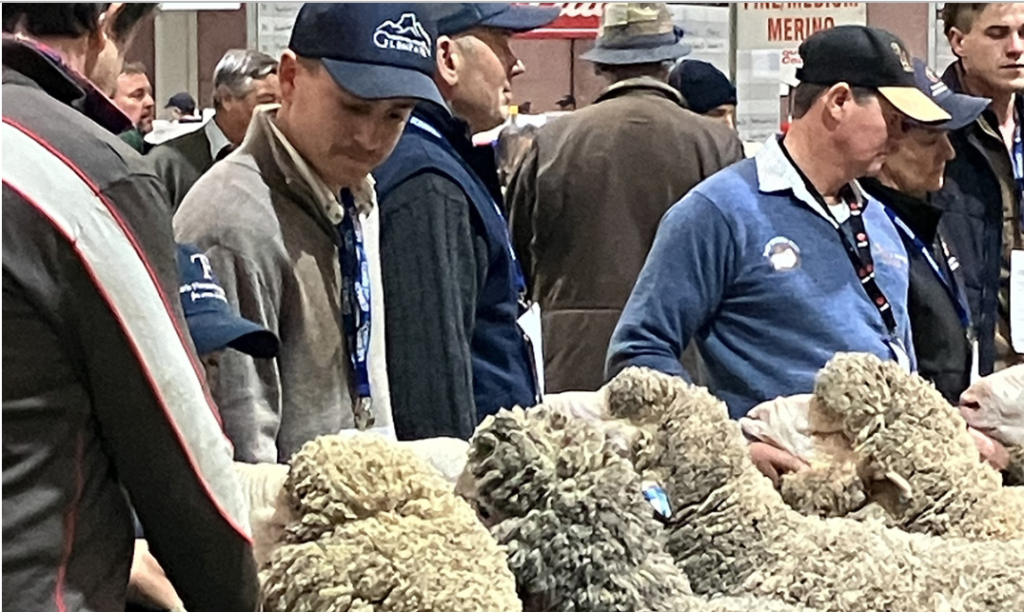
The Australian Sheep and Wool Show took place in Bendigo over the weekend of July 20. It is the largest event of its type in the world showcasing the mighty Australian sheep.
Over three days, thousands of people braved chilly weather to experience what the industry has to offer from food, fashion and fibre to everything in between.
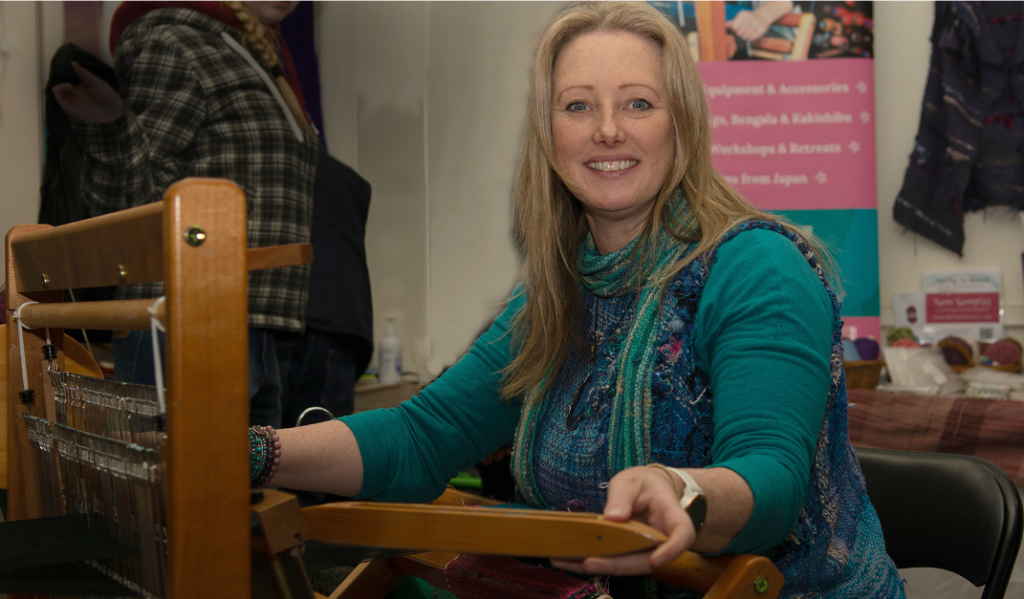
Spread across the Bendigo Showgrounds, visitors could watch sheep dog trials, weaving and yarn spinning displays, fleece judging and sample a diverse range of arts and lifestyle inspired by the wool industry.
The event attracts craftspeople from everywhere including Ian McColl of OxArt Pottery, Taradale. Ian or ‘Ox’ to his friends has made objects out of clay for as long as he can remember and once shown how to use the pottery wheel he was hooked on a lifelong journey.
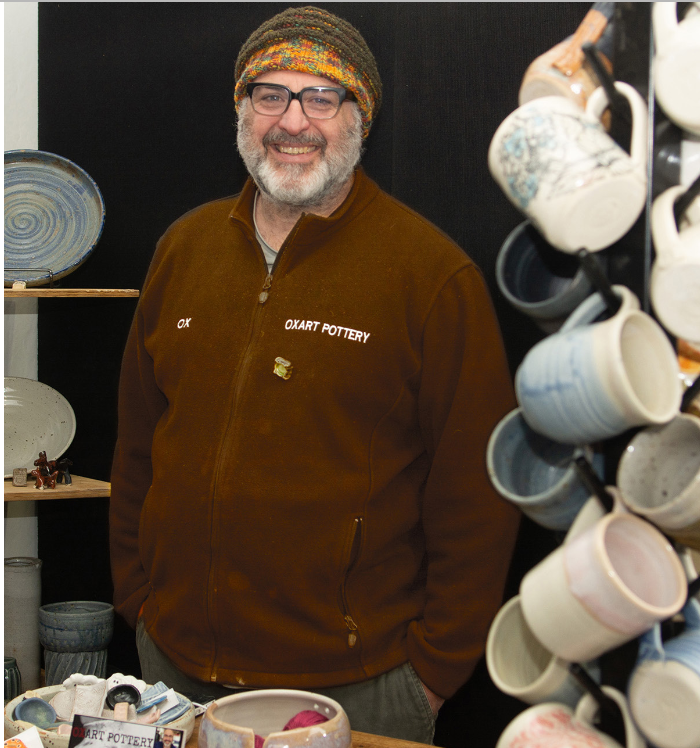
OxArt produces a wide variety of pottery products designed to be used on a daily basis including mugs, plates, platters, teapots and yarn bowls.
Popular with weavers everywhere, yarn bowls are, for the benefit of the ignorant, soup bowl sized vessels with a curl cut into the side. The weaver’s yarn, placed inside, is drawn through the slot smoothly and evenly.
I guess you could put a lid on it too which would prevent cats from upsetting things. But do weaving folk even let cats get near their work? Perhaps that’s a story for another time.
“The yarn bowls we have at this stand,” says Ian “were derived from a specific request we got a good few years ago at a market. Someone asked if we made yarn bowls.
“I said ‘I didn’t know’ because I didn’t know what they were, but from then on I’ve been making a lot of them. That’s how I came to be taking part in this event. A friend and fellow stall holder suggested that it would be really good for us to come along because of our wool bowls.”
Together with his partner Leanne, Ian has been based in Taradale for the past four years where they have a large studio, workshop and gallery. Originally a roadhouse on the old Calder Highway, the couple have transformed the site into a nexus of creativity.
“We were looking for a place somewhere around Central Victoria where we could run a studio. We went past it and thought we should probably have a look at that one. Three days later we bought it.
“We’ve got three big electric kilns and a big gas kiln plus all of the equipment that you need to run a proper gallery space and workshop. Besides our own work we have a base for a variety of pottery classes and small school group workshops which we run on a regular basis.”
In recent years it would seem that there has been an enormous growth in the popularity of handmade and unique craft objects including functional ceramics.
In response, small businesses have emerged all over Victoria that specialise in creating handmade bespoke items from clothing to homewares.
Events such as The Lost Trades Fair and the Australian Sheep and Wool Show have shown great support for this growth and proven to be enormously popular as people look to alternatives to cheap mass-produced product.
And Ian, who has worked in the industry long enough to have seen its highs and lows, agrees.
“We’re really finding that people are wanting a connection to handmade, to hear the story of how and where something is from. With my work people love to learn about clay, what the glazes are and people are simply wanting to use hand-thrown pottery again. It’s really lovely.”
Words & images: Tony Sawrey


July 18th, 2024Bullarto stud win at Victorian Sheep Show

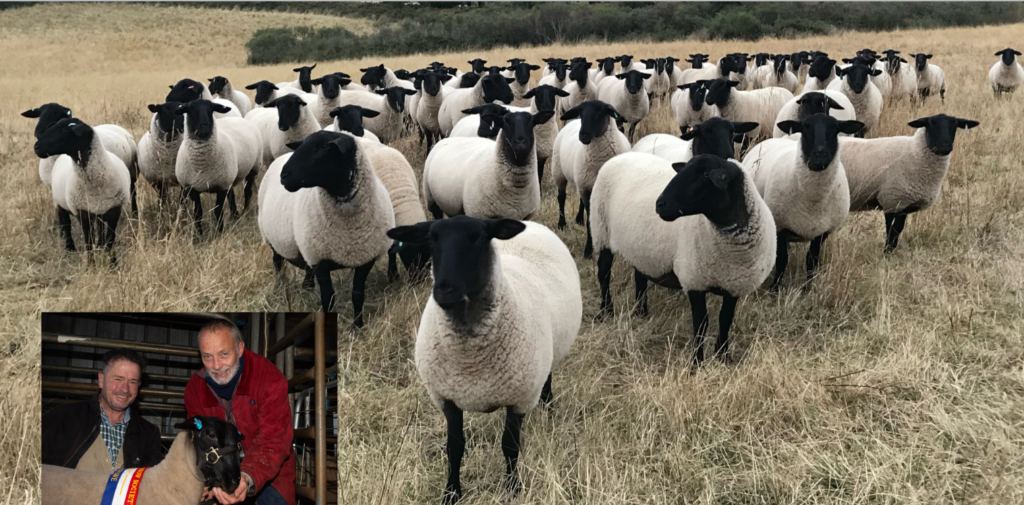
Bullarto-based Oberon Suffolk Sheep Stud collected numerous category wins at last month’s Victorian Sheep Show.
Wins included Supreme Champion Suffolk, Champion and Reserve Champion Suffolk Ewes, 1st and 2nd in the Shorn Ewe Under One and a Half Years, while also winning the Interbreed ASSBA Ewe Champion.
The black-faced, floppy-eared Suffolk sheep breed are instantly recognisable from episodes of the kids’ claymation series Shaun the Sheep.
But for stud principals Bruce Rolfe and Douglas Scott, Suffolks are their livelihood in which they have invested many years of hard work.
And to have their efforts pay off so well in the judging ring was a significant achievement. Bruce and Doug fronted nine entries for the event and the star of the show was Oberon 3039, a delightfully shapely and feminine maiden ewe known in the barnyard as Gloria.
“I’m very proud of her and she’s my little star,” says Bruce.
Bruce and Doug have been operating Oberon Suffolk Stud for over 20 years and their animals are an important asset.
The stud’s bloodlines have been carefully cultivated and they are cared for and monitored to bring out their best qualities.
Today these prize livestock are sold to buyers across Australia and overseas, and appearances at judging competitions are a vital part of the promotion of their stud, as it is for many other breeding operations around the country.
For anyone visiting the area, a glimpse of their sheep may look like little more than barnyard props to complement a Sunday drive. But the work that goes into growing and presenting a champion ewe at industry competitions is extraordinary.
“I began showing Suffolks in 2014 and started off with a small team of two rams and two ewes because it is expensive and you have to start preparing them early. Also while a full team is 12 you need to feed up at least 24 to give you replacements if necessary,” Bruce said.
“They change as they grow and a lamb that looked fantastic four months previously may be dropped from the team by show time.”
Bullarto stud win at Bullarto stud win at Victorian Sheep ShowVictorian Sheep Show Bruce begins his show preparations in February, introducing a special diet full of protein and carbohydrates to his animals.
Suffolks are classed as a meat sheep and a good show animal has lots of muscle and he has to feed them every day to give them a chance to grow and to be up with the size of the other livestock in the show. Then two weeks before the event they are shorn closely and evenly.
“The day before judging they are scanned with ultrasound and weighed. This information is then available to the judge during their appraisal. We then clean them up and make sure they look good. You also have to train them to lead in the halter and to present well. You have to give them little treats all the time and every time they do the right thing.”
As it turned out on the big day, judge Ellie McDonald was very impressed with the ewe’s neatness and excellent structure. She remarked that Gloria was born for the show ring and stood well.
“I loved how she showed her deference to the judge,” says Bruce. “Look at me! Look at me!”
Despite all the work that goes into producing and showing champion Suffolks, Bruce and Doug are keen to continue showing their animals. The next big outing is the Australian Sheep and Wool Show in Bendigo, July 19-21.
It’s a huge event where the country’s growers and food, fashion and fibre lovers gather to celebrate the mighty Australian sheep, including of course, the dainty maiden ewe Gloria from Oberon Stud, Bullarto.
Words: Tony Sawrey | Image: Supplied | Inset: Tony Sawrey
May 26th, 2024Where, what, why and who of the Wastelands Cup

Where: Where do artists go on holiday? Straight to the wastelands of course.
Creative folk are forever busy, swanning about in some poetic reverie, dispensing passion and ebullience for all things aesthetic. But when the time comes to spare a few days for relaxation, that task should take the form of attending an event that leaves reality outside a padlocked gate.
What: Far from prying eyes, far from civilised society, the Wastelands Cup as it is known, takes place somewhere in NSW. It is a bare windswept place and the lucky participants are only there because they know someone who knows someone else who knows whose land it is and where the key is stashed.
The guerilla event has been going on now for many years, starting out as a bit of get-together among friends to thrash old cars around a two-kilometre track into the wee small hours until motors blew up or the beer ran out. These traditions continue today except the event has grown a little more sophisticated.
Why: At some point over the past decade, a trophy was created out of old gear box parts, the visitors began to organise themselves into teams, the motley wheeled creations began to get more and more outlandish and at dusk on the Saturday night, the Wastelands Cup would be presented to the most deserving machine and its team.
It was and remains a vastly unfair competition, subject to the vagaries of a popular vote, liberal payments of baksheesh to organisers, nepotism and general corruption. Loud revving of engines helps, as does undressing, dressing up and cross dressing.
However, there are two fundamental rules. All teams must be seen to be doing constant circuits day and night and to be able to bring their machines to the judging circle under their own power or be disqualified with extreme prejudice.
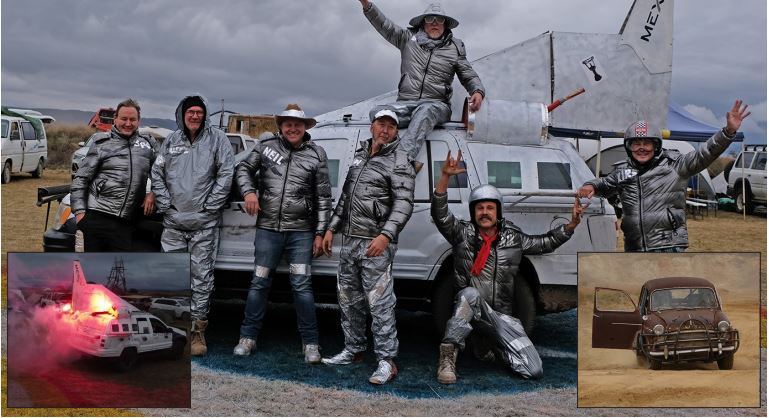
Who: The 2024 event saw a couple of teams come up from Victoria, the Freeloaders from Woodend and Spacemex from Wheatsheaf. Spacemex, pictured above, consisted of a crew of eight people decked out in silver-like actual astronauts, headed by Jeep stalwart Tony Whitehead.
The craft, a Jeep Grand Cherokee tarted up as a space shuttle complete with wings and tail fin was a very comfortable vehicle to do laps in, with plush suspension soaking up the ruts and jumps with astounding ease, almost like you were in outer space or something. To complete the picture a launchpad was established at base camp and emergency flares, pictured left inset, were deployed on the shuttle wings to facilitate smoky and thunderous launches.
However the competition was stiff. The Freeloaders had their own version of a Tesla Cyber Truck, a sound system, DJs and a golf range. Rockatansky, a veteran team from Sydney were stalking the course with a pair of 1950s Morris sedans grafted onto Suzuki Terios running gear. Known as Boris, pictured right inset, and Doris they were a formidable sight as they paced the course, not to mention the vulgar spectacle of their feral pit crew with welders, cranes and coffee machines in constant operation to keep the little cars and drivers functioning.
Judging was at 5pm and with an hour to go it was unclear who would take the cup with the teams neck and neck. However Rockatansky are film/television types including prop builders and pyrotechnicians and they executed a cunning plan.
One of their drivers took Doris out on a pretext of getting a few more loops in before deadline and set about rolling her a couple of times on a particularly rutted section of track, damaging a front wheel.
Winner: They got back to the pits somehow and proceeded to enact a dramatic display of repairing the car before deadline complete with craning, welding, grinding, sledge hammering and coffee drinking. It was an effective performance which won over the motley crowd and Rockatansky took to the Wastelands Cup for 2024.
I would like to think Spacemex came close to winning but like I said, the entire event is corrupt and rife with cronyism. Furthermore it is rumoured the Wastelands Cup is cursed.
Better to come a close second and lament that ‘we wuz robbed’ than have some greasy metal albatross around your neck for the next 12 months. With the presentations out of the way, guests settled into a routine of chatting around the bonfire or continued to flog cars around the circuit in the dark.
Others went to bed at a sensible hour, the sound of overheating, overstressed, over revving engines lulling them off to sleep. Until next year, viva la Wastelands!
Words & images: Tony Sawrey
April 29th, 2024TRATA plans for former railway station

In the second half of the 19th century Trentham was a major hub for timber production, much of which went underground supporting the tunnels excavated at mines in nearby Daylesford.
And so when a railway was constructed between Carlsruhe and Daylesford branching off the main line to Bendigo, Trentham was one of the stops.
The first section to Trentham opened on February 16, 1880. To service freight and passengers a handsome weatherboard station house and 80m platform was installed complete with extra rail sidings and goods sheds. Sadly by the 1970s the old line was being used less and less as its bridges, tracks and rolling stock fell into poor repair, and in June 1978 the line was closed for good.
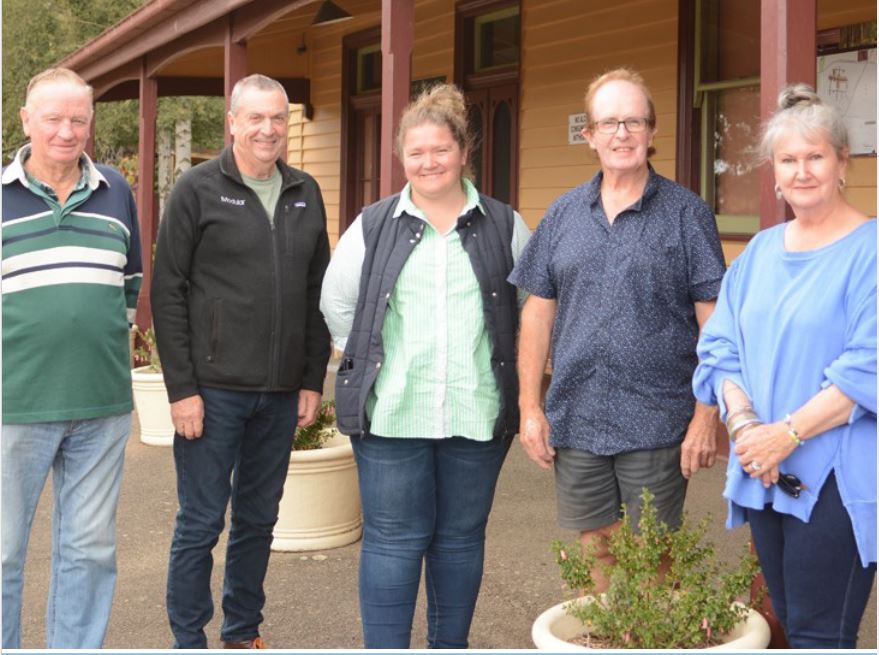
For many years the old station and railway yards were neglected until around 25 years ago when a group came together to try and save it. The preservation group has been known by several names over the years but in July 2023 it became the Trentham Rail and Tramway Association and the new committee has some new plans in place to utilise the precinct.
“Our association maintains and preserves the entire precinct allowing the community to use the facilities for events in the town including the Tractor Pull, Spudfest, classic car shows, and any other events deemed suitable,” says TRATA president Leigh Sutcliffe
“We realised we could actually utilise this space a lot better,” says committee member Rob Urquhart. “It could be a centre for the whole town and hopefully draw more people from outside the district to discover what we have here. We have always been told it is one of the best preserved stations around and we are pretty proud of that.”
Work on the area has certainly taken on some newfound momentum with financial and material assistance coming from a range of sources. And in February they were fortunate to receive small project funding from VicTrack which they put towards landscaping.
The group has also received grants from a number of local businesses and Hepburn Shire Council. This has allowed them to put in picnic tables built by the men’s shed and rebuild the front gates as per original. Committee member Lea Davis has also been doing a lot of work on rejuvenating the whole garden precinct.
“We are trying really hard to give it a feel of an English garden,” says Lea. “It is early days yet but we have planted rhododendrons, dogwoods, foxglove and magnolias all the way down along the station.”
In previous years the precinct was the site of the Trentham market and the tourist information centre. However Covid lockdowns put an end to the market and the information centre is to be relocated to the new Trentham Hub currently under construction. But there are plans to bring the market back after winter.
Leigh says the the old station needs to be re-stumped so they will be looking for additional support to start that project in the near future.
Words & image: Tony Sawrey

April 12th, 2024Meet you at the Bowlo, with new menu offer

“Meet you at the Bowlo,” has been a part of Daylesford’s dinning vocabulary for many, many years.
While other establishments come and go, the Daylesford Bowling Club has been a centre of the community for 125 years. And that tradition is set to continue with recently arrived chefs Geoff Wellington and Sharnee Halson and a new menu commencing this month.
“We are just putting the finishing touches to it now” says Geoff, “including local beef cheek and mash with red wine, chicken scaloppini and scotch fillet.
“It will also feature some blasts from the past specials such as ham, steak and pineapple, lambs fry, steak and kidney, curried sausages and salmon patties.”
I decided to see what was on offer on a busy Sunday afternoon and brought friend Gabrielle along, who did not need too much convincing.
Aside from the great selection on the current menu, there was a host of specials on the board.
I choose Sharnee’s chicken kiev with chips and salad ($36) and a Hollick the Bard Cabernet Sauvignon ($8.5). A fantastic dish and sure to become a popular choice from the specials board with sumptuous chicken breast drenched in garlic butter encased in a golden breadcrumb crusted chips and a crispy garden salad.

Gabrielle selected the pan grilled salmon with tossed salad, chips and hollandaise sauce ($36) accompanied by a 750ml bottle of Villa Jolanda Prosecco ($10).
It was a great choice with a thick salmon steak grilled to perfection smothered with a fresh, vibrant hollandaise sauce.
Dessert was a straightforward matter with two choices. I took the pavlova with berries, couli and cream while Gabrielle had the sticky date pudding. Both were only $12 and the perfect finish to a great Sunday lunch.
The Daylesford Bowling Club is very much a part of the local community supporting families and the young and older with kids-eat-free offers and seniors’ discounts. There is also a tradies’ lunch Monday to Friday with a 25 per cent discount on all main courses.
Or opt for the Sunday lunch carvery with roast pork, crackling, apple sauce and vegies accompanied by one more selection of beef, lamb or chicken and dessert for $30.”
As part of the Bowlo’s 125th anniversary celebrations the club will also have a promotion where every main meal purchased gets a ticket to go in the raffle drawn on the first of every month.
First prize is a $125 club voucher. Second is any meal in the pub for $12.50 and 3rd prize will get you any drink including a bottle of wine. All this and one of the best views over Daylesford.
Words & images: Tony Sawrey
February 16th, 2024$50k to get back to racin’ at the Basin
The Daylesford Speedway Drivers Association, administrators of the Daylesford Speedway track in the Basin Reserve, have set up a GoFundMe page to raise $50,000 for a new concrete safety wall for the historic circuit.
While already part of the club’s six year infrastructure improvement plan, the fundraising efforts have been given greater urgency by the track’s temporary closure after the death of competitor Stephen Douglas at a meeting in February last year.
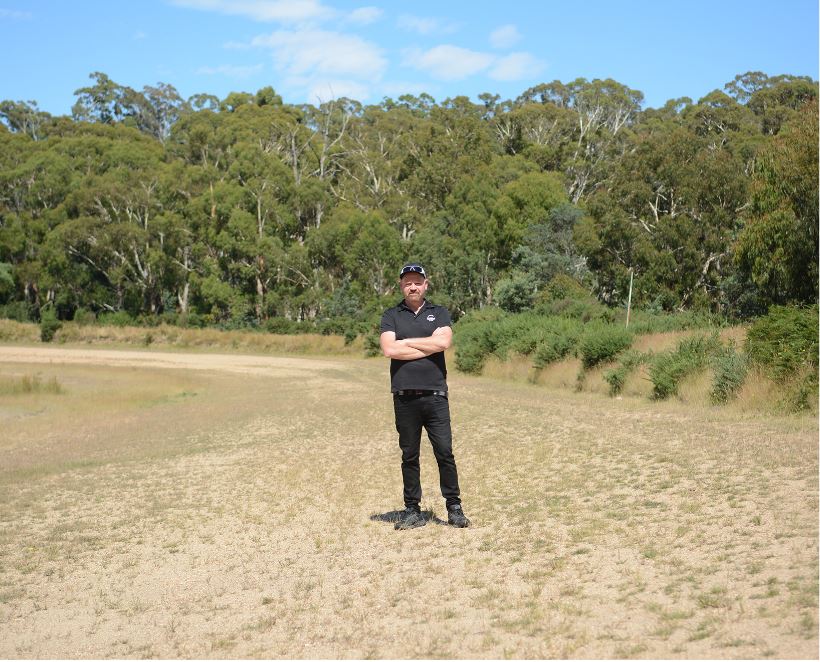
“Everything’s been on hold since the accident,” says club president Aaron Meakins, pictured above.
“Our land is managed by Hepburn Regional Council who have been very supportive. But DEECA, (Department of Energy, Environment and Climate Action) who own the reserve, have said we are not to run any more meetings until the report from the Coroner is released and any recommendations are carried out.”
The Daylesford Speedway is the oldest speedway in Victoria and has been in operation for over 60 years after being built in the late 1950s by two returned servicemen, Kim Walker and Keith Cole.
A community-orientated track, its meetings have always had an air of nostalgia about them recalling the rough and ready fender-bending action from the sport’s earliest days.
While the club has struggled with adversity from bushfires to flooding in the past, the current situation has been difficult. There has been no racing now for 12 months and it is a sad experience to visit the site, see fixtures rusting and weeds spreading across the banked corners of the old ring.
There is no clear indication when the Coroner’s report will be released and the situation has obviously been frustrating for the DSDA’s dedicated members.
But ever optimistic, they are using this downtime to coordinate fundraising initiatives so as to be on the front foot once permission is given to hold meetings there once again.
“We are expecting some form of directive from the Coroner regarding safety upgrades,” says Aaron.
“Ultimately, putting a concrete wall in at a speedway is a natural progression that we as a club have to take. It was already in our six-year plan prior to the incident but of course, with losing 95 per cent of our income that we could normally generate in a season, it has put a hold on everything.
“We have had to resort to other avenues to try and get funding to get the place reopened.”
Besides the GoFundMe page which has received $2000 in pledges so far, they have created a legislative council petition for State Government assistance and begun the process of applying for state and federal grants.
Other support is coming from the various competitors and sponsors across the entire dirt track speedway fraternity who have fond memories of the Daylesford circuit which they would like to see continue.
“I’m very optimistic that we will have the work started within the next six months and everything ready for the 2025 season.
“Every club needs to fight to keep their tracks open and Daylesford is the oldest speedway in Victoria. To lose a piece of history like that would be a massive loss.”
Link: www.gofundme.com/f/help-daylesford-speedway-build-a-wall
Words & image: Tony Sawrey
December 22nd, 2023Look out: radical harvest ahead
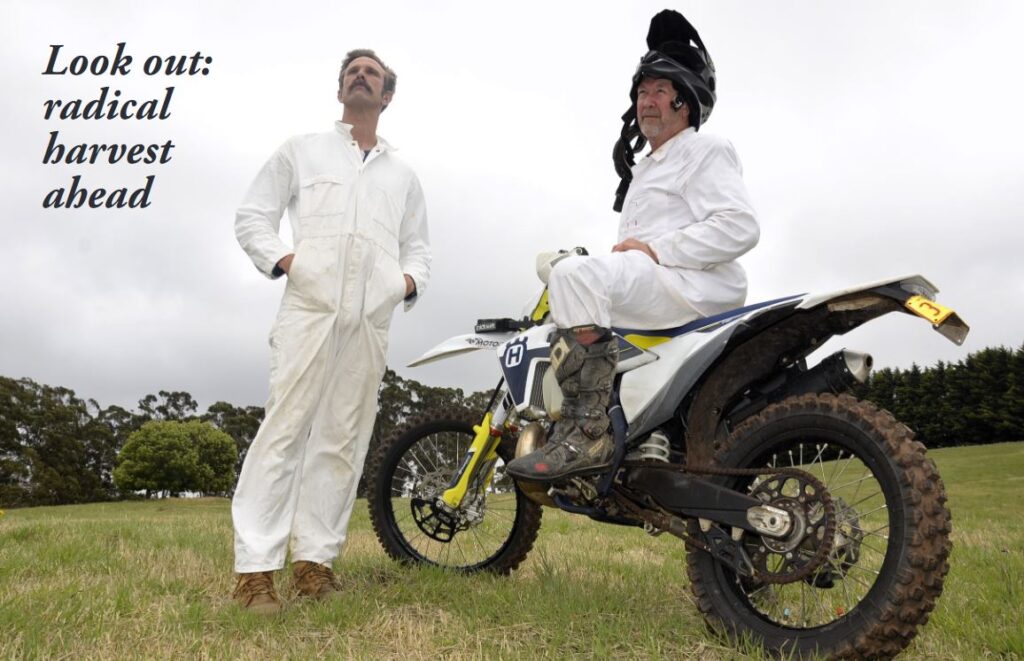
Using a motorbike to “paint” with doesn’t just produce a fairly unique work of art in the landscape.
It also produces a pretty decent physical workout. Just ask local artist Tony Sawrey (also known in his other guise as a writer for The Local).
Tony is among a group of several artists currently planning or creating work as part of the six-month-long arts project that is Radical Fieldz.
It’s the brainchild of Glenlyon artist Ryan Kennedy (aka RFK).
The project started in October and involves a series of arts events taking place every month at Glenlyon through to March 16 when they culminate in a day-long outdoor event.
This will take place on a yet-to-be publicly disclosed private estate and will feature a range of unique works including installation and performance pieces.
Tony’s motorbike “painting” will be among them and he was happily working on his creation when The Local caught up with him on site recently.
“I do a lot of artwork, painting and installations, in outdoor environments but it’s the first time I’ve used a motorbike,” he said.
“In this case we’ve laid out a roughly 90 by 80 meter wide design. We’re thinking come April we might put in rye grass (in the soil cut up by the bike’s tyre tread) which will strike pretty quick.
“And we’re hoping that will be growing by the time the final event happens – the final harvest,” Tony said.
“I’ve got to do ongoing work with this, just running the pattern until we can turn up some of the dirt.
“I’ve wanted to do something like this for years, but it really takes that collaboration with someone like Ryan which is why the Radical Fieldz program is so interesting and different.
“There’s a lot of collaboration involved. It’s transforming something which has a prosaic use and creates something else out of it.”
Ryan, or RFK as he is also known, will also have site-specific work included as part of the final culminating event on March 16 as will not only other artists, but also a few less likely suspects.
These include a local ornithology group and a local fitness group who are getting involved in various interesting ways.
“I’m working with several community groups to reframe how they work in the community through the lens of art,” RFK says.
“We’ve got Daylesford CrossFit joining us and we’re literally doing a tractor pull. We’ll be working in teams. It will be a choreographed piece, basically an exercise to drag the tractor across the field.
“We’re also working with FLOCK which is the Friendly Little Ornithology Club, and Castlemaine Zen will be doing a meditative walk to really set the tone of awareness and intention for the day of the event.”
In the lead up to the day-long March harvest event, there’s an ongoing series of events featuring artists attending the monthly Glenlyon market that happens each third Saturday of the month.
This is followed in the afternoon, after the market, with a different co-creative arts event at the Glenlyon community dam.
“We are doing a community sound composition at our next event on December 16,” RFK says.
“We’ve got a sax quartet, a cellist, an eastern European band, some friends with fascinating horns and engines to rev and we’re going to be exploring sound.
“We’ve also been given a grant and we’re going to do some work on a big painting event on Saturday, January 20 from 2-6pm with the Glenlyon Progress Association.
“We’re going to be working on a mural out the front of the Glenlyon Shire Hall.
“It will be like an abstract map of the town highlighting what the town’s about, referencing landmarks around the town.
“I just felt like there was room for a constant and creative space within the community and that’s something I wanted Radical Fieldz to offer.
“I feel like the more we empower the community to be creative the more interest they have in our own work as artists.”
With the location of the March 16 culminating harvest event to be revealed closer to the occasion, RFK can divulge a bit more of what may be expected on the day.
“Expect something you probably haven’t seen before,” he says.
“We’re on Facebook and Instagram and I am encouraging local artists and community groups that want to get creative to get in touch with us. “The program is unique and we’ve got a lot of creative individuals around there.”
Words and Image: Eve Lamb
November 10th, 2023Those halcyon days of the friendly fifties
Words & image: Tony Sawrey
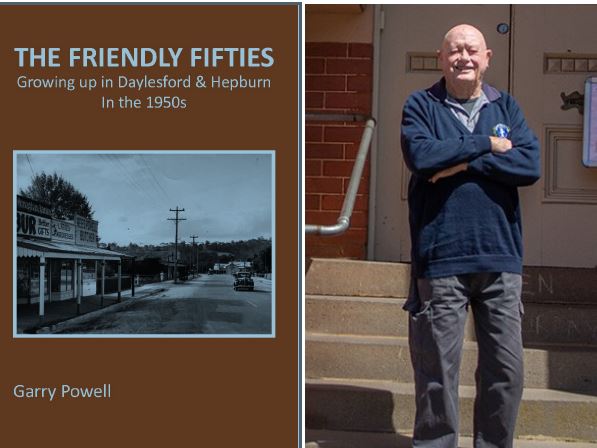
Garry Powell is a prolific author with nearly 20 published books to his credit including several local histories such as Double Gold, the History of Mount Franklin and District co-written with Janet MacDonald.
His latest work, to be released later in November through the Daylesford and District Historical Society is The Friendly Fifties – Growing up in Daylesford and Hepburn in the 1950s. Across 130 pages, peppered with countless photos from the period, he presents a tableau of simpler times blessed with greater community cooperation and friendliness.
“I was prompted to do this book by Jan Smith at the historical society,” says Garry. “We were well into recording local oral histories when Covid hit and we had to stop.
“So instead, it was suggested that, since I had grown up in Daylesford and had many connections in the area, what about doing a bit of a history of when you were going to school? So I began work on it during lockdown.”
His work lays out in detail the minutiae of daily existence growing up in Daylesford and Hepburn in times that are clearly considered to have been happier than today. It is a picture of a perfect little rural town.
Wives at home, men out working, kids walking off to school and doing sport on the weekends. In his recollections, Garry captures an era evoking the atmosphere of a d’Arcy Doyle or David Bromley painting with children playing and holding hands.
In fact, as Garry points out, his most significant memory of growing up in the region is not anything specific, neither date, time or event but a state of being.
“I could walk down the street here as a kid and know everyone. It was just the friendliness of everybody, everybody knew everybody. How fortunate it was to grow up in such a close and active community.”
Nonetheless it could be said that The Friendly Fifties tends to avoid dwelling on the negative aspects of life in post-war rural Australia. While it was certainly a time of halcyon childhoods, the decade was also marked by a stifling Menzies-style conformity and conservatism along with rigid gender roles.
Not to mention the spectre of the Stolen Generations, practices of forced adoption and the repressed trauma of returned servicemen. All of these stories and more have local iterations.
However Garry makes clear that the difference between the life he experienced growing up in the town is far removed from that of today.
Above all, the economy of the area has shifted from that of an insular working town with industries such as woollen mills and timber to that of tourism.
And with these changes he believes the population has lost its connections with each other.
In the book’s foreword written by Professor Tom Griffiths of the Australian National University, Garry wonders if such strong, close communities continue to exist and asks of local people today: “Could they just walk into anyone’s home for a cuppa?”
November 9th, 2023Responsible building on bush blocks
Words & image: Tony Sawrey
In a region such as the Central Highlands, the natural environment is what attracts people to this area, it sustains our tourism industry and by extension, the real estate market as people seek a more permanent escape from the city.
But, of course many new landowners, especially those on bush blocks, must take into consideration the potential perils of the scrub that surrounds them and the possibility of forest fire.
With this concern in the back of the mind owners respond to the threat in various ways. The most extreme being to bring in the machinery, clear away and remove everything, wipe the slate clean. It is an approach that is pretty common and you don’t have to look too hard to see examples of such wholesale clearing.
But is this the only way to develop a bush block? Strip it bare? What about the creatures that live in that environment? Surely there is a middle path between preparing your place in case of fire and allowing the local wildlife some form of shelter and sustenance for the rest of the time.
On the other hand, while some commentators on social media might have you thinking the entire place is ready to be overwhelmed by rapacious development, the reality is nothing like those peri-urban regions where vast housing estates march to the horizon.
Here development advances quietly, often hidden and in piecemeal but persistent fashion. And while the Hepburn Shire Council does have specific guidelines relating to bush block development, it is not a straightforward matter as Bradley Thomas CEO explains:
“The removal of native vegetation is a complex matter. Native vegetation generally requires a permit to be removed, however, each property should be assessed on its own merits.
“Factors considered in determining whether a permit is required include zoning, the size of the land and any environmental overlays (eg, bushfire management overlays).
“Council continues to take enforcement action on native vegetation removal. Property owners who are unsure of the requirements for permits for the removal of vegetation on their own land can contact council for guidance.”
However Gayle Osborne at Wombat Forestcare feels that in some cases people have probably cleared more than they are legally allowed to. And there doesn’t seem to be any follow up to make sure that people have stuck to the guidelines.
“It is quite a distressing situation,” she says, “because we are clearing more native vegetation than we are regenerating. We are also losing mature trees that are needed as habitat for koalas particularly and possibly losing trees with hollows that affect creatures like gang-gangs which are now a threatened species.”
Another concern is when people strip away dead standing trees and undergrowth. But Gayle urges landowners to keep some perspective when doing such work. Dead trees are organic apartment blocks for nesting birds from parrots to treecreepers and suites for greater gliders.
Fallen timber is full of little insects, many of which are pollinators and sustain little birds such as blue wrens. The thin carpet of mulch on the forest floor has taken many generations to build on top of clay and much of the vital nutrients for growth are in it.
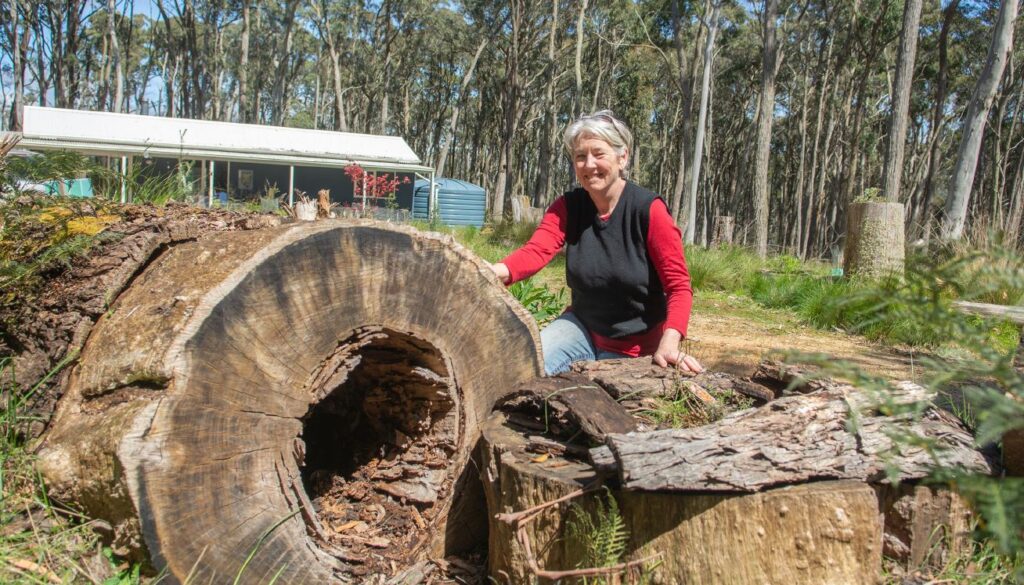
Maree Keating, pictured above, is a land owner with a small, pretty blue house abutting the north Wombat State Forest surrounded by native flowers and grasses. She lost many trees in the great storm of 2021 and fuel load mitigation is a constant concern, but Maree’s clean-up and maintenance approach keeps the native ecology firmly in mind and the native creatures that depend on it
“After the 2021 storm I had a team come over and clean up all the fallen trees at the front,” she says. “Some really wanted to flatten the land for me and remove the organic rubbish and tidy it up. I had to explain about weed infestations every time the tractors go into the land, and also that the roots and stumps and beheaded trees were all really valuable habitat for birds, snakes, wombats and so on.”
Today, her land retains much of this fallen timber, forming boundary fences and new habitat. Some of the larger logs are slowly hollowing out creating shelter for the many mammals that share her land from echidnas to tiny marsupial mice.
And while the possibility of fire remains a concern, Maree is more conscious of the needs of the original inhabitants of the surrounding forest.
“Ultimately owning a bush block or land with native habitat on it comes with it a responsibility to care for the creatures that share it with you.”
September 28th, 2023Clopping on: continuing the Clydesdale tradition
The early development of Australia from its roads to farms would hardly have been possible without the contribution of heavy horses.
They were the trucks and tractors in the time before mechanisation took over, and the most well known of these hard working creatures was the Clydesdale. And despite their size they are considered one of the most docile of horse breeds, with a kind temperament.
However, compared to other breeds such as stock horses or thoroughbreds which are foaled in the hundreds every year, there are comparatively few Clydesdales. Their numbers plummeted after WWI and while there has been a resurgence over the last few decades, there are less than 3000 registered animals in Australia and maybe 10,000 worldwide.
With such a small gene pool, as a breed they were once considered vulnerable to extinction. But that is not going to happen anytime soon thanks to the work of horse people such as Matthew and Jaimie Thompson of Sandy Creek Clydesdales outside of Maldon.
“We have been slowly building up our breeding program since we established the stud in 2014,” says
Matthew, “and we hope to produce seven foals (all registered) this year all of which will be broken in and trained for both riding and harness.”
Matthew and Jaimie’s stud sits on 25 hectares outside of Maldon where they currently run over 20
horses including their stallion Sandy Creek Albert, seven brood mares and an array of colts and fillies.
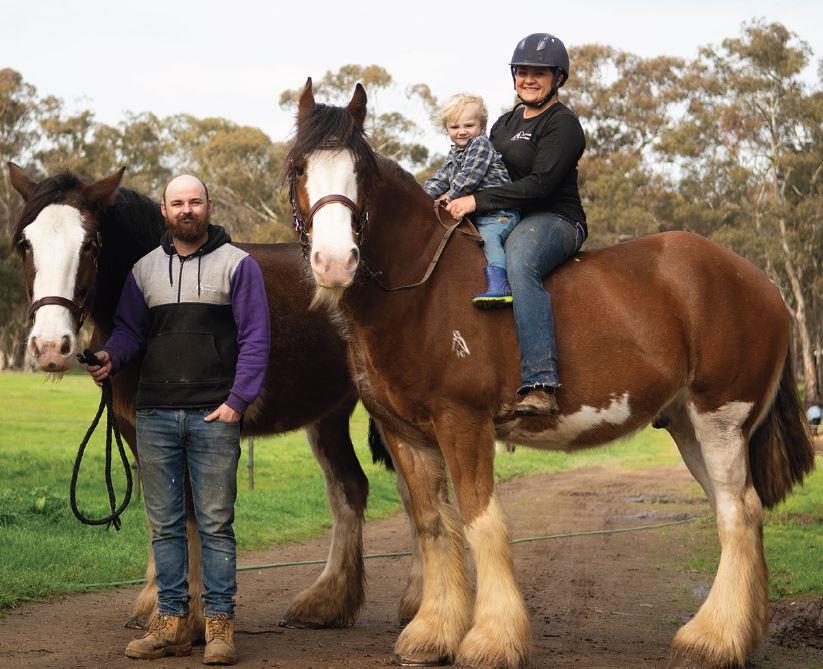
They share all the day-to-day chores on the farm and training duties and their operation is part of the Commonwealth Clydesdale Horse Society of Australia (established 1918). And, along with their children Hunter, pictured above with his parents, and Billie, the young couple are making a mark in the small specialist world of Australian Clydesdales.
“We have always wanted to improve on the qualities of the horses we have,” says Jaimie. “We will keep all the fillies we produce and we are transitioning to breaking in more of our own horses and suitably matching them to future owners. Over the next eight years we will be building stables and looking at buying another block of land to grow feed.”
The Clydesdale breed was founded in the early 18th century in Scotland when two breeders, John Paterson of Lochlyoch and Scottish peer James Hamilton, imported Flemish stallions and mated them with native draught mares in the Clyde Valley. From these beginnings thousands of Clydesdales were exported to many countries of the world and were known here as the horse that built Australia.
At Sandy Creek Clydesdales they are keeping this history alive, maintaining their traditional role under harness as a work horse.
Matthew is an experienced blacksmith and heavy fabrication engineer and makes and repairs all forms of carriages which allows him to bring the horses out for all sorts of events from weddings to historical displays. However Jaimie is quick to point out that the breed is highly suitable for other tasks
“Riding is actually where the Clydesdales are going. Because these days not everyone is like a farmer who needs eight horses to serve as a tractor. Today most buyers just want one or two. They are used to do dressage, jumping and at Melbourne Royal they have the heavy horse ridden classes. Also Clydie crosses are frequently used as bronc horses in rodeo competitions.”
As the weather finally grows a little warmer this month, Matthew and Jaimie have a very hectic schedule to juggle including clinics, carriage hires and a lot of travelling.
“Our schedule turns pretty chaotic,” says Jaimie. “We are off to Victor Harbour in South Australia to assist with their horsedrawn tram and have Melbourne Royal Show coming up.
“We are competing there but also have Clydesdale and blacksmithing displays going on for the whole 11 days. After that we are off to the Elmore field days doing cart rides then to Nhill in Western Victoria. Then there are weddings in between with the horses and carriages as well as breaking in for outside clients.”
Words & image: Tony Sawrey
May 25th, 2023Lockdown life leads to sequel and 10th novel
Words: Tony Sawrey | Image: Contributed
OH, WHAT one could do if only given the time to think, to have the freedom from the millstone of work and social distractions. What art we could create, what books we would write.
So, while being traumatic for many when Covid drove the country into isolation
in early 2020, it was for others an opportunity to think, research and create.
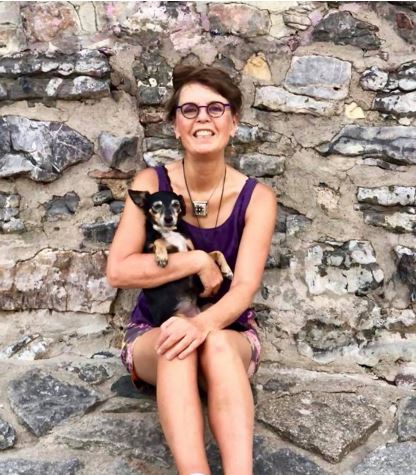
Author Catherine de Saint Phalle was one of those people. After coming to live
in the Central Highlands scant months before everywhere went into lockdown her
response to the isolation of Covid was to sit down and write another book.
Her new work is titled Call Me Marlowe and published through Transit Lounge
Press. The work was released on May 1 with an official launch at Brunswick Bound
bookshop in Melbourne on May 18.
Born in London, Catherine’s childhood was spent between France and England
and she started writing stories at seven. She left France in 2003 to live in Australia
and was shortlisted for the 2017 Stella Prize for a memoir of her parents called
Poum and Alexandre. Call Me Marlowe is her 10th book and a product of her life in
lockdown in a little cottage in a big garden overlooking Daylesford.
“I bought the house in late 2019 and I was here full time for three and half years,”
says Catherine.
“I think that place is always important to any writer and being in the country
offers a different pace, different feeling with people who live there and it inspires and
nourishes you. I wrote my whole novel here during that time and along with two
translation projects I was actually quite busy.”
Set in both Prague and Melbourne, Call Me Marlowe captures a man’s search for
his heritage in the hope of understanding his estrangement from his mother. And
with a gentle touch, the novel explores the nature of trauma – both personal and
political – in the lives of its characters.
“I wrote it as a sequel to my 2019 novel The Sea and Us but the publisher wanted
it to be a stand-alone so I worked on it again which made me revisit it in a different
way.
“So it can be considered as a stand-alone but by the same token it is the same
character (Harold Vaněk) and the story just continues. I may even write a third novel
about him, I don’t know. I am even referring to him in a new book in a very distant
way.”
Catherine says it is typical for her to take two to three years to write a book,
putting aside time for writing in the morning with translation projects in the
afternoon. The next work is, in her words, a strange mix between a memoir and a
novel.
“The main character is a potter but I’m only five or six chapters into it. I’m still on
the worksite as it were, with piles of rubble peeping out of everywhere.”
And when looking at a screen, researching, writing and thinking become a little
tedious, there is always the garden to retreat to. Catherine is passionate about growing
things, the beauty of nature and the respite gardening offers from the mental toil of
writing.
“My garden kept me sane during Covid,” she says. “It continues to do so now and
I work very hard on it. The presence of nature is so important to me. You feel safe and
never feel alone because nature is so omnipotent and always there.”
April 13th, 2023Clayton’s story-telling dream
Words: Tony Sawrey | Images: Contributed
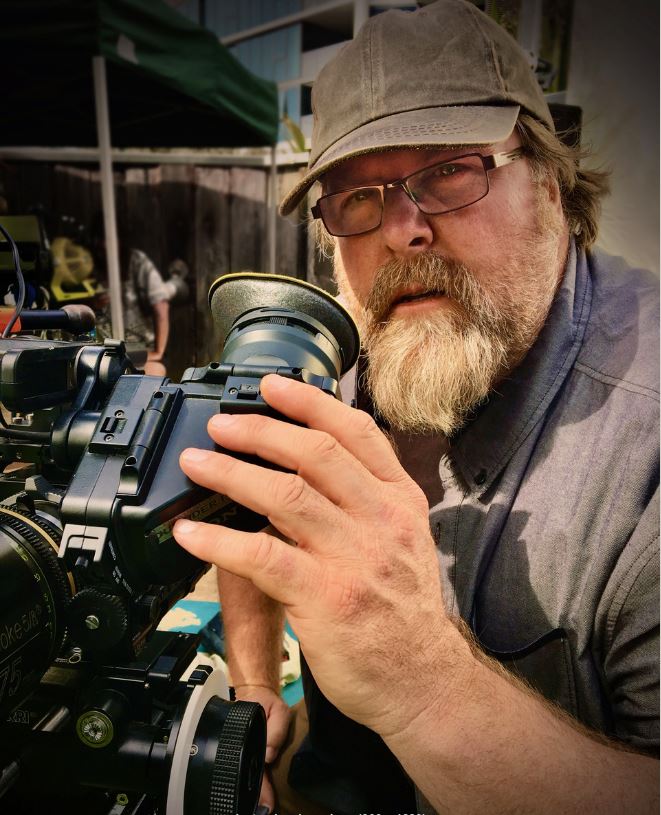
FILM director and producer Clayton Jacobson loves to tell a good story. And when he comes to the Central Highlands region to play double bass in the Duck Downpickers he can cultivate the emotional
connections of story telling with his audience.
Their music is old timey/Americana; irreverent and joyful, a perfect medium for
communicating tales directly from the heart.
We can often forget in these hyper-modern times the value of this ancient craft
and Clayton wants nothing more than to bring such an immediacy found in live
music to the medium of film. And his day job as CEO of Dreamscreen Australia is
helping to do just that.
Clayton is best known as director for his 2006 debut feature film Kenny starring
his brother Shane Jacobson, their dad Ron and himself as Kenny’s brother. But over
a professional career spanning 30 years he has worked in many areas of production
including the ever increasing use of computer graphics and green screen.
Computer graphics production workshops drive the film industry. From
superhero blockbusters down to commercials they provide the effects and scenery that
help maintain the illusion we hope to be immersed in.
Green screen backdrops on studio stages allow performers to perform roles placed
into those rendered virtual environments later on. The process is expensive, time
consuming and often difficult for actors to work with.
It is one of the many reasons that the film art form (especially at Hollywood
blockbuster level) has been criticised for losing its primary reason for existing; that of
a medium for telling stories.
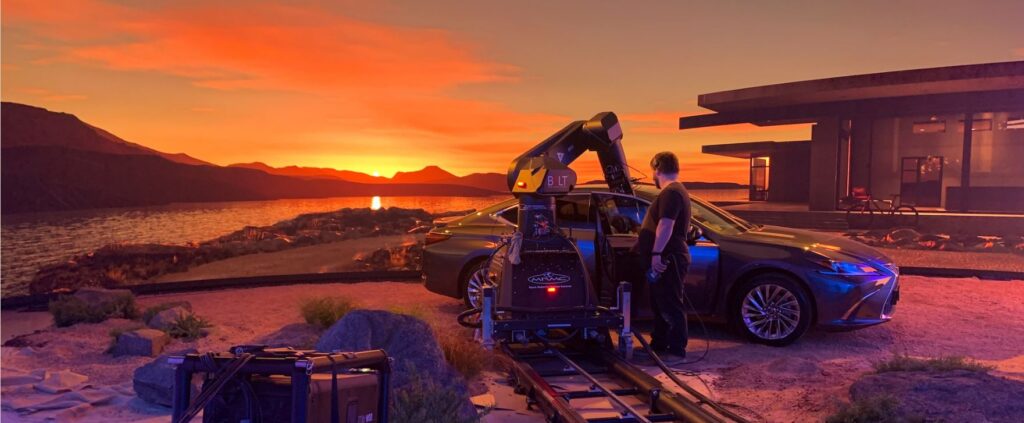
As productions have become more and more complicated and expensive, simple
story telling has been buried beneath machinery and vast crews. Clayton, like many
creatives in the film industry, started thinking about alternatives. For him that turned
out to be the development of LED screens and virtual backdrops.
This is where highly detailed backgrounds, shot live or rendered on computer, can
be displayed as virtual scenery for actors to work in front of. It is a simplification of
the production process that is destined to take over the film and television industry
with the audience never noticing the difference.
“I first came to this sort of technology back in 2004,” says Clayton. “Later in
2009 I did an online web series called Mordy Koots with a gaming company called
Uber Soft. That was my first dip into this world of virtual backdrops and I could see
the potential, but still the quality of the gaming engine wasn’t quite there.”
The key advancement came around 2016 when gaming engines (processors that
live in a console allowing backgrounds in computer games to shift and change in real
time) were producing noticeably higher quality rendered environments.
At this point it was just a matter of projecting them on LED screens at larger
dimensions (they can be up to 12 metres high and 90 metres long) and since then the
take-up has been rapid.
Today there are over 200 LED Volumes (production stages) around the world
including Dreamscreen Australia’s 15×5 metre stage in Epping, Melbourne. And what
gave Clayton the time and motivation to turn his own Volume I stage into a reality
was the advent of Covid.
“When Covid hit I actually had a film I was about to make in Bulgaria with Guy
Pearce,” he says, “but that was blown out of the water and I could see that Covid was
going to be with us for a few years.
“So I decided to work on establishing Dreamscreen as a means to keep working
while the entire film industry was halted due to travel restrictions, lockdowns, limited
crews and social distancing.
“But I got so excited by this technology and getting the studio up and running
that I’ve been happy to walk away from directing etc to concentrate on this new
venture for now because I do believe this is the future of filmmaking.”
The new technology is set to catapult film and TV production through a
revolution as seismic as the adoption of CGI in the 1990s. Live backdrop productions
have created a disruption in the structure that normally dilutes the story teller’s
vision.
At the same time in Clayton’s view it is also a chance for those dreamers to
broaden the scope of their ideas and a vision to life with an immediacy normally out
of reach, something more like that a musician enjoys when interacting with their
audience.
“It is no coincidence,” says Clayton, “that one of the first phone calls I got when I
was talking publicly about Dreamscreen was from an Australian writer who does a lot
of television.
“He was saying: ‘Clay, I’m just so thrilled that you are doing this because it means
that I’m going to be able to dream bigger, I’m going to be able to offer up stories to
the networks that are on a larger scale and they won’t be cut down as easily due to
budget constraints’.”
Which brings us back to the Duck Downpickers and the satisfaction of telling a
story to an audience where the reactions and feedback are instant.
“I love it every time we play. We get to know the locals who come to watch. It is
something to look forward to.
“I can leave all the troubles of the day behind and put it all aside and unlike film,
the reaction from an audience is immediate, you get something almost immediately
compared to work in the film industry which takes days, weeks, months, even years.”
March 31st, 2023The craft of photography in the 21st Century
PHOTOGRAPHY in the 21st Century is a remarkably easy medium to engage with. Every phone has a
camera and digital technology, including editing and digital filters which can generate results that satisfy most people.
With such conveniences available, it is easy to ignore the fact there is actually much, much
more than meets the eye if you truly want to understand the craft.
Margund Sallowsky is a master of the medium including the use of equipment and chemicals that defined the practice of photography before digital cameras took over around 25 years ago.
Her passion started when she took her first shots with her father’s Agfa camera at the age of 11. That was in her homeland of Germany and today, the long-time Hepburn resident continues to develop her knowledge.
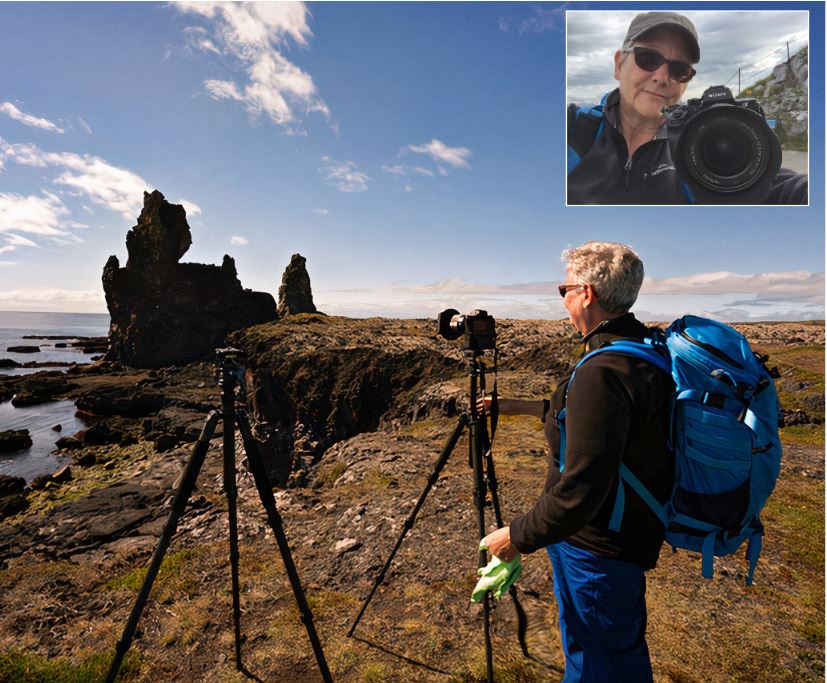
“I strive to take my skills to the next level,” she says: A level of photographic acuity far beyond that of your
average camera phone user for sure.
“My professional development as a photographer commenced as an apprentice,” she says.
“After receiving my trade degrees, I enrolled in a diploma in visual communication course at
the University of Applied Science in Dortmund.
“Later I moved to Australia in the early 80s and purchased a small cottage in Hepburn in 1989. Meanwhile I worked as a photographer at Phillip Institute of Technology (now RMIT University) and later enrolled there in a post-graduate diploma in fine art photography, graduating in 1992.”
Over a career spanning four decades Margund has worked with many different
subjects, but coming from one of the most industrialised areas of Germany she cultivated a particularly strong interest in industrial installations, architecture and worker photography, documenting the lives of labourers in the steel foundries and factories of the Ruhr valley.
Today she continues to work in a diverse range of photography fields, from virtual
reality technology that allows the creation of virtual tours of exhibition spaces, to
documenting landscape and weather. This includes not only numerous works of the
local region but further afield.
“I am very interested in photography of the natural environment and in 2017 I
went to Iceland. We did a flight by helicopter for three and a half hours over southern
Iceland and I took a whole lot of aerial shots.”
And after moving to Hepburn permanently in 2020, Margund was able to
put the time into producing a body of work from this journey – showing six works
and winning a prize for best commercial work at the 2020 Salon at the Centre for
Contemporary Photography Melbourne.
“It is quite time consuming but I want to continue working on further exhibitions for the Iceland images including showing them locally.”
Like with most subjects, sometimes the easiest part is taking the pictures. And for
an experienced photographer such as Margund, the technical considerations are an
integral part of the production process and almost second nature.
What is harder to attain and what takes considerably more thought and
experience is the ability to give images the means to transcend time and place. That is
to say, shifting an image from one of mere record or documentation into something that is art.
“The construction of the photo is the first thing, the feel you get when you see
a scene,” she says. “The other thing is then in post production. You want to express
some sort of emotion, it has to be strong, it has to show something to trigger a
response in the viewer and you want that to come out of the image.”
However, while Margund has an extensive knowledge of effects, filters and post
production colour enhancement so easy to attain with digital tools like Photoshop,
she is cautious not to overuse them.
“You want to say something with the image but I don’t want to lie. I don’t want
to say that was a sky that brought down 50 tonnes of rain, I want to keep it more
in natural light but in a way that still speaks to people. Some people are all obsessed
with really screaming colour which is fine, I’m not criticising that approach but it is
not my style of dealing with a scene.”
Today, after working full-time for RMIT and now as a casual contractor for the
National Gallery of Victoria and a freelance photographer for Scienceworks and
Government House among many others, Margund is content to spend most of her
time in Hepburn.
“The quiet of Hepburn is really important for me, I don’t want to completely
give up my professional life but I want to retain that time to create more of my own
work.”
Words: Tony Sawrey | Images: Contributed
March 20th, 2023The real stories of Trentham’s history
THE site of the old Trentham Police Station on Camp Street is getting a makeover.
Built in 1866 it is one of the town’s oldest buildings and now the home of the Trentham and District Historical Society. And, along with its museum, lockup and stables, it will soon feature a new installation, the Trentham District Story project, commemorating the district’s history and people up to the
present day.
“It is a project we have wanted to do for a long time,” society vice president
Susie Spence said. “We have a very active committee and have decided to use the
large outdoor space at the old police station to make a walk-in display.”
The society has realised the project through support from Hepburn Shire
Council, Bendigo Bank, Cool Country Classic Car Club, Trentham Masonic
Centre, private contributions and fundraising. Work is almost complete and the
official opening with Mayor Cr Brian Hood will take place on Friday, March 24.
There will be 12 panels featuring detailed history of the region including
the lives of the original indigenous inhabitants, flora and fauna, the arrival of
European settlers seeking timber and gold and the town’s ups and downs through
disease, wars and economics.
The new exhibit will also include, with the support of Gardens For Wildlife
Victoria, a native garden featuring many of the plants the first inhabitants used for
food and medicine.
And to mark the contribution of agriculture and timber harvesting to the
timeline of local history there will be a single furrow plough and Trewhella tree
jack.
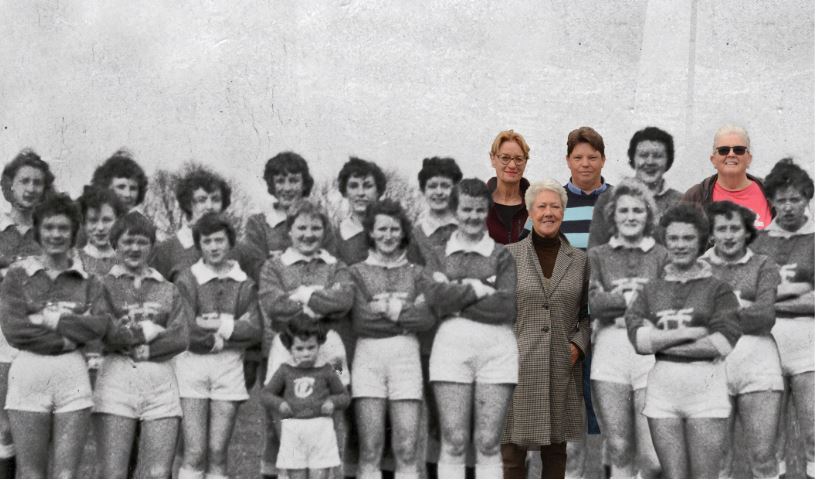
An important part of the display will be the often overlooked role of women
contributing to the wellbeing, prosperity and character of the area; from the wives
of early settlers and bush nurses to teachers and the Grasshoppers women’s football
team of the 1950s.
“The women’s stories start with Louisa Tubbs adapting to the loneliness of
station life at Tylden,” Susie says. “Then there was Betsey Trewhella who made
the arduous journey from England with her children to join husband Ben on the
Blackwood goldfields and Charlotte Robson who nursed the sick and delivered
babies in the fledgling Newbury community.”
The mining, timber and agriculture industries of the area posed inherent
dangers for the early European settlers. Furthermore, outbreaks of measles,
typhoid, whooping cough, diphtheria and the perils of childbirth made life in the
Trentham district one of isolation and hardship until well into the 1930s.
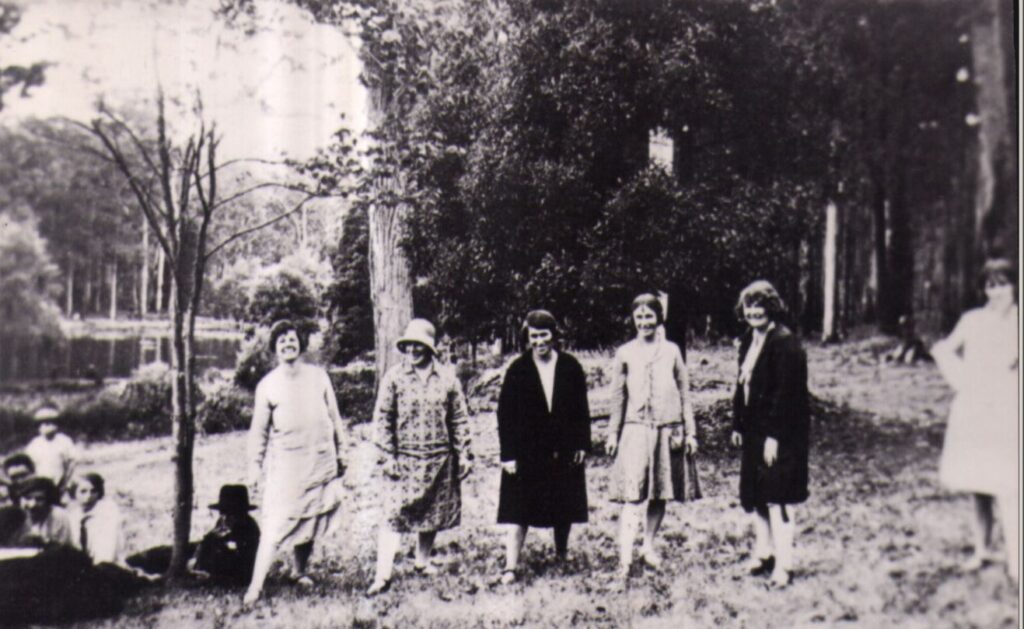
And during World War II when many of the men enlisted to serve overseas,
agricultural survival depended on the mothers and daughters left behind.
“Many people today would have no idea about that sort of thing and the
impacts it had on the community. But the Trentham District Story project paints
a very good picture of what life has been like here. I’m not sure that everyone will
take the time to read the lot but locals particularly can come back and take in
some more every time and reflect on the changes that have taken place over the
years.”
The official opening of the Trentham District Story will start at 11am on
Friday, March 24 at the old Trentham Police Station at 3-5 Camp Street.
For information and to RSVP contact info@trenthamhistoricalsociety.org.au
Words: Tony Sawrey | Images: Contributed
March 1st, 2023Table tennis for life
Words & image: Tony Sawrey
IT IS comfortable to assume that local sporting clubs are a permanent
part of the fabric of any town. As if they have been there since the
beginning and will never disappear.
However the social disruptions caused by Covid over the past few years has seen
many community organisations fall by the wayside. Daylesford has been no exception
with several sporting clubs closing their doors.
However the Daylesford Table Tennis Association has proved to be an exception.
It continues to have regular social and competition gatherings as it has always done
since the 1950s.
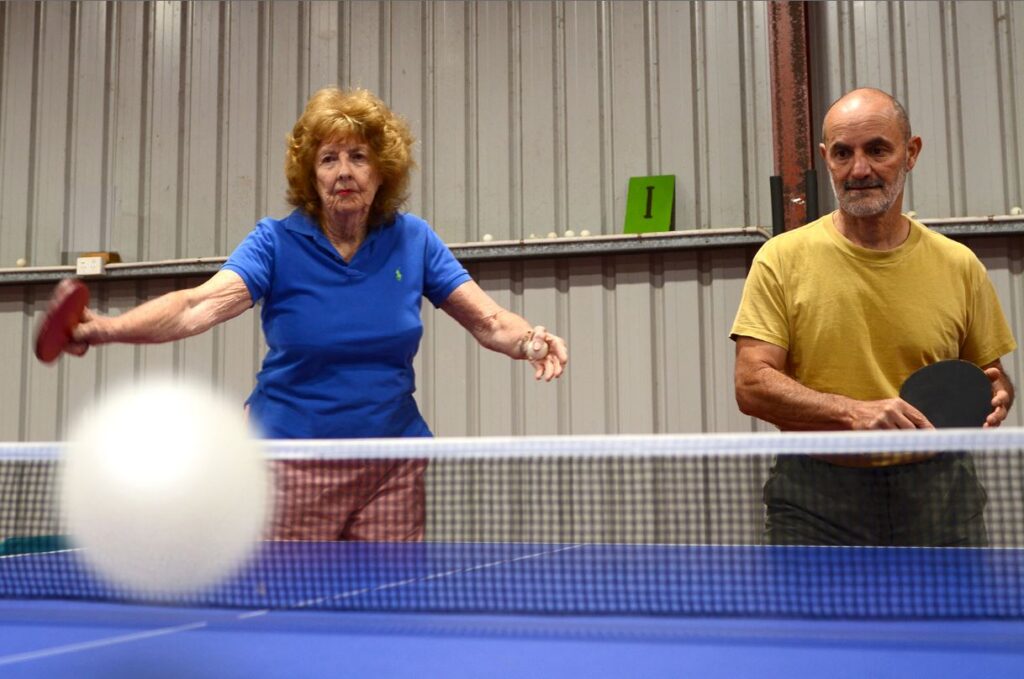
“Cricket, basketball and squash have all folded,” says club president Monty
Osewald. “It has been tough the last few years but we have survived.”
The club is located in Victoria Park in a shed built by members in 1985. It has six
tables and holds regular sessions servicing the table tennis needs of over 30 people of
all ages and genders. Though that number is down slightly from the 40 or more who
used to duke it out in the ’50s it is still an impressive number of players.
“We take all comers and our members range in age from teenagers to over 60s,”
says Monty.
“People can be a little isolated out in the countryside at times but our club is a
great place to meet and socialise, even over the winter months.”
Table tennis first emerged in the middle of the 19th century in Victorian England
and due to its compact indoor layout, it is now enjoyed worldwide and even became
an Olympic sport in 1988. And because beginners can engage with the game almost
straight away it has become a common recreational pastime among players of all ages.
At the Daylesford club the oldest player is Ron Hewson who says; “Table tennis is
a game you can play all your life.”
Another senior player is Jane Bradfield who came to the sport seven years ago. “It
is dead easy,” she says, “and I got into it through U3A. I was a horse rider previously. I
have coaching every week and there is a lot to learn.
“The most important technique is brushing up on the ball, you don’t just whack
it; it is all art. I mostly play doubles, simply and purely because I’m not a chicken
anymore and you have more time between the shots.”
As Jane mentioned, the association has initiated a professional coaching program
for players of all levels to improve their game skills, which commenced early February
and is running for five weeks. It was made possible by a Hepburn Shire Community
Sporting Grant and costs only $1 per session. And there are more opportunities to
come.
“We are currently setting up a program in the second school term (early May) for
12- to 18-year-olds,” says Monty, “where we will have the participants bussed down
here to play and get coaching.”
If you are keen to have a go at table tennis, social play takes place every
Wednesday, Friday and Sunday from 10am to 12 noon with a competition evening
held every Wednesday from 7.30 pm to 9.30pm. Annual membership is $100
otherwise the walk-in cost is $3 per session. For more information or membership
queries contact Monty on 0448 667 738,
Link: www.facebook.com/DaylesfordTableTennis/