


August 16th, 2023Stop the Towers rally reaches Spring Street

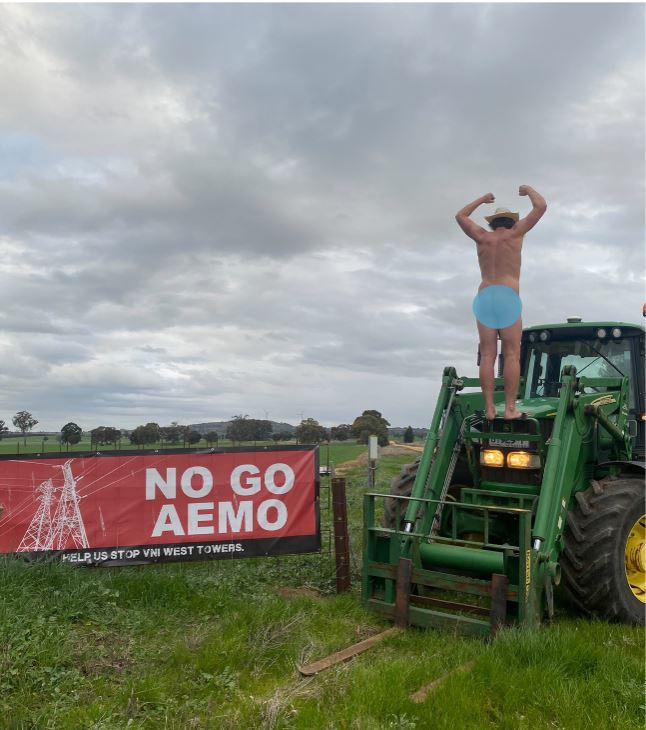
Words: Donna Kelly | Image: Contributed
A STOP the Towers rally went all the way to the steps of Parliament House in Spring Street, yesterday Tuesday, August 15.
A convoy of tractors, agricultural vehicles, horses and fire trucks departed Cathedral Place at 12.45pm and formed a distinctive procession along Spring Street and around Parliament House.
The event was organised by the Regional Victoria Power Alliance, consisting of farmers, their rural, regional, and suburban neighbours, retail and tourism business owners, and many other community members. Alliance members come from Central, Western and North Western Victoria and are deeply concerned about “the irreversible environmental, social, and economic impact that will occur from two 500kV overhead transmission line projects known as VNI West and Western Renewables Link (VNI West Stage 1)”.
The members say their fight is against the industrialising of the regional and rural areas with the message: The Victorian Government must Stop the Towers – save the environment, communities, and farms and find a better solution to transmit electricity and support the transition to renewable energy.
Spokesperson Glenden Watts, “the naked farmer” from Yeungroon, says that he and everyone else in the western and north-western regions only learnt earlier this year that they were in an area of interest for VNI West.
“Over the past few years whenever we heard about the people fighting the Western Renewables Link, we had thought ‘poor buggers’ but we never thought this would happen to us,” he said.
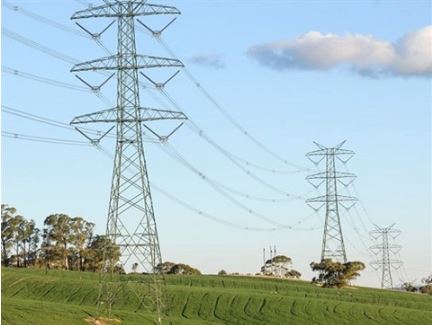
Glenden said to deliver both projects the Victorian Government, in consultation with AEMO, was proposing to construct over 800 steel towers up to 80m in height, around the same height as the MCG lights.
The steel towers will carry the high-voltage transmission lines for over 400km, running westwards from Sydenham on the edge of Melbourne to Bulgana near Ararat and then northwards to Kerang and beyond before crossing over the Murray River into New South Wales, he said.
“The farming families who will be impacted have already cared for their land over many generations. We grow and raise food and fibre for our state and our nation, and we look after our environment.”
Glenden said the alliance supported renewable energy, action on climate change and protecting the environment.
“But we want the transition away from fossil fuels to use environmentally sustainable energy solutions. A green generation solution requires a green transmission solution. Constructing more overhead electricity transmission lines using century-old technology is not in Australia’s strategic national interest, nor cost-
effective given its irreversible environmental, social, and economic impact.”
Ballarat federal MP, Catherine King said she had been deeply concerned about the project since she first heard about it “and my position hasn’t changed”.
“I have been clear from the start that our community should have been better listened to throughout this entire process. This is a beautiful, productive part of the world. While new transmission lines do need to be built to connect renewable energy into the electricity grid, this is not the way to do it.
“Through my submission to the most recent AEMO consultation process, I continued to encourage AEMO and the project’s proponents to properly consult with impacted communities.”
Macedon state MP Mary-Anne Thomas said new transmission was vital for securing affordable power for Victorians and enabling the development of the renewable energy industry as “we work towards net-zero emissions by 2045”.
“These transmissions projects will form part of the national electricity grid and deliver more affordable and renewable power to Victorians. VicGrid is already providing greater oversight of the development of the WRL and VNI West projects that are being developed by AusNet and AEMO. WRL is still subject to an EES, which will consider alternative routes and undergrounding.
“There will be full and fair compensation payment for landowners who host new transmission infrastructure. The details of these payments will be negotiated on a case-by-case basis with property owners once a final route for the project is determined.”
An AusNet spokesperson said AusNet was working with government and stakeholders to accelerate critical transmission projects that will secure affordable, renewable and reliable energy to Victorian homes and businesses.
“We continue to consult with communities as we refine the proposed route to minimise impacts on landholders, the environment and farming operations, and thank those landholders who are working with us.”

June 4th, 2023Council to ‘advocate strongly’ for alternative VNI West route as ‘concerns’ remain

The Hepburn Shire Council will continue to ‘advocate strongly’ for an alternative to the route currently preferred for the Victoria New South Wales Interconnector West (VNI West) project, mayor Cr Brian Hood says.
This comes after details of the preferred option for the Victoria New South Wales Interconnector West (VNI West) project were outlined by the Australian Energy Market Operator (AEMO) and Transgrid just over a week ago.
Hepburn Shire Council issued a media release stating that it was pleased the terminal station is no longer proposed for Mount Prospect but still has serious concerns about the increase in size of transmission line towers and the abject lack of genuine consideration for undergrounding lines.
“The community and Council have campaigned strongly against the location of the terminal station in our Shire, consequently we are very pleased to see it is no longer the preferred option,” said Mayor of Hepburn Shire, Cr Brian Hood.
“At the same time, we feel for the communities who are now facing the unwelcome prospect of a terminal station and towers in their region. We sincerely hope AEMO and Transgrid will engage more closely with the community as the projects continue,” he said.
Cr Hood said the biggest concerns for Hepburn Shire Council now are the significant towers and easements planned as part of the proposed Western Renewables Link (WRL) corridor, which forms part of VNI West.
“This is a beautiful part of the world. There is strong visitation and economic activity through tourism and it is also some of the best agricultural land in Victoria. It is incredibly disappointing that undergrounding transmission lines has not been genuinely considered in either project given these towers will be up to 80 metres high and easements up to 100 metres wide,” said Cr Hood.
“Farmers will face the unwelcome prospect of massive easements around transmission infrastructure on their property, thereby restricting agricultural activities in this incredibly productive land,” he said.
“Given these challenges we question the rationale of maintaining the currently proposed alignment of WRL through Hepburn Shire now that the terminal station will be relocated. On that basis we will be continuing to advocate strongly for a change to the proposed route.”
A Ministerial Order has been implemented to progress the preferred option, which connects VNI West from Dinawan Energy Hub in NSW, via a new terminal station near Kerang directly to the WRL at a new terminal station near Bulgana in Northern Grampians Shire (rather than at Mount Prospect in Hepburn Shire).
“While Council is highly supportive of renewable energy there has been a missed opportunity for genuine consideration for placing powerlines underground in some of the more sensitive areas. The refusal to consider that option represents inappropriately short-term thinking,” said Cr Hood.
“We encourage the community to continue to make their voices heard throughout this process, including the upcoming Environmental Impact Assessment process,” he said.
Those seeking further information may visit https://participate.hepburn.vic.gov.au/VNI-West.