November 5th, 2026Our past stories

Hepburn Springs The town of Hepburn Springs was originally known as Spring Creek, the site of gold discovery in 1852 by James Egan.
Hepburn was known as the Old Racecourse, which is the location of the recreation reserve. Both towns were located on the Jim Crow Diggings and attracted people from Italy, France, Switzerland, Germany, England and Ireland. Ironically, these multicultural towns were later named after a Scotsman.
The National Trust’s Story of Hepburn Graves gives an overview of the Scottish Captain John Stuart Hepburn. He was in the first party of overlanders from Sydney to the Port Phillip district in 1836. Born in 1803, he became a mariner and after having landed in Hobart, entered into a plan to overland stock from New South Wales to Central Victoria.
In April 1838 he settled at the Smeaton Hill Run (named after a small hamlet near his birthplace) and in 1849 proceeded to build Smeaton House on the northern side of the valley of the so-called Captain’s Creek. Thus, the Hepburn family became the original settlers in the Smeaton area and today their name is reflected in the popular town of Hepburn Springs and local government area of Hepburn Shire.
In 1864, a group of residents in Hepburn Springs wanted to preserve the mineral waters in the town as they were being endangered by mining. On March 13, 1865, the Victorian Government gazetted the temporary reservation of a site for mineral springs purposes in Hepburn. This was followed by the same site being permanently reserved by the government on May 5, 1868. The Mineral Springs Reserve was happening.
The Geelong Advertiser of February 11, 1878 shows that the water was of quality and had been awarded a Gold Medal at Exhibition London 1873, First Class Certificate at Exhibition Melbourne 1875 and supported by numerous testimonials from medical men and recommended as a refreshing drink as well as a valuable remedy in various complaints, with no artificial gases or chemicals of any sort being used. The water was supplied direct from the spring, in cylinders of five gallons and upwards, at four shillings per gallon.
In 1894, a bathhouse was built with advertising in The Age newspaper on December 22 that year trying to attract people to try hot or cold mineral baths, recommended by medical professionals. The temptation was so great that many people headed to Daylesford by train. The Argus reported on January 21, 1895 that 450 visitors arrived by train – the large majority of them tempted by Hepburn Mineral Springs.
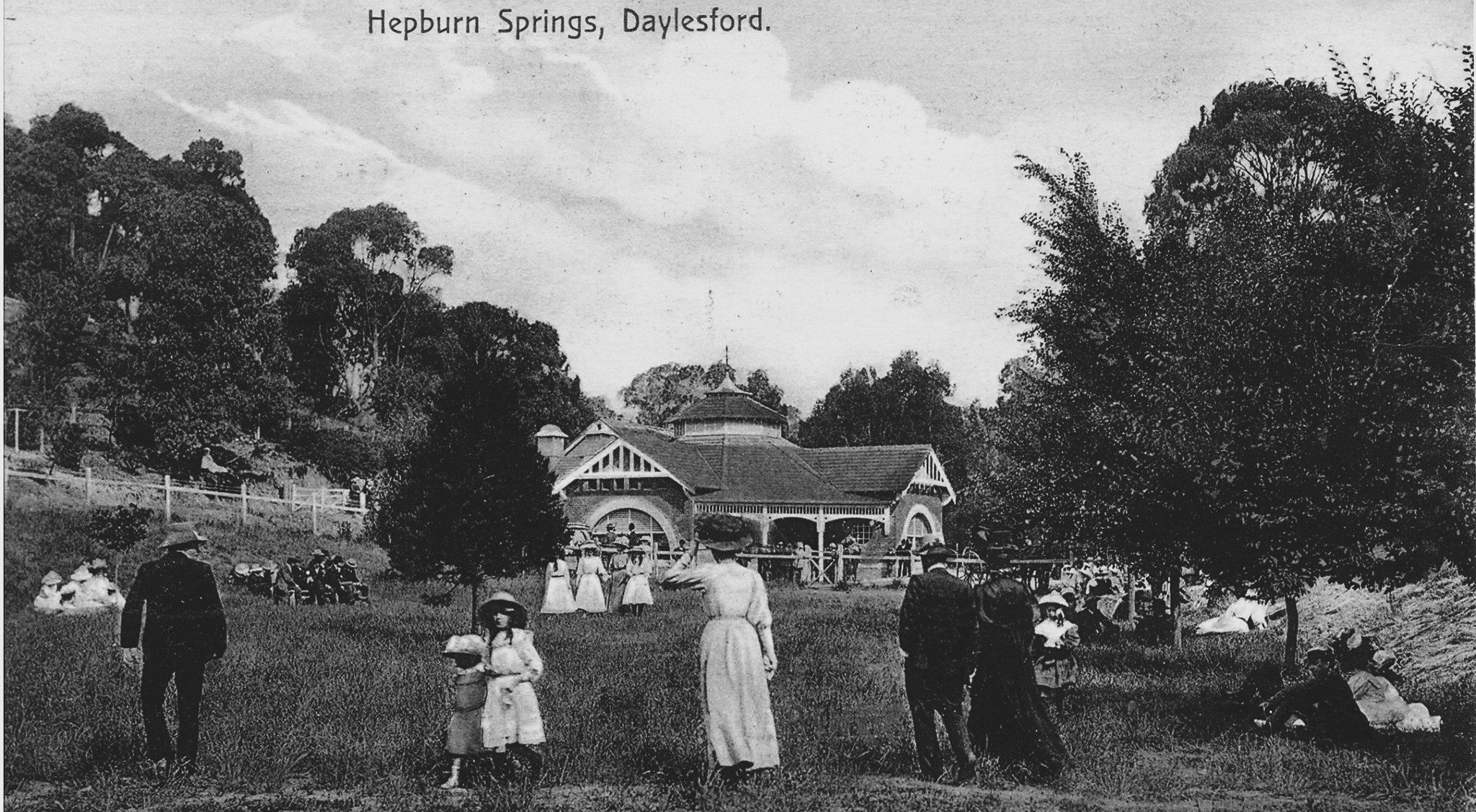
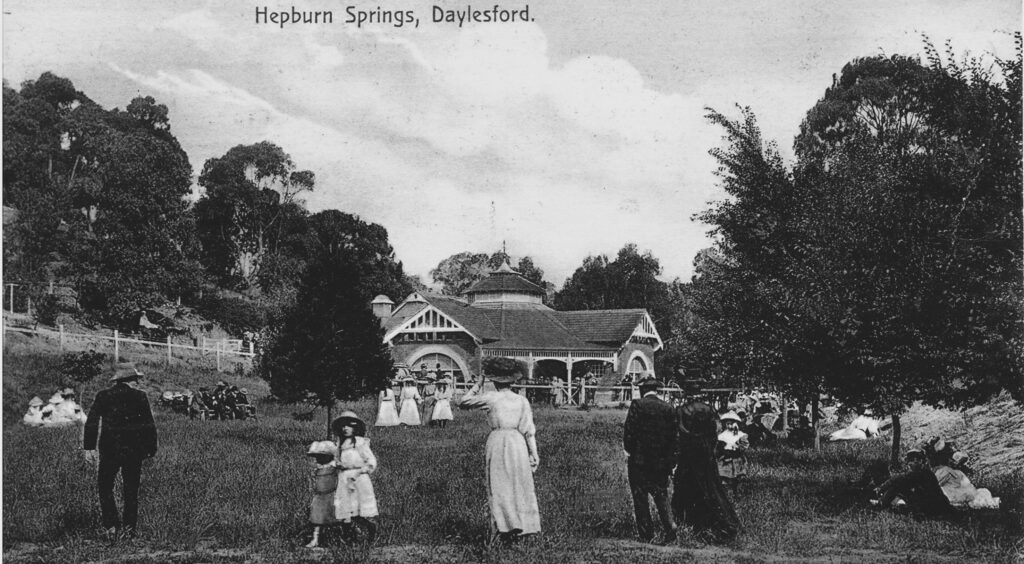
Around 1908, a pavilion was erected at the reserve. A few years later, disaster struck, with The Argus newspaper reporting on November 22, 1911 that the mineral spring had run dry, with mining operations blamed. “The Hepburn mineral spring, the flow of which is usually about 100 gallons per hour, has practically ceased running. It was discovered that the mining organisation of North Frenchman’s Company had cut through a wall of the Spring. Once repaired the flow returned to normal and bathing and drinking recommenced.”
The waters’ popularity was evident in the Sun-News Pictorial dated January 10, 1936 reporting: “Heavy drinking fashionable at Hepburn Springs at holiday time but the attraction is nothing more sinister than mineral water.”
Hepburn Springs has the largest concentration of mineral springs in one area and includes Argyle, Golden, Liberty, Locarno, Soda, Sulphur and Wyuna. When next in the area why not go on a taste-testing walk and satisfy the need to top up your body’s minerals?
Image: The Friends of Hepburn Mineral Springs Reserve – Facebook page