February 5th, 2025Glen’s garden
We live in a house of many guises – beginning as two goldmine offices in Doctors Gully, Hepburn Springs before being hauled onto logs by a team of horses to become the basis of a family cottage, after the closure of the mine sometime in the early 1900s.
Those early pioneers must have been avid gardeners judging by the selection of beautiful century-old trees and shrubs and traces of rock walls they left for us to build upon.
We thank them, almost daily, as we are greeted by an ever-increasing variety of insect-eating and nectar sipping feathered friends, who daily visit our bird bath and seed feeders unknowingly helping us in our garden by pollinating our fruit and feasting on many of the insect and grub invaders.
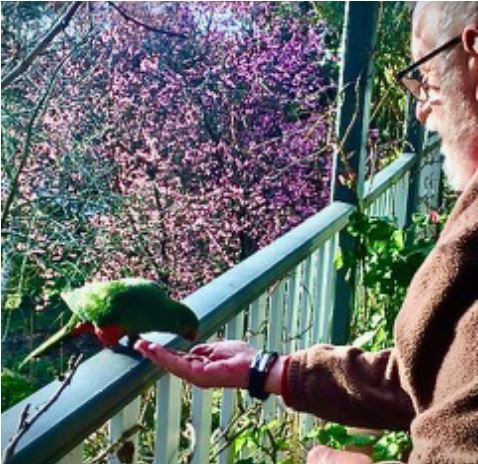
Among the regular feathered visitors are a couple of king parrots and a pair of gang-gang cockatoos, who stop over on their yearly pilgrimage to feed on our ash trees.
One particular king parrot pair now have the cheek to land on our balcony and herald their arrival. Last year the male left the others, came up and fed from my hand, while the female wavered in the distance.
So I’m hoping she will have the courage to accompany him all the way this year.
Q: A struggling liquidambar
I shall be grateful for your advice on a suitable replacement for a variegated liquidambar we planted in our north-facing lawn last spring. It seems to be suffering from wind burn as the leaves are turning black at the edges. We plan to shift it to a more sheltered spot at an appropriate time and replace it with a more sturdy one once it has shed its leaves in winter. Perhaps the blackened leaves could be caused by overhead watering and strong winds. Sarah, Creswick
A: You have answered your own question when you say “perhaps it had too much water!” Especially if it’s mostly on the foliage. With your young liquidamber surrounded by lawn and, more than likely, nearby tree roots it would be unlikely to get its fair share.
I would suggest that you should leave things as they are until late autumn when deciduous trees are bare and the soil super moist. You can then carefully lift your liquidambar and replant it in a new shady non-north facing plot.
As for a replacement I would suggest you would do very well with the bronze leaf “smoke bush” (cotinus coggygria) which is a large shrub/small tree with large olive green leaves which turn bronze to purple in autumn.
Q:. I have a lot of red gum seeds that have fallen off the tree and still remain in the pod. Some are open but most are still closed. How can I get them out without damaging them? Ray, Woodend
A: The best way of opening the pods would be to place them in a dry box with a layer of dry sand on the bottom and leave them in the sun. They should soon dry out and open of their own accord.
Your garden questions answered! Simply email your enquiry to: Garden queries c/o glenzgarden gmail.com You should see your answer in the next edition of The Local.