


May 24th, 2025Hepburn Wildlife News

with Marita McGuirk
As the weather becomes cooler and fire bans are lifted, we start to notice a faint smell of smoke in the air as people begin to burn off leaf litter and branches that they may have had in piles for many months. They may also be carrying out fuel reduction burns of roadsides, gullies and paddocks.

An important fact to keep in mind when planning your burn, is that animals often make their home in piles of leaves and branches.
Birds such as pardalotes will build nests amongst the branches. Lizards will readily live in the thermally protected piles of leaves, not to mention all the insects that will be living in these leaf and branch stacks.
Echidnas are one of the animals that will make a home for themselves and their young (called puggles) in piles of leaves and branches.
So, if your stack has been in place for a few months, it is a very good idea to move it before you set it on fire. This will give all the animals that have made it their home a chance to avoid being burnt.
The echidna which is recovering at the Hepburn Wildlife Shelter was found in a private garden beside a block that had been burnt to reduce the fuel load.
The echidna has burns to its back and side and was thin and dehydrated when found. Gayle Chappell is optimistic about its chances of recovering.
Gayle tells me that there is a myth that echidnas can bury themselves and avoid being burnt in a fire.
When echidnas are frightened, they will bury themselves in leaves and softer soil around trees. The problem is that the leaves and organic matter in the soil will burn and the quills (spines) on the echidna will also burn.
Echidna quills are hollow and when they are exposed to fire, they become super-heated. The heat travels down the quill and into the muscle tissue causing severe damage.
Unless the echidna can bury itself under many centimetres of soil and the soil does not contain any organic matter that will burn and the fire is not very intense, it will be burnt in a fire.
If the echidna can take shelter totally underground, it can survive a fire. But this is not the case for echidnas that are caught above ground when people burn off.
Hepburn Wildlife News with Marita McGuirk Gayle and Jon at the Hepburn Wildlife Shelter have treated many animals that have been burnt by fire.
Please take care and consider the animals when conducting your fuel reduction burns and burn-offs around your property.
Dr Marita McGuirk is a field ecologist and environmental scientist, and a volunteer at the Hepburn Wildlife Shelter. Marita will write monthly columns about the shelter and the animals it cares for. If you would like to donate or volunteer, or just to find out more information, head to www.hepburnwildlifeshelter.org
Article sponsored by The Local Publishing Group

April 27th, 2025Hepburn Wildlife News
with Marita McGuirk
When you are driving along a country road and you see birds by the roadside, it is always advisable to slow down. If the birds take flight, there is a good chance that they will fly into your car.

This is what happened to the two gang-gang cockatoos currently recovering at the Hepburn Wildlife Shelter.
These birds flew into a passing car and have concussion and bruising. Luckily, the car was going slowly, or the outcome would have been much worse for the birds.
Gang-gang cockatoos are now listed as an endangered species. A large portion of their habitat was destroyed in the Black Summer bushfires of 2019-20 and habitat is being lost daily as land clearing and native-forest logging continues.
These birds nest in the hollows that form in trees and most eucalypts (gum, box and stringybark), will be over 80 years old before decent nest-bearing hollows have formed, which makes nesting places few and far between.
This is why it is so important to retain and protect any large old trees, even if they are dead, as they will still be home to many animals.
Gang-gang cockatoos will often be seen in pairs because they are monogamous and mate for life. They mostly eat seeds from eucalyptus and wattles and will also eat flower buds and insects.
In late spring they may be seen in the Hepburn State Forest enjoying the seeds from the local wattle trees. They are not as raucous as other cockatoos, and you may not know they are above you until you hear dislodged seeds falling to the ground.
In recent times they have developed a taste for exotic species, namely hawthorn berries. These berries are a favourite food for the gang-gangs recovering at the shelter.
Marita McGuirk is a field ecologist and environmental scientist, and a volunteer at the Hepburn Wildlife Shelter. Marita will write monthly columns about the shelter and the animals it cares for. If you would like to donate or volunteer, or just to find out more information, head to www.hepburnwildlifeshelter.org
March 1st, 2025Hepburn Wildlife News
with Marita McGuirk
Late on a Thursday night several weeks ago a local woman was driving home from a night out with friends.
As her car headlights pierced the night she glimpsed a jerking movement in the ditch by the side of the road.

She was driving on Ajax Road, Daylesford, which is bordered by state forest on each side. She had frequently seen kangaroos, swamp wallabies, a wombat and even an echidna crossing this road and knew that there was a very old wallaby and an ancient looking kangaroo that fed on the grass growing by the roadside.
So she stopped her car and went to see what was in the ditch. She found an injured kangaroo. This animal had been hit by a car, probably several hours previously, judging by the flattened grass around it, and abandoned.
The kangaroo tried to drag itself away as she approached; it was unable to stand as its legs were obviously broken.
She didn’t want to frighten the injured animal, so she went back to her car and phoned the Hepburn Wildlife Shelter.
Julie Cais from the shelter quickly arrived. She found that the kangaroo was too badly injured to be saved so she euthanased her. But the roo was a mother, and Julie found a live joey in her pouch.
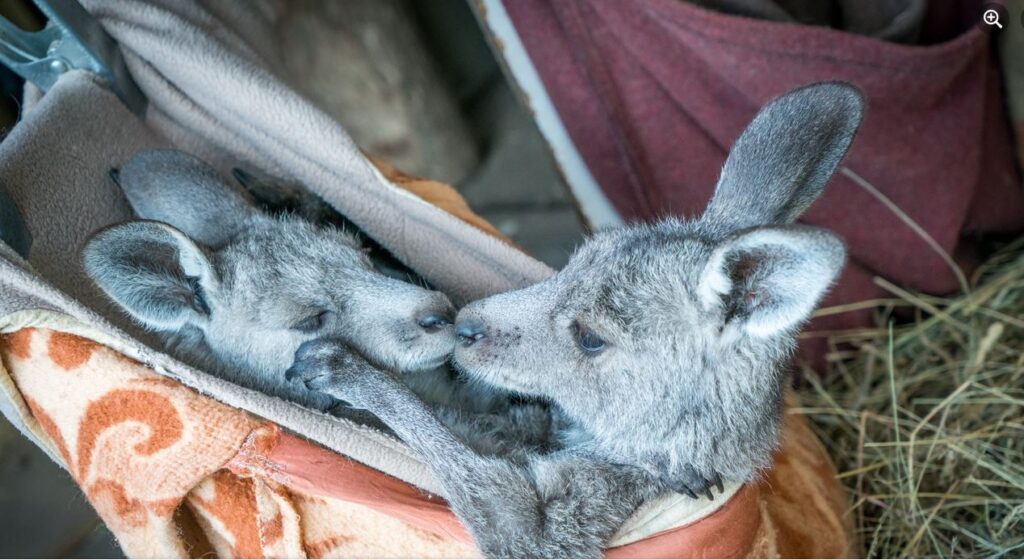
Julie carefully wrapped the joey in one of the warm woollen pouches she always carried in her car and brought the joey back to the Hepburn Wildlife Shelter.
At the shelter, Gayle assessed the joey for injuries and found she had mild bruising. She gave her fluids to restore her electrolytes and allowed her to settle in.
The joey is now doing very well, she has the specialised care that only the Hepburn Wildlife Shelter can provide.
This includes a special milk formula, and she has 14 other orphaned joeys as company. The special milk joeys require costs the shelter about $500 a week: please donate as you are able.
Marita McGuirk is a field ecologist and environmental scientist, and a volunteer at the Hepburn Wildlife Shelter. Marita will write monthly columns about the shelter and the animals it cares for. If you would like to donate or volunteer, or just for more information, head to www.hepburnwildlifeshelter.org
February 1st, 2025Hepburn wildlife news
with Marita McGuirk

On a hot day in January, a bushwalker was enjoying a walk along one of the Hepburn Shire tracks when he saw a koala sitting at the base of a tree.
It was mid-afternoon, an unusual time to see a koala on the ground, as they are nocturnal and usually stay in their tree and sleep throughout the day.
So, he went over to see if the koala was hurt. It was a large animal, panting rapidly and clearly unwell. A healthy koala would quickly try to get away from an approaching human by climbing the nearest tree, but this koala remained sitting.
As the bushwalker was concerned for the koala’s safety he phoned the Hepburn Wildlife Shelter.
Trevor, a wildlife rescuer, was contacted to go and pick up the koala. This meant walking for an hour to the site where the koala was located, and then carefully picking up the koala and carrying it for an hour back along the track.
This was no small effort as it was a large male. Rescuing a koala is a specialised task as they have very strong sharp claws, and a frightened animal can bite.
Trevor is very experienced and was able to pick up the large koala and carry him for an hour back to his car and then on to the shelter.
At the shelter Jon Rowdon had to clear out an enclosure for the koala, meanwhile Gayle Chappell conducted a health assessment and concluded that the koala was very dehydrated and possibly blind in one eye.
Gayle put the koala into the ICU and gave him rehydration fluids.
The koala spent the night in the ICU, where his condition was closely monitored, and the following day he was moved to his enclosure to recuperate.
Gayle is hoping to get an animal eye specialist to come and assess the koala’s damaged eye and, in the meantime, he is in safe hands.
Marita McGuirk is a field ecologist and environmental scientist, and a volunteer at the Hepburn Wildlife Shelter. Marita will write monthly columns about the shelter and the animals it cares for. If you would like to donate or volunteer, or just for more information, head to www.hepburnwildlifeshelter.org

January 17th, 2024Your say…

Wildlife shelter concerns
I read with interest your article, and comments, re the impending ‘delicensing’ of the Hepburn Wildlife Shelter. (The Local, January 1, 2024).
The change of acronym struck me as particularly noteworthy under the circumstances. It’s virtually an unwritten law that whenever a new CEO is appointed or restructured into these semi-government bodies, a first move is to change the name so that the new structure can effectively distance itself from the assumed incompetence and poor judgment imposed by the previous management.
A long time ago I retired after some three decades in a position in tertiary education which required a talent for hands-on technical and personnel management. From this viewpoint I was able to see the destruction and chaos created by ruthless corporatisation of higher education.
The fallout is very apparent today in the lack of trades skills and scientific research that is modern Australia. Upper level academics started to take early retirement, or moved to other disciplines fairly early in the piece when top level decision-making positions were handed willy-nilly to inexperienced MBA graduates and the like.
Fee-paying overseas and remote learning students were expected to create massive profits, while the education standard plummeted – you were not allowed to fail a fee- paying student.
We all saw how well that worked out during the pandemic. Many of the lost tenured positions, and innumerable casual and sessional staff, who were made redundant have moved interstate or elsewhere and will probably never return to education. “The Education State” imprinted on your Victorian car number plate now looks like a sad joke.
Anyway, back to DELWP/DEECA. Look familiar? Which brings us back to the matter of volunteering. I can’t imagine what goes on in the heads of these pseudo government authorities that gives them the idea that volunteers are merely out-of- work dilettantes who are there for the presumed prestige, and to help to fill in their spare time.
The fact that most volunteers are, and have been, experts in their fields and are now earnestly taking up positions from which they can contribute to society. They do not need to be bullied by some johnny-come-lately puffed up latter day executive.
Unless governments value the contribution of these thousands of unpaid workers, and start treating them with the respect they deserve the nation will lose a highly valuable sector and workforce.
My wife, who prior to retirement held high-level managerial positions in the public health and education sectors, now volunteers in the local/regional health and aged care field.
With the most recent government ‘shake-up’ which has produced masses of new and revised legislation purporting to ‘regulate’ the sector, she and other volunteers are expected to understand and oversee the implementation of new (and frequently ambiguous) regulations that even paid and experienced CEOs have difficulty interpreting.
Your (quoted) use of the words “unrealistic, unreasonable and absurd” barely scratches the surface when it comes to the tangled and bully-ridden mess of authorities claiming to be responsible for regional services.
Unless and until more helpful and supportive oversight is forthcoming, together with adequate funding for implementation, the State will continue to alienate and lose the goodwill and services of this army of very competent and willing volunteer workers.
From (Mr) Kerry Williams, Creswick

January 3rd, 2024Just sayin’…
By Donna Kelly
First of all, Happy New Year! It’s 2024 already – and the years just keep rolling around. My lovely Nan told me once that time goes faster as you get older, and it’s true. But getting older is also a privilege not open to everyone.
So who’s complaining.
This edition came out on January 1 and, as usual, we decided on a retrospective edition with just a few of the stories we wanted to share again, including the sad loss of a couple of wonderful community stalwarts. Vale Harold and Serge.
Of course, you can’t cover everything and some things are best left in the past.
We mostly try to be a good news publication but it’s hard sometimes. You know what I mean. It’s not that we are not thinking about those situations but just not bringing them to the fore. I hope everyone is OK.
And I hope you have enjoyed the past year of editions of The Local – we love putting it all together and have a fantastic crew who do all the hard yards. Thanks to all of them for their work, commitment and, most of all, friendship and support.
Also thanks to our advertisers. I hope that you do support them. It is not because of us, but because of them, that you have a lovely free read each fortnight. Have a look through the pages each edition and if you can thank them by using their services it would be much appreciated.
Now, as I said most of this edition is looking back but we do have new adverts, check them out, and also a bit of a distressing story on the potential closure of the Hepburn Wildlife Shelter by the Department of Energy, Environment and Climate Action. Or DEECA. Formerly DELWP.
If you check out our story on page 4 by journo Eve Lamb you will read that the departmental threats come after the shelter, that’s been operating for 22 years, has refused to reapply to renew its authorisation (or licence) due to the imposition of conditions which its operators say are “unrealistic, unreasonable and absurd”.
Those operators are Gayle Chappell and Jon Rowdon. Both very experienced and trained wildlife carers who have basically put their lives on hold for those 22 years and dedicated themselves to saving wildlife. Day in, day out, night in, night out, theytake in injured wildlife and nurse them back to health.
There is no funding. They are helped by amazing volunteers who wash and dry bedding, make up formulas, feed animals around the clock, provide compassion, raise funds and collect donations of
sheets and blankets and anything that could possibly help an animal in need.
As far as I know no injured animal has ever been knocked back. They all get the care, and love, that they need in the most stressful time of their lives. I remember seeing Jon in town during the 2009 bushfires and he looked exhausted. Fifteen years ago – and still they continue with their life’s work.
I don’t know what’s going on with the department, but surely the fix is a helping hand not a fist. Maybe some of the department’s cost to change its name could have gone to wildlife shelters. I don’t think an injured joey gives a stuff if the overriding wildlife body is DEECA or DELWP.
Hmmm. Maybe if the shelter is shut down we take any injured wildlife to the nearest DEECA office? And if it’s after five, perhaps we drop them off at a manager’s home for the night. I am sure they wouldn’t mind doing the 2am feed.
This is just bureaucracy gone mad. This is an essential service. You help not hinder. Gee, a thank you might even be nice as well, for 22 years of service to the community. Oh, stop the press, read page 4 about a fundraiser at the Hepburn Golf Club! It’s such a great cause. Just sayin’…
December 21st, 2023Hepburn Wildlife Shelter under threat
The future of much-loved Hepburn Wildlife Shelter hangs in the balance with DEECA threatening to enforce the removal of all wildlife in its care from early in the new year.
The departmental threats come after the shelter, that’s been operating for more than two decades, refused to reapply to renew its authorisation (or licence) due to the imposition of conditions which the shelter’s operators say are “unrealistic, unreasonable and absurd”.
Highly experienced local wildlife carers Jon Rowdon BSc and Gayle Chappell BSc have been running the shelter just out of Daylesford for 22 years, rehabilitating hundreds of orphaned and injured wildlife annually, and say it’s the first time the department has ever attempted to enforce such conditions.
“We can’t reapply for our authorisation because we can’t operate under those conditions,” Ms Chappell says.
Their current authorisation to function as a wildlife shelter is due to expire on December 31 with tensions building for the past year and coming to a head this week.
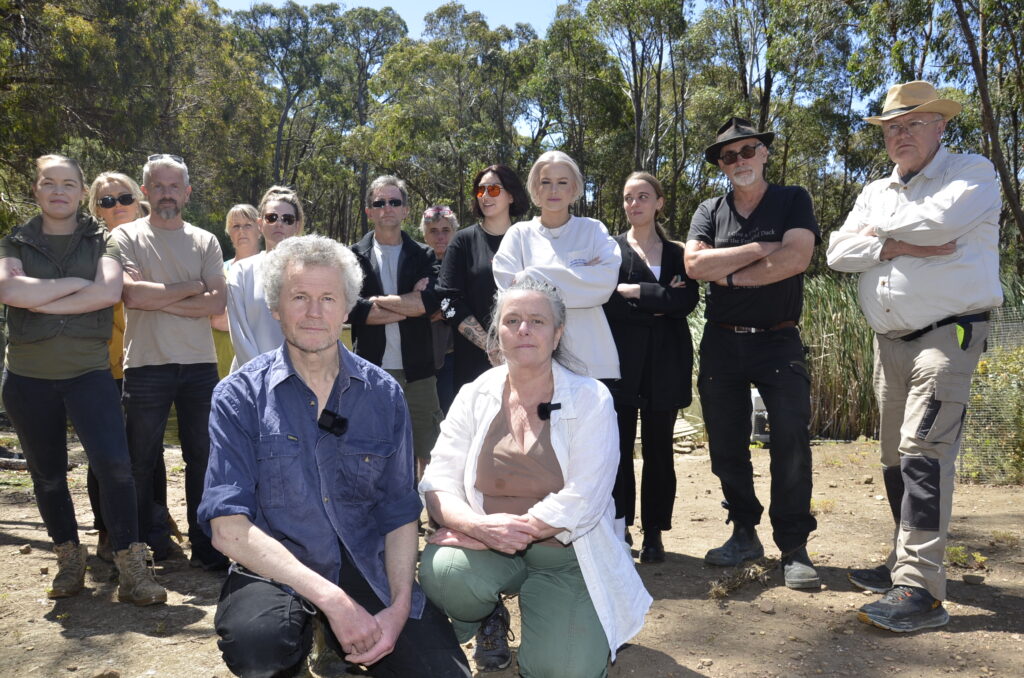
On Wednesday amid the threats, Ms Chappell and Mr Rowdon had been expecting DEECA officers to visit and inspect the shelter that currently has some 100 animals, including some threatened species, in its care.
Anticipating the visit, on Wednesday Mr Rowdon, Ms Chappell, fellow wildlife carers, shelter operators and rescuers from across the region, and Animal Justice Party representatives, gathered at the shelter in a show of support.
But at the eleventh hour the DEECA representatives themselves cancelled their visit and failed to show.
“We’re a good shelter. They need to extend our authorisation to at least allow us to keep the animals currently in our care to the end of their rehabilitation, and essentially they need to engage with us properly,” Ms Chappell said.
She says they and a concerning number of other shelter operators have been subject to “bullying” from the Department of Energy, Environment and Climate Action (DEECA).
A letter, dated December 18, to the Hepburn Wildlife Shelter from Ash Burns, Regulatory Program Manger with the department reads:
“Please be aware that from 1 January 2024, any wildlife acquired under your authorisation must either be released or transferred to another authorised shelter or foster carer with the appropriate skills and experience to continue their care.”
Among the most experienced wildlife carers in Australia, Ms Chappell and Mr Rowdon say that forcing the relocation of animals currently in their care to other shelters would be extremely stressful for the animals and potentially risk causing some to die.
They and other shelter operators like Manfred Zabinskas OAM of the East Trentham Wildlife Shelter say there’s a critical need for wildlife shelter operators, carers and rescuers to be enabled meaningful input into the regulation of the sector which is entirely volunteer-run and unfunded yet provides a crucial service.
The brewing crisis at the Hepburn shelter highlights the far wider need for the work of the state’s wildlife carers, rehabilitators, rescuers and shelter operators to be properly valued and funded accordingly, they say.
“Wildlife rescues and calls to Wildlife Victoria have been dramatically increasing over the last couple of years, says Greendale based wildlife rescuer and foster carer Trevor Crawford.
“We’re all volunteers and we get no funding support at all,” says Mount Alexander region wildlife rescuer Glynn Jarrett, also on site on Wednesday.
“We do it because we love it and we rely on people like Gayle and Jon. If we lose this shelter we’re really going to struggle.
“We feel the department is working against us not with us.”
The Hepburn Wildlife Shelter is understood to be the largest such shelter in the state and Ms Chappell said the Animal Justice Party is now making ministerial representations on its behalf.
A Conservation Regulator spokesperson with the department has since confirmed that the Conservation Regulator had “received further communication from the authorisation holder indicating they would like to continue operating beyond the expiry date”.
“This request will be assessed with consideration of the minimum legal requirements for shelters and carers to operate under the Wildlife Act 1975 and relevant Code of Practice.” she told The Local.
She also said: “The Conservation Regulator cancelled a planned inspection at Hepburn Wildlife Shelter on 20 December 2023 due to the prioritisation of other operational matters”.
Words: Eve Lamb